


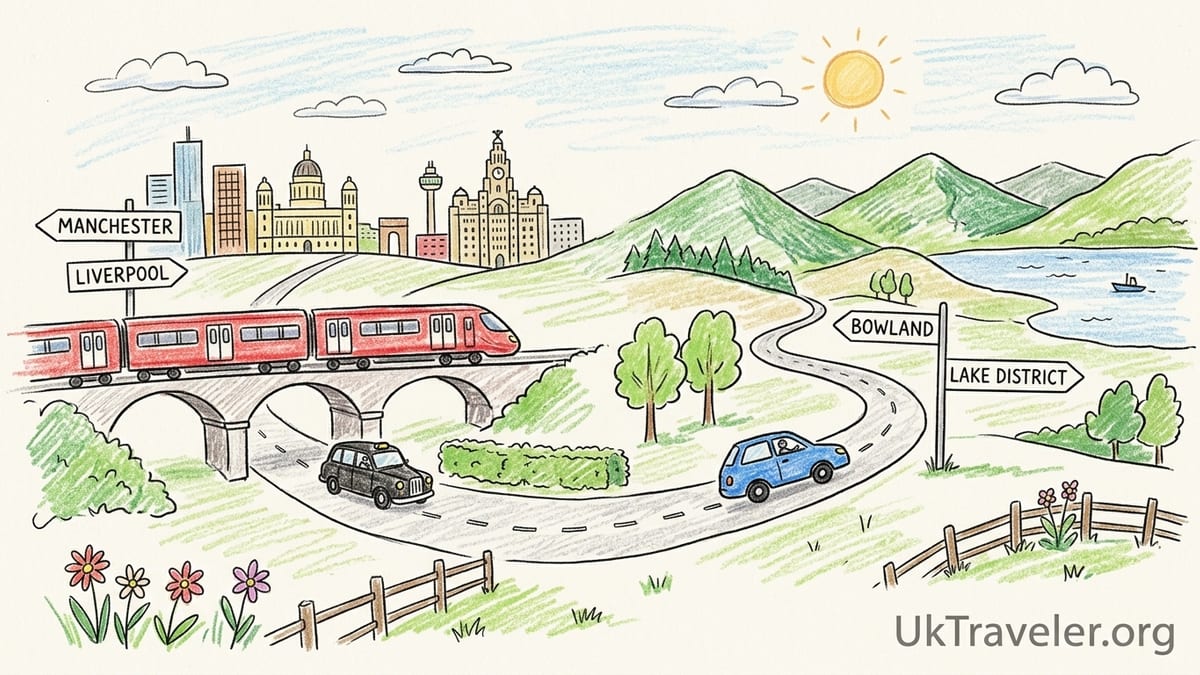
North West England is one of Britain’s most varied regions, with industrial-powerhouse cities, medieval walled towns, seaside resorts and the dramatic fells of the Lake District. Working out whether to cover all this by train or by car is not always obvious. The rail network between the major hubs is dense and surprisingly fast, while roads give you freedom to explore quieter corners like the Forest of Bowland or rural Cheshire. This guide looks at real journey times, on-the-ground logistics and different trip styles to help you choose the right mix for your own itinerary.
Where Trains Work Brilliantly Between North West Cities
For travel between the main urban centres of North West England, rail is a clear strength. National Rail’s own destination information lists fastest journey times into Manchester as about 36 minutes from Liverpool, around 50 minutes from Chester and roughly 56 minutes from Lancaster on the quickest services. Manchester itself is unusually well served, with four central stations: Piccadilly, Victoria, Oxford Road and Deansgate, all within or right on the edge of the city centre. This gives you multiple route options and frequent services throughout the day.
VisitBritain notes that Chester is less than an hour from both Manchester and Liverpool, with some trains between Liverpool and Chester covering the roughly 28 mile distance in about 33 minutes. From Manchester to Lancaster, express services on the West Coast Main Line and connected routes typically take under an hour on the fastest trains, linking the city quickly to the historic county town and the wider Lancashire coast. These timings mean you can realistically base yourself in one city and day trip to another without spending half the day in transit.
The Manchester to Liverpool corridor, served by operators such as Northern, TransPennine Express and others, usually offers several trains an hour during the day. Advance fares booked a few weeks ahead can often start in the low single digits in pounds for off-peak departures, especially when using a Railcard. Manchester to Chester has at least hourly services via both the Mid-Cheshire and North Wales routes, providing an alternative when one line is disrupted. This frequency and competition helps keep door-to-door times competitive with driving once you factor in city traffic and parking.
For a short city break circuit such as Manchester, Liverpool and Chester, rail is not only fast but also simple. You can step off the train right in central Liverpool Lime Street or Manchester Piccadilly and walk or take a tram to most hotels in 10 to 15 minutes. In Chester, the station is around a 15 minute walk or quick bus ride from the historic city walls and cathedral. Renting a car purely to link these cities rarely saves significant time and can easily add stress, fuel and parking charges.
Using Trains as Gateways to the Lake District and Beyond
Trains are also highly effective for reaching the gateway towns around the Lake District and the wider Cumbrian coast. VisitBritain suggests that the southern Lake District can be reached from Manchester in roughly 1 hour 20 minutes by train, depending on service and connection. In practice, this usually means travelling from Manchester or Manchester Airport to Oxenholme Lake District on the main West Coast line, then connecting to Windermere, or staying on northbound services to Penrith for Ullswater or Carlisle for the far north of the park and Hadrian’s Wall country.
Oxenholme, Penrith and Carlisle act as major rail gateways into the national park. From Oxenholme, the short Windermere branch line heads directly into the heart of the south Lakes, with stations at Kendal, Burneside, Staveley and Windermere. From Penrith, regular buses run to Pooley Bridge and Glenridding, opening up the Ullswater area without a car. Carlisle anchors the northern end of the region and links east to Newcastle and south along the Cumbrian coast to places like Whitehaven and Barrow-in-Furness.
Lake District public transport has been strengthened in recent years, and car-free travel is more realistic than many visitors expect. Local bus companies operate frequent seasonal services from Windermere, Ambleside and Keswick to popular walking areas such as Grasmere, Borrowdale and Langdale. For example, in summer it is common to find buses every 20 to 30 minutes along the busy Bowness to Ambleside to Grasmere corridor during the daytime. There are also lake cruises on Windermere, Ullswater and Derwentwater that connect jetties with nearby villages, so you can combine rail, bus and boat in a single day out without driving.
This integrated network means a traveller could arrive at Windermere by late morning from Manchester, check into a guesthouse within walking distance of the station, and be on a lakeside boat or a bus to Ambleside shortly afterwards. For many visitors focused on the main valleys and classic sights, a car is not a necessity, especially in peak season when parking at honeypot sites such as Tarn Hows or the central Keswick car parks can be difficult and expensive.
When a Car Becomes the Better Tool
Despite the strengths of rail in the North West, there are clear situations where having a car makes travel smoother. One is exploring the Forest of Bowland, an Area of Outstanding Natural Beauty that lies between Lancaster, Clitheroe and the outskirts of the Yorkshire Dales. Rail touches only the edges, at places like Lancaster, Preston and Clitheroe. The postcard villages of Bowland, including Newton-in-Bowland, Dunsop Bridge and Slaidburn, are connected mostly by infrequent rural buses or not at all on weekends, so relying solely on public transport would limit how many places you can realistically reach in a day.
Rural Cheshire presents similar challenges. Mainline stations such as Chester, Crewe and Macclesfield are well connected, but many of the county’s appealing villages and stately homes are in the gaps between rail corridors. Visiting places like Audlem, Little Moreton Hall or the quiet lanes around Tarporley and Malpas is far easier by car. Buses may run only every couple of hours and often finish in the early evening, which can be restrictive if you want to linger over dinner in a country pub.
The smaller Lancashire towns and coastal fringes often require either slow local trains with changes or awkward bus combinations. For example, getting from Lancaster to coastal villages beyond Morecambe, or inland to places like Garstang or the Wyre countryside, usually means multiple modes of transport. With a car, you can link Lancaster, the Trough of Bowland, the Ribble Valley and the Fylde Coast in a single flexible loop, stopping at farm shops, viewpoints and short walks en route, without constantly planning around departure boards.
Even within the Lake District, a car can be useful if your focus is on more remote valleys such as Wasdale, Ennerdale or Eskdale, or if you want to stitch together coast and countryside in one trip, such as visiting St Bees Head, Ravenglass and Wastwater in a day. Buses do run to some of these areas in season, but services are often limited to a few journeys daily. Driving gives you greater control over early starts for hiking, spontaneous photo stops and later finishes after dinner, particularly outside school holidays and summer.
City-Only Trips: Manchester, Liverpool and Chester
If your itinerary is exclusively or primarily about the cities of North West England, the case for travelling by train is very strong. Manchester, Liverpool and Chester are all compact enough in their central districts that you will spend much of your time on foot, using only occasional buses, trams or taxis. In this context, the convenience of rolling your luggage off the train directly into the city centre outweighs the supposed flexibility of a car that would spend most of its time in a hotel car park.
Imagine a four-night trip focused on culture and nightlife. You might arrive in Manchester by train from London, check into a hotel near Piccadilly, then take a one-day return to Liverpool for the Beatles Story, the Albert Dock museums and evening music in the Baltic Triangle. Another day trip could take you to Chester, with its Roman walls and black-and-white Tudor revival buildings, less than an hour away by rail. Buying off-peak day returns or flexible singles makes this kind of hopping between cities straightforward.
Driving the same loop would introduce several frictions. Central parking in Manchester and Liverpool often costs the equivalent of tens of pounds per day in multi-storey car parks, and navigating one-way systems and bus gates can be stressful for visitors. At busy times, journey times by car can equal or exceed those by rail because of congestion on the M62 and M56 corridors. If you plan to enjoy the pubs, cocktail bars and breweries that are part of the appeal of these cities, not having to designate a driver is another strong argument for sticking with trains.
For city breaks, therefore, a car is usually unnecessary and can become a liability. The combination of frequent intercity trains, urban tram networks such as Manchester’s Metrolink, and plentiful local buses keeps everything accessible. Many hotels in these cities also market themselves directly on their proximity to major stations, offering luggage storage so you can maximise sightseeing time on arrival and departure days.
City Plus Lakes: Mixed Train and Limited Car Hire
For travellers who want to combine a city stay with time in the Lake District, a blended approach often works best. One practical pattern is to travel between major cities by train, then hire a car only for the rural segment. For example, you might spend three nights in Manchester, travel by train to Oxenholme or Windermere, pick up a rental car there for four days of exploring the central and western Lakes, then drop it back before returning south by rail.
This strategy keeps you off motorways and out of busy city traffic for most of your driving. Many national and local car rental firms have depots in or near key rail gateways like Lancaster, Kendal and Carlisle, in addition to the larger operations at Manchester Airport. Picking up a car at Kendal after arriving by train from Manchester could have you on the road into the Kentmere valley or over the Kirkstone Pass by late morning, without the need to negotiate Manchester’s inner ring roads.
Another option is to skip car hire altogether if your Lake District plans are centred on the well-served south and central areas. A traveller could base themselves in Bowness or Ambleside after arriving by train and bus, using the frequent local network for days out to Grasmere, Coniston and Keswick. Lake cruises on Windermere and Ullswater, combined with buses, open up attractive circular routes that begin and end at the same accommodation without a vehicle. In high season, this often proves less stressful than competing for limited parking at popular trailheads.
Consider also the environmental and cost balance. Train travel significantly cuts emissions compared with solo driving over the same distance, and hiring a car only for selected days keeps both fuel use and rental bills down. A typical week-long itinerary might include three days with a car for remote hikes and scenic passes and four days relying solely on foot, bus and boat. This still delivers a sense of freedom and discovery while avoiding the expense of a full-week hire.
Lancashire and Rural Road Trips
For travellers specifically interested in Lancashire’s villages, coastline and countryside, a car-heavy or fully self-drive itinerary makes more sense, though rail still has a supporting role. You might arrive in Lancaster or Preston by train and then rent a car to explore, using the rail journey as a stress-free way to cover the long stretch from London or another distant city. Once in possession of a car, you gain the flexibility to navigate the patchwork of A-roads and country lanes that link together market towns, seaside promenades and moorland passes.
A classic loop could start in Lancaster, then head into the Forest of Bowland via the Trough of Bowland road before dropping down into the Ribble Valley around Clitheroe and Whalley. From there, you could reach the coast at Lytham St Annes or the quieter sections of the Fylde, then swing north through Morecambe Bay and back to Lancaster. Public transport touches each of these areas in isolation, but connecting them in a single coherent route by bus and train would require very careful planning and generous time buffers.
Even shorter breaks benefit from a car. A long weekend might focus just on the Ribble Valley and Bowland, staying at a rural inn or farmhouse bed and breakfast. Having a vehicle lets you drive to trailheads on the fells, pubs up isolated side roads and viewpoints that are not on any bus route. You can also respond to the region’s famously changeable weather by switching plans mid-day, something that is hard to do when your schedule is locked to sparse bus timetables.
That said, it can still be worth returning the car before re-entering the big cities at the end of your trip. For instance, you could drop a hire car in Preston or Lancaster after your countryside loop, then continue to Manchester or Liverpool by train for a final night. This avoids city centre parking and traffic and may reduce the overall rental cost by shaving a day off the hire.
Family Travel, Groups and Multi-County Itineraries
Families and small groups face a slightly different calculation when weighing trains against driving. Rail tickets add up quickly for four or five people, even with discounted child fares and Railcards, and a hire car or family SUV may work out cheaper for certain itineraries. On the other hand, managing tired children, luggage and pushchairs is often easier when no one has to concentrate on driving or parking, and trains give kids space to move around.
For a family splitting time between Manchester and the Lake District, one pragmatic approach is to take the train north, then hire a medium-sized car at Oxenholme, Kendal or Windermere for a few days. This keeps motorway mileage to a minimum while giving you the ability to reach child-friendly but remote spots such as the small beaches on the western lakes, animal attractions tucked away in the countryside, or quiet picnic areas far from main roads. Returning the car before heading back south by rail lets everyone relax for the final leg.
Multi-county itineraries that cover several regions, such as a route from Manchester to North Wales via Chester, then up to the Lake District and across to Yorkshire, are usually best built around the rail network with targeted car hire. The spine of your journey can follow fast trains between Manchester, Chester and Lancaster or Oxenholme, while short rental periods fill the gaps in rural North Wales, Bowland or the Dales. This structure reduces the risk of delays due to motorway incidents on longer hops, since trains are less exposed to road traffic disruptions.
For groups of friends on a budget, it can also be worth comparing the cost of a single people-carrier rental against split train fares. Packing five adults into one vehicle may be economical if you are mainly driving between a few fixed bases and your accommodation includes free parking. However, if your focus is nightlife in Manchester and Liverpool and walking in central Lake District honeypots, trains plus buses will often provide easier access directly into the places you want to be, without the headache of finding parking spaces for a large vehicle.
The Takeaway
Across North West England, rail and road each have clear strengths, and the best choice depends heavily on your exact route and priorities. Trains excel between the major cities and key gateways to the Lake District, with National Rail listing fast journeys of around 36 minutes between Manchester and Liverpool, about 50 minutes to Chester and roughly 56 minutes to Lancaster. VisitBritain and regional tourism bodies highlight how quickly you can travel from these urban hubs to Chester and the southern Lakes, making city-to-city and city-to-Lakes moves straightforward without a car.
Cars, on the other hand, come into their own in the Forest of Bowland, rural Cheshire, the smaller towns of Lancashire and the more remote valleys and coastal corners of the Lake District. In these areas, low bus frequencies and the spread-out nature of attractions make driving significantly more efficient, especially if you value flexible start times, spontaneous detours and reaching less visited viewpoints or trailheads.
For many visitors, the most balanced answer is to treat trains as the backbone of the trip and cars as a supporting tool. Travel between cities like Manchester, Liverpool, Chester and Lancaster by rail, then consider short rental periods from gateway towns such as Oxenholme, Kendal or Lancaster when you want to dive deeper into countryside areas. This approach combines the low-stress, low-emission advantages of rail with the freedom of the open road where it really counts.
By thinking in terms of segments rather than a single all-or-nothing transport choice, you can tailor your plan: city-only trips almost always favour trains, mixed city-and-Lakes holidays work well with a few days of car hire, Lancashire and Bowland road trips are best built around driving, and complex multi-county routes often benefit from a rail spine and carefully chosen rural driving days. With that in mind, you can confidently build an itinerary that matches your comfort level, budget and appetite for adventure across this varied corner of England.
FAQ
Q1. Is it quicker to travel between Manchester and Liverpool by train or by car?
In normal conditions, the fastest trains between Manchester and Liverpool take a little over half an hour, while driving can take a similar time when traffic is light but often stretches longer at busy periods. Once you factor in potential congestion on the M62 and city centre parking, rail is usually more reliable for door-to-door timing between the two city centres.
Q2. Can I visit the Lake District without hiring a car at all?
Yes, if you focus on the south and central areas. You can travel by train to Oxenholme or Windermere, then rely on the local bus network and lake cruises to reach Bowness, Ambleside, Grasmere and Keswick. This works particularly well in spring and summer when services are more frequent, and if you choose accommodation close to a bus stop or pier.
Q3. Where in the North West is a car most useful?
A car is especially helpful in the Forest of Bowland, rural parts of Cheshire, smaller Lancashire towns away from the main rail lines, and the more remote Lake District valleys and coastal stretches. In these areas, buses can be infrequent and journeys by public transport may require several changes, so driving gives you significantly more flexibility.
Q4. Is driving in Manchester and Liverpool difficult for visitors?
Driving in the centres of Manchester and Liverpool can be stressful for those unfamiliar with British city traffic. There are one-way systems, bus priority lanes and busy junctions, especially at peak times. Parking is available but often expensive in central multi-storey car parks. For most city-only visits, using trains, trams, buses and taxis is simpler than hiring a car.
Q5. How far in advance should I book train tickets in North West England?
Many advance fares open for sale roughly 8 to 12 weeks before the travel date, and booking early can secure lower prices on popular routes such as Manchester to Liverpool or Manchester to Oxenholme. For short intercity hops, it is still possible to buy tickets on the day, but last-minute fares are often higher at peak times.
Q6. Are there good family discounts on trains in the region?
Families can benefit from national Railcards that reduce many fares by about a third, and children receive discounted tickets by default. Some operators also run promotional offers during school holidays. For a family of four or five making multiple journeys, it is worth comparing the cumulative cost of rail tickets against a few days of car hire plus fuel and parking.
Q7. Where is the best place to pick up a hire car for countryside exploring?
Many travellers choose to collect rental cars in gateway towns rather than big city centres. Locations such as Lancaster, Kendal, Carlisle or near Oxenholme and Penrith stations work well, as they are close to both rail lines and rural areas. This strategy reduces the need to drive in heavy urban traffic while still giving easy access to the Lakes, Bowland and rural Cheshire.
Q8. Is parking difficult in the Lake District?
Parking can be challenging around popular spots such as Bowness, Ambleside, Keswick and at well-known walking trailheads, especially on sunny weekends and during school holidays. Many car parks fill by late morning. If you do drive, arriving early or using park-and-ride style bus services where available helps, while a car-free approach can avoid the issue altogether.
Q9. Can I combine North West England with other UK regions using trains?
Yes. Manchester, Liverpool and Carlisle are all major nodes in the national rail network, with direct services to cities such as London, Birmingham, Glasgow, Edinburgh and others. This makes it easy to bolt a North West segment onto a wider UK itinerary and avoid long-distance driving altogether, then hire cars only for localised rural exploring.
Q10. For a first-time visitor, is it better to choose trains or driving overall?
For most first-time visitors, starting with trains between cities and adding a short car hire for specific rural days provides the best balance. You avoid the pressure of navigating unfamiliar roads immediately on arrival, make use of fast and frequent rail links, and still have the freedom of a car where buses and trains are thin on the ground.