


North West England is one of those regions that looks simple on a map but feels wildly varied on the ground. Over several trips in the last few years, I have followed the same broad pattern that VisitBritain suggests in its five-day North West itinerary, pivoting around four big pillars: Manchester, Liverpool, Chester and the Lake District. I have also detoured into Lancashire’s coast and countryside and Cheshire’s gentler rural corners. What follows is not a box-ticking list of every town with a train station, but a candid account of where I actually spent my time, what those places delivered and, just as importantly, where I would shorten or extend my stay if I were planning the trip again.
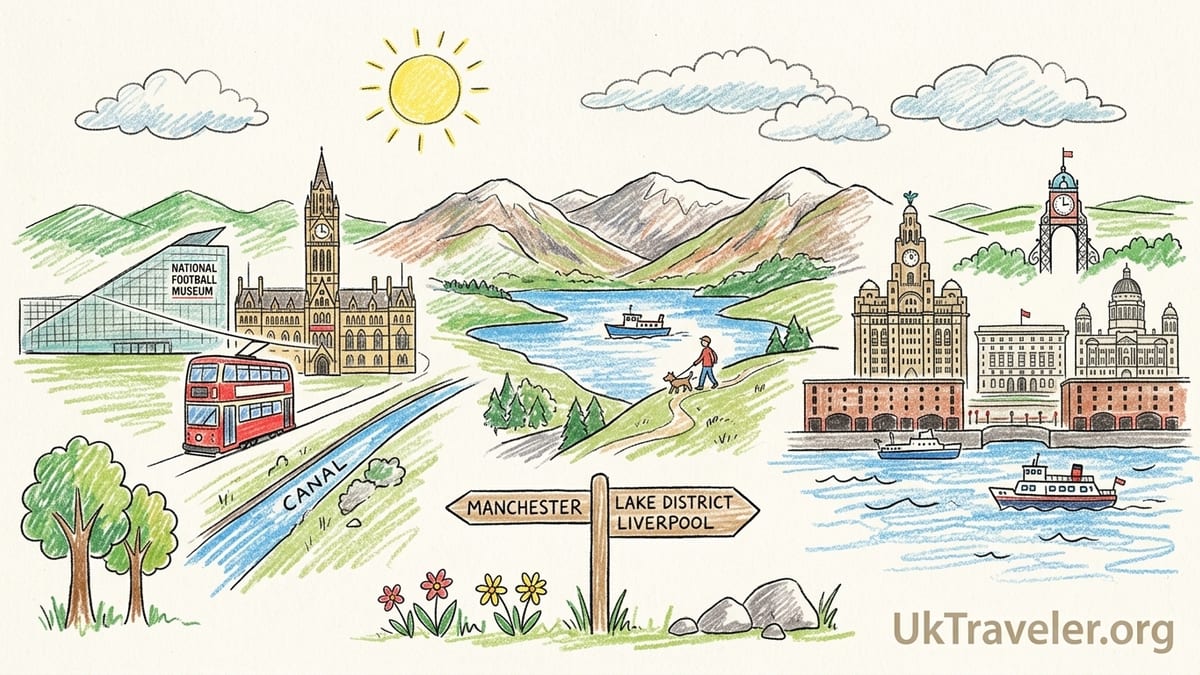
Manchester: Culture, Music, Football and a Buzz That Runs Late
Across three separate visits I have spent a total of six nights in Manchester, arriving twice by direct train from London and once by train from the Lake District via Oxenholme. That felt just enough for a first-timer to get beyond the obvious football and music clichés and to use the city as a base for day trips, but the more time I gave Manchester the more it justified extra nights. The compact city centre, clustered around Piccadilly Gardens, St Peter’s Square and the Northern Quarter, meant I could walk almost everywhere, with the tram used mainly to hop to Salford Quays and the Etihad area. The atmosphere hit me most in the evenings, when the office crowd thinned out and the city’s reputation for culture and nightlife, which local tourism and city strategies now lean into heavily, was very obvious in practice.
What Manchester delivered for me was density: galleries, arenas, live-music venues and football all within a short tram ride. One afternoon I walked from the Science and Industry Museum through Castlefield’s canals, then crossed into the city centre in time for an early dinner and a gig at Band on the Wall in the Northern Quarter, a venue that local tourism boards often highlight when they talk about the city’s music heritage. On another evening I followed the crowds to the AO Arena, currently billed as one of Europe’s busiest indoor venues, and on a different trip I toured Old Trafford and visited the National Football Museum, which sits right in the centre. Manchester marketed itself to me as a place where culture and football intertwine and, on the ground, that mix felt genuine rather than forced.
Was six nights too long or too short? For a first sweep of the city, I would say three nights is a comfortable minimum and five nights is ideal if you want one or two day trips out to places like Liverpool, Chester or the Peak District without sacrificing evenings in the city. On one stay I used Manchester as a base for a day trip to Liverpool, catching an early train from Victoria and returning on a late train around 22:00 so I could still end the night with a drink around Ancoats. It worked, but it left me wishing I had committed separate nights to Liverpool itself. Manchester works best as a base when you want urban energy every night and day trips by rail in multiple directions.
Evenings in Manchester have a noticeably different texture depending on where you stay. Around Deansgate and Spinningfields I found a polished bar scene and restaurants that felt business-heavy midweek, while the Northern Quarter and Ancoats gave me independent bars, ramen joints and small-plate places that stayed lively but not unruly into the late evening. For one trip I booked dinner at a small, modern British restaurant near Ancoats and spent around 30 to 40 pounds per person for a main, a shared starter and a glass of wine, which felt on par with other big UK cities. If I had to trim my time anywhere, I would shorten my hours spent in the Arndale shopping centre area and along the most generic high streets, and instead add an extra evening just wandering between Ancoats, the Northern Quarter and the canal basins around Castlefield.
Liverpool: Waterfront, Music History and Museums That Deserve More Time
In Liverpool I have clocked four nights in total, split across two trips, plus one or two rushed day visits when I was trying to follow someone else’s itinerary. Those day trips convinced me that Liverpool really rewards at least two full days and two or three nights if you care about its waterfront and museums. Each time I arrived by train into Lime Street Station, which drops you within walking distance of the main cultural districts, and I either walked or used buses along the waterfront. Compared with Manchester, Liverpool felt immediately defined by water: the Mersey, the docks and, further out, the beaches along the Sefton Coast.
The area that VisitLiverpool describes as the Waterfront, centred on the Royal Albert Dock, Pier Head and the cluster of historic buildings often called the Three Graces, turned out to be where I spent most of my daylight hours. The first time I visited, I made the mistake of trying to rush where the local tourist board suggests you linger. I squeezed the Museum of Liverpool, the Merseyside Maritime Museum and an early evening drink around the Albert Dock into a single afternoon. That was not enough. On a later trip I gave the waterfront almost two full days, including a ferry across the Mersey, time in the World Museum and a slow wander through the Tate Liverpool’s exhibitions. Liverpool promotes the fact that it has one of the largest collections of museums and galleries outside London, and as a visitor, that felt accurate on the ground, especially if you like to go slowly through exhibits rather than skim.
Evenings in Liverpool had a more relaxed, almost seaside feel when I stuck to the waterfront, and a louder, live-music-heavy edge around Mathew Street and the Cavern Quarter. One Saturday I ate at a casual Italian restaurant near Castle Street, paying roughly 18 pounds for a pizza and 7 to 8 pounds for a glass of wine, then walked down to the docks for sunset. Another evening I booked a small-venue gig, which cost around 15 to 25 pounds for a ticket, and finished the night with a pint near Bold Street, an area that mixes independent restaurants and bars. These prices and experiences felt consistent across my visits, even allowing for rising costs in recent years.
If you are deciding whether Liverpool should be a day trip or a base, my experience is that one full day allows you to see the waterfront, step into one major museum and walk through the city centre, but it does not leave space for both the musical heritage and the wider coastal area. Two or three nights let you take a daytime ferry, visit at least two museums in depth and still have evenings free for live music without rushing for the last train. If I were shaving time, I would cut back on the purely shopping-focused hours around Liverpool ONE in favour of more time in lesser-known corners of the docks or a train ride up to Crosby to see the Another Place sculptures on the beach.
Chester and Rural Cheshire: Heritage, Walls and Slower Nights
Chester, which VisitBritain often pairs with Liverpool in itineraries, gave me a very different kind of experience. I have spent a total of three nights in Chester, once as a two-night stay and once as a single overnight stop between North Wales and Manchester, both times arriving by train. Walking out of the station and into the compact centre, it quickly became clear that Chester excels at concentrated heritage rather than urban buzz. The Roman amphitheatre, the black-and-white Rows and the complete circuit of city walls all sit within about ten minutes’ walk of each other, which meant I could cover a lot of ground on foot without transport.
On my first visit I circled the walls twice, once in late afternoon and again just after sunset, and spent a full morning exploring Chester Cathedral and the narrow streets radiating from Eastgate Clock. That was all achievable with one overnight stay, but it felt tight. With two nights, I could slow down, revisit favourite corners at different times of day and build in an excursion along the River Dee path. In the evenings, Chester’s atmosphere was quieter than either Manchester or Liverpool. Pubs along the Rows filled comfortably, but there was no sense of a major late-night scene, which made it a good counterpoint after several nights in bigger cities.
Outside the city, I also spent two nights in rural Cheshire, staying in a small village about a 30-minute drive from Chester, reached by rental car from Manchester Airport. That part of Cheshire delivered what its county marketing often promises: low, green farmland, brick villages, and stately homes dotted at short intervals. I visited one of the larger estates where entry for adults was around 20 to 25 pounds, including access to gardens and house, and spent an afternoon on signed walking trails that started right outside the village pub. Evenings here were very subdued, centred on pub dinners where a main course might cost 16 to 22 pounds and bookings were wise on weekends.
In hindsight, Chester works beautifully as either a one-night stop on a wider route between Liverpool, North Wales and Manchester or as a two-night base if you want rural Cheshire day trips without changing hotels repeatedly. I would not personally allocate more than two nights to the city itself unless you have a specific interest, such as intensive cathedral visits or a slow-paced, car-free break. If anything, I slightly overestimated how much time the central shopping streets needed and would instead extend my stay in the countryside, where an extra evening walk or another unhurried pub meal added more value than another lap of the Rows.
Lake District: Landscapes, Lakes and Why I Needed More Time
Across three trips I have devoted a combined eight nights to the Lake District, typically arriving by train to Oxenholme and then switching to a local train or bus toward Windermere and Ambleside. VisitBritain treats the Lake District as one of the main pillars of a North West itinerary, and that matches my experience. After the intense urban days in Manchester and Liverpool, the shift into a national park of lakes and fells was dramatic. My stays ranged from two-night dashes to four-night bases, and each time I left feeling that I could easily have added at least one more night.
On my first visit I made what is probably the classic first-timer mistake: I tried to sample too many different towns in too few days. I spent one night near Bowness-on-Windermere, took a lake cruise and a short bus ride to Ambleside, then transferred to Keswick for a single night. Technically, I “saw” a lot, but most of the time was spent in transit or skimming the lakeshore. When I returned for four nights based solely in Ambleside, reached by bus from Windermere station, the region finally opened up. I could walk from my guesthouse straight onto low fells in the morning, take a boat across Windermere or up to Waterhead in the afternoon, and still be back in time for dinner.
In terms of daily costs, my most recent stay gave a clear picture. A return train ticket from Manchester to Windermere booked in advance cost roughly 25 to 35 pounds, depending on timing. Local buses between Windermere, Ambleside and Grasmere were often covered by a day ticket in the region of 10 pounds, which made car-free travel viable. Dinners in Ambleside and Grasmere ranged from 17 to 25 pounds for a main course in a mid-range bistro to around 12 to 15 pounds for a hearty pub meal. These figures will continue to shift with inflation, but even in 2025 and 2026 it was possible to keep costs reasonable by mixing pub dinners with occasional splurges.
Evenings in the Lake District were shaped by early closing times. Compared with the late buzz of Manchester, Ambleside and Grasmere began to quieten noticeably after 22:00. I learned to book restaurants for 19:00 or 19:30, especially on weekends or during school holidays, because many kitchens stopped serving by 21:00. This rhythm suited early walks the next morning but is worth knowing if you are used to city dining hours. As for famous places that did not need as much time as expected, Bowness-on-Windermere fell into that category for me. It is a useful gateway, with boat piers and plenty of accommodation, but on the ground the high streets felt more crowded and souvenir-driven than Ambleside or Keswick. I was glad I had spent only a few daylight hours there.
If I were planning a first-time Lake District visit focused on North West England as a whole, I would recommend at least three nights, preferably four. The region works best as a base rather than a day trip from Manchester or Liverpool, both because of travel time and because the weather can shift quickly. On my last stay, a rainy first day that might have ruined a one-off visit simply became a lower-level walk along the lakeshore, followed by clearer weather on the following two days. Here more time almost always improves your visit, while frantic box-ticking leaves you feeling short-changed by the landscapes.
Lancashire: Coast, Countryside and Places I Would Extend
Lancashire, which the county’s tourism board promotes through a mix of Blackpool’s bright lights, Morecambe Bay’s shorelines, Lancaster’s heritage and the inland hills of the Forest of Bowland and Ribble Valley, took me multiple trips to understand. In total I have spent six nights in the county, usually arriving by train into Preston or Lancaster and then using a rental car or local buses. Lancashire is not as immediately legible as the Lake District or as heavily marketed internationally as Manchester or Liverpool, but this is where I found several places that deserved more time than I initially gave them.
The first of those was Lancaster. I originally treated it as a half-day stop on the way to Morecambe Bay, grabbing a quick look at Lancaster Castle and a coffee in the city centre. On a later trip I gave Lancaster two full nights, staying within a ten-minute walk of the station. That extra time allowed for a proper visit to the castle, an afternoon in Williamson Park, which looks out across Morecambe Bay toward the Lake District fells, and an evening circuit of the compact pub and restaurant scene around Dalton Square. Lancaster’s role as a historic county town is often noted in county-wide tourism material, but on the ground it felt more like a liveable university city with enough culture and dining to justify at least one or two nights.
Morecambe Bay and the Lune Valley provided a different kind of coastal-and-river landscape. On one spring visit I spent a single night in Morecambe itself, walking the promenade and looking back to the Lake District hills. It was enough to get a taste of the town and its improving seafront, but too short if you want to explore the wider bay or take guided walks across the sands, which operate on specific dates and tides. A newer visit left me wishing I had devoted two nights here, one for the promenade and art deco architecture, and another for a drive or bus ride around the bay’s quieter edges. Prices here were generally a little lower than in the Lake District. A fish-and-chips supper along the promenade cost under 15 pounds per person including a drink, and guesthouse rates felt gentler outside school holidays.
Inland, the Forest of Bowland and the Ribble Valley were my biggest surprises. Official national tourism bodies describe this area as endlessly beautiful, with peaks and valleys that have inspired walking routes and even literary connections, and Lancashire marketing consistently highlights the area as a rural showcase. My own experience, spread over three nights in total, supported that. I based myself once in a village on the edge of the Forest of Bowland and once in the market town of Clitheroe in the Ribble Valley. Both stays were reached by a mix of train to Preston or Clitheroe and then local buses or short taxi rides. Days were given over to low to moderate hill walks, visits to viewpoints over the Trough of Bowland and meals in country pubs where menus leaned heavily on local lamb, cheese and seasonal produce.
The Forest of Bowland region, designated as a National Landscape, felt considerably quieter than the Lake District even on sunny weekends. Parking at popular starting points for walks was still competitive by late morning, but the paths themselves were never crowded. On one day I walked a circular route that gave views across to Morecambe Bay and the distant Lakeland fells, then returned to a village where my main-course pub lunch cost about 18 pounds. Evenings were low-key, with the night sky far darker than in any city, which matched national-level promotion of the area as a place for dark-sky stargazing. If I were allocating time again, I would cut a full night from any stay focused solely on Blackpool’s seafront lights and reallocate it to an extra night in Bowland or the Ribble Valley, where each additional unhurried walk felt like a real gain rather than a repeat.
Places That Did Not Need As Long As I Gave Them
Not every famous spot in North West England matched the amount of time I originally scheduled. The clearest example is Blackpool. Lancashire tourism materials rightly point to Blackpool as the county’s most iconic seaside resort, with its tower, long promenade and amusement parks. I dedicated two nights there on my first Lancashire trip, arriving by direct train and staying within easy walking distance of the seafront. I walked the length of the promenade, visited the tower complex, spent time near the Pleasure Beach area and, because I visited in autumn, experienced the Blackpool Illuminations in the evening. It was undeniably memorable, but by the end of the second day I felt as if I were repeating myself.
In practical terms, Blackpool worked very well as a day trip or a single overnight stop, especially if you time your visit with the Illuminations season or a specific show. Prices along the promenade varied, but it was entirely possible to find a sit-down meal for under 20 pounds per person and a bed-and-breakfast room for less than in Manchester or the Lake District, especially outside weekends. Yet after one full day and one evening, I found myself looking for quieter coastal stretches or inland walks. The high concentration of arcades, chain eateries and loud bars suited a particular type of holiday, but for my own interests in landscapes and smaller-scale heritage, it felt like a place I could enjoy in shorter bursts.
I had a similar experience, on a smaller scale, in the most crowded parts of Bowness-on-Windermere. As the arrival point for many lake cruises and coach tours, its streets around the piers and main shopping area were consistently busy. On one trip I spent almost a whole day here, ducking in and out of shops and cafes, and by the evening I realised that a few focused hours would have delivered the same value. By contrast, smaller places like Grasmere and Keswick, which I had originally slated for brief visits, rewarded longer, slower days with more satisfying walks and less crowded evenings.
These experiences shifted how I plan time in the region. Now, when building an itinerary, I treat heavily promoted, high-footfall areas as places to drop into rather than automatic overnight bases. I might, for example, allocate a single evening and night to Blackpool to see the tower lit up, then spend the following nights in Lancaster or the Ribble Valley. Or I might disembark a lake cruise in Bowness, enjoy a few hours at the lakeshore and then continue by bus back to a quieter base. The region’s rail and bus network, which county and national tourism boards frequently emphasise, makes this kind of flexible planning realistic without a car.
The Takeaway
After spreading more than twenty nights across North West England, from city centres to moorland valleys, my main conclusion is that time is best invested where contrast and depth meet. Manchester justified multiple nights as a cultural and footballing hub with strong transport links in every direction. Liverpool earned at least two or three nights on the strength of its waterfront, museums and music heritage, which simply cannot be absorbed in a rushed day. Chester and rural Cheshire offered a gentler rhythm, working best as one or two-night stops that break up faster-moving city days.
The Lake District demanded and repaid every extra night with more walks and a better chance of catching good weather, while Lancashire’s mix of coast and countryside revealed itself only after I stayed beyond the obvious Blackpool seafront. Places like Lancaster, the Forest of Bowland and the Ribble Valley, which are still emphasised primarily in regional rather than global marketing, turned out to be where I would most eagerly extend future trips. Meanwhile, a few of the most iconic spots, such as Blackpool’s promenade and central Bowness-on-Windermere, proved more satisfying as day visits.
If you are planning your own route through North West England, use the big four of Manchester, Liverpool, Chester and the Lake District as structural pillars, as VisitBritain already suggests, but be prepared to redistribute time away from the busiest waterfronts and shopping streets. Add nights where the evenings are most rewarding for you, whether that is neon-lit music venues in Manchester, sunset walks along Liverpool’s docks, quiet pub dinners in Cheshire or dark-sky stargazing above Bowland’s hills. The region is dense with options. The real skill is not in seeing everywhere, but in knowing where to linger.
FAQ
Q1. How many days do I realistically need for a first trip to North West England?
For a first trip focused on Manchester, Liverpool, Chester and the Lake District, I would aim for at least seven to ten days. That allows two or three nights in Manchester, two or three in Liverpool, one or two around Chester and three or four in the Lake District. With less time you can still enjoy the region, but you will need to treat more places as day trips rather than overnight bases.
Q2. Is Manchester or Liverpool better as a base city?
Both work, but for my trips Manchester had a slight edge as a base because of its rail connections to the Lake District, Liverpool, Chester and even the Peak District. I found it easier to do day trips in multiple directions from Manchester, while Liverpool felt better as a dedicated two or three-night stay focused on the city itself and its waterfront.
Q3. Can I visit the Lake District as a day trip from Manchester?
It is technically possible by taking an early train to Windermere and a late train back, but I would not recommend it as your main experience of the national park. By the time you transfer to buses and reach walking areas, you will have limited hours on the ground and will be very dependent on weather. Staying at least two or three nights in or near Ambleside, Keswick or another base gave me a far richer experience.
Q4. Is Blackpool worth staying overnight or just a day trip?
After spending two nights there and visiting again on shorter trips, I would personally treat Blackpool as a focused day trip or a single overnight stay, especially if your visit coincides with the Illuminations or a specific show. One full day gave me enough time for the tower, promenade and seafront atmosphere. Beyond that, I preferred to spend nights in quieter coastal or inland bases such as Lancaster or the Ribble Valley.
Q5. Do I need a car to explore Lancashire and the rural areas?
You can reach Lancashire’s main hubs like Lancaster, Preston and Blackpool by train, and there are buses into areas such as the Ribble Valley and the Forest of Bowland. On my trips, a car made it much easier to reach trailheads and smaller villages in Bowland, but I was still able to do satisfying walks and village visits using public transport plus occasional short taxi rides. If you dislike driving narrow country lanes, a combination of trains, buses and organised tours is a workable alternative.
Q6. How expensive is it to eat out in these North West destinations?
Across my recent visits, a main course in a mid-range city restaurant in Manchester or Liverpool typically cost between 17 and 25 pounds, with slightly lower prices in pubs or cafes. In smaller towns and rural areas, pub mains could often be found in the 14 to 20 pound range. Higher-end restaurants in places like Manchester’s city centre or the Ribble Valley’s country inns will cost more, so I usually mixed pub dinners with occasional splurges to keep the daily budget reasonable.
Q7. When is the best time of year to visit the Lake District and Lancashire’s countryside?
My most rewarding trips fell between late April and June and again in September and early October. In these windows the Lake District and Bowland hills were usually green and walkable, accommodation was easier to book than in peak school-holiday weeks, and the weather often allowed for a mix of lake cruises and hill walks. Winter visits can be atmospheric but bring shorter daylight and a higher chance of rain or low cloud, so I found them better suited to cosy pub stays and short local walks.
Q8. Is Chester better as a base or a quick stop?
Chester works well as both, depending on your priorities. On one trip I used it as a one-night stop to break the journey between Liverpool and Manchester, which was enough to walk the city walls and see the Rows. On another I stayed two nights and used the full day in between to explore more slowly and take a river walk. If you also want to see rural Cheshire without changing hotels, two nights in Chester is a comfortable choice.
Q9. How lively are evenings outside the main cities?
Evenings in smaller towns such as Ambleside, Keswick, Lancaster and Cheshire villages were much quieter than in Manchester or Liverpool. Pubs and restaurants were active until around 22:00, but late-night options were limited. I learned to book earlier dinners and plan for relaxed nights rather than expecting big-city nightlife. If evening buzz is important to you, concentrate more of your nights in Manchester or Liverpool and treat rural stays as slower interludes.
Q10. If I only have five days, where should I focus?
With five days I would choose two main bases rather than trying to see everything. One option is three nights in Manchester with a day trip to either Liverpool or Chester, plus two nights in the Lake District. Another is three nights in Liverpool, including a day trip to Chester, followed by two nights in either the Lake District or Lancashire’s coast around Lancaster and Morecambe Bay. In my experience, depth in a few places beats rushing through many.