


North West England can look deceptively compact on the map. Manchester, Liverpool, Chester and the Lake District seem to sit in a neat cluster, with Lancashire and Cheshire in easy reach. In reality, the mix of rail hubs, slow scenic roads and changeable Lake District weather means that how you structure your bases matters more than how many dots you add to your map. This guide sets out a planning framework for 5, 7 and 10 day itineraries that feel full but not frantic, using real travel times and concrete examples rather than rigid, hour by hour schedules.
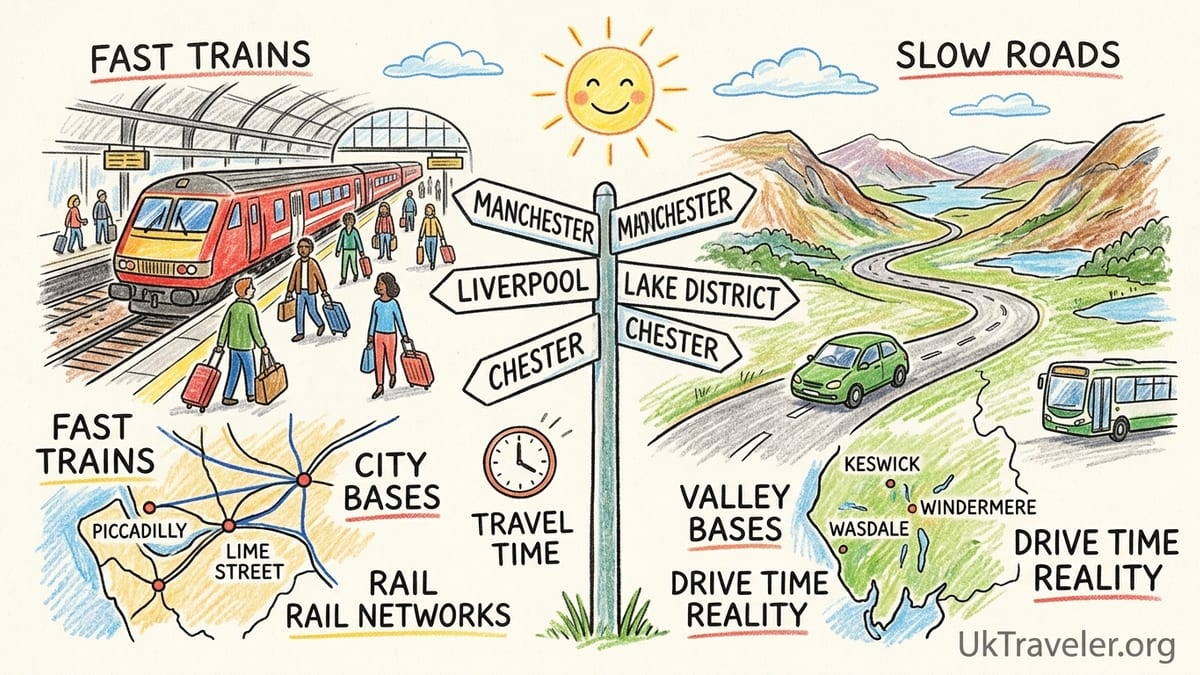
Understanding Distances, Bases and Travel Time Reality
The official tourism board itinerary for five days in North West England combines Manchester, Liverpool, the Lake District and Chester, and presents it as plausible in a single trip. That is useful evidence of basic regional scale, but it is still ambitious. Manchester to Liverpool by train can be as little as 35 minutes from Piccadilly to Lime Street on fast services, so combining these two cities is straightforward. By contrast, reaching the Lake District already pushes you into slower travel: VisitBritain highlights direct services from Manchester Piccadilly to Windermere that take around two hours, including the change at Oxenholme when required. This is already a half day, once hotel check in and walking from stations are factored in.
Inside the Lake District, travel time can stretch in ways that catch first time visitors out. The Lake District National Park’s own visitor information uses drive time examples such as Windermere to Keswick at around 40 minutes, illustrating that even two well known towns inside the park are not side by side. The same official guidance explains that valley roads are often narrow and winding, and average speeds can be low even in good conditions. Locally published drive time examples make this clear: a journey like Kendal to Wasdale can take around 1.5 hours by car, even though the raw distance on the map does not look huge. This is part of what makes planning bases, not day trips, the more relaxed way to experience the national park.
For a 5 to 10 day trip, most travellers are best served by limiting themselves to two or three main bases for the entire itinerary. For instance, five days might use Manchester and Liverpool as rail friendly anchors plus one countryside base in Windermere or Ambleside. Seven days might be split between Manchester, Liverpool and a Lake District village without adding further moves. A ten day trip might add a fourth base, such as Chester, Lancaster, a Lancashire coastal town or a Cheshire village, but only if you are comfortable with a couple of repacking days. The more you move, the more you risk losing half days to luggage, station transfers and check in windows.
This is also why day trip expectations need to be realistic. Manchester tourism information shows the Lake District (Windermere) as around 1 hour 40 minutes away by train via Oxenholme in ideal conditions. Regional driving guidance from England focused travel sources suggests Manchester to Windermere is roughly 85 miles and about 1.5 hours by car in light traffic, with Liverpool to Windermere closer to 2 hours. Those are off peak estimates. On a busy summer Saturday, the same journeys can creep well past two hours one way, especially on the M6. Building in this margin when you choose bases and plan your daily patterns will make the difference between a trip that feels calm and one that is defined by timetables.
Rail or Rental Car: Choosing Your Mode City by City
The North West is unusually forgiving for visitors who do not wish to drive, especially for the city portions of their trip. Manchester, Liverpool and Chester are all on well served rail lines, and there are direct trains between Manchester Airport and central Manchester, and on toward Liverpool and the Lake District line via Oxenholme. Timetables change often, but recent schedules show multiple trains per hour on peak days between Manchester and Liverpool and regular services into Lancaster, Oxenholme and onward to Windermere. Intercity trains are usually the fastest way to move between city bases, and day tickets or off peak returns can offer good value for travellers willing to travel outside rush hour.
Once you pivot into the fells, the picture changes. The Lake District National Park authority actively encourages bus, boat and rail use, and highlights key services like the 555 bus through the central lakes and the open top 599 between Bowness and Grasmere. There are also frequent boat services on Windermere, Coniston Water and Ullswater, run by local operators that act as practical transport as well as sightseeing. With a bit of planning, a base like Bowness, Ambleside or Keswick can be enjoyable without a car, particularly in summer when routes are more frequent. In practice, this works best if you are prepared to accept a slightly slower pace and work your walks around the bus and boat patterns.
A rental car begins to add value in two main scenarios. The first is when your Lake District base is away from the major transport corridors, for example in Wasdale, Borrowdale or the quieter valleys on the western and southern edges. Public transport into these areas exists but may be infrequent or indirect. If your accommodation is a farmhouse B&B or a self catering cottage outside a village, a car will usually make daily logistics easier. The second is when you want to connect countryside regions that are not directly linked by rail, such as combining the Lake District with the Yorkshire Dales or remote parts of Lancashire in the same week. In these cases, routes might exist by bus and train, but can require several changes and most of a day.
Cost comparisons are worth thinking about. A week of standard class off peak rail travel between Manchester, Liverpool and the Lake District, plus local buses in Cumbria, can be surprisingly affordable, particularly if you buy advance tickets and make use of regional day rover passes. A compact rental car for a week, picked up at Manchester Airport, might cost the equivalent of several hundred pounds in 2026 once insurance and fuel are included, depending on season and demand. Families or groups of three or four often find a car better value when costs are shared, while solo travellers often do better on rail and bus. In any case, it is rarely worth having a car on hand for dense urban days in central Manchester or Liverpool, where parking fees and one way systems quickly outweigh the convenience.
How Many Days and Bases: 5, 7 and 10 Day Frameworks
Five days in North West England is long enough to get a real feel for the region, but it does force choices. Treat VisitBritain’s own five day route, which combines Manchester, Liverpool, the Lake District and Chester, as a signpost rather than a prescription. You can in theory sample all four in five days, but every extra stop adds more hotel changes and travel days. A more relaxed five day structure might focus on Manchester and Liverpool plus one contrasting base, or one city plus the Lake District only. For example, you might spend two nights in Manchester, one full day in Liverpool as a day trip, then two nights in Windermere to get a taste of the Lakes.
Seven days allows the classic pattern of two cities plus one countryside base without feeling as if you are living from a suitcase. One common model is three nights in Manchester, two in Liverpool and two in Windermere or Ambleside, using fast trains between cities and the rail line via Oxenholme to reach the Lakes. With an entire week, you can give each city at least one full sightseeing day, plus a flexible day that can be used for a day trip to Chester from either Manchester or Liverpool. You also have two or three full days to enjoy the Lake District, with time for a lake cruise, one moderate fell walk and a low key rainy day option like a museum or distillery tour if the weather closes in.
Ten days opens the door to a richer city and countryside combination. With this length, you can reasonably include Manchester, Liverpool and the Lake District, plus either a Lancashire coast or countryside stop, or time in Cheshire or Chester. One example frame would be three nights in Manchester, two in Liverpool, three in a Lake District base and two in Chester, with direct trains covering the city legs and a rental car or train plus bus combination used for the Lakes. Another option is to spend longer in the countryside and keep the cities as short bookends, for instance two nights in Manchester, two in Liverpool, five in the Lakes and a final night back near Manchester Airport before flying out.
The key is to decide on the number of bases first, rather than listing every town you might like to see and trying to fold them into overcomplicated sequences. In practical terms, five days works best with two bases, seven days with two or three, and ten days with three, occasionally four, if you enjoy change. Once you have your base count, start placing anchor nights where onward travel is simplest. For example, if your long haul flight arrives into Manchester in the morning, spending the first night in the city before transferring to the Lake District on day two allows for jet lag and reduces the risk that any flight delay will cause you to miss a prebooked long distance train.
First Time Highlights: Cities and Lakes Without Rushing
First time visitors often want to tick key highlights without feeling as if they have joined a coach tour. In Manchester, that might mean time in the redeveloped canal basins around Castlefield, a visit to the Science and Industry Museum, a walk through the Northern Quarter, and, for football fans, a tour of either Old Trafford or the Etihad Stadium. These are all easily reached on foot or by tram from central hotels. With two full days, you can add an afternoon at a gallery such as the Whitworth or Manchester Art Gallery, or a live music evening in one of the smaller venues.
Liverpool’s core highlights cluster conveniently around the waterfront and city centre. In one full day, you can visit the Royal Albert Dock, explore The Beatles Story or the Museum of Liverpool, and walk up to the city’s two cathedrals. Another day gives you the chance to add a ferry across the Mersey, explore the Georgian Quarter or take a short Merseyrail trip to the Wirral coast. The 35 minute train connection from Manchester Piccadilly to Liverpool Lime Street makes Liverpool a viable long day trip from Manchester if you prefer to avoid another hotel, though two nights in the city allows for evenings on the waterfront without having to watch the clock.
In the Lake District, a first time “highlights” pattern can work well if you follow the natural geography. Several recently published three day Lake District itineraries for first timers follow a south to north pattern, starting in the Windermere and Bowness area, then moving through Grasmere and Rydal, and finally into the Keswick and Borrowdale area for the wilder northern fells. For a shorter stay, simply compress that logic. A two or three night stay based in Windermere or Ambleside might look like a cruise on Windermere and a low level walk on one day, then a bus up to Grasmere or Keswick for another day to get a sense of the different landscapes.
This is also where weather buffers matter. The Lake District is known for changeable conditions, with rain possible in any season. If you only have two days there, and you plan a single major fell walk, keep the following day free of fixed bookings so you can swap activities. For example, if you base in Ambleside, you might plan a flexible window where one day is dedicated to a circular walk such as Loughrigg Fell or the Fairfield Horseshoe, while the other day is set aside for indoor or mixed weather activities such as Dove Cottage at Grasmere, the Windermere Jetty Museum or a distillery tour near Bassenthwaite. Treat your Lake District days as a pool of options rather than a checklist that must be completed in sequence.
Cities Plus Nature: Blending Culture, Fells and Coast
One of North West England’s strengths is the ease with which you can combine industrial heritage and modern culture with pastoral landscapes and coastal scenery. A seven day “cities plus nature” itinerary can make that contrast explicit. You might begin with three nights in Manchester, using one day for the city itself and one for a short rail day trip, for example to the Peak District towns of Edale or Glossop, which sit around 30 to 40 minutes away by train and offer instant access to moorland and ridge walks. That leaves a day to travel to your Lake District base, arriving in time for an evening walk along the lake.
From a Lake District base, you could then build two or three full days that each balance active time outdoors with a cultural or culinary element. One day could be devoted to walking, such as a route above Ullswater or around Buttermere, reached by bus or car, with a pub dinner in a village like Keswick or Hawkshead. Another day might blend a shorter walk with a cruise on Windermere, using services between Bowness, Ambleside and Lakeside that effectively act as water buses, and a visit to a site linked to Beatrix Potter or William Wordsworth. If you have a rental car, a further day can reach quieter corners such as Wasdale or Eskdale, understanding that an out and back drive from Ambleside will likely consume several hours simply due to road conditions and narrow passes.
Coastal North West England can also be woven into a longer nature themed trip. The Lancashire coast around Morecambe Bay or the traditional seaside resort of Blackpool sits roughly an hour by train from cities such as Manchester and Preston. You might add a night in a coastal town at the end of a ten day trip for a slower final day before flying home. Alternatively, if your international flight departs late from Manchester, an early train from the coast could allow for a final walk on the beach before heading inland, though this works best in shoulder seasons when holiday crowds are thinner.
When you combine cities and nature, sequencing matters. It can be kinder on your energy levels to put the higher commitment hiking days in the middle of the trip, not the very start or very end. For example, fly into Manchester, adjust for time zones with two easy city days, then move to the Lake District for your more physically demanding walks, and finally decompress with an easier city like Liverpool or Chester, where most sights are reachable on foot and you are never far from a cafe or restaurant if fatigue bites.
Family Travel, Food Lovers and Road Trip Models
Families visiting North West England need to factor in attention spans, luggage logistics and the reality that frequent hotel changes can be disproportionately tiring with children. For a five or seven day family oriented trip, two bases work best. You might spend three or four nights in Manchester or Liverpool in an apartment style hotel that allows for simple breakfasts and laundry, followed by three or four nights in a Lake District cottage or family friendly guesthouse. From Manchester, you can take children to attractions like science museums, football stadium tours, and indoor climbing walls. From a Lake District base such as Bowness or Keswick, family friendly options include short lake cruises, easy lakeside paths, visitor centres with play areas, and farm attractions in Cumbria’s valleys.
Food focused travellers might approach the region as a chain of meals and markets. Manchester’s restaurant scene has expanded significantly in recent years, with everything from modern British tasting menus in the city centre to street food style markets under railway arches. Liverpool adds waterfront dining, dockside cafes and historic pubs. Lancashire and Cumbria bring in farmhouse cheeses, local lamb, Herdwick mutton and artisanal bakeries. A ten day “food and countryside” trip could base you in Manchester for three nights of urban eating, then in a Lake District inn known for its kitchen, followed by two nights in a market town such as Kirkby Lonsdale or Lancaster, where you can explore local producers on a smaller scale.
Dedicated road trippers, by contrast, might deliberately reduce city time to create a loop through varied landscapes. With ten days and a rental car, one pattern would start and end in Manchester, with one or two nights in the city at the beginning or end and the remainder divided between two Lake District bases and one stop in Lancashire or Cheshire. You might, for example, spend three nights in the central Lakes around Ambleside, two nights in the northern Lakes near Keswick, and three nights in a Cheshire village or on the Yorkshire border. Drive times between each step are often quoted at between 1.5 and 3 hours off peak, but you should allow longer to stop at viewpoints, take short walks and account for single track sections.
Even for self drive itineraries, constant motion is not ideal. It can be tempting to plan a new bed for every night, especially when guidebooks dot maps with enticing names. In practice, many experienced visitors prefer “hub and spoke” patterns that limit drives to every two or three days, and then catch several valleys or coasts as day loops. From Ambleside, for instance, you might spend one day driving over the Kirkstone Pass to Ullswater and back, another day over to Coniston and the Duddon Valley, and a third day north toward Keswick and Borrowdale, all while keeping the same accommodation. This reduces packing time and allows you to build familiarity with parking areas and local services.
Building Weather Buffers and Why “Close” Can Still Take a Day
The Lake District experiences some of the highest rainfall totals in England, and its microclimates can produce rapid changes in conditions between valleys. A morning that begins in low cloud around Windermere can turn clear by midday, while a planned ascent in Wasdale may see the tops disappear into mist. For short trips, it is important to build in weather buffers, especially if your heart is set on a particular ridge walk or boat cruise. Instead of scheduling one fixed “hiking day” and one fixed “museum day,” consider treating each day as a flexible time block with indoor and outdoor options, and make the final call on the morning itself based on the latest forecast.
Part of that flexibility also means accepting that some journeys will effectively consume an entire day, even at modest distances. Official guidance from the Lake District National Park gives a rough car journey time of 40 minutes between Windermere and Keswick, which seems quick on paper. Yet that time assumes smooth traffic and does not include stops, parking searches or bus connections at either end. Once you factor in leaving your accommodation, reaching the car or bus stop, driving or riding, then walking onward to your chosen trailhead or attraction, the window can easily grow to 1.5 hours door to door. Returning later that day doubles that figure.
The Kendal to Wasdale example, often cited in planning discussions, makes the same point in more extreme fashion. While the direct distance does not appear huge, real world drive times can approach 1.5 hours one way, particularly if you avoid the very narrow high passes. That means that a simple there and back transfer to a west coast valley, plus even a modest walk, comfortably fills a day. On days like this, it is sensible to design a “deep dive into one valley” theme rather than trying to add a second major activity in a different part of the park.
The practical takeaway is to sketch your itinerary at the level of valleys and hubs, not just individual towns. If you know that you want to explore both the central lakes around Windermere and the northern lakes around Keswick, consider splitting your time between two bases instead of attempting to commute between them every day. Similarly, if you are keen to include both the Lake District and another rural region such as the Yorkshire Dales or North Wales, it may be better to assign whole days to travel and light exploration, rather than assuming you can squeeze in full morning and afternoon activities on those transfer days.
FAQ
Q1. Is five days really enough for Manchester, Liverpool and the Lake District?
Five days is enough to get a flavour of all three if you keep to two bases and accept that the Lake District portion will be quite short. A common pattern is three nights in a city, using one day for a rail day trip to the other city, and then two nights in a Lake District base like Windermere or Ambleside. You will not see the whole national park, but you will experience at least one lake, one fell walk and both cities without constant packing.
Q2. Should I rent a car for my first visit to North West England?
If your plans are limited to Manchester, Liverpool, Chester and the central Lake District, you can comfortably use trains, buses and lake boats, particularly in summer when services are frequent. A rental car becomes more useful if you want to stay in quieter Lake District valleys, travel outside high season when public transport is reduced, or combine the Lakes with less connected rural areas. Many first time visitors split the difference by relying on rail in the cities and hiring a car only for the Lake District section.
Q3. How many bases should I plan for a ten day trip?
For ten days, three bases is a good starting point. For example, you might spend three nights in Manchester, three in the Lake District and four split between Liverpool and Chester. This keeps travel days to a manageable number while still giving you different perspectives on the region. Adding a fourth base is possible if you enjoy moving frequently, but it will increase the share of your time spent in transit.
Q4. Is the Lake District realistic as a day trip from Manchester or Liverpool?
It is technically possible as a long day trip by train or car, and some visitors do it, but it is a compromise. Recent rail journey patterns suggest around 1 hour 40 minutes from Manchester to Windermere via Oxenholme in each direction when connections line up, and driving can take around 1.5 to 2 hours one way outside peak traffic. By the time you account for local transport from Windermere to trailheads or cruise piers, you may only have five or six useful hours in the park. Staying one or two nights in the Lakes gives a much more relaxed experience.
Q5. When is the best time of year to combine cities and the Lake District?
Late spring and early autumn are often ideal for a mixed city and countryside trip. In May, June, September and early October you usually find longer daylight than in winter, milder temperatures than in high summer heatwaves, and slightly fewer crowds than in school holiday peaks. City attractions run year round, so you can hedge against rainier periods by focusing more time on Manchester and Liverpool if the Lake District forecast looks poor.
Q6. How should I plan for bad weather in the Lake District?
Assume that at least one of your planned outdoor days could be affected by low cloud or heavy rain, regardless of season. Build in flexible days where your only fixed commitment might be a dinner reservation, and have a shortlist of indoor or low level alternatives such as museums, historic houses, distilleries or short lake cruises. Avoid tying high level hikes to non refundable tours or transport if you can, and be willing to swap days around at short notice.
Q7. Is Chester worth adding if I already have Manchester and Liverpool in my plan?
Chester offers a very different feel to the larger cities, with a compact walled centre, Roman history and distinctive two level “Rows” shopping streets. Fast trains from both Manchester and Liverpool take around an hour or less, making Chester easy to add as either a full day trip or a short overnight stay. If you have seven days or more, and you enjoy historic architecture and walkable centres, Chester can be a rewarding fourth stop.
Q8. Where should I base myself in the Lake District as a first time visitor?
For most first timers arriving by train, Windermere, Bowness and Ambleside make practical bases, with frequent buses, boat services and a range of accommodation. If you prefer a slightly quieter atmosphere while still having good public transport, Ambleside is a strong option. Travellers with a car who want a wilder feel might look at Keswick in the north, which offers easy access to Derwentwater and the surrounding fells, or at villages like Grasmere and Hawkshead in the central Lakes.
Q9. How expensive is it to travel around North West England by public transport?
While exact fares vary by date and booking window, public transport in the region is generally affordable compared with hiring a car for solo travellers and couples. Advance purchase rail tickets between Manchester, Liverpool and Oxenholme can be good value, especially outside peak commuter times, and regional rail and bus passes can reduce costs further if you plan several journeys in a short period. Families and groups should compare this against the total cost of a rental car, fuel and parking to see which option wins for their specific dates.
Q10. Can I visit both the Lake District and another rural region like the Yorkshire Dales in one week?
It is possible but requires careful pruning. In seven days, you might realistically spend three nights in the Lake District and three in the Dales, but you would have limited time for cities like Manchester and Liverpool. Transfers between national parks often take most of a day when you factor in driving or multiple public transport legs, food stops and check in times. If this is your first trip to the UK, many travellers prefer to focus on one rural region plus cities, and then plan a return visit to explore another area in depth.