


The North West England coast is often reduced to a single image of Blackpool Tower rising over a crowded promenade, but the shoreline from Morecambe Bay to the Liverpool City Region contains far more variety than that postcard suggests. Over repeated trips in every kind of weather, I have walked these fronts, watched the tide swallow entire beaches, fought coastal winds for an ice cream, and hunted out the rare corners I would happily book a weekend around. This is a personal coastal circuit, focused on the places I have genuinely spent time in, and the ones I would actually return to.
Understanding This Stretch of Coast
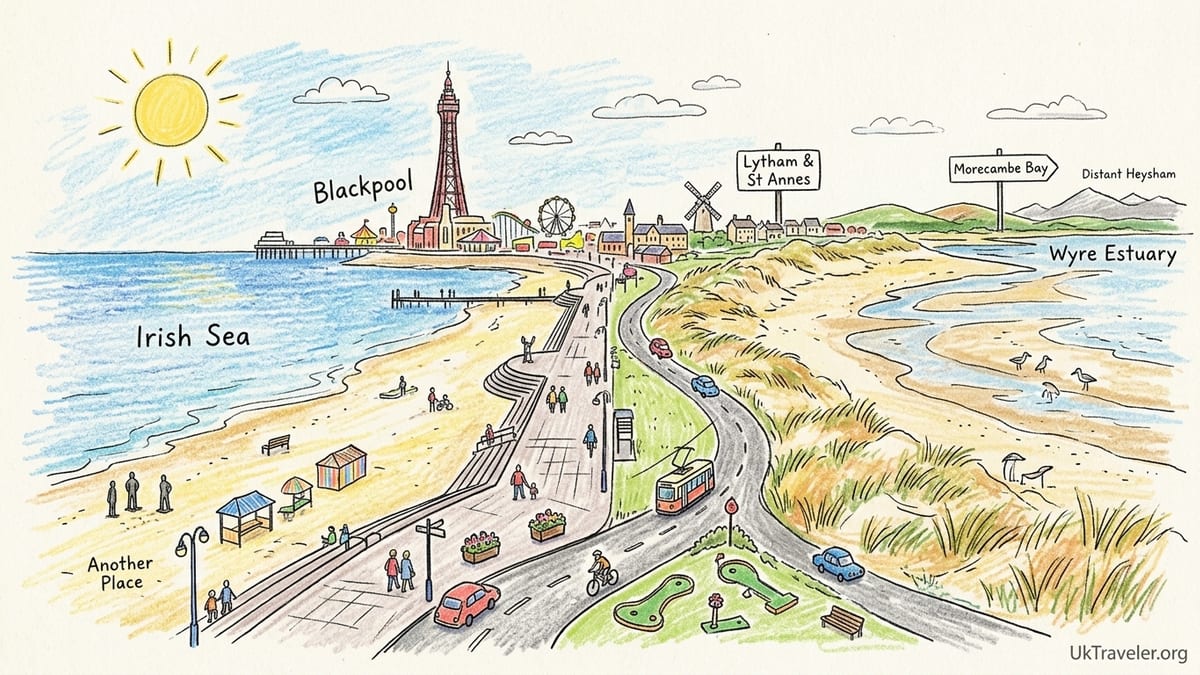
Lancashire’s tourism board talks about its coast as a run of distinct personalities from the wide, wildlife-rich bay at Morecambe down through Blackpool, Cleveleys, Fleetwood and the Fylde towns of St Annes and Lytham, framed by the Irish Sea on one side and low countryside on the other. That description matches my experience on the ground. In a relatively short drive you move from classic amusement-arcade seafronts to quiet dunes, river estuaries and formal promenades that feel more like parks than beaches.
VisitLiverpool, for its part, has worked hard in recent years to reposition the city region as more than a dockside skyline. It now actively promotes the Sefton and Wirral coasts, pointing to places like Crosby, Formby and New Brighton as part of the same short-break story as the Albert Dock and city museums. That is exactly how I have used them, hopping on Merseyrail with sand still in my shoes to be back among warehouses and galleries in under an hour.
What follows is not an exhaustive directory but a set of coastal stops I know well enough to describe in practical detail. I have walked these promenades, paid the parking machines, queued for coffee in the wind and, on good days, swum where the tide and lifeguards allowed. There is one famous name I would not rush back to, and one modest stop that surprised me into staying longer than planned.
Blackpool: Classic Entertainment on a Working Beach
Blackpool remains the reference point for this coast. The first time I arrived by train and walked down to the Central Pier, it was the smell that hit me first: a mix of fried onions from burger vans, sweet waffle batter and the tidal tang of wet sand. The beach itself, on a falling tide, is wide and convincingly sandy, with enough space between the three main piers for children to safely dig and paddle while adults keep half an eye on the roller coasters inland.
The promenade along the Golden Mile is fully paved, multi-level in places, and busy. This is not the place for a silent coastal stroll. The surface is flat and accessible, with clear separation between tram tracks, cyclists and walkers, and you can easily push a buggy from the South Pier up to the Tower. In summer, you share the path with hen parties, day-tripping families and people wandering between attractions like Madame Tussauds and the Tower Dungeon. It has the atmosphere of an open-air corridor connecting entertainment venues rather than a contemplative seafront.
Parking in central Blackpool is comprehensively metered and it is safer to work on the assumption that anything near the promenade is pay and display. On-street tariffs on central seafront stretches now run into several pounds for a few hours at peak times, and local discussion often singles out some promenade car parks as the most expensive in town. If I plan to stay into the evening, I usually pick a slightly inland multi-storey or leave the car at my accommodation and use the tram, which runs the length of the front and keeps you out of the parking hunt altogether.
Food here tends toward fast satisfaction rather than artisanal subtlety. You will not struggle to find cod and chips, doughnuts still warm from the fryer or plastic cups of beer. There are pockets of better coffee and a few modern bistros if you duck back from the promenade, but much of the front is still geared to volume trade. As for staying overnight, I would and do, but more for the Illuminations, events and nightlife than for the beach itself. Blackpool is where I go for a bright, noisy coastal fix and a sense of old-fashioned seaside theatre, not for a peaceful swim and an early night.
Lytham & St Annes: Quieter Fylde Sands with a Genteel Edge
Drive or tram south from central Blackpool and the tone changes quickly. By the time you reach St Annes, the front has softened into a traditional Lancashire resort with gardens, a handsome pier and a deeper strip of dune-backed sand. The seafront here has a broad, tidy promenade behind the beach with shelters, a splash zone and miniature golf, but it feels measured rather than brash. I have watched families cycle slowly along the front while grandparents sit on benches under flower baskets, the Pleasure Beach rides now a distant silhouette.
The beach surface at St Annes is a mix of firm, walkable sand and sometimes shallow pools left by the tide, with dunes and marram grass behind. On a rising tide there is a long, gentle shelf so paddling feels relatively safe if you respect the changing water line. Swimming is possible on calmer summer days, although it still involves a long walk across wet sand at low tide to reach swimmable depth. There are no dramatic cliffs here, just a horizon of sea and sky that glows at sunset.
Practicalities are straightforward. The main seafront car parks sit behind the dunes and along the green, and while charges apply, they are noticeably less intense and less contested than Blackpool’s prime spots. I have usually been able to find a space within a few minutes even on school holiday weekends. The promenade is fully paved with ramps, so it works well for wheelchairs and pushchairs. Wind is still a fact of life; more than once I have carried a takeaway coffee back to the car rather than try to drink it on a gusty bench.
The café scene is more relaxed. Think independent coffee shops in the streets behind the front and traditional tearooms looking over bowling greens. Seafood tends to be counter-service fish and chips or pub menus featuring local catch rather than dedicated oyster bars. This is exactly the sort of place I would choose for a low-key long weekend. I have stayed in small guest houses and mid-range hotels here when I wanted access to Blackpool’s theatres and attractions without having its nightlife directly outside my window.
Cleveleys & Fleetwood: Everyday Fylde Coast with a Surprise
North of Blackpool, Thornton-Cleveleys and Fleetwood occupy a narrower strip between the sea and the Wyre Estuary. Promotional material now frames this as a connected run of accessible promenade and sandy sections, and that is how I have experienced it. The paved coastal path between Cleveleys and Fleetwood stretches for several miles, a mixture of sea wall, wide shared-use path and occasional ramps down to the beach. It is ideal for long, wind-ruffled walks, especially outside school holidays when the route is used more by dog walkers and local joggers than by day trippers.
Cleveleys beach itself is a patchwork of shingle and sand, with stepped concrete sea defences leading down from the promenade. On a mid-tide, broad ribbed sandbanks appear between patches of pebbles, and children hunt for shells between the rocks of the sculpted sea wall. It is not as instantly photogenic as Blackpool’s sweeping bay, but the water feels closer and there is less background noise. Small cafés cluster around the main street junction, where it meets the sea, serving reliably hot tea and sandwiches even on grey days.
Fleetwood is where I was most surprised. The town has a modest reputation compared to Blackpool, but its broad Esplanade and views across the river mouth and Morecambe Bay are genuinely impressive in the right light. Standing on the upper promenade near the Mount Gardens, looking north, you see the curve of the bay and distant fells behind. The beach here is a mix of sand and mudflat near the estuary channel, but further along there are wide sandy sections backed by dunes. It is more of a walking and kite-flying coast than a serious swimming destination, due to currents and channels, yet it feels spacious and uncrowded.
Parking in both Cleveleys and Fleetwood has, in my experience, been manageable. Streets slightly back from the front offer timed or low-cost spaces, and there are small pay-and-display car parks behind the promenade that usually have at least a few spaces outside peak summer afternoons. Seafood is most rewarding in Fleetwood, where cafes and fishmongers still trade on the town’s fishing heritage. I have eaten plates of simply fried local fish here that outclass the average promenade tray elsewhere. If I were planning a quiet coastal weekend with lots of walking and reading rather than entertainment, I would happily base myself in a Fleetwood guest house overlooking the estuary.
Morecambe: Big-Sky Bay Views and a Promenade Worth the Journey
Morecambe Bay is often spoken about in terms of its ecological importance and notorious quicksands rather than as a classic bucket-and-spade resort. That reputation is partly deserved. This is not the place for casual wading far from shore. Tides sweep across the bay at speed, and local authorities and charities put a lot of effort into guiding organised cross-bay walks safely across the sands. For me, though, Morecambe is less about swimming and more about the extraordinary sense of space.
The promenade runs for several kilometres along the front, a wide ribbon of concrete and occasional sculpted seating, with almost uninterrupted views across the bay to the Lake District fells. On clear evenings, the light here can be spectacular. I have seen the hills turn purple while the last sun hits the wet sand and turns it into a mirror. Even on indifferent days, the combination of broad pavement, Victorian-era buildings and modern features like the Eric Morecambe statue gives the place a sense of character and continuity.
The beach itself changes character with the tide. At low water, what you mostly see is glistening mudflat and textured sand stretching far out, cross-hatched by shallow channels. At higher states of the tide, there are pockets of shingle and sand where children dig and paddle under parental surveillance. Strong currents and the complex sandbanks mean that, in practice, I have only ever paddled at the edge, never attempted serious swimming. If you want to be in the water, you are usually better off at a managed pool elsewhere in town.
Parking in Morecambe has been relatively straightforward on my visits. There are several long, linear car parks along Marine Road with hourly tariffs that undercut the highest Blackpool prices, and beyond the central core you can often find on-street spaces. Cafés along the front range from unpretentious fry-up spots to more contemporary venues with big windows to watch the weather roll over the bay. Crowds are very weather-dependent. On windy spring days I have walked long stretches of promenade almost alone, while a sunny weekend can fill the seating around the central festival market area. Would I stay overnight? Absolutely, especially if I wanted a base with easy rail access to Lancaster and day trips to the Lakes without paying Lake District accommodation rates.
Liverpool City Region: Crosby, Formby and New Brighton
Many visitors still experience Liverpool purely as a city break, yet the wider city region has coastline on both banks of the Mersey that combines easily with urban days. The key advantage here is transport. Merseyrail trains run regularly from central Liverpool to coastal stations, turning beaches into straightforward half-day add-ons rather than self-drive excursions. I have used these services to step from city pavements onto wet sand in barely half an hour.
Crosby Beach, on the Sefton Coast, is unlike the resorts of Lancashire. It is an industrial estuary edge, with the shipping lane and wind turbines firmly in view, and Antony Gormley’s cast-iron figures, Another Place, scattered along several kilometres of sand. Underfoot, the beach is mostly compact wet sand with a scattering of shallow pools, perfect for long reflective walks and photography rather than for swimming. Strong currents and shipping mean that, in practice, this is a walking and art-going beach. The promenade behind is intermittent and more like a sea wall path, but there are railings, steps and sloping ramps and a pleasant linear walk north or south from the main access points.
For a more natural-feeling strand, Formby lies a little further north. Managed by the National Trust, it offers a backdrop of high dunes and pine woodland with red squirrel habitat. Access to the beach is via boardwalk or sand paths, so you feel a transition from shade and needles underfoot to soft, pale sand and a gently shelving sea. At busy times, particularly on warm weekends, parking at the main Lifeboat Road and Victoria Road car parks is tightly managed, with charges that support conservation and overflow restrictions when full. I have arrived early on sunny days to secure a space and watched latecomers being turned away at the gate.
On the Wirral side, New Brighton faces out into the Mersey mouth and Irish Sea, its restored waterfront now mixing a lighthouse, leisure complex and a broad curve of largely sandy beach. The promenade here is family-friendly, fully paved, and offers a classic walk from the fort and lighthouse around to the newer cafés and ice cream stalls. Wind is a given, especially when weather systems press in from the west, but on calmer evenings I have sat at outdoor tables with views across to the Liverpool skyline, watching container ships glide past.
Across these Liverpool City Region beaches, swimming practicality depends heavily on conditions and tide. There are lifeguard services on some stretches in main season, and I have seen plenty of confident locals in the water on calm summer evenings, but this is still an industrial and estuarine coastline at many points. My own use has been cautious paddling, beach walking and dune exploration rather than long-distance swimming. For a city-break visitor, the real appeal is contrast. You can spend a morning in the Tate Liverpool and be standing barefoot in wet sand at Crosby by late afternoon.
The Famous Seaside I Would Not Rush Back To
Among the places I know on this coast, the one famous resort I would not personally prioritise again is Southport. Although not part of the Lancashire coastal strip described earlier, it is often bundled with North West seaside options and promoted alongside Formby and Crosby as part of the broader region. I have walked Southport’s historic pier, explored the Marine Lake area and wandered the length of its broad, asphalt seafront, and there is no question that it has heritage and dedicated fans.
However, each time I have visited the practicalities have felt out of balance with the rewards, especially compared with nearby alternatives. The beach often seems to begin a long way from the promenade, particularly at low tide. This results in a long, sometimes windswept walk over flat sand for those who actually want to meet the water. On days when I could see the shimmer of the sea line but not easily reach it in a reasonable stroll, I found myself missing the simpler arrangement at St Annes or the drama of Morecambe’s visible bay.
Parking is dispersed between town-centre multi-storeys and seafront options, with tariffs that are not out of line with the region but require some planning if you want both a town visit and a beach session. Cafés and restaurants are concentrated around Lord Street and the town, meaning you can end up shuttling between inland food and a relatively bare seafront. None of this makes Southport a bad destination; it just means that, with limited coastal days to spend, I now tend to look north to the Fylde or across to the Liverpool City Region instead.
The Quiet Coastal Stop That Surprised Me
The quieter stop that genuinely surprised me on this stretch of coast was Fleetwood. Before my first visit I knew it mostly as a name on the Fylde tram terminus and in football scores. On the ground, approaching along the Esplanade with the Wyre Estuary to one side and neatly maintained gardens on the other, it felt unexpectedly grand. The sense of space, with Morecambe Bay opening up to the north and the industrial outlines of Heysham far off, gives it a spacious, end-of-the-line atmosphere that some modern resorts try very hard to manufacture.
What impressed me most was the mix of simple amenities and authentic maritime character. On my first long walk there, I parked easily near the front in a modest pay-and-display and wandered past pastel shelters, a restored pavilion and the ferry slipway to Knott End. Local initiatives such as beach wheelchairs, based nearby, signal that this is a community still committed to its seafront. The beach may not have the postcard visual punch of a pier against the sunset, but the combination of dunes, sand and low sea wall makes it a very human-scale place to spend time.
There are enough places to find a proper sit-down meal of local fish, or just a paper-wrapped takeaway to eat on a bench, without the sense that the front has been hollowed out into a row of identical chains. On a midweek afternoon outside school holidays, I shared the promenade mainly with dog walkers, older couples and a few teenagers on bikes. It felt lived in rather than preserved or repackaged for tourism. It is not perfect, and like many working coastal towns it shows signs of economic strain in patches, but as a base for a quiet coastal break with long walks built in, Fleetwood earned a place on my shortlist.
The Takeaway
Seen up close, the North West England coast resolves into a sequence of very different experiences rather than a single, undifferentiated “seaside.” Blackpool offers classic entertainment energy, a wide sandy working beach and a promenade that behaves like a funfair-lined avenue. Morecambe trades in bay views, big skies and thoughtful walks along its promenade, with the water more to be admired than plunged into. Lytham St Annes and the quieter Fylde stretches give you proper sand, softer edges and enough cafés and parking to support a relaxed long weekend.
North of Blackpool, Cleveleys and Fleetwood knit together into an everyday coast with glimpses of something special, particularly where Fleetwood opens out toward Morecambe Bay and the river. Across the Mersey, the Liverpool City Region shores add cultural twists, whether in the form of art installations at Crosby, red squirrel woods behind Formby’s dunes, or the revived family-friendly arc of New Brighton. Even Southport, which I would not personally prioritise, helps underline the variety of forms a North West seaside can take.
For travellers planning their own route, the choice comes down to mood. If you want noisy nights, ride passes and late fish and chips, base yourself in Blackpool and perhaps escape to St Annes or Cleveleys for a breather. If you value bay views and city access, Morecambe combined with trips to Lancaster or into the Lakes makes sense. If you are already in Liverpool, look toward Crosby, Formby or New Brighton to add sand and salt to an urban break. My own return list is clear: Morecambe for its light, Fleetwood for its quiet character, and Lytham St Annes for a gentle, all-ages beach weekend within easy reach of everything else.
FAQ
Q1. Is Blackpool a good base for exploring the wider Lancashire coast?
Yes, if you want classic attractions and public transport. The tram runs north to Cleveleys and Fleetwood and south toward St Annes, so you can sample quieter stretches without moving accommodation.
Q2. Where on this coast is best for a peaceful beach day?
For a calmer atmosphere with proper sand and enough facilities, St Annes and Lytham are good choices, as is the promenade between Cleveleys and Fleetwood outside school holidays.
Q3. Can you safely swim at Morecambe Bay?
Morecambe Bay is known for fast tides and shifting sands. I only paddle at the edge there and do not treat it as a primary swimming destination, preferring managed pools or other beaches.
Q4. How easy is it to reach Crosby and Formby beaches from central Liverpool without a car?
Very easy. Merseyrail trains run regularly from central stations, with journey times that are typically around 20 to 30 minutes, followed by a short walk to the shore.
Q5. Is parking difficult along the Blackpool promenade?
Close to the central piers and Tower, parking is both in high demand and relatively expensive, especially in main season. Inland car parks or park-and-ride style approaches using the tram can reduce stress.
Q6. Which coastal town surprised you most in a positive way?
Fleetwood surprised me with its open views across the estuary and bay, its long promenade and its sense of lived-in maritime character without heavy crowds.
Q7. Are there genuinely quiet spots near Liverpool’s coast?
Yes. Away from main access points, the dunes and woodland behind Formby can feel surprisingly tranquil, and some stretches around the Sefton and Wirral coasts are much less busy outside peak weekends.
Q8. Would you recommend staying overnight in Morecambe?
Yes. Morecambe works well as a base, with bay views, a long promenade and good rail links to Lancaster. It is especially appealing if you want to combine coast with inland day trips.
Q9. Is Southport worth including in a short coastal itinerary?
It depends on your interests. I found the distance between promenade and sea and the split between town and beach less compelling than other stops, so I would not prioritise it on a brief trip.
Q10. If I only have one day, which stretch of this coast should I choose?
If you want entertainment and a sense of classic seaside, choose Blackpool and perhaps hop to St Annes. For a more reflective day of walking and views, Morecambe or Fleetwood are better options.