


I realised just how fragile my car-free plan for North East England was while jogging down a hedge-lined lane outside Bamburgh, watching the tail-lights of the X18 disappear around a bend. I had misread the afternoon timetable by one column, which meant the bus I needed back to Newcastle was the one I was now waving at in defeat. The next through bus to the city was more than 2 hours away. A local taxi from Bamburgh to Alnwick wanted about £35 for a 25-minute ride, and if I skipped the cab I would lose my slot to tour the castle interior entirely, plus miss my planned evening in Tynemouth. That single mistake turned a well-intentioned public-transport-only itinerary into a stressful reminder that in this region, the network is excellent between big centres but far less forgiving once you chase castles, beaches and tiny villages.
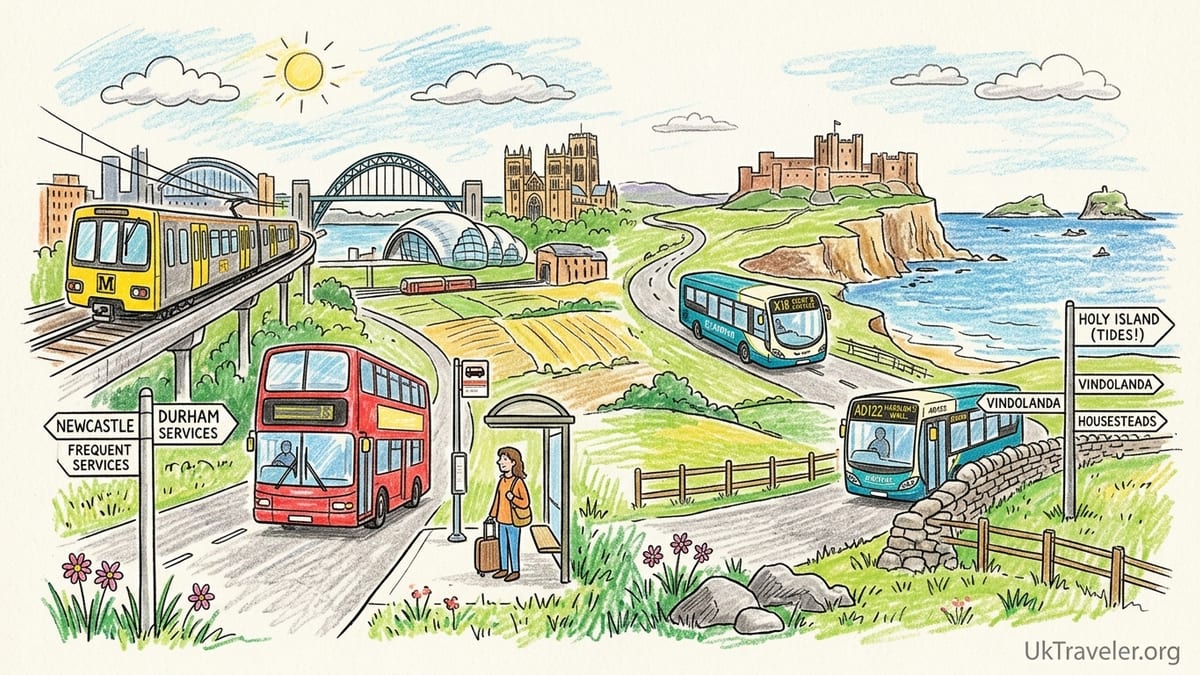
Urban and Intercity: Where the North East Network Shines
To be clear, the North East is not badly served by public transport overall. If your plans run between Newcastle, Sunderland, Durham, Tynemouth, South Shields and the major rail stations, the system often feels impressively dense and affordable. Newcastle’s Central Station is on the East Coast Main Line, so fast LNER and Lumo trains link it with London, York and Edinburgh, while Northern services spread west to Hexham and Carlisle and south to Middlesbrough and Darlington. Within Tyne and Wear, the Metro stitches together Newcastle, Gateshead, the coast and the airport, with trains as often as every 12 minutes on core sections and contactless payment that caps your daily spend.
On my first days without a car, I glided from Newcastle to Tynemouth on the Metro in about 25 minutes, walked the pier, and continued along the line to Whitley Bay for fish and chips on the seafront. The connection was seamless because the Metro station is in the heart of both towns. Similarly, trains between Newcastle and Durham take roughly 15 minutes and run at least twice an hour during the day, which makes spontaneous day trips to Durham Cathedral wonderfully simple. Buses layer on top of this: Go North East’s services between Newcastle, Gateshead and Durham, for example, are frequent enough that I rarely checked a timetable in the city.
Inside this urban lattice, public transport does exactly what car-free travellers hope. It feels like a European regional network, not a patchy rural one. That positive first impression is what convinced me to attempt an entire North East itinerary by train, Metro and bus. The trouble began as soon as I tried to push beyond the main corridors to the castles, trailheads and remote beaches that sell the region on Instagram.
What I discovered is a two-speed system. Between cities and big towns, trains and Metro are often faster and less stressful than driving. But beyond that core, the frequency drops, connections become brittle and the cost of delays climbs quickly. The North East is easy to enter without a car and easy to cross along certain routes, yet surprisingly hard to truly explore in depth without at least some private wheels.
The Coastal Puzzle: X18, 418 and the Spaces Between
Northumberland’s coast is one of the most beautiful in Britain, and it is not fair to say it is unreachable without a car. The Arriva X18 “Coast and Castles” bus connects Newcastle’s Haymarket Bus Station with Morpeth, Amble, Alnwick, Seahouses, Bamburgh and Berwick-upon-Tweed along a single spine. Current weekday timetables list departures from central Newcastle roughly hourly through the day, with selected journeys running all the way to Bamburgh and Berwick. Fares on the X18 are capped by England’s national bus fare scheme, so a single is around £2 for many sections, and a Northumberland rover-style day ticket costs under £10, which is objectively excellent value for that distance.
The gaps only become obvious when you overlay the timetable on what you actually want to do. From Newcastle to Bamburgh, my real journey using the X18 took just under 3 hours including the crawl out of the city and through Alnwick. One northbound bus set off from Newcastle Haymarket a little after 9, reached Alnwick bus station close to 11, then continued through Seahouses to Bamburgh around 12. I had beautiful coastal views, but by the time I walked up to the castle I had spent half the day on a bus. The last southbound bus that would get me back to Newcastle at a reasonable hour left Bamburgh late afternoon, giving me perhaps four hours in total to see the castle, visit the beach and find lunch. There were no early evening coastal buses that would allow a sunset walk while still delivering me back to the city the same night.
The 418 service, which historically has filled in sections of the coast such as Beadnell, Howick and Belford, adds some flexibility but does not fix the fundamental issue. While timetables and operators have evolved, the pattern remains one of a limited number of daytime journeys rather than a turn-up-and-go service. Miss one connection from an X18 onto a 418 at Alnwick or Belford and you can easily end up with 90 minutes of dead time in a small town, or a stranded late-afternoon walk in a village that does have some buses but none that line up with your onward train.
That afternoon outside Bamburgh was a lesson in how little slack this network offers. A five-minute overrun at the castle shop, a queue at the toilets or a delayed coffee can cascade into a missed X18. The next bus might technically exist, but it may terminate early or reach Newcastle so late that any evening plans evaporate. A one-way taxi from Bamburgh to Alnwick, quoted to me at about £35, plus a train or bus back to Newcastle pushes the total cost of salvaging the day toward £50 for one person. At that point, the economics of a two-day car rental start to look much more reasonable.
Castles, Villages and the Limits of Bus-Only Exploring
Even where buses exist, many headline attractions remain awkward on a pure public-transport itinerary. Alnwick is reachable either by train to nearby Alnmouth followed by a 10 to 15 minute bus, or directly by the X15 or X18 from Newcastle. That part works. The complication comes if you want to combine Alnwick with smaller villages or stack it with another major sight on the same day. The buses to Craster, Howick and Embleton are relatively infrequent, and an hour lost at a missed connection can be the difference between fitting in a coastal walk to Dunstanburgh Castle and spending an unplanned afternoon in a bus shelter.
In theory, it is possible to chain Alnwick, Craster and Embleton in one ambitious day using the coastal buses. On my trial run, the gaps were too large to make it worthwhile. By the time I had toured Alnwick Castle and its gardens in the morning, the timing of the next bus to Craster would have left me at most an hour and a half for a walk and a quick look at Dunstanburgh before I had to reverse back to catch an X18 towards Newcastle. The arithmetic only works if you are prepared to accept very short visits or are staying on the coast overnight. The buses connect the dots, but they do not create the kind of flexible network that lets you improvise.
Seahouses and Bamburgh illustrate the same pattern. The X18 brings you to both, so declaring them “impossible” without a car would be unfair. You can reach Seahouses from Newcastle in under three hours, book a late-morning boat trip to the Farne Islands and return the same day. What you cannot do easily is add a meaningful walk on the Northumberland Coast Path, drop by Beadnell or Budle Bay bird reserve, and then still catch a connection that reaches Newcastle in time for dinner. The distances may look short on a map, but the timetables stretch them out.
This is where the car-free ideal rubbed hardest against reality. I am comfortable reading timetables and do not mind walking long distances. Even so, I found myself constantly watching the clock at castles and beaches, mentally subtracting time for bus stops that might be a 15-minute walk out of the village, or for services that did not run at all on Sundays or late evenings in shoulder season. The same region that feels generous and open by car felt narrow and timeboxed from a bus seat.
Hadrian’s Wall: AD122’s Strengths and Its Hard Limits
Hadrian’s Wall is better served by public transport than many visitors assume, largely thanks to the AD122 Hadrian’s Wall Country Bus. This Go North East route currently runs between Hexham Bus Station and Haltwhistle Rail Station, stopping at major wall attractions like Chesters, Housesteads, Vindolanda, Once Brewed visitor centre and the Roman Army Museum. A Northumberland day rover ticket on this bus is around £6 for adults, a conspicuously good deal for hopping between multiple world-class archaeological sites.
However, even AD122 has hard structural limits that matter once you move beyond a simple out-and-back. Timetables around autumn 2026 show off-peak gaps of around two hours between buses at some key stops in one direction. That means if you get off at Housesteads, walk a dramatic but slow two or three mile section of wall and then want to continue on by bus to Vindolanda, you must time your walk very carefully. An unhurried visit to Housesteads fort, museum and café, combined with even a modest walk, can swallow an entire two-hour window without you noticing. Miss that bus and you have a long wait on an exposed roadside stop or a forced change of plan.
On my first no-car wall day, I set out from Newcastle by train to Hexham, which takes around 35 minutes, then connected onto the AD122 for Housesteads. That connection worked well and I reached the fort by late morning. The catch came later, when my ambition outstripped the timetable. I wanted to see at least two forts and fit in a substantial walk. After an hour and a half exploring Housesteads, I set off along the wall path towards Steel Rigg, expecting to catch the bus there. A slower-than-expected section over the crags and a longer pause at a viewpoint meant I crested the final hill just in time to watch an AD122 pull away. With the next service not due for roughly another two hours, the multi-fort fantasy collapsed into a choice between an unplanned long hike or retracting to one site for the day.
AD122 is still the right choice for many visitors. It works wonderfully if you commit to one or two main stops, or if you are walking a longer stretch with accommodation booked along the route. My criticism is not of its existence but of how brittle it feels for day-trippers who want to “collect” several forts in one go. For them, a short car rental delivers a level of flexibility the bus cannot match, especially if rain, blustery winds or tired legs advise a last-minute schedule change that the timetable cannot accommodate.
Remote Adventures: Kielder Forest and the Edge of the Network
If the coastal routes and Hadrian’s Wall test your patience, Kielder Forest tests your resolve. Kielder is a vast area of forest, reservoir and dark skies park in western Northumberland. It is one of the region’s crown jewels, especially for stargazing and off-grid cycling. Yet reaching it without a car is, even now, closer to an expedition than a casual day trip.
The broad outline goes like this. From Newcastle, you either take a train or fast bus to Hexham or Carlisle, then look for infrequent local services that creep up toward Bellingham or Kielder village. Schedules change, but recent patterns have meant only a small handful of buses a day, sometimes tied to school hours. That makes a same-day return from Newcastle deeply impractical. Reaching Kielder for a late-night observatory event by public transport is essentially impossible on a simple out-and-back pattern, since there is no night bus leaving the reservoir once the stargazing session ends.
On my research trip, I chose not to attempt Kielder entirely by bus because the realistic options were either a very long weekend with awkward midday arrivals and early morning departures, or a combination of public transport and expensive taxi legs from Bellingham or Hexham. Taxis for that last stretch are quoted in the region of £40 to £60 each way, depending on pick-up point and time of day, which rapidly erodes the advantage of avoiding a rental car. Those who do not drive can book organised stargazing tours that include transport or join private transfers from Newcastle, but the key point is that the ordinary scheduled network does not support flexible independent trips into Kielder without deep pre-planning and at least one expensive element.
Kielder sharply exposes a truth I kept meeting in softer form elsewhere along the wall and coast. The North East’s public transport is designed primarily to move residents between towns and cities, plus a few key tourist zones. It is not a mesh designed for visitors to string together a dozen remote experiences in four or five days. For that kind of ambitious exploring, some private vehicle access still makes a disproportionate difference.
Door-to-Door Reality Checks: Sample Journeys Compared
Comparing real door-to-door journeys made the trade-offs starker than any abstract pros and cons list. Take Newcastle to Bamburgh, starting near Newcastle Central Station. Walk or Metro to Haymarket, factor in 10 to 15 minutes to buy a ticket and find the right stand, then board the X18. If you catch a mid-morning departure, you will arrive in Bamburgh around lunchtime after approximately three hours of slow but scenic travel. Your realistic time on the ground before you must think about the return bus is four to five hours. A small delay, a missed bus or a closed attraction compresses that window fast.
Now compare that with renting a small car for two days from central Newcastle. Daily rates in autumn 2026 fluctuate, but it is possible to find compact cars for roughly £45 to £60 per day, plus fuel and insurance. A return drive to Bamburgh from Newcastle takes around 1 hour 20 minutes each way in light traffic. With a car, I spent a full unhurried day moving between Bamburgh, Seahouses and Budle Bay, then returned to Newcastle after sunset. Spread over two people, the per-person cost was roughly similar to what I would have spent on two long bus days plus one emergency taxi. The difference was not purely financial; it was the freedom to respond to the weather and my mood instead of to a timetable grid.
Durham to Beamish Museum is another instructive route. Without a car, you can reach Beamish from Durham by bus with a change, for example using Go North East services via Chester-le-Street. The ride itself may only take around an hour if connections line up, and the adult admission ticket to Beamish rewards the effort. But returns in the late afternoon can involve a crush on commuter buses and another change in a small town, all while tired from walking. By contrast, a car turns this into a 25 to 30 minute drive each way from Durham city centre, and families with children or mobility issues often report that those 60 saved minutes of waiting and walking are worth more than the petrol.
From Newcastle to Housesteads, the public-transport chain of train to Hexham plus AD122 should, in theory, work well. In my case, it did going out, but not coming back. Train delays into Hexham caused a missed connection with the AD122 on a blustery afternoon, forcing an hour and a half’s wait at the bus station. Once out at the wall, a missed bus at Steel Rigg added another two-hour gap. The total door-to-door time for what looked like a simple wall day swelled past ten hours, of which barely five and a half were spent at the wall itself. The same day by car from Newcastle, even allowing for traffic and parking at Housesteads and Steel Rigg, would likely consume seven to eight hours door to door and offer far more flexibility to bail out if the weather turned.
Then there are some journeys where public transport competes strongly. Newcastle to Saltburn-by-the-Sea is a pleasant example. Trains from Newcastle to Middlesbrough, then onward to Saltburn, take roughly one hour 45 minutes to two hours total with a smooth connection, and you alight just a short walk from the pier and cliff tramway. Because Saltburn is compact and rail-served, there was no sense of being stranded; I could enjoy a long seaside afternoon and still be back in Newcastle mid-evening. Here, train plus walking felt like the ideal combination and I never wished for a car.
Holy Island: When Tides and Timetables Collide
Holy Island of Lindisfarne is the most striking example of a place where buses technically serve the destination but do not necessarily make independent visits easy. The 477 bus between Berwick-upon-Tweed and Holy Island is timed around safe causeway crossings. Timetables from recent years show individual operating days and departure times varying depending on tidal windows, with some runs on selected Wednesdays and Saturdays leaving Berwick around mid-morning and returning to the mainland mid to late afternoon.
This means you must coordinate three moving parts: your rail journey to Berwick, the 477 bus, and the tide tables governing safe crossing of the causeway. On my planning day, I looked at a sample timetable where a Berwick departure just after 10 in the morning and a Holy Island return after 3 in the afternoon were only possible on days with a long midday low tide. On other dates, departures slipped earlier or later, or disappeared entirely when the tides did not leave a sufficient safety margin. The result is that independent car-free visits to Holy Island demand near-military planning. A missed morning train from Newcastle to Berwick by even 20 minutes can render the whole day unworkable, because there simply is no later bus once the causeway becomes unsafe.
Travel websites repeatedly stress that causeway times are non-negotiable. Even if you arrive by bus, you must respect the published safe crossing windows because an unexpectedly high tide can isolate stranded vehicles and pedestrians. For day-trippers, this means no lazy brunch in Newcastle before a spontaneous Holy Island jaunt. You choose your date around the tide times first, then lock in train and bus tickets to match. In foul weather, the lack of flexibility feels punishing. If a gale makes island walking miserable on the one day when a bus-and-tide combination works from Newcastle, the only alternatives are to go anyway or abandon Holy Island for that trip.
Visitors who do not drive can work around this by overnighting in Berwick, which gives more slack to catch the 477, or by joining an organised tour that includes minibus transport and tide-safe scheduling. But compared with rolling up at a random castle or town on the mainline, Holy Island by scheduled public transport drives home how often the most memorable experiences in the North East still favour travellers with access to a wheel and an ignition key.
When a Short Car Rental or Guided Tour Makes Sense
After two weeks of testing timetables, I would not suggest abandoning public transport in the North East. The key is to be strategic about when you insist on staying car-free and when a short burst of private transport will repay you in time, flexibility and sanity. Renting a car for just two or three days in the middle of a longer rail-based trip can unlock Bamburgh, Seahouses, inland stretches of Hadrian’s Wall and Kielder in a way that buses and trains simply cannot match on typical holiday timescales.
On one trip, I kept the car-free frame for Newcastle, Durham and Tynemouth, then picked up a small hire car near Newcastle Central for a 48-hour loop. Day one took me to Bamburgh, Seahouses and back via Alnwick for an early evening stroll, with the entire day’s driving under four hours and no stopwatch ticking for bus departures. Day two was a wall circuit, visiting Housesteads, Steel Rigg and Vindolanda at my own pace before returning the car in Newcastle that evening. The fuel and hire costs for that two-day window came to roughly £140 in total, shared between two of us. Compared with the compounded cost of long bus journeys and likely taxis if we had stuck to public transport, the premium felt justified for what we gained in experience.
Guided excursions and private day tours fill some of the same gap for those who cannot or prefer not to drive. From Newcastle and Durham, various operators offer full-day trips to Hadrian’s Wall, the Northumberland coast or Lindisfarne in small groups. Prices vary but often fall somewhere between £60 and £100 per person, including transport and guiding. When you break down what you would otherwise spend on a mix of train tickets, buses and the occasional emergency taxi, plus the value of a knowledgeable guide at complex sites like the wall, these tours are not unreasonable. The trade-off is loss of independence; you visit where the itinerary goes, not where your curiosity leads.
Private transfers sit at the highest end of the spectrum. Door-to-door cars from Newcastle to Bamburgh, Holy Island trailheads or Kielder can run into three-figure sums for a return, which only makes sense if split across a small group or attached to a special experience like a dark-sky event or lodge stay. For most independent travellers, a well-timed short hire car is a more economical way to reclaim control over the most fragile parts of the network.
A Four-Day Car-Free Itinerary That Still Works
Despite these criticisms, I left the North East with a clear sense of places I would happily revisit without driving, and routes where the buses and trains really do deliver. If you are determined to stay car-free, a realistic four-day itinerary might look like this, tested against current timetables and my own trips.
Day one: Base yourself in Newcastle. Use the Metro to reach Tynemouth and Whitley Bay, strolling between stations along the coastal path if the weather cooperates. With trains every few minutes and no need to book ahead, you can dawdle over fish and chips, dip into independent shops and return to Newcastle whenever you are ready. The only planning required is to make sure you catch the last Metro back in the late evening.
Day two: Take a morning train from Newcastle to Durham for the cathedral, castle and riverside walks. Trains are frequent and journey times short, so you have the freedom to stay for dinner in Durham or return mid-afternoon and spend the evening at the Quayside in Newcastle. Public transport excels here, and a car would only be a parking liability on Durham’s tight hillside streets.
Day three: Devote a full day to Hadrian’s Wall using train and the AD122 bus. From Newcastle, travel by rail to Hexham, connect to AD122 and choose one primary stop such as Housesteads or Vindolanda with perhaps a short wall walk to a second bus stop. Accept from the outset that this is a one- or two-site day rather than a grand circuit of every fort. By narrowing your scope, you can absorb timetable quirks and still return to Newcastle by early evening without the stress that sank my overambitious multi-fort attempt.
Day four: Use the X18 or train plus bus combination for a coastal town that works with the timetable. Alnwick is a good candidate. You can reach it by direct bus from Newcastle or by train to Alnmouth then bus, see the castle and gardens and have time to wander the town. Seahouses also works if you are content with a single coastal focus and plan your Farne Islands boat in line with the X18’s arrival and departure. In both cases, build in enough slack that if a bus is delayed or a queue at an attraction runs long, your day is dented rather than ruined.
The Takeaway
My conclusion after treating the North East as a laboratory for car-free travel is blunt. I would not again plan to see every castle, beach and village in this region relying only on trains and buses. The network is simply not built for that style of rapid, high-coverage sightseeing. Frequencies thin out in the very places that tempt you most, connections are often fragile, and a single missed bus can turn into a lost afternoon or an expensive taxi ride that wipes out the savings of travelling by public transport in the first place.
At the same time, I would wholeheartedly return car-free to several parts of the region. Newcastle, Durham, Sunderland, Tynemouth, Whitley Bay and Saltburn are all enjoyable and efficient by train and Metro, and Hadrian’s Wall can be rewarding by bus if you accept its natural pace. The AD122, X18 and 477 services are not broken; they simply reflect the realities of thin rural demand and complex geography. It is our itineraries, not the buses themselves, that often need to change.
If you are willing to combine an urban rail-and-Metro core with a short, well-planned car rental or a targeted guided excursion, North East England opens up dramatically. Two or three days with a steering wheel give you Bamburgh at sunset, quiet coves between Seahouses and Beadnell, flexible wall-hopping and realistic access to Kielder. The rest of the time, you can enjoy the pleasure of stepping off trains in the heart of old cities and letting someone else handle the driving.
In the end, the region taught me to respect both the power and the limits of public transport. It is more than good enough to anchor a memorable trip, but not yet strong enough in its rural corners to support every whim of a castle-chasing, beach-hopping visitor on a tight schedule. Next time I go back, I will still buy the rover tickets and swipe into the Metro. I will just also allow for that small, strategic rental car window that buys me the freedom clocks and columns in a timetable can never quite offer.
FAQ
Q1. Is it realistic to explore North East England completely without a car?
It is realistic if you focus on cities, larger towns and a few key rural routes like the X18 and AD122, but difficult if you aim to visit many remote castles, villages and trailheads in a short trip.
Q2. Which parts of the North East work best by public transport?
Newcastle, Durham, Sunderland, Tynemouth, Whitley Bay and Saltburn all have strong rail or Metro connections and compact centres that are easy to explore on foot once you arrive.
Q3. How long does it take to reach Bamburgh from Newcastle by bus?
Using the X18 from Newcastle Haymarket, the journey to Bamburgh typically takes around two and a half to three hours each way, depending on the specific departure and stops.
Q4. Is Hadrian’s Wall easy to see without a car?
It is possible and often enjoyable using trains to Hexham or Haltwhistle plus the AD122 bus, but timetables mean you should concentrate on one or two main sites per day rather than many forts.
Q5. Can I visit Holy Island of Lindisfarne by bus and train in one day?
Yes, but only on dates when the 477 bus and safe tide times align with trains from your starting point, and you must plan closely around the published causeway windows.
Q6. Is it worth renting a car for just two or three days?
For travellers who want to see Bamburgh, multiple Hadrian’s Wall sites or Kielder, a short rental often saves enough time and taxi costs to justify the expense, especially when shared.
Q7. How reliable are rural bus services like the X18 and 418?
They are generally reliable when they run, but frequencies are low, some journeys do not operate daily, and missed connections can lead to long waits or shortened sightseeing time.
Q8. Are guided day tours a good alternative to driving?
Guided tours from Newcastle or Durham to Hadrian’s Wall, the coast or Holy Island can be a good option if you do not drive, trading some independence for convenient transport and expert commentary.
Q9. What car-free itinerary would you recommend for a first visit?
Four car-free days work well if you base in Newcastle, visit Tynemouth and the coast by Metro, take a day trip to Durham, spend one day on Hadrian’s Wall with AD122, and choose either Alnwick or Seahouses for a final day.
Q10. When does a public-transport-only plan become too ambitious?
It becomes too ambitious when you try to combine several remote sites in a single day, rely on tight rural connections, or assume buses will run late into the evening in sparsely populated areas.