


On Saturday 24 October 2026, I walked through the entrance of Beamish, the Living Museum of the North, with a fresh Unlimited Pass on my phone, £35 lighter and expectations set sky high. I had booked a standard adult ticket online a week earlier, partly to dodge the reputed queues at the gate and partly because every piece of marketing promised that this was not just a museum, but a full day immersed in North East history. I knew the headline offer: pay once, visit as often as you like for twelve months. As an international-style, one-and-done visitor who might not be back in County Durham for years, I wanted to know something more basic. For one full day, in 2026, is Beamish really worth £35?
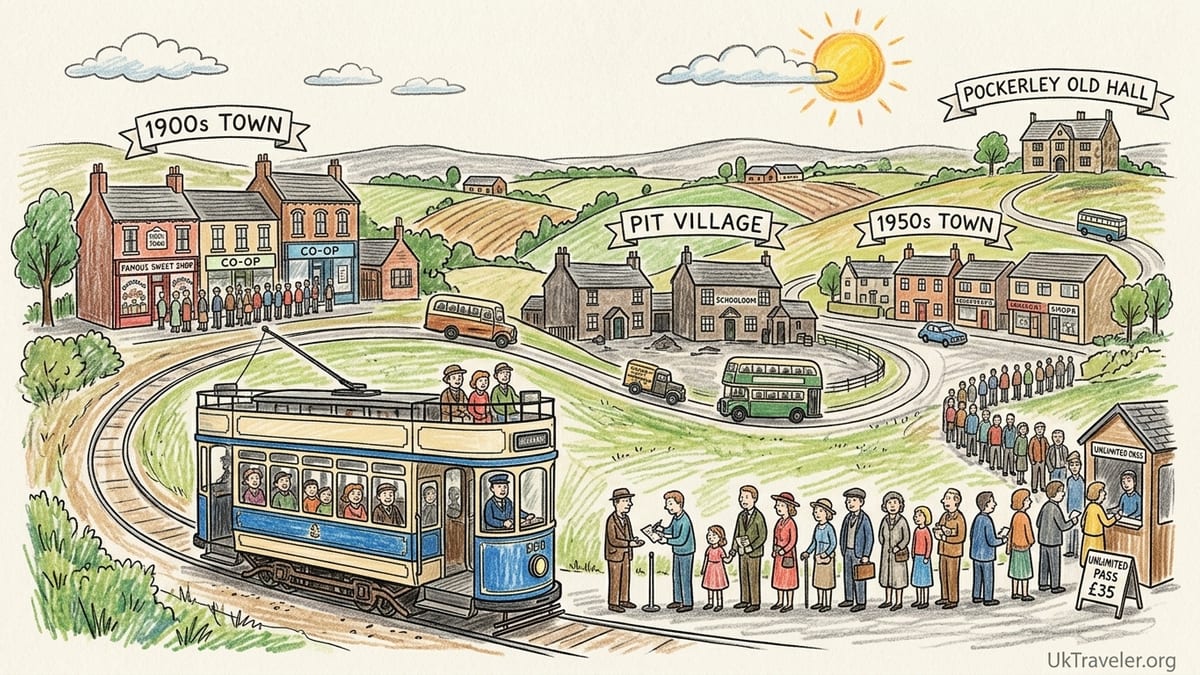
The Reality Behind the £35 Unlimited Pass
Beamish’s pricing in late 2026 is very clear. A standard adult Unlimited Pass is £35, children aged 5 to 16 pay £20.50, and a family of two adults and two children is £85.50. Seniors and students pay a reduced rate, but every daytime ticket sold on the official site is marketed as an Unlimited Pass, valid for repeat daytime entry for twelve months from your first visit. There is no cheaper, one-day-only tariff quietly hiding in the small print. If you just want a single day, you still pay the full Unlimited price.
On my October visit, I bought the adult Unlimited Pass online before arrival. At the admissions desk, a staff member scanned the QR code and took a quick photo to associate with the pass, which is how they stop it being casually shared. The process was friendly and efficient, but while they highlighted all the things I could do “next time,” there was no equivalent conversation about how to shape a single, intensive day on-site. The system is set up to nurture repeat custom for locals and regional visitors, not to optimise one concentrated visit.
This structure is brilliant if you live in Newcastle, Durham or Sunderland and can drop in several times a year, perhaps for seasonal events or with visiting relatives. For a family of four that returns three or four times, the numbers quickly start to feel good value. For a solo traveler who will likely come once, especially from overseas, the economics feel much more exposed. The same £35 that unlocks a year of casual visits for a local has to deliver a full sense of payoff in a single 6 to 7 hour window for you.
Crucially, the Unlimited Pass framing shapes expectations. I walked through the turnstiles knowing that I would probably not be able to visit again within the year, so every queue, every congested food outlet and every closed door hit differently. Beamish might be priced and designed as a year-long relationship, but my assessment, and that of many one-day visitors, rests on what you actually manage to experience before closing time.
First Impressions, Scale and the Hidden Cost of Walking
Beamish covers around 350 acres of hilly North East countryside, with major zones that include the 1900s Town, Pit Village, 1950s Town, 1940s Farm and the 1820s Pockerley area. I knew from the map that it was large, but it was only when I stepped through the entrance that the scale truly registered. From the gate, you look down towards the 1950s Town and across to the tramway, and it is immediately clear that this is not a compact city museum where you drift from gallery to gallery under one roof.
On my visit, Beamish was open from 10:00 to 16:00 for the autumn season, with last admission an hour before closing. Those six hours sound substantial, but you lose non-trivial chunks of time simply moving between zones. Walking from the entrance to the 1900s Town at a reasonable pace took me around 15 minutes. The Pit Village sits further along the tramway loop; the 1940s Farm and Pockerley Old Hall require either a good uphill walk or a successful wait for a bus or tram.
This is where the free internal historic transport system becomes both an asset and a liability. The trams and buses are beautiful working exhibits, part of the museum’s identity, and they are included in your ticket price. In practice, queues at busy times grow long enough that you have to start choosing between using them efficiently as transport, or treating them as a ride you might, or might not, get to experience. On my October Saturday, I spent nearly 25 minutes in one queue for a tram at the 1900s Town and a similar time waiting for a bus at the Pit Village, only to watch two full vehicles depart before I could board.
If you are fit and do not mind walking several kilometres, you can mitigate some of this by bypassing queues and tackling the hills on foot. I tracked over 16,000 steps during my day without doing every minor side path. For anyone with mobility issues, small children or simply limited stamina, the combination of wide distances, unpredictable vehicle capacity and North East weather can quietly erode the value of the day. You pay £35 for open access, but in practical terms, you are constrained by how much ground you can cover in the time available.
1900s Town and Pit Village: Atmospheric but Crowded
I started in the 1900s Town, the flagship area that regularly appears in promotional photos. Architecturally and atmospherically, it is superb. The street lines are convincing, the period shop fronts are well detailed, and the interior spaces feel lived-in rather than stagey. I walked into the Co-op store and was drawn into a long, engaging explanation of tea importing and rationing from a costumed interpreter who clearly knew both the script and the underlying history. The printed ephemera, counter scales and packaging gave a tangible sense of early twentieth-century retail that a standard glass-case display could never replicate.
Yet the crowds changed the tone. By late morning, the street was shoulder-to-shoulder, and the famous sweet shop had a queue that snaked out the door and halfway down the pavement. I waited fifteen minutes, shuffled forward a few steps and then abandoned the attempt. It was not that the sweets were particularly expensive; it was that, as a one-day visitor, I could see half an hour disappearing for what was essentially a themed purchase I could get elsewhere. Several families nearby came to the same conclusion, glancing at their watches and stepping out of the line with mild frustration.
At the adjacent Pit Village, the storytelling is powerful when you can actually access it. The colliery schoolroom, miner’s cottages and chapel collectively evoke a clear narrative of industrial and domestic life. In one cottage, I chatted with an interpreter stoking a range and explaining the shifts between coal-fired and electric domestic technology. It was one of the most informative conversations I had all day. But between the village and the town, much of my scheduled time dissolved into queues for the tram loop and shuffling congestion around the fish and chip shop, which is deservedly popular but chronically busy at peak meal times.
The result is that the most convincing, educational parts of Beamish around 1900 can be oddly difficult to enjoy fully. The physical history is there and the staff are committed, yet your ability to soak it up is repeatedly capped by waiting times and bottlenecks. On a quiet weekday outside school holidays, this might feel very different. On a weekend or holiday, the friction is real and directly affects the value you extract from that £35.
1950s Town, 1940s Farm and 1820s Pockerley: Depth vs Time
The newer 1950s Town is one of Beamish’s headline developments, and it shows. The streetscape, complete with recreated houses, shops and community buildings, feels authentic and surprisingly familiar if you grew up with grandparents who reminisced about postwar Britain. On my visit, the interiors were rich with detail: patterned wallpaper, early televisions, Formica tables and period magazines casually left about. Staff in period clothing chatted informally about rationing’s slow end and the arrival of consumer credit, turning what could have been a nostalgic set into a social history lesson.
I found the 1950s area easier to enjoy than the 1900s Town, partly because the visitor flow was more dispersed, and partly because there were fewer blockbuster, queue-inducing shops. It was possible to step into a house, listen to an interpreter, browse the décor and take photographs without feeling pressed to make room for the next family every thirty seconds. In terms of educational payoff per minute, this was one of the strongest zones on-site.
Further out, the 1940s Farm offered a very different mood. Here, the story of wartime agriculture unfolds among fields, barns and a modest farmhouse. It felt quieter, perhaps because the walk and hills filter out some of the crowds. Inside the farmhouse kitchen, staff were demonstrating wartime recipes and talking about rationing and “dig for victory” campaigns. I left with a much clearer sense of how the home front reoriented food culture, something that is easy to flatten into clichés in standard exhibitions.
The 1820s Pockerley area, with its old hall and early nineteenth-century landscape, is the part of Beamish that most rewards slower, reflective exploration. The hall itself, low-ceilinged and atmospheric, is staffed by interpreters who can dive into topics from Georgian religion to landownership. The surrounding fields and gardens were pleasantly uncrowded on my visit. The trade-off is time. To reach Pockerley and the farm without relying entirely on buses or trams requires a decent uphill walk. I spent nearly 40 minutes in total just transitioning between the 1950s Town, the farm and Pockerley, even before adding interpretive time. For a one-day visitor, it becomes a constant calculation: do you allocate substantial time to these outlying but rich areas, or do you concentrate on the more easily accessed 1900s core?
Queues, Food Bottlenecks and the Weather Problem
Beamish is an open-air museum in North East England. That simple fact has major implications for value. When the weather plays along, you are wandering through recreated streets and landscapes that feel alive and spacious. When it does not, you are either damp, cold, or hiding indoors along with everyone else, which exacerbates congestion inside the most popular buildings. My October day began dry but chilly, moved through a period of light drizzle and ended with enough wind to make outdoor waiting uncomfortable. The museum operates in all but the most severe conditions, so whatever forecast you get, you need to assume at least some weather exposure.
The internal transport queues magnify this. In poor weather, more visitors choose to queue rather than walk, which lengthens waiting times at major stops near the entrance, the 1900s Town and the Pit Village. The tram and bus fleet is finite and, according to recent visitor comments, is not always deployed at a level that keeps queues manageable on busy days. Several reviews from summer 2026 mention failing to get on a tram at all because of queues and limited capacity, and feeling that this undermined their ability to see the whole site in a day.
Food is another friction point. The fish and chip shop at the Pit Village deserves its reputation; the portions were generous and the flavor felt appropriate to the industrial heritage context. But I queued for over 20 minutes, and by the time I found a dry place to sit, I had burned roughly 40 minutes of my six-hour window on one meal. Other cafes and food outlets around the site are similarly popular at peak times, and prices for hot meals and drinks, while not extortionate by UK attraction standards, add noticeably to the cost of the day. Unless you pack a picnic, you should budget at least £10 to £15 per person for food and drink if you stay for a full opening session.
This combination of weather, queues and food bottlenecks chips away at perceived value. Beamish is not doing anything unusual by charging for catering and operating historic vehicles with limited capacity. But when you frame admission as £35 for a day that, for many visitors, includes long waits in the cold and a struggle to cover the full site, the experience can feel less like open-ended exploration and more like a sequence of time management compromises.
Counting the True Cost: Beamish vs Free and Cheaper Alternatives
To assess whether Beamish is worth £35 for a one-day visitor, you have to consider the whole spend. Most travelers do not teleport themselves to the entrance. From central Newcastle, it takes around 45 to 60 minutes by public transport, often involving a combination of train or Metro and bus. In summer 2026, a dedicated “Time Traveller” bus line was publicised as serving Durham, Ushaw and Beamish, but at other times you may rely on regular regional buses or pay for a taxi. A realistic round-trip cost from Newcastle or Durham can be in the region of £8 to £20 per person, depending on ticket deals, bus passes and group size.
Once inside, your soft costs begin. Add a modest lunch and a hot drink or two, and you are likely to spend another £15 to £20 per adult unless you are extremely disciplined and bring all food with you. Many visitors, especially those with children, buy sweets, small toys or vintage-style items from the shops, which can easily add another £10 or more per head. By the time you ride home in the evening, that £35 admission may have translated into a total outlay of £60 to £80 per adult for the day, and significantly more for a family.
Contrast this with cultural time in nearby cities. In Newcastle upon Tyne, major museums such as the Great North Museum: Hancock and the Discovery Museum offer free general entry, relying on donations and cafe or shop income instead. In practice, this means you can spend several hours immersed in regional history, natural science or maritime heritage without paying an entrance fee. Add free-to-enter art galleries and cathedral visits, and an entire day of engaging culture in Newcastle can be achieved for the price of a few coffees and a sandwich.
Durham offers a similar pattern at a smaller scale. While specific attractions such as the cathedral tower or some university museums may charge modest fees, simply exploring the cathedral, the riverside paths and small local museums can yield a richly historical day with minimal hard costs. None of these experiences replicate Beamish’s immersive, walk-in streetscape format, and it would be dishonest to pretend that a series of galleries and static displays feels identical to riding a 1900s tram or stepping into a colliery schoolroom. But as a traveler doing basic arithmetic, it is impossible to ignore that the alternative to a £35 ticket plus travel and food is often a free day in town that is, at worst, slightly less theatrical but still historically substantial.
Seasonal Hours, Transport Availability and Planning for One Day
Beamish’s opening hours vary through the year. In peak season from late March to late October, the museum generally opens daily from around 10:00 to 17:00, with shorter 10:00 to 16:00 days and some weekday closures in the winter shoulder months. Last admission is usually one hour before closing. Special evening events and Christmas experiences require separate tickets and do not fall under the daytime Unlimited Pass model. Anyone considering a one-day visit should first check which schedule applies, because the total hours available on site can shrink noticeably outside summer.
Internal transport also responds to season and demand. While the tramway and bus routes form a continuous loop linking the entrance, town, Pit Village, farm and Pockerley, the number of vehicles in operation and the frequency at each stop are adjusted day by day. On my October Saturday, trams and buses appeared roughly every 15 to 20 minutes when services were flowing well, but gaps were longer after driver breaks or minor operational issues, which then created surges of waiting visitors. Beamish’s transport collection is one of its glories from an enthusiast point of view, but from a practical access perspective, it is not a turn-up-and-ride metro system.
Planning becomes essential for a single visit. I found it helpful to think in half-day blocks. I spent my morning on the entrance side of the loop, covering the 1900s Town and Pit Village in detail, then used early afternoon to reach the 1940s Farm and Pockerley before ending in the 1950s Town nearer closing. If I had followed the crowds and simply boarded the first tram each time without a plan, I suspect I would have spent far more time in queues and far less in meaningful conversation with interpreters.
Beamish’s own messaging gently assumes that you will return, which can make the advice on pacing feel more relaxed than it should for a once-only visitor. You are often told that you can “catch it next time” or “visit that area on your next trip,” which is absolutely true for locals and repeat travelers. For someone squeezing Beamish into a tightly planned North East itinerary, the reality is less flexible. Your one day has a firm closing time, and you will not get back within the year to fill in the gaps without unusually generous travel plans.
Who Gets the Best Value from Beamish?
Based on my October 2026 visit, the profile of visitors who derive clear value from Beamish is distinct. First, there are local or regional residents who can realistically visit several times across the year. For them, the Unlimited Pass delivers cumulative value. A family pass that initially feels expensive begins to spread across spring, summer and Christmas visits, school holiday trips and the occasional half-day outing when friends or relatives stay. Queues and crowds are more tolerable when you know you can come back on a quieter weekday to explore that skipped corner.
Second, there are transport and industrial history enthusiasts who will happily commit an entire day, or several, to specific aspects of the site. If you are excited to photograph vintage trams, scrutinise colliery machinery or spend an hour discussing the details of a recreated print shop, the density of material at Beamish can fully justify the £35 even in one intense session. The key is that you arrive with focused interests and a realistic plan, rather than a vague idea of “seeing everything.”
For international tourists and short-stay visitors with only one free day in the region, the picture is more complicated. If you are travelling with children who love hands-on, outdoorsy experiences and do not mind walking, Beamish can be a highlight, provided you accept the cost and the queues as the price of that immersion. If you or members of your group have limited mobility, dislike crowds or are highly price-sensitive, you may find that a combination of free museums in Newcastle or Durham plus a modestly priced historic attraction elsewhere feels like a better overall bargain.
It is also important to weigh Beamish against other regional heritage draws. Attractions such as Durham Cathedral, the Great North Museum: Hancock, Discovery Museum, and various smaller local museums and galleries may not wrap you in living history to the same extent, but they tell overlapping stories about the North East’s past. They do this at either no entry cost or a significantly lower fee, often in fully indoor settings where weather and walking distances are less of an issue. For many itineraries, especially in poor weather or winter, these alternatives can deliver more predictable value for limited time.
The Takeaway
So, is Beamish Museum worth £35 for a one-day visitor in 2026? My own conclusion, after a full October Saturday, is cautious. Beamish is an impressive, at times remarkable, achievement: a 350-acre open-air museum where you can walk, smell and hear approximations of 1820s, 1900s, 1940s and 1950s life. When you are standing in a colliery cottage kitchen listening to an interpreter talk about coal dust and washing days, or wandering through a 1950s living room where the television hums softly in the corner, it feels worth every pound.
However, this experience is framed and constrained by one hard fact. The £35 price is built around an Unlimited Pass model that heavily favours those who can return multiple times over twelve months. If you are unlikely ever to set foot in Beamish again, you are paying a premium for access you will never use. Crowds, queueing for historic transport, congested food outlets, long walking distances and exposure to North East weather all make it harder to see everything and reduce the effective value of that one day.
My advice is to treat Beamish as a priority only if you either care deeply about Britain’s industrial and social history, or if you are willing to spend significantly for a single, distinctive heritage day. Plan meticulously: arrive at opening time, pack some food to reduce both queues and costs, know which areas matter most to you, and accept in advance that you will not see everything. Under those conditions, a one-off visitor can still emerge feeling that the £35, while steep, bought something genuinely memorable.
If your budget is tight, your time in the North East is short, or your tolerance for crowds and walking is low, Beamish may be better left for a future trip when you can give it several visits. In that case, you may well find that a day split between free museums and atmospheric city streets in Newcastle or Durham delivers a richer, more relaxed sense of place at a fraction of the cost.
FAQ
Q1. How much does Beamish Museum cost in 2026?
Adult daytime admission in late 2026 is £35 for an Unlimited Pass, children aged 5 to 16 pay £20.50, and a family ticket for two adults and two children is £85.50.
Q2. What is included in the Beamish Unlimited Pass?
The Unlimited Pass includes repeat daytime entry for twelve months from your first visit and access to standard exhibits and internal historic trams and buses, but special evening events usually require separate tickets.
Q3. Is Beamish good value for a one-day visit?
Value depends on your interests and expectations. Enthusiasts and families planning a full, well-organised day can find it worthwhile, but casual or budget-conscious visitors may feel the £35 price is high compared with free alternatives in Newcastle and Durham.
Q4. How long do you need at Beamish?
You should plan at least a full day, ideally from opening until close, to experience the main areas. Even then, queues, walking distances and weather mean you are unlikely to see everything in detail in a single visit.
Q5. How busy does Beamish get?
Beamish can be very busy on weekends, school holidays and special event days, with long queues for the sweet shop, fish and chip shop, and historic trams and buses. Weekdays outside holidays tend to be quieter.
Q6. What are the seasonal opening hours?
From late March to late October, Beamish typically opens daily around 10:00 to 17:00, with shorter 10:00 to 16:00 hours and some weekday closures in winter. Always check the latest schedule before visiting, as dates and times can change.
Q7. How do you get to Beamish without a car?
Most visitors without a car travel via bus from Newcastle or Durham, sometimes using seasonal services that stop directly at the museum. Journey times are often 45 to 60 minutes each way, and you should factor this into your day plan and budget.
Q8. Are there cheaper or free alternatives nearby?
Yes. In Newcastle, museums such as the Great North Museum: Hancock and the Discovery Museum offer free general entry, as do several galleries and historic sites. Durham also has low-cost and free heritage experiences, though they are different in style from Beamish’s open-air format.
Q9. Is Beamish suitable for visitors with limited mobility?
The site is large and hilly, with significant walking between zones. Historic trams and buses provide transport, but queues and limited capacity can be challenging. Visitors with mobility issues should review Beamish’s accessibility information, consider hiring mobility aids on-site if available, and build extra time into their schedule.
Q10. Who is Beamish best suited for?
Beamish is best for local or repeat visitors, families who can use the pass several times, and travelers with a strong interest in social and industrial history who are prepared to commit a full day and accept the costs, walking and crowds that come with the experience.