


The first thing I remember about arriving in Newcastle was the light. I stepped out of Central Station on a clear Friday afternoon and the city seemed to tilt gently downhill toward the Tyne, terraces of stone catching the low sun. I could just see the curve of the Tyne Bridge at the bottom of the street, a green arc framing the river and the red brick of the Quayside. It felt compact and instantly readable, the kind of place where you can drop a bag at your hotel and be walking the river in ten minutes.
Checking In Beside the Bridges
For this weekend I based myself on the Quayside, at a mid‑range chain hotel looking across to the Swing Bridge and the Tyne Bridge. Nightly rates in late 2026 around this stretch typically sit near 120 to 140 pounds for a standard double if you book a few weeks ahead, a bit above the wider city median but you are paying for the view and the ability to walk almost everywhere. My room was nothing remarkable in design, but I could lean on the windowsill and watch joggers trace the river path beneath the lit arches of the bridges.
From the hotel door I could be at the bottom of Grey Street in under ten minutes, up in Grainger Town in fifteen, or walking east along the river to Ouseburn in twenty. That practicality shaped the whole weekend. I never once used a taxi inside the centre, just my feet and, once, the Metro up to Byker for the views back along the river. Newcastle’s compactness is one of its underrated luxuries; the Quayside base made it feel even smaller.
The only trade‑off was noise. On Friday and Saturday nights, especially in warmer months, the Quayside can hum well past midnight. Groups spill between bars, music carries from terraces, and the laughter under the Tyne Bridge amplifies off the water. My room faced the river and, even with the window shut, I could clearly hear snatches of 90s pop and the occasional off‑key chorus. If you are a light sleeper, asking for a higher or rear‑facing room is wise.
Overall, though, waking up to that riverside view and being able to step straight onto the promenade felt worth the occasional late‑night shouts drifting up from below. It set the tone for a weekend shaped by the city’s relationship with its river and the old stone streets rising above it.
First Evening: Under the Tyne Bridge and Into Grainger Town
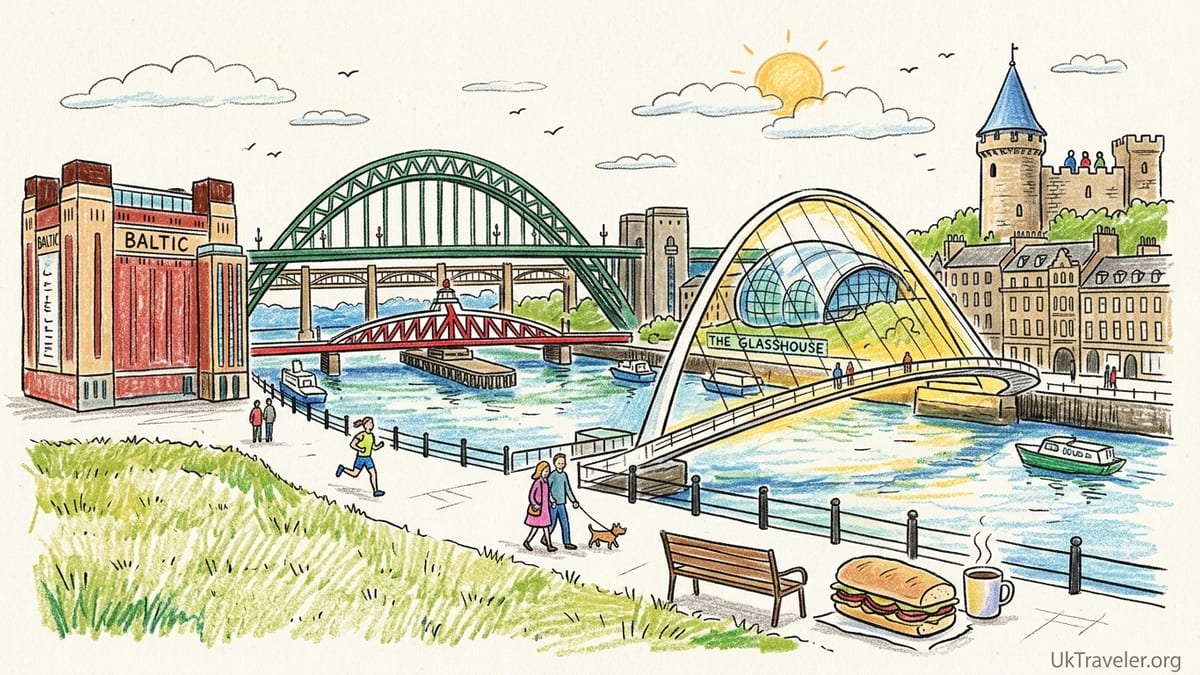
I spent my first few hours doing what almost everyone does in Newcastle, whether they plan to or not: walking the Quayside. The riverfront path here is broad and level, perfect for a slow stroll as you get your bearings. The Tyne Bridge, opened in 1928 and often compared with Sydney Harbour Bridge, looms overhead, while downstream the elegant curve of the Gateshead Millennium Bridge glows after dark, tilting like an eye over the water.
It was early evening, that in‑between time when the office crowd has thinned and the night‑out groups have not quite arrived. Couples sat with takeaway coffees on the benches. A dog walker paused under the bridge to photograph the reflections. Across the water, the red brick shell of the Baltic flour mill, now the Baltic Centre for Contemporary Art, stood like a backdrop to the Glasshouse, the glass and steel concert hall that anchors the Gateshead bank of the river.
Hunger pushed me uphill into Grainger Town. This dense grid of 19th‑century stone terraces and arcades is the legacy of developer Richard Grainger and architect John Dobson, who reshaped Newcastle between the 1820s and 1840s into a neoclassical showpiece. Their work produced Grey Street, Grainger Street, Clayton Street and the Grainger Market, all within a few minutes’ walk of one another and still full of life nearly two centuries later.
Climbing Grey Street from the river, the curve of the road revealed one honey‑stone facade after another, with the portico of the Theatre Royal as a focal point partway up. The evening light caught carved cornices and pilasters, but what struck me most was that these grand buildings now house everyday life: bustling bars at pavement level, barber shops tucked into arches, flat lights glowing above. It is easy to stand at Grey’s Monument at the top and forget you are in a working city, but if you look closely you notice delivery vans edging down side streets and students cutting through the arcades with supermarket bags.
Saturday Morning: Markets, Stotties and a Castle With a View
Newcastle works best on foot, so I started Saturday by following Grainger Street to the Grainger Market. Opened in 1835 as part of Grainger’s redevelopment, it is still a covered maze of butchers, fishmongers, florists, hardware stalls and tiny cafés. Recent refurbishment has tidied its aging roofs and passageways, but the atmosphere inside remains more practical than polished. You feel locals doing their weekly shop, not just visitors wandering with cameras.
Breakfast was a simple but very local pleasure: a bacon and egg sandwich in a soft white stottie, the thick, flat, round bread that is a North East staple. At one of the market cafés a generously filled stottie sandwich and a mug of tea came in at just under 6 pounds. That sort of price point is part of Newcastle’s charm; you can still eat well on a modest budget if you look away from the obvious chain restaurants and into places where the tiled walls feel older than your grandparents.
From Grainger Market it is only a short walk back toward the river to Newcastle Castle. The keep and the Black Gate remain from the medieval fortress that gave the city its name. I booked my ticket online earlier that morning, which meant I could walk straight in and climb the narrow stone stairs without queuing. Adult entry when I visited was a little over 10 pounds, and the main attraction is the rooftop view. From the parapets you see the Tyne Bridge almost at eye level, the railway arches, the red rooftops of the Quayside and, upriver, the layered decks of road and rail bridges. It is one of the best places to appreciate how tightly the city, river and transport routes are knitted together.
The displays inside the keep do a solid job of sketching out the site’s Norman origins and later history, but the interpretive panels feel a little crowded and old‑fashioned compared with some newer city museums. Still, for a small independent attraction, the castle feels fairly priced, and the chance to look down at the river traffic and the line of pubs under the arches justifies the climb.
Into Ouseburn: From Waggonways to Workshops
By late morning I was ready to see how Newcastle’s industrial past has been reworked for the present, so I walked east along the Quayside toward Ouseburn. The riverside path gradually narrows, the office blocks thin out, and before long you are passing under brick railway viaducts and the concrete span of Byker Bridge. Here the city changes scale. Old warehouses, stables and mills step up the sides of the valley, many of them now turned into studios, small venues and cafés.
This pocket of the city was once a dense industrial district, with glassworks, pottery, flour mills and a waggonway carrying coal down to the Tyne. Today it is Newcastle’s most distinctive creative quarter, a mix of artists’ spaces, music pubs, children’s attractions and a community farm. The Ouseburn Trust estimates that visitor numbers have grown steadily over the past decade, and new projects are emerging under a long‑term strategy that treats the valley as both a heritage landscape and a living neighbourhood.
My first stop was the Victoria Tunnel, a preserved 19th‑century coal wagonway running under the city from the Town Moor down toward the river. In the Second World War it served as an air‑raid shelter for thousands of residents, and since 2010 volunteers with the Ouseburn Trust have led guided tours. I had pre‑booked a 1¼‑hour tour online, which at the time cost around 13 to 14 pounds for adults and 6 to 7 pounds for children over seven. Tours are capped at a small group size and you must book in advance, which is enforced for safety reasons in the confined tunnel space.
After a safety briefing at the Trust’s base on Lime Street, our group donned hard hats and followed the guide past the tunnel entrance set near Hotel du Vin. Inside, the air cooled instantly to the constant 12 degrees Celsius that the guides like to mention. We walked along the limewashed brick, stopping at former blast‑wall sections used to divide shelter bays. Sound effects recreated the thump of wartime bombs and the rattle of imaginary coal wagons, but the most affecting moments were the personal stories: families crowding onto wooden benches overnight, children playing games by torchlight, people remembering what it was like to emerge after an air raid and check whether their streets were still standing.
Art, Storytelling and a Rooftop Lunch
Back in daylight, I climbed the slope toward The Biscuit Factory, a short walk from the main cluster of Ouseburn pubs. Housed in a former Victorian biscuit factory on Stoddart Street, the gallery is one of the largest commercial art spaces in the UK, with changing exhibitions of contemporary painting, photography, ceramics and design. Entry is free, which immediately changes the feel; there is no pressure to “get your money’s worth,” just the easy pleasure of wandering across timber floors and between brick pillars looking at work by mostly British artists.
The building’s industrial bones are part of the draw. Original roof trusses and exposed brick walls frame clean white display spaces flooded with natural light from overhead. Some pieces run into the thousands of pounds, but there are also smaller prints, ceramics and jewellery in the low hundreds, and the gallery works with an interest‑free art purchase scheme that allows locals to spread payments across several months. Even if you are not in the market for art, it is an absorbing way to spend an hour between pubs or before lunch.
Speaking of lunch, The Factory Kitchen café on the top floor became my accidental base camp. This bright, plant‑filled space opens onto a roof terrace with skyline views toward the city centre. The menu leans toward brunch and Mediterranean‑inspired plates, with a focus on local suppliers. Prices at my visit were similar to many independent city cafés: specialty coffee around 3 to 3.50 pounds, soups and lighter dishes under 10 pounds, more substantial plates in the low to mid teens. I ordered a bowl of seasonal soup with a cheese and chive scone, plus a flat white, paying just under 13 pounds in total. It felt like good value for the quality of cooking and the setting.
In the afternoon I dropped back down into the heart of the valley to visit Seven Stories, the National Centre for Children’s Books. Set in a converted granary warehouse on Lime Street, the centre explores the history and craft of children’s literature through exhibitions, storytimes and events. Entry to the exhibition spaces was free when I visited, with optional paid workshops and performances bookable in advance. Some areas were partially closed for renovation work, something the venue advises checking before travel, but there was still enough on show to make it worthwhile, especially the original illustrations and manuscripts that adults lingered over as much as the children.
Between galleries and storytelling, I walked up to Ouseburn Farm, the community city farm perched partway up the valley side. Entry here is also free, with donations encouraged, and it is one of the most disarming spots in Newcastle. A few minutes’ walk from graffiti walls and live music venues, you suddenly find yourself watching pigs snuffle in straw, goats leaning over fences and children feeding chickens. Information boards explain the farm’s role in education and community support as much as agriculture. It moments like these that show how comprehensively Ouseburn has been reimagined without losing its working‑class roots.
Pubs Old and New: From Castle Keep to Ouseburn Arches
Newcastle’s pub culture is a reason people come for the weekend, and it would be dishonest to pretend I did not lean into that. What surprised me, though, was how different the atmosphere felt from one area to another, and how much of the drinking scene now revolves around craft beer and food rather than pure excess.
In the city centre I gravitated toward a couple of older pubs with serious heritage. Near the castle there are historic venues tucked into narrow lanes and under arches, some with dark wood panelling and stained glass that feel unchanged since the days of river pilots and merchants. A pint of local cask ale here typically came in around 4.50 to 5 pounds, which is comparable to many northern cities but noticeably cheaper than London or Edinburgh. These central pubs draw a mix of office workers, older groups and visitors; the soundtrack on a Saturday afternoon is often quiet conversation rather than chart hits.
Down in Ouseburn later that same day the tone shifted. The valley is strung with pubs and bars under the arches and beside the river, many of them independent and tied to small breweries. Spots like The Cluny combine venue, bar and kitchen, serving rotating taps of local beer alongside live music, while riverside pubs close to the Ouseburn mouth offer outdoor terraces that fill quickly on any dry afternoon. Here I found keg craft beers edging closer to 6 or 7 pounds a pint, especially for stronger IPAs or imported styles, and cocktails even higher. Newcastle is no longer the cheap drinking city it once had a reputation for being, at least not in the fashionable corners.
Comparing old and new, I preferred the balance in Ouseburn, where a climb up the bank or a short walk around a bend reveals another venue with its own mood. That said, some of the most Instagrammed river‑view pubs can feel overcrowded and self‑conscious at peak times, their narrow interiors rammed and service understandably harried. If you want to experience the best of Ouseburn’s pub scene, arriving earlier in the afternoon or on a Sunday rather than a Saturday night makes a big difference.
Nightlife, Food and the City After Dark
Newcastle’s nightlife reputation precedes it, especially among British visitors. I went in half expecting stag and hen parties on every corner, but what I found was more nuanced. Areas like the Bigg Market and parts of Collingwood Street still thrum with loud music, neon signs and shot‑bar offers. Walking through around 11 pm on Saturday, I saw the classic clusters of themed fancy dress, high heels being carried rather than worn, and door staff working hard to keep order. Drinks here were not particularly cheap, with many spirit and mixer combinations around 6 to 8 pounds, and I did not linger long. If that full‑throttle party strip is not your idea of a good night, you can easily avoid it.
On the Quayside itself, the mood on my weekend felt more varied. There were couples eating at riverfront restaurants, small groups sharing bottles of wine on terraces, and yes, a handful of louder bars pushing late night deals. By midnight the noise under the Tyne Bridge bounced off the water and carried up to my hotel room, but it rarely tipped over into aggression. Daytime felt markedly different: dog walkers, runners, families with scooters and prams, people photographing the bridges. It almost felt like two separate promenades, one at noon and one at midnight.
Food was a highlight across the weekend. Beyond the market stottie and Ouseburn lunches, I tried a classic portion of fish and chips from a takeaway not far from the river. A large cod and chips set me back just under 11 pounds, eaten on a bench with the bridge lights for company. The batter was crisp, the chips golden if slightly under‑salted for my taste, and the portion easily large enough to share. On the other hand, a slightly fancier small‑plate dinner at a Quayside restaurant felt less successful. Dishes hovered in the 8 to 12 pound range, and while the menu read well, a couple of plates arrived lukewarm and under‑seasoned. With so much competition along the river, it is worth scanning recent reviews and peeking at what is actually leaving the kitchen before committing.
Overall, the city’s food scene impressed more than it disappointed, particularly at the independent cafés and mid‑range spots. I never felt short of options for a good coffee around 3 pounds, a substantial brunch in the 10 to 15 pound range, or a pint of well‑kept local beer under 6 pounds. The danger, if anything, is trying to cram too many stops into a short stay.
Across the River: Baltic, The Glasshouse and a New View
No weekend centred on the Quayside feels complete without crossing to Gateshead. I did this on Sunday morning, when the city felt a little slower, walking over the Millennium Bridge just as it began to fill with runners and dog walkers. Looking upriver you can see the stacked bridges in sequence, from the Swing Bridge to the High Level Bridge and beyond, each layer of engineering a reminder of the Tyne’s working past.
On the Gateshead side, I spent time at Baltic, the contemporary art centre housed in the former Baltic flour mill. Entry was free when I visited, with donations suggested. The building itself is part of the experience. Industrial concrete and huge exhibition halls contrast with narrow viewing platforms cut toward the river. An upper‑floor terrace offers one of the best vantage points back toward Newcastle, taking in the full sweep of the Quayside and the arches of Grey Street rising behind it. Exhibitions change regularly, and as with any contemporary art space, some floors resonated with me more than others, but the overall experience justified the short walk.
Right next door, The Glasshouse concert hall with its curved roof looked almost like a ship docked beside the river. I did not attend a performance on this visit, but even from the outside you can see how the venue anchors the Gateshead bank, both visually and culturally. On future trips I would plan around a performance there, pairing a late‑afternoon Ouseburn wander with an evening concert and a walk back across the Millennium Bridge under its coloured lights.
After returning to the Newcastle side, I joined a short city‑focused river cruise that had launched recently from the NE1 Newcastle City Marina. The refurbished vessel offered a licensed bar and commentary pointing out bridges, former shipyards and new housing developments along the banks. A one‑hour cruise ticket on my autumn visit cost a little under 20 pounds for adults. It was not the most dramatic scenery once we left the tight urban section, and in overcast weather the grey river can feel subdued, but the perspective from the water helped tie together places I had walked earlier.
A Practical Two‑Day Itinerary and What I Would Do Differently
Looking back, the weekend naturally fell into a two‑day itinerary that others could follow with minor tweaks. Day one worked well focused on the historic core and riverfront. Arrive by late morning, check into a central or Quayside hotel, then spend the afternoon in Grainger Town, wandering Grey Street, Central Arcade and Grainger Market with a simple lunch there. Mid‑afternoon, head to Newcastle Castle for the rooftop views and a short immersion in the city’s earlier history. As evening draws in, walk the Quayside from the Swing Bridge to the Millennium Bridge, pick a riverfront spot for dinner, then either cross to Gateshead for night views back toward the city or climb back into Grainger Town for a drink in one of the older pubs.
Day two can be devoted largely to Ouseburn and the creative side of the city. After breakfast near your hotel, walk or take the short Metro hop toward Ouseburn and aim for a mid‑morning Victoria Tunnel tour, making sure you have booked in advance. After emerging into daylight again, wander through the valley, visiting Ouseburn Farm and Seven Stories if they fit your interests. Climb to The Biscuit Factory for gallery browsing and lunch in The Factory Kitchen, then spend the afternoon moving slowly between Ouseburn’s pubs and cafés, ideally finishing at one of the riverside spots where you can watch the Tyne and the railway arches. If time allows before departure, cross the Millennium Bridge to Baltic for one more view back toward Grey Street’s curve.
In terms of neighbourhoods, Ouseburn was the area I enjoyed most. It combined history, community projects, live music, food and drink in a compact, walkable bowl of a valley that still bears visible traces of its industrial past. Compared with the more polished Quayside or the formal symmetry of Grainger Town, Ouseburn felt lived‑in and slightly improvised, in the best way.
For accommodation next time, I would probably split the difference between atmosphere and sleep. A first‑time visitor who wants the full riverside experience will not regret a Quayside base, but now that I know the city better I might pick a quieter street in Grainger Town or close to Central Station, where hotels can still be within walking distance of everything but set back from the loudest nightlife. With the city centre so compact and hotel prices citywide currently averaging around the equivalent of 120 to 130 US dollars a night, choosing based on noise and character rather than pure proximity feels sensible.
FAQ
Q1. Is Newcastle walkable for a weekend visit, or do I need public transport?
Newcastle’s centre is compact, and for a typical weekend focused on Grainger Town, the Quayside and Ouseburn you can walk almost everywhere. I only used the Metro once for a quicker hop near Ouseburn, and even that would have been walkable with more time.
Q2. Which neighbourhood is best to stay in for a first visit?
If river views and nightlife appeal, the Quayside is an excellent base, with most sights within a 15‑minute walk. For a quieter stay with characterful streets and easy access to shops and cafés, Grainger Town and the streets near Central Station work well and are still close to the river.
Q3. How far in advance should I book a Victoria Tunnel tour?
Tours have limited capacity and must be pre‑booked. On my visit, weekend slots filled several days ahead, so it is wise to secure a time as soon as you know your dates, especially if you want the longer two‑hour tour.
Q4. Is Ouseburn suitable for families with children?
Yes. Ouseburn Farm, Seven Stories and the riverside paths make it a genuinely family‑friendly area, and several pubs and cafés welcome children by day. Even the Victoria Tunnel can work for older children who are comfortable underground and interested in history.
Q5. How expensive are food and drinks in Newcastle now?
Prices vary by area, but during my weekend typical costs were around 3 pounds for a quality coffee, 10 to 15 pounds for a substantial brunch, 4.50 to 6 pounds for a pint of beer and 10 to 15 pounds for mains in mid‑range restaurants. Trendy bars and cocktail spots on the Quayside and in Ouseburn can be noticeably higher.
Q6. Does Newcastle’s party reputation match reality?
In specific streets like the Bigg Market and Collingwood Street late on weekend nights, the reputation feels justified, with loud music and crowds. However, many other areas, including much of the Quayside and Ouseburn, offer a more relaxed mix of food, music and conversation, so you can easily tailor your experience.
Q7. Do I need to cross to Gateshead, or is Newcastle side enough?
Crossing the Millennium Bridge to Gateshead is worthwhile. Baltic’s viewing decks and the sight of The Glasshouse perched beside the river offer a different perspective on Newcastle’s skyline, and the walk itself is short and scenic.
Q8. Are Newcastle’s markets worth prioritising on a short trip?
Grainger Market is well worth an hour for its mix of food stalls and old‑fashioned traders, especially at breakfast or lunch. The Sunday Quayside Market adds atmosphere along the river if your visit includes a Sunday, though it can be busy.
Q9. Is a river cruise on the Tyne a good use of time?
A short city‑focused cruise from the central marina is a pleasant way to join up what you have walked on land, especially if you enjoy commentary on bridges and river history. In dull weather or if your schedule is very tight, you might prioritise Ouseburn or Baltic instead.
Q10. What would you do differently on your next Newcastle weekend?
I would keep the Ouseburn focus but plan one evening around a performance at The Glasshouse and be more selective about Quayside restaurants, leaning harder toward independents with strong recent reviews. I would also choose a slightly quieter hotel street to balance atmosphere with better sleep.