


Hadrian’s Wall is often described as a single attraction, but the UNESCO World Heritage frontier is really a chain of distinct sites spread across rural Northumberland and Cumbria. To get the best from it, you need to think in terms of excavated forts, museums and specific walking sections rather than “doing the wall” in one go. This guide focuses on the most rewarding stretches and Roman sites around the central, most scenic sector, with practical detail on tickets, walking routes, transport and accessibility.
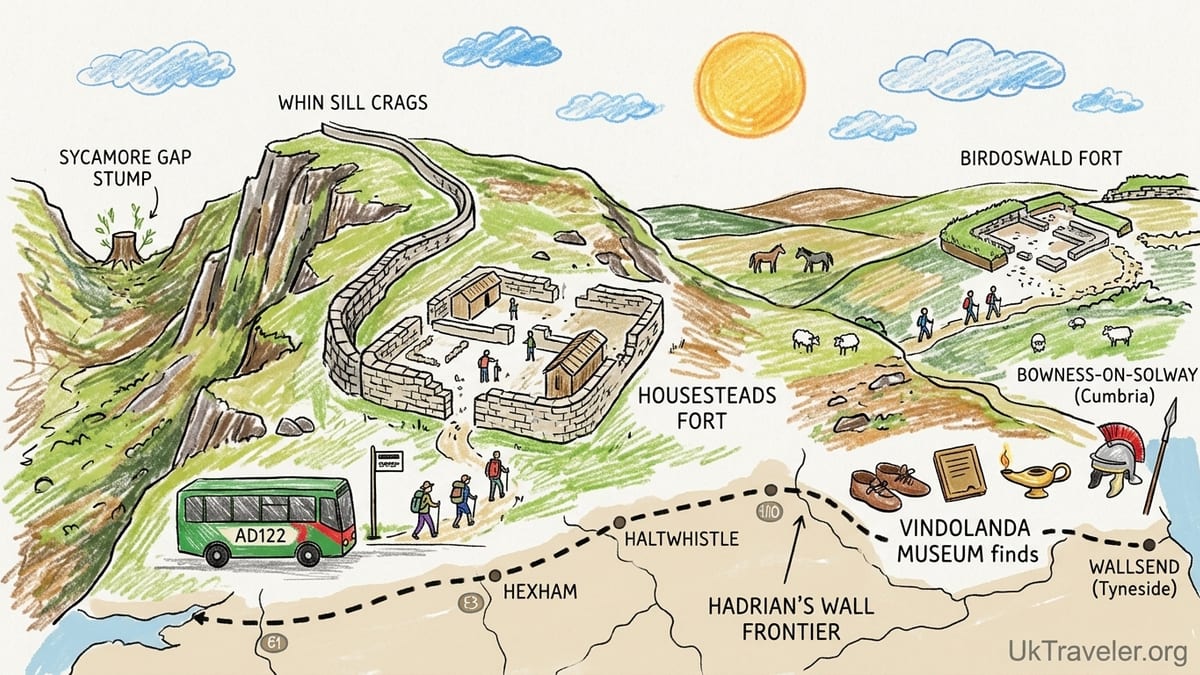
Understanding Hadrian’s Wall as a Frontier, Not One Attraction
Hadrian’s Wall runs for about 73 miles between Bowness-on-Solway in Cumbria and Wallsend near Newcastle, crossing from the Cumbrian coast through Northumberland’s high ground to the River Tyne. Only certain stretches still have substantial stone wall standing. Other sections are banks, ditches or even invisible beneath modern roads and fields. Instead of expecting a continuous monument, it is better to plan around key Roman forts, museums and preserved wall-top walking routes.
The highest concentration of classic “wall scenery” lies in rural Northumberland between Chollerford and Greenhead. Here you find Housesteads Roman Fort, Vindolanda, Chesters Roman Fort, the Roman Army Museum, Steel Rigg, Sycamore Gap, The Sill National Landscape Discovery Centre and several well-preserved milecastles, including Milecastle 39 near Steel Rigg. Farther west in Cumbria, sites such as Birdoswald Roman Fort, Banks Turret and the coastal forts around Maryport offer good archaeology but a gentler, less craggy landscape.
There are three main ways to experience the frontier. Excavated forts such as Housesteads, Vindolanda, Chesters and Corbridge let you walk through barracks, granaries and headquarters buildings. Wall walks, for example between Steel Rigg and Housesteads, give you the physical sense of a border running along dramatic crags. Museum collections, led by Vindolanda’s museum, the Roman Army Museum and Corbridge, supply inscriptions, shoes, armour and writing tablets that make individual soldiers and families feel real.
For most visitors with one or two days, focusing on the Northumberland central sector is the most satisfying approach. You can combine at least one major excavated fort with a short or moderate-length walk along a preserved section of wall, and use the seasonal AD122 bus to link Hexham and Haltwhistle with Housesteads, The Sill, Vindolanda and the Roman Army Museum without needing a car.
Key Roman Sites in Northumberland and Cumbria
Housesteads Roman Fort sits on one of the highest points of the central wall and is managed by English Heritage in partnership with the National Trust. The fort, known to the Romans as Vercovicium, has well-defined walls, latrines and barrack blocks. A modern museum beside the fort displays finds such as altars and inscriptions recovered from the site, helping you interpret the ruins just outside.
Vindolanda, a little to the south of the wall line near Bardon Mill, is a separate auxiliary fort and civilian settlement with its own remarkable story. Excavations here have revealed successive timber and stone forts and one of the most important collections of Roman writing tablets found anywhere in the empire. Nearby, the Roman Army Museum at Carvoran focuses on the life and organisation of soldiers along the northern frontier, using 3D film, reconstructions and original artefacts.
Chesters Roman Fort, near Chollerford, occupies a gentler riverside setting on the North Tyne. The site preserves a fort that controlled the bridge and river crossing, with impressive bathhouse remains down by the water. Its small but rich museum, originally the home collection of the Clayton family who owned much of the land here, is packed with inscribed stones, altars and sculpture recovered from Chesters and neighbouring stretches of wall.
Corbridge Roman Town, slightly further east again and closer to the modern village of Corbridge, lies off the main line of the wall but was a key supply base on Dere Street, the Roman road north. Here you walk through stone streets, granaries and workshops rather than a classic wall-top fort. In Cumbria, Birdoswald stands out as the main excavated fort west of the Northumberland crags. It offers stretches of wall, turrets and a visitor centre, with nearby turf wall sections and coastal installations completing the picture of the frontier’s western half.
Excavated Forts, Wall Walks and Museums: What to Expect
Excavated forts are outdoor archaeological sites where you wander through the stone outlines of Roman buildings. At Housesteads you climb from the car park to a windswept plateau where the fort walls still form a rectangle enclosing gateways, headquarters, granaries and barracks. At Vindolanda, ongoing digs expose layers of earlier forts. You may see archaeologists at work in summer, and interpretation panels around the site help you imagine timber and stone structures rising above the foundations.
Wall walks are stretches where you can actually walk alongside or on top of the Wall. The classic central section near Steel Rigg and Housesteads includes high whinstone crags, steep ascents and descents and views north to the Cheviot hills. Other sections, such as near Chesters or Birdoswald, are gentler, following grassy embankments and low wall remains. These walks rely more on the landscape than on dense ruins and work best if you have at least basic hillwalking fitness.
Museum collections complement both. The Vindolanda museum displays leather shoes, ink-written tablets, wooden combs and military equipment from the fort and vicus, all preserved in waterlogged conditions. The Roman Army Museum, a short drive or AD122 ride away, offers a more didactic experience with films, reconstructions and a detailed timeline of Hadrian’s frontier policy. At Housesteads and Chesters, smaller on-site museums hold altars, inscriptions, carved tombstones and everyday objects found during excavation of those specific forts.
For planning purposes, allow around two hours to explore a single excavated fort and its museum, more if you add a wall-top walk from the same car park. Museums such as Vindolanda’s and the Roman Army Museum can merit 60 to 90 minutes each, particularly in poor weather when walking on the high crags is less appealing.
Practical Comparison: Housesteads, Vindolanda, Chesters and the Roman Army Museum
Housesteads, Vindolanda, Chesters and the Roman Army Museum form the core cluster of major Roman attractions in the central sector. Each has a separate admission charge, although Vindolanda and the Roman Army Museum offer a joint “Saver” ticket that includes one visit to each within a 12 month period, which is useful if you are staying locally and splitting your time. English Heritage manages Housesteads and Chesters, with free entry for English Heritage and National Trust members who show a membership card at the ticket office.
At Housesteads, admission for non-members is broadly in line with other English Heritage major sites and can be checked at the time of booking. The car park at the base of the hill is run by Northumberland National Park, with charges for several hours’ stay that are clearly displayed on entry. There is a 750 metre uphill walk from the car park to the fort on a steep, uneven path, which can feel strenuous in bad weather. Accessible parking spaces are available by arrangement near the museum for those with limited mobility, but must be requested at the information centre in the car park on arrival.
Vindolanda and the Roman Army Museum are operated by an independent charitable trust. The Saver ticket is typically only a modest increase on single-site entry and gives considerable flexibility because it does not require you to visit both on the same day. The car parks at both sites are right beside the entrance, and the paths around the museums and much of the Vindolanda fort are firm underfoot, so these are often better choices for visitors who want a strong museum experience without a long climb.
Chesters sits between the two in terms of terrain. From the on-site car park, the walk to the fort and riverside bathhouse is relatively short and on sloping but manageable grass. The museum is compact but densely packed with carved stones and inscriptions that appeal to visitors who already have some interest in Roman history. As a rough guide, first-time visitors commonly spend about ninety minutes at Chesters, up to three hours at Housesteads if they explore the surrounding wall, two to three hours at Vindolanda including the museum, and about an hour at the Roman Army Museum.
Tickets, AD122 Bus Discounts and Getting Around
The AD122 bus is the key public transport link along the Northumberland central section. Operated by Go North East, it runs between Hexham and Walltown Quarry via Chesters, Chollerford, The Sill, Steel Rigg, Once Brewed, Vindolanda, Haltwhistle and the Roman Army Museum. Current timetables for 2026 show multiple services per day in both directions during the main season, with fewer departures outside peak months. The timetable is updated periodically, so before you rely on the service you should confirm the latest times with local tourist information or the operator.
On-board or driver-issued day tickets usually offer unlimited travel on the route for one day, which makes it practical to combine two or three sites without a car. For example, you could travel from Hexham to Housesteads in the morning, on to The Sill for a mid-afternoon break, then back to Hexham by early evening, all on one rover-style ticket. The bus stops are clearly marked near site entrances but you should allow a few minutes’ walk, especially at more rural locations such as Steel Rigg and Housesteads.
English Heritage publicises an incentive for bus users: eligible visitors who arrive at Housesteads on the AD122 bus can receive a 20 percent discount on walk-up admission. The discount is designed to encourage car-free access. The conditions include presenting a valid same-day AD122 ticket at the Housesteads ticket office and purchasing a standard on-the-day ticket rather than using it alongside other promotions. The exact wording and any seasonal limitations can change, so you should always check current details on-site or via English Heritage information before assuming the discount will apply.
For drivers, access to the central section is straightforward from the A69 between Newcastle and Carlisle. From Hexham or Haydon Bridge, well-signed minor roads lead to Chesters, Housesteads, Vindolanda, Steel Rigg and The Sill. Car parks in this area typically charge by the hour with a daily maximum and do not allow overnight parking. Surfaces are generally tarmac or compacted gravel, but can be busy on fine summer weekends, so arriving before late morning is sensible if you want to park close to the main paths.
Three Tried-and-Tested Walking Routes
If you prefer to experience the wall on foot rather than driving between car parks, three walks in the central sector offer different levels of commitment. Each route described here is based on well-used public rights of way along the National Trail. Exact distances and ascent figures can vary slightly by start point and diversions, so treat them as approximate and carry an up-to-date map.
A short accessible-friendly option starts and ends at The Sill National Landscape Discovery Centre near Once Brewed. From The Sill’s car park, there is a signposted path leading to a viewpoint over the wall and crags. An easy circuit of approximately 2 to 3 kilometres uses smooth, well-maintained paths and boardwalk-style sections around the centre grounds, with gentle gradients and step-free access inside The Sill itself. This suits visitors using wheelchairs or with limited mobility who still want to glimpse the line of the wall in the wider landscape without tackling steep stone steps.
The popular Steel Rigg to Sycamore Gap walk is an intermediate route over classic craggy terrain. Starting from the Steel Rigg car park, you follow the Hadrian’s Wall Path west and then north-west along the crags, with repeated short climbs and descents on stone steps. The section to the former Sycamore Gap and back is around 3 to 4 miles, with roughly 200 to 250 metres of cumulative ascent. While not a mountain hike, it is exposed to wind and weather, with some narrow rocky sections. Sturdy footwear and waterproofs are advisable, and the route is unsuitable for buggies or standard wheelchairs.
For experienced hikers, a longer one-way traverse between Housesteads and Steel Rigg provides a day on the most dramatic part of the wall. Walking west from Housesteads car park towards Steel Rigg covers roughly 8 to 9 miles following the National Trail, with total ascent around 400 to 500 metres. Expect steep ups and downs, stone steps, open moorland and little shelter. Many walkers use the AD122 bus to return to their starting point: for example, catching the bus from Steel Rigg or The Sill back to Housesteads or onward to Hexham. Because bus frequencies change seasonally, you should plan your direction and departure time around a specific return service and carry enough clothing, food and water in case you miss one and have to wait.
Sycamore Gap after the 2023 Tree Felling
Sycamore Gap, a deep dip in the ridge between Milecastle 39 and Crag Lough, became one of Britain’s best-known viewpoints after appearing in films and guidebooks. Its isolated sycamore tree stood beside the wall and was photographed by countless walkers. On the night of 27 to 28 September 2023, the tree was deliberately felled, leading to widespread coverage in national media and an investigation by Northumbria Police. Conservation bodies later confirmed the tree had been removed for safe storage and that some limited damage to the wall fabric occurred when it fell.
Today, the stump and landscape at Sycamore Gap remain part of the Hadrian’s Wall World Heritage Site. The dramatic landform, the sweep of the crags and the curve of the wall are unchanged, but visitors will no longer find a mature tree in the dip. The National Trust and partner organisations have explored options for the timber and for future planting or regeneration, and there have been reports of regrowth emerging from the old stump. Whatever happens with new planting, the Gap itself is still a powerful place to understand how the Romans used the escarpment as a defensive line.
Walkers visiting Sycamore Gap should follow any signage and temporary barriers that protect both the archaeological remains and any new growth. Paths in this section can be muddy after rain, and stone steps become slippery, so the usual precautions about footwear and weather-appropriate clothing apply. Photography remains welcome, although you will now be recording a changed but still historically rich view.
It is important not to think of the felling as erasing Hadrian’s Wall. The frontier comprises miles of masonry, turf wall, ditch, forts and civilian settlements. Even iconic symbols can change or disappear over time, but the archaeological landscape of the central sector, from Steel Rigg to Housesteads and beyond, continues to offer a vivid, largely intact picture of a Roman border zone.
Guided Walks, Multiday Tours and Luggage Transfers
While many visitors explore the wall independently for a day, there is an active network of companies offering guided Roman history walks and multiday itineraries. In Northumberland, local walking guides based in Hexham or Haltwhistle lead small groups along central stretches, often focusing on topics such as frontier defence, daily life in forts or the story of the Vindolanda tablets. Their tours typically include one or two short walks combined with time inside a fort or museum, and they can adapt the route to the group’s fitness and mobility.
For travellers who want to complete longer sections or most of the National Trail, several UK-wide walking holiday operators organise self-guided itineraries from 3 to 10 days, usually running east to west or vice versa between Wallsend and Bowness-on-Solway. These companies arrange overnight stays in inns and guesthouses along the line of the wall, transfer your luggage each day and provide route notes. Examples include specialist walking holiday brands that cover national trails across Britain, many of which list Hadrian’s Wall Path among their core offerings.
Group guided holidays are another option, often based at a single hotel in Hexham, Haltwhistle or Carlisle with daily coach transfers to different wall sections. These are popular with travellers who enjoy having a tour leader handle logistics and interpretation. Some operators build in evening lectures on Roman archaeology or visits to less-frequented sites like Coria at Corbridge or the fort at Maryport in Cumbria.
Whichever style you choose, it is worth checking exactly what is included. Luggage transfer services usually move one bag per person up to a specified weight between pre-booked accommodations, but may not cover very remote properties or same-day changes of plan. Guided day walks may expect a baseline level of fitness and appropriate outdoor clothing; some require walking boots and waterproofs as a condition of participation. Booking ahead is strongly advised for peak months such as June to September.
One-day and Two-day Sample Itineraries
If you have only one day, base yourself on the central Northumberland sector. A classic one-day Roman itinerary without a car might begin in Hexham, taking a morning AD122 bus to Housesteads. Spend late morning climbing up to and exploring the fort and its museum, giving yourself at least two hours on site. Around mid-afternoon, catch the bus west to The Sill, where you can have a late lunch, look around the visitor centre and take a short viewpoint walk. In late afternoon or early evening, return by bus to Hexham for dinner.
With a car, a different one-day circuit becomes possible. Start at Vindolanda when it opens, giving yourself two to three hours to tour both the excavated site and the museum. After lunch at the café or a picnic, drive the short distance to the Roman Army Museum and allow about an hour for its displays and film. Then continue to Steel Rigg in mid-afternoon for the intermediate walk to Sycamore Gap and back, timing your return to the car park before dusk. This combination balances archaeology, museum interpretation and a memorable section of wall walk.
For two days focused on walking, you can aim to cover the central crags between Chollerford and Greenhead in sections. On day one, travel to Chesters by bus or car, explore the fort and museum for about 90 minutes, then follow Hadrian’s Wall Path westwards over rolling countryside as far as your fitness and the timetable allow, finishing at a bus stop for a return to your base. On day two, concentrate on the more rugged crags between Housesteads, Steel Rigg and Walltown, either by repeating the Steel Rigg to Housesteads traverse or by linking shorter out-and-back sections from The Sill and Walltown car parks.
Those with extra time could extend west into Cumbria, visiting Birdoswald to compare its gentler pastoral setting with the harsher Northumberland heights. A combined Northumberland and Cumbria trip over three or four days would give a rounded sense of how the Roman frontier adapted to different landscapes along its length, especially if you include a visit to the excavated town at Corbridge and, at the far eastern end, the museums around Newcastle and Wallsend.
Recommendations by Mobility and Interest
Visitors with limited mobility or those using wheelchairs will find the steep slopes of Housesteads and the craggy paths around Steel Rigg challenging. In these cases, Vindolanda, the Roman Army Museum, Chesters and The Sill make better primary targets. They offer level or gently sloping access from car parks to entrances, indoor interpretation, and shorter walks to viewpoints. At Housesteads, accessible parking near the museum can be arranged on a first-come basis, but there is still some uneven ground around the fort itself, so expectations should be set accordingly.
Travellers whose main interest is archaeology and artefacts might prioritise Vindolanda and Corbridge for their extensive artefact collections, supported by time at Housesteads or Chesters to experience an excavated fort in situ. Those more drawn to landscapes and photography will gravitate towards Steel Rigg, Sycamore Gap, Walltown and the open moorland above Housesteads, where compositionally rich views of the wall and surrounding countryside are available in almost every direction.
Families with school-age children often enjoy the more hands-on and visually engaging exhibits at the Roman Army Museum, where films and interactive displays explain how soldiers lived and trained. Combining this with Vindolanda lets children first see objects in cases and then imagine them in use as they walk through the remains of streets and barracks. The AD122 bus can itself be part of the experience, bridging several sites while giving everyone a rest from walking.
Whatever your mobility or main interest, it is important to factor in Northumberland’s changeable weather. Even in summer, temperatures on the high crags can be cool with strong winds. Paths can quickly turn slippery, and cloud or rain can reduce visibility. Carrying layers, waterproofs, sturdy footwear, snacks and water will make the difference between a rushed visit and the kind of unhurried exploration that allows the story of the Roman frontier to sink in.
The Takeaway
Approaching Hadrian’s Wall not as a single tick-box attraction but as a series of forts, museums and walks unlocks a far richer experience. The excavated remains at Housesteads, Vindolanda, Chesters and Corbridge, the interpretive strength of museums such as Vindolanda’s and the Roman Army Museum, and the dramatic wall-top paths around Steel Rigg and Sycamore Gap together create a layered understanding of life on Rome’s northern frontier.
By using the AD122 bus where practical, taking advantage of discounts such as the Housesteads walk-up reduction for bus arrivals, and choosing walks that suit your fitness and mobility, you can shape a trip that feels personal rather than hurried. The loss of the famous Sycamore Gap tree in 2023 changed one view, but the historic landscape that made it iconic is still very much present, from crag-rimmed milecastles to quiet river crossings.
Whether you have a single day or several, combining at least one major fort, one strong museum and one short or intermediate walk will give you a rounded encounter with the Wall. With a little planning around transport, opening times and terrain, Hadrian’s frontier becomes not just a line on the map but a lived, walkable story running across two counties and nearly two millennia of history.
FAQ
Q1. Is it realistic to “see Hadrian’s Wall” in one day?
In one day you can explore one or two major sites and a short wall walk, usually in the central Northumberland sector, but not the entire 73 mile frontier.
Q2. Which is better for first-time visitors, Housesteads or Vindolanda?
Housesteads offers a classic wall-top fort in a dramatic setting, while Vindolanda combines extensive excavations with one of the richest Roman museums in Britain; if possible, visit both.
Q3. How difficult is the Steel Rigg to Sycamore Gap walk?
The route is short but involves repeated steep ascents and descents on stone steps and is exposed to wind and weather, so it suits reasonably fit walkers with good footwear.
Q4. Can I still visit Sycamore Gap after the tree was felled in 2023?
Yes, the landscape, wall and path remain open, though you will find the stump rather than the famous mature tree and should follow any local safety or conservation guidance.
Q5. How often does the AD122 bus run along the wall?
The AD122 runs several times a day between Hexham and Walltown in the main season, with reduced frequency at quieter times; always check the current timetable before travelling.
Q6. What is the English Heritage 20 percent AD122 discount at Housesteads?
English Heritage offers around 20 percent off standard walk-up admission at Housesteads to visitors who arrive on the AD122 bus and show a valid same-day ticket, subject to current conditions.
Q7. Are the main forts and museums suitable for wheelchair users?
Vindolanda, the Roman Army Museum, Chesters and The Sill have comparatively level access and facilities, while Housesteads involves a steep 750 metre climb unless accessible parking by the museum is available.
Q8. Do I need to book tickets for Vindolanda and the Roman Army Museum in advance?
Advance online purchase is available and can be convenient, but Saver tickets are valid for 12 months and there is generally no need to reserve a specific time slot for normal daytime visits.
Q9. Can I walk a section of Hadrian’s Wall Path and return by public transport?
Yes, in the central sector many walkers complete one-way routes between Housesteads, Steel Rigg, The Sill and Walltown, returning by the AD122 bus, provided they plan around specific departures.
Q10. Are there guided multi day walking holidays along Hadrian’s Wall?
Several UK walking holiday operators offer multi day Hadrian’s Wall itineraries with accommodation and luggage transfer, and some run fully guided groups with a leader and daily coach support.