


North East England is built for road trips, with compact driving distances, coast and countryside within an hour of major cities, and characterful small towns to use as bases. This guide sets out two genuinely different itineraries for exploring Newcastle, Durham and Northumberland on the road: a one-week circuit that hits the classics, and an extended 10 day version that adds Kielder’s dark skies, more of the Northumberland coast and a Tees Valley finale. Every day includes realistic driving times, suggested stops, example costs and practical notes on roads, parking and public transport, so you can adapt the plans to your own style rather than chasing an over-ambitious checklist.
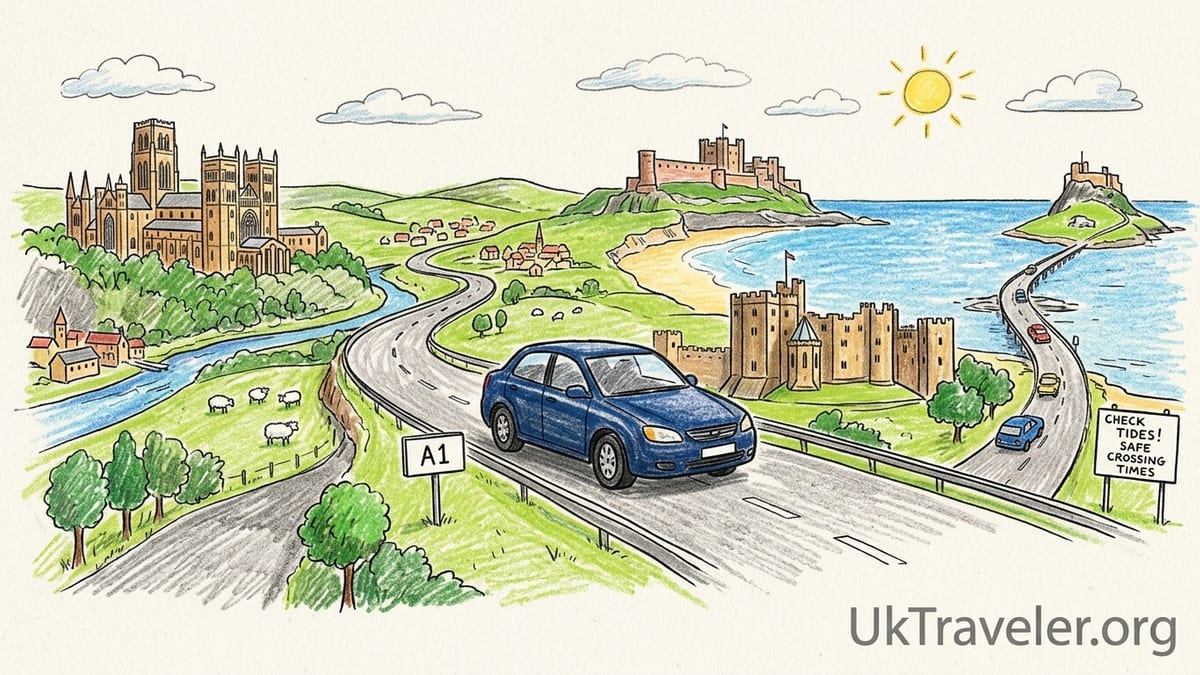
Key Driving Basics in North East England
Before mapping a route, it helps to understand how the main roads in North East England feel behind the wheel. The A1 runs north to south from Yorkshire to Scotland and is the default spine of most itineraries. In County Durham and Northumberland it is mostly dual carriageway, with a 70 mph national speed limit between key junctions, frequent services and direct access to places like Durham, Alnwick and the turn-off for Holy Island at Beal. In school holidays and on summer Saturdays it can slow around Newcastle and at single carriageway bottlenecks north of Morpeth, but for covering distance quickly it is still the most efficient choice.
The A19 offers a quieter alternative between Teesside, Sunderland and the eastern side of Newcastle. It is dual carriageway for almost its entire length through the region, with a 70 mph limit except at junctions and roadworks. If you are driving between the Tees Valley (for example, Saltburn or Hartlepool) and Newcastle or the northern suburbs, the A19 usually beats the A1 both on paper and in stress levels, as you avoid heavier long-distance traffic and some of the larger lorry flows that favour the A1.
The A69 links Newcastle with Hexham and Carlisle, providing the most direct modern route towards Hadrian’s Wall. East of Hexham it is largely dual carriageway with a 70 mph limit, so driving from central Newcastle to Hexham often takes around 35 to 45 minutes in ordinary traffic for roughly 25 to 30 miles. Once you divert off the A69 to reach specific Roman sites such as Housesteads, Vindolanda or Steel Rigg, expect narrower B roads with steep gradients and stone walls, where 30 to 40 mph is a more realistic cruising speed.
Many of Northumberland’s rural and coastal roads are older A and B routes that feel very different from the trunk roads. The coastal drive from Alnwick to Seahouses and Bamburgh uses a patchwork of the B1340, B1341 and nearby lanes, often wide enough for two vehicles but with occasional pinch points, tractors and walkers. In the interior, routes around Kielder Water and the remote uplands are often long stretches with no fuel, patchy mobile signal and wildlife on the carriageway after dark. To keep the trip enjoyable, plan daily driving totals of 60 to 100 miles with time buffers, rather than assuming that a 30 mile cross-country stretch will take the same time as 30 miles on the A1.
Seven Day Itinerary: Classic Highlights Circuit
This one week circuit is built around Newcastle and Gateshead, Durham Cathedral, Hadrian’s Wall, Alnwick, Bamburgh, Seahouses and Holy Island. Daily driving distances are kept to roughly 40 to 100 miles, so you can sightsee without feeling chained to the car. Costs below are indicative for late 2026 in pounds sterling and may change, so treat them as planning anchors rather than fixed quotes.
Day 1 begins in Newcastle or Gateshead, with a suggested base near the Quayside or at Gateshead’s waterfront for easy access to the A1. If you start in Newcastle after picking up a rental at the city centre or airport, you can park in a multi-storey such as Eldon Square or Quayside. Spend the day on foot between the Baltic Centre for Contemporary Art, the Sage Gateshead concert hall, the seven bridges over the Tyne and the city’s Victorian centre. For meals, the Bigg Market and Grey Street areas have plentiful mid-range pubs and bistros. A realistic day’s spending for two adults, excluding accommodation, might be 60 to 90 pounds for meals, coffees and one paid attraction.
Day 2 runs from Newcastle to Durham and on to Hexham. Leave Newcastle via the A167 or A1 and park at one of Durham’s central car parks or the park-and-ride sites that connect by frequent bus to the cathedral. Durham Cathedral is free to enter with a voluntary donation, though there are charges for the tower or museum areas. Allow two to three hours for the cathedral, castle exteriors and river loop, then drive south on the A167 or rejoin the A1 and cut west to Hexham via the A69. The stretch from Durham to Hexham is roughly 40 to 50 miles and takes around 60 to 75 minutes including city traffic. Overnight in Hexham, which has small hotels and guesthouses within walking distance of the abbey and restaurants. Estimate 12 to 15 pounds for parking and fuel combined today, plus 60 to 100 pounds for meals for a couple.
Day 3 focuses on Hadrian’s Wall from a Hexham base. Pick two major sites rather than trying to tick off everything. A common pairing is Vindolanda and Housesteads, both west of Hexham. Driving Hexham to Vindolanda and then to Housesteads and back is roughly 40 to 50 miles, almost all on the A69 with short rural sections. Parking at each site is paid, and admission for non-members can add up, so English Heritage membership or joint tickets that include the Roman Army Museum can be good value for couples or families who expect to visit two or more sites. For example, a family of four can easily spend 60 to 90 pounds on combined entry and parking for a full wall day, while membership spreads that cost over additional sites across England.
On Day 4 you travel from Hexham to Alnwick. Drive east to rejoin the A69, then loop around Newcastle on the A1 northbound. The total distance is about 65 to 75 miles, usually taking 1.5 to 2 hours depending on traffic. In Alnwick, park near the town centre or at the main Alnwick Castle car park if the castle season is active. Official information confirms that Alnwick Castle opens in spring and closes for the 2026 season on 20 October, with daytime visitor access during that period and a separate programme of winter events. This means that if you are travelling outside the spring to mid-autumn window, you will still see the castle exterior and the adjacent Alnwick Garden, but not tour the main interior rooms.
Plan an afternoon exploring the market town streets, the bookshop in the old railway station and the castle or garden depending on dates. Two adults can expect to spend in the region of 50 to 80 pounds on combined garden and castle tickets in 2026 if bought on the day, so pre-check exact current prices and online discounts before you travel. Alnwick makes an excellent overnight base with multiple inns and hotels. Once you add dinner and drinks, daily non-accommodation costs for a couple often land around 120 to 160 pounds including attractions in castle season.
Seven Day Itinerary: Coast, Seahouses and Holy Island
Day 5 runs from Alnwick to Bamburgh and Seahouses, both easily reached on rural coastal roads. The Alnwick to Bamburgh drive via the B1340 and nearby lanes is roughly 20 to 25 miles and usually takes about 40 minutes. Bamburgh offers castle views, a long beach and small cafes in the village. Parking charges apply along the seafront and near the castle, so keep coins or a bank card handy for pay-and-display machines. A light lunch in Bamburgh for two might be 20 to 30 pounds, depending on venue.
Continue to Seahouses, only a 10 minute drive south along the coast. Seahouses harbour is the gateway to the Farne Islands, with several operators running wildlife boat trips. Official National Trust guidance and local operator schedules show that landings on Inner Farne and Longstone Island are generally offered from around 1 April to 30 September, weather permitting, with autumn and winter schedules more focused on non-landing cruises and grey seal viewing. In late October you should not count on landing on bird sanctuary islands, although some cruises may still operate. Overnight in Seahouses or nearby Beadnell so you can leave the car parked and walk to dinner around the harbour.
Day 6 is dedicated to Holy Island of Lindisfarne, and this is where tide planning becomes critical. Instead of assigning a fixed timetable, you must revolve the day around official safe crossing windows. Northumberland County Council publishes causeway safe crossing times for each day of the year, and local tide websites summarise the live status. On a sample autumn day you might see two safe crossing windows, such as early morning from around 06:45 to 12:55 and late afternoon from around 19:30 to midnight. The exact times change daily, so you should check the official table for your precise dates.
A practical pattern is to leave Seahouses and drive the 25 mile route to the causeway via the A1 and local roads so that you reach the mainland causeway end shortly after the start of the safe window. Crossing takes roughly 5 to 10 minutes in a car. Once on Holy Island you can park in the large visitor car park outside the village and explore the priory ruins, village streets and views towards Bamburgh. Plan to depart in time to finish the crossing at least 30 minutes before the end of the safe period, erring on the side of caution. If you overstay and the tides rise, you may be stuck for several hours until the next window, and rescues are dangerous and extremely costly.
For Holy Island day costs, expect around 6 to 8 pounds for parking, modest entry fees for the priory museum if open, and 20 to 40 pounds for cafe meals and drinks for two. After returning across the causeway, drive south on the A1 and overnight either back in Seahouses, or break the journey with a final night in Newcastle or Durham depending on your departure plans. The Beal causeway to Newcastle distance is roughly 55 to 65 miles and usually takes 1.5 hours via the A1 in good traffic.
Day 7 fills any remaining gaps or provides weather flexibility. If you overnight near Newcastle, you might visit Tynemouth Priory, Whitley Bay or one of the museums along the Great North Road before returning a rental car in Newcastle or at the airport. Daily non-accommodation spending for the final day can be modest if you focus on free seafront walks and one paid museum. As a rough guide, a couple on this 7 day circuit can expect fuel costs of perhaps 120 to 180 pounds depending on vehicle efficiency and final mileage, plus 70 to 120 pounds in parking and attraction fees if they focus on the headline sites.
Ten Day Itinerary: Adding Kielder and Tees Valley
The 10 day itinerary builds a different rhythm rather than simply stretching the same week. It introduces Kielder Water and Observatory in the remote interior, extends along more of the Northumberland coast and finishes with a Tees Valley loop through Hartlepool, Saltburn and the fringes of Middlesbrough or Darlington. This version suits travellers happy with a few longer drives and who want more variety in scenery and towns.
Days 1 and 2 mirror the shorter itinerary, with arrival in Newcastle, a full city and Quayside day on foot, then a move to Durham Cathedral and an overnight in Hexham. The extra time comes from what happens next. On Day 3, instead of focusing entirely on the central Hadrian’s Wall corridor, you drive from Hexham to Kielder Water. The direct route north west via B roads is about 35 to 40 miles and typically takes 1 to 1.5 hours due to the slower rural speeds. Around Kielder you can walk short forest trails or take a lake cruise in season. Accommodation ranges from lodges and cabins to a basic village inn and camping.
Kielder Observatory sits high above the reservoir and is one of the UK’s leading public astronomy venues. Official updates in October 2026 confirm that its astronomy programme is continuing, with regular evening events bookable in advance. Tickets vary by event type, but you should expect to pre-book and to drive up a narrow forest road in darkness. Local advice suggests not tackling a long drive to Kielder and then attending a late-night session in the same day, but instead planning at least one overnight nearby, so that you can arrive rested and drive back to your bed in 20 to 30 minutes rather than 90.
Day 4 then connects Kielder back to the Hadrian’s Wall corridor. You can drive south east through Bellingham and rejoin the A68 or A69 near Hexham, visiting a single wall site in the afternoon, such as Housesteads or Vindolanda, before returning to Hexham or continuing to Corbridge or another Tyne Valley village for the night. Daily mileage today might be 50 to 70 miles, with mixed fast and slow sections. Fuel and parking costs for this interior loop can run to 25 to 40 pounds for a couple including daytime food, given the lack of large supermarkets and the focus on cafe meals.
From Day 5 the 10 day route rejoins the coast near Alnwick. Drive on the A69 and A1 to Alnwick for a night, as in the shorter itinerary, then add an extra coastal day rather than moving on quickly. Day 6 can become a slow exploration north from Alnwick through Craster, Embleton and Beadnell, with short walks to Dunstanburgh Castle, beach time and seafood lunches. The drive from Alnwick to these villages is under 30 miles in total, but rural parking charges and small-lane driving mean you should keep expectations modest. Overnight in Seahouses or Bamburgh depending on accommodation value and your preference for either a harbour town or a quieter village dominated by the castle.
Ten Day Itinerary: Holy Island and Tees Valley Extension
Day 7 again centres on Holy Island, using the same tide-driven planning as in the 7 day route. This time you can afford to treat it as a more relaxed day, perhaps timing your visit to be present on the island during high tide when the causeway is submerged and the atmosphere feels more remote. One pattern is to cross towards the end of the morning safe window, stay through midday and early afternoon, and leave on the second safe window, assuming tides align that way for your dates. You must still consult the official tables for your specific days and keep weather conditions in mind.
After crossing back to the mainland, overnight back in Seahouses, Bamburgh or Alnwick. This gives you flexibility if weather has been poor earlier and you want to repeat a boat trip, a castle visit or a long beach walk. If you are travelling between early April and the end of September, you might book a Farne Islands landing trip today, paying boat fares to a private operator plus National Trust landing fees for Inner Farne or Longstone Island if required. Off peak, cruises that circle the islands to see seals and seabirds without landing are more likely to run.
Day 8 begins the Tees Valley extension. Drive south from Alnwick area via the A1 or A19. One practical option is to follow the A1 around Newcastle then cut onto the A19 near Sunderland and continue to Hartlepool, a route of roughly 75 to 90 miles that typically takes about 1.5 to 2 hours. Hartlepool’s historic quay and Royal Navy museum cluster around a redeveloped dockside with pay-and-display parking and cafes. You might spend half a day here, then overnight in Hartlepool or continue to Saltburn-by-the-Sea, another 25 to 30 miles further south along the A19 and local roads.
Saltburn offers a classic Victorian seaside setting with a wide beach, funicular cliff lift when in season and surf schools. Parking along the front is typically charged, and the steep hill between town and seafront rewards those who pack light. Expect to pay around 10 to 15 pounds for full-day parking and local fares, plus 30 to 50 pounds for meals and snacks for a couple if eating in cafes rather than self-catering. Accommodation in Saltburn, Redcar or nearby villages makes a good springboard for the final two days of the itinerary.
Day 9 explores either the coastal strip or the inland Tees Valley towns. One option is to head towards Middlesbrough for the industrial heritage around the river, football stadium tours and galleries, then loop to Darlington for its railway connections and more traditional market town centre. The A19 and A66 combine to form fast dual carriageway links, although city traffic can slow progress at peak times. If you prefer countryside, you could instead drive inland towards the edge of the North York Moors while still returning to Teesside at night. Daily mileage today is highly variable, but staying under 80 miles keeps driving comfortable.
On Day 10 you close the loop by returning to Newcastle or Durham for your departure. From Darlington or central Teesside, the A1 or A19 provides a direct northbound line. Darlington to Durham is around 30 miles and usually under 40 minutes on the A1, with Durham to Newcastle taking another 20 to 30 minutes. For rental car returns, factor in extra time to refuel and navigate to a city or airport depot. Overall, the 10 day route may cover 550 to 750 miles, implying fuel costs in the region of 160 to 230 pounds depending on vehicle consumption and how many side trips you add.
Where to Base: Newcastle, Durham, Hexham, Alnwick, Seahouses and Bamburgh
Choosing overnight bases is one of the biggest practical decisions, and the right pattern changes as you extend from 7 to 10 days. Newcastle works well as an arrival and departure city with strong rail connections, car rentals and a dense restaurant scene, but using it as a single base for day trips to Hadrian’s Wall, Holy Island and Tees Valley quickly becomes inefficient. For example, an out-and-back day from Newcastle to Lindisfarne is roughly 150 miles of mixed A1 and rural driving, plus tide constraints, which creates long days with little margin for weather or traffic.
Durham is compact and atmospheric, especially for cathedral views at sunrise or dusk, yet it lies slightly off the most efficient line to Northumberland’s coast. One or two nights here allows you to enjoy the World Heritage Site and riverside walks without the need for repeated in-and-out drives from Newcastle. Hexham, by contrast, is ideal for Hadrian’s Wall, as it sits directly off the A69 and is within 30 to 40 minutes of multiple wall forts and museums. For a wall-focused day, basing in Hexham or nearby Corbridge can easily shave an hour of driving compared with staying in Newcastle.
Alnwick works as a central Northumberland hub, equidistant from the southern stretches of the coast and the A1 back to the cities. Basing here for two or three nights allows day trips both north to Bamburgh and Seahouses and south to Amble or Warkworth. However, if your itinerary heavily features boat trips from Seahouses, long beach days and Holy Island, shifting your base to Seahouses or Bamburgh is more efficient. This avoids repeated 25 mile each-way journeys from Alnwick on rural roads and gives you the ability to walk to the harbour for early boat departures without worrying about parking.
Seahouses is busy and practical, with supermarkets, fish and chip shops and several mid-range guesthouses, while Bamburgh is quieter, with the castle dominating the skyline and a smaller selection of pubs and inns. For families who want facilities and easy food options, Seahouses is generally more convenient. For couples seeking quieter evenings and dramatic views, Bamburgh often feels more special. In a 7 day itinerary, one or two bases along the coast beyond Alnwick may be enough. In the 10 day version, a pattern of Newcastle or Durham, then Hexham, then Alnwick, then Seahouses or Bamburgh, and finally Tees Valley spreads driving sensibly.
Costs, Passes and Public Transport Options
Car rental for this sort of trip typically dominates transport costs. By late 2026, compact manual cars from major brands rented in Newcastle or Durham often price in a rough band such as 35 to 60 pounds per day in low season and more in summer, especially when booked close to departure. Automatic transmissions can cost more. A 7 day hire at 40 pounds per day works out at 280 pounds before fuel and any one-way fees, while a 10 day hire at similar rates becomes 400 pounds. Adding a second named driver, full collision damage cover and child seats can increase this further.
Fuel costs depend on both pump prices and your vehicle’s efficiency. If your planned mileage is around 400 to 500 miles for the 7 day circuit and 550 to 750 miles for the 10 day route, and you are driving a medium hatchback averaging about 45 to 55 miles per gallon, you could expect to spend somewhere in the region of 100 to 150 pounds on fuel for the shorter trip and 130 to 200 pounds for the longer one at contemporary late 2026 prices. Rural petrol stations in Northumberland can be slightly more expensive than big supermarket forecourts along the A1 and A19, so consider topping up near larger towns when practical.
Parking and attraction tickets can add up quickly for heritage-focused trips. Hadrian’s Wall, Durham Cathedral’s paid areas, Alnwick Castle, the Alnwick Garden, Bamburgh Castle interiors, Lindisfarne Priory, and National Trust or English Heritage properties along the way all charge individual fees. A solo traveller who plans to visit only one or two paid sites may be best paying ad hoc. Couples or families who want to go inside multiple castles and museums often find value in an English Heritage or National Trust membership. For example, if a family of four visits several English Heritage-managed Roman sites and priory ruins in one holiday, membership can save tens of pounds compared with separate tickets, provided they have time to make use of it elsewhere in the year.
There is limited scope to substitute public transport without drastically changing the feel of a road trip, but some segments can be done more efficiently by train or bus. Durham and Newcastle are directly linked by frequent trains, often taking under 20 minutes, which makes it possible to base in one city and day-trip to the other without touching the car. The Tyne and Wear Metro serves coastal suburbs such as Tynemouth and Whitley Bay, allowing car-free days on the coast from a Newcastle base. Hadrian’s Wall also has seasonal bus services from Hexham and Haltwhistle that connect to viewpoints and forts, reducing the need to navigate narrow lanes or to move the car between each site.
However, remote places such as Kielder, many stretches of the Northumberland coast and Holy Island cannot realistically be reached and enjoyed on tight schedules solely by public transport, particularly outside summer. Buses are infrequent, and Holy Island timetables cannot always align conveniently with safe crossing tidal windows. For these sections, a car or organised tour remains the practical choice. If you want to reduce driving without giving it up entirely, a mixed approach often works well: pick up a car in Newcastle after two car-free city days, or return the car early in Durham and finish your trip using trains.
Rainy-Day Alternatives and Map-Ready Routes
North East England’s changeable weather makes it wise to build indoor alternatives into your route map. On a wet day in Newcastle, museums such as the Discovery Museum or the Great North Museum offer several hours of cover within walking distance of central parking and hotels. In Durham, the cathedral’s interior, small museums and independent cafes around the Market Place provide shelter from showers. Along the coast, Alnwick Garden has glasshouse areas and seasonal events, while Bamburgh Castle’s interior rooms can absorb a rainy half-day when beaches are unappealing.
For mapping, think in terms of logical segments connected by the main arteries. Segment one is Newcastle to Durham to Hexham on the A1, A167 and A69. Segment two covers Hexham to the Hadrian’s Wall forts and back on the A69 and local roads. Segment three runs from Hexham or Newcastle to Alnwick via the A69 and A1. Segment four is the Northumberland coast ribbon from Alnwick through Craster, Embleton, Beadnell, Seahouses and Bamburgh to the Holy Island turn-off near Beal. Segment five takes you south again on the A1 or A19 to Hartlepool, Saltburn and Tees Valley towns, and segment six returns inland on the A1 or A19 to Durham or Newcastle.
When plotting Holy Island specifically, mark the causeway in your navigation app but resist the temptation to rely solely on estimated drive times. Your hard constraints are the official safe crossing windows, which you can download or screenshot for each travel day before you set off. Build at least 30 minutes of buffer at both ends of each safe window and remember that congestion can form at the start of popular crossing periods in high summer when many visitors arrive at once. If you wish to walk the Pilgrims’ Way across the sands instead of driving, allow roughly two hours on foot from the mainland end and treat tidal safety with equal seriousness.
In Kielder’s case, road mapping means noting fuel stops and grocery options in advance. The route into the forest from the A68 or Bellingham offers very limited services, so filling up in Hexham or another larger town reduces anxiety. Late-night drives after observatory sessions are on dark, often wet roads with wildlife. Using a daytime reconnaissance run to the observatory helps you feel more confident later, and staying locally for two nights gives extra flexibility if weather forces an astronomy event to run under cloud or if you want a spare evening.
The Takeaway
Both the 7 day and 10 day North East England road trips give you a coherent circuit that balances cities, coast and countryside without excessive mileage. The shorter route focuses on iconic highlights: Newcastle’s bridges, Durham Cathedral, the Roman frontier at Hadrian’s Wall, Alnwick’s castle silhouette, Bamburgh’s beach-backed stronghold, Seahouses harbour and tide-shaped Holy Island. It suits first-time visitors with limited time or those combining the region with Scotland or Yorkshire.
The 10 day version turns the trip into a deeper exploration rather than simply a slower one. Adding Kielder Water and its dark skies exposes you to one of the UK’s largest areas of low light pollution, while the extended coast days let you appreciate smaller fishing villages and walks rather than rushing between landmarks. The Tees Valley finale weaves in a different flavour of northern life, from regenerated docksides in Hartlepool to Victorian promenades in Saltburn and the industrial and cultural stories around Middlesbrough and Darlington.
Whichever length you choose, the keys to a satisfying trip are realistic daily distances, an understanding of the A1, A19, A69 and rural road mix, and disciplined planning around Holy Island’s tides and seasonal opening dates for places like Alnwick Castle, the Farne Islands and Kielder Observatory. With those practicalities handled, you can relax into a journey of stone-built villages, sweeping beaches and warm, understated hospitality that rewards slow travel as much as rapid touring.
FAQ
Q1. When is the best time of year to drive this North East England route?
For castle interiors, Farne Islands landings and long daylight hours, late spring to early autumn is ideal. Outside roughly April to October, many attractions move to reduced hours or close, though the landscapes and cities remain rewarding and quieter.
Q2. How do I plan my Holy Island visit around the tides?
You should check the official Holy Island causeway safe crossing timetable for each specific date, then plan to arrive shortly after the window opens and leave well before it closes. Build at least 30 minutes of buffer at both ends and never attempt to cross when the causeway is marked unsafe, even if you see other vehicles.
Q3. Is it possible to do this trip without a car?
You can link Newcastle, Durham, Tees Valley towns and some coastal spots by train and bus, and seasonal buses run to parts of Hadrian’s Wall. However, places like Kielder, much of rural Northumberland and Holy Island become very hard to visit efficiently without a car, especially outside peak summer.
Q4. Are the A1, A19 and A69 difficult roads for visitors unused to UK driving?
All three are main routes with good signage and mostly dual carriageway sections, so they are generally easier than narrow country lanes. The challenge comes when you leave them for rural roads with stone walls, blind bends and farm traffic, where reduced speeds and extra caution are essential.
Q5. How many overnight bases should I use on a 7 day trip?
A sensible pattern for 7 days is two or three bases, for example Newcastle or Durham for city sights, Hexham for Hadrian’s Wall and Alnwick plus Seahouses or Bamburgh for the coast and Holy Island. Using just one city base leads to longer daily drives and less flexibility.
Q6. Is membership of English Heritage or the National Trust worth it for this itinerary?
If you plan to go inside several historic sites managed by these organisations, such as Hadrian’s Wall forts, priory ruins or certain castles, membership can pay for itself over a week or ten days, especially for couples or families. If you only intend one or two paid visits, buying individual tickets usually makes more sense.
Q7. What should I expect to spend per day, excluding accommodation?
For two adults driving a modest car, a realistic working figure combining fuel, parking, simple meals and one paid attraction is often around 80 to 150 pounds per day, depending on how many admissions and restaurant meals you include. Families will spend more on tickets and food but can save by self-catering and choosing passes wisely.
Q8. Do I need to pre-book Farne Islands and Kielder Observatory tickets?
For Kielder Observatory, advance booking is strongly recommended because events are capacity-controlled and specific to dates and times. Farne Islands boat trips can sometimes be purchased on the day, but landing trips in peak season and good weather often sell out, so reserving in advance where operators allow is wise.
Q9. Which coastal town is better to stay in, Seahouses or Bamburgh?
Seahouses has more shops, restaurants and boat tour options within walking distance, making it very practical, especially for families. Bamburgh is quieter and more atmospheric, dominated by the castle and a huge beach, and often suits couples or travellers who prefer evenings with fewer crowds and darker skies.
Q10. Is driving in winter in Northumberland risky?
Winter brings shorter days, more rain, potential snow and ice on upland and rural roads, and a higher chance of poor visibility. Trunk roads usually stay open, but remote routes around Kielder and some inland areas can be challenging. If travelling in midwinter, allow extra time, carry warm clothing and check local conditions before heading into the interior.