


The first time I saw Durham, I was looking out of a train window and suddenly the landscape tightened, the River Wear looped in on itself and a great block of stone rose above the trees. The cathedral and castle sat together on their rocky peninsula, ringed by the river like a natural moat. Even from a moving carriage it felt improbably dramatic, the kind of view you expect from an old engraving rather than a modern rail line. That sudden glimpse was enough to convince me that I needed to get off the train next time and give Durham a full day of my time, to find out whether this city is worth an overnight stay in its own right or better folded into a Newcastle city break.
Arriving in Durham and First Impressions from the River
I arrived in Durham by train from Newcastle on a clear spring morning, a journey that takes around 15 minutes and runs frequently through the day. Stepping out of the station, I could already see the cathedral’s bulk across the valley, but what struck me most was the sense of height. Durham’s historic centre sits high above the river on a tight peninsula, and almost everything between the station and the World Heritage Site involves some degree of uphill walking. If you have luggage, this is the first moment you start weighing the merits of staying overnight against the ease of a quick day trip.
Instead of marching straight up, I dropped down towards the river first. From the station I followed signs toward Framwellgate Bridge and the city centre, then cut down one of the narrow lanes that tumble towards the Wear. At the bottom, the atmosphere changed. Traffic noise faded, replaced by the slap of oars and the caw of rooks in the trees. The river curves sharply here, and between gaps in the branches the cathedral tower appeared and disappeared like a ship’s mast behind headlands.
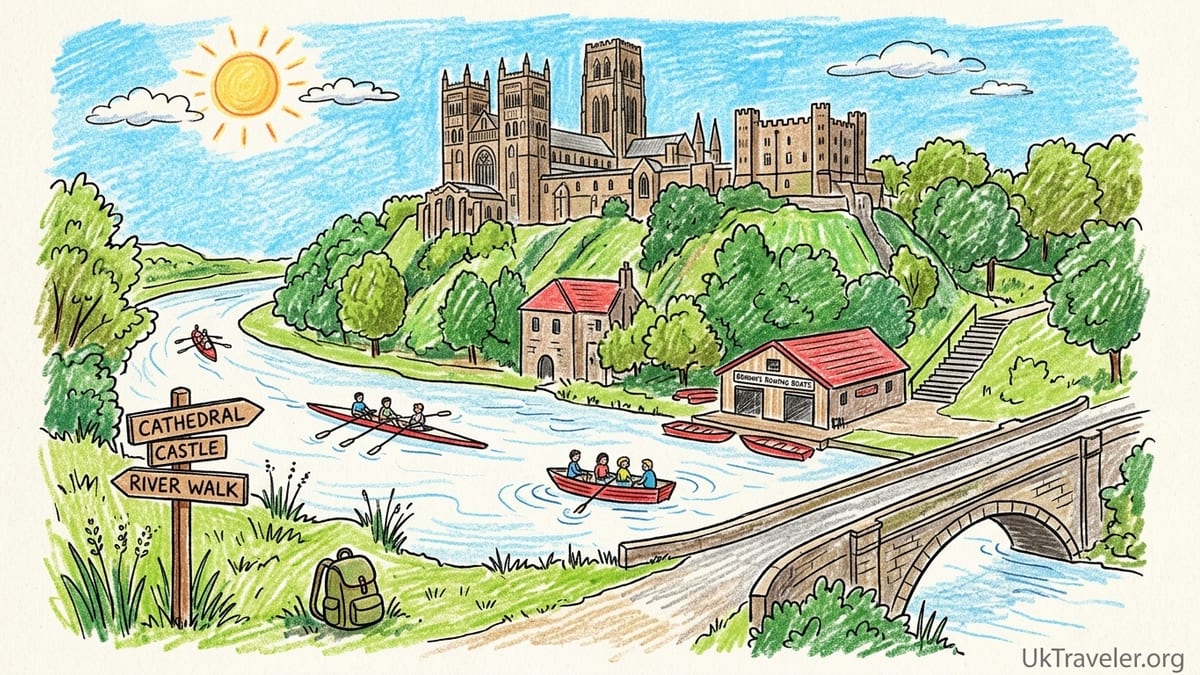
I crossed Framwellgate Bridge into the compact Market Place, then angled towards Elvet Bridge. Below it sits Brown’s Rowing Boats, a small, old-fashioned boathouse and the boarding point for the Prince Bishop river cruiser. From the stone parapet I watched a student rowing crew slide past, chased by a flotilla of hired rowing boats zigzagging with varying levels of confidence. Seeing the peninsula from water level, the cathedral and castle stacked one above the other, is one of Durham’s defining views, and it convinced me to plan my day as a loop along the river and up to the plateau, rather than heading straight for the big sights.
Because I wanted to see Durham after dark as well, I had booked a modest guesthouse about ten minutes’ walk from the centre instead of basing myself entirely in Newcastle. Prices in Durham’s historic core can be noticeably higher than equivalent mid-range options in Newcastle, especially on university term weekends or graduation periods, so staying just beyond the tightest cluster of streets can ease the budget while still making an overnight practical.
Durham Cathedral: Romanesque Stone and a Living Church
From Market Place I followed Saddler Street, a steep, narrow run of shops and student haunts, up towards the cathedral. Near the top, traffic drops away and the street opens on to Palace Green, a broad grassy square framed by the cathedral on one side and the castle on the other. It is one of those spaces that explains a whole city at a glance. Students crossed the lawn shouldering rucksacks, a small school group clustered around a teacher, and a line of visitors drifted towards the cathedral’s north door.
Durham Cathedral does not charge an entry fee. Instead, there is a clearly signposted suggested donation of around £5 per adult at the welcome desk, and contactless donation points positioned in a few places inside. I appreciated the honesty of this approach. There was no pressure and nobody checked whether I had paid, but it felt fair to contribute something to the upkeep of a building that still functions daily as a place of worship, not just a museum piece.
Inside, the first impression is of weight. Durham is one of the great Norman Romanesque churches of Europe, and you feel that immediately in the thickness of the pillars and the rounded arches that march down the nave. The stone is carved with bold chevrons and zigzags that catch the light from the high windows. There is less height and glass than in a Gothic cathedral like York, and more solid geometry, as if the whole building has been hewn from a single block of sandstone. Standing halfway down the nave, the alternating patterned columns lead the eye towards the distant choir screen, giving a powerful sense of rhythm and depth.
I walked slowly around the edges of the nave, stopping at the information boards that describe how the cathedral was built to house the shrine of St Cuthbert and later became home to the Venerable Bede’s remains. Those stories are not just historical. Every so often a bell sounded or a verger passed by, and later in the morning a short act of worship was announced over a discreet speaker. During that fifteen minutes, visitors were asked to pause, and the building’s role as a working Anglican cathedral came to the forefront. People sat quietly in the pews, a handful lit candles near the side altars, and the earlier murmur of sightseeing dropped to a respectful hush.
Cloisters, Stained Glass and Skipping the Tower
One of my favourite parts of the visit was the cloister, the square courtyard enclosed by covered walkways that open off the south side of the nave. Stepping through the doorway felt like entering a film set, which it effectively is, given its appearance in several Harry Potter scenes. The grass in the centre was intensely green after overnight rain, and the arches around it framed constantly changing vignettes of students cutting across the quadrangle, tour groups following guides with coloured lanyards, and choir members hurrying between rehearsals.
Here the Romanesque style feels less overwhelming than inside the nave. The cloister arcades are simpler but still massive, and if you look closely you can see where medieval masons repaired or altered individual stones. A small exhibition in one of the former monastic buildings explains the daily life of the Benedictine monks who once lived here, which helps the cloister make sense as a living space rather than just an attractive courtyard. I sat on a stone bench and listened to the echo of footsteps for a while, something you rarely get chance to do on a rushed whistle-stop visit.
Durham’s stained glass is scattered across its chapels, and much of it is Victorian, but a few windows stand out. In the Galilee Chapel at the west end, the colours are deep and jewel-like, casting blues and reds onto the stone floor. Near the high altar, modern glass is worked into older frames, and I found myself drawn to a contemporary window that uses abstract forms to suggest water and pilgrimage. It is a reminder that this is still a site of active creativity rather than only a repository of the past.
The cathedral offers several paid experiences in addition to the free general entry, including a museum, guided tours and a climb up the central tower. On the day I visited, the tower was open with tickets sold separately, but I decided not to climb. Partly that was a question of time, and partly of honesty. The ascent is more than 300 narrow steps, and while the views over the river loops and city roofs are widely praised, I wanted to leave enough energy for exploring the riverside paths. Instead, I spent a little extra time in the museum area, which has a separate admission fee and contains treasures associated with St Cuthbert in carefully controlled light. It is the kind of small but dense exhibition that rewards a slow lap more than a quick dash.
Durham Castle, Palace Green and Understanding the Peninsula
From the cathedral it is a short walk across Palace Green to the entrance of Durham Castle. The building dominates one side of the square, but it is not simply a tourist site. The castle functions as University College, one of Durham University’s oldest colleges, and that means access is tightly controlled around academic life. You cannot simply wander in at will. Instead, visitors must join a guided tour at set times, which are bookable in advance, with adult tickets currently priced around £7.50. Tours generally last about 50 to 60 minutes and are often fully booked on busy days, so planning ahead is wise.
I had reserved a mid-afternoon tour slot, which let me explore the outside of the peninsula first. At my allocated time, the guide met our small group by the gatehouse. We were reminded that parts of the castle are student accommodation and that during term time we might see undergraduates rushing past in gowns, late for formal dinners or tutorials. Inside, the route threaded through a Norman chapel with simple rounded arches, a great hall lined with portraits and long tables, and a courtyard that felt more like a college quad than a royal stronghold. The guide balanced architectural detail with anecdotes about student traditions, and that dual identity is what makes Durham Castle distinctive compared with castles that exist solely as heritage attractions.
Back out on Palace Green, the steepness of almost every approach became obvious. Streets like South Bailey, Owengate and Saddler Street all slope markedly, and while the distances are short, a day in Durham will involve repeated climbs and descents. For travellers with limited mobility this is an important consideration, especially as some cobbled sections can be slippery in wet weather. Traffic restrictions around the peninsula, including barriers and one-way systems, keep cars largely out of the central loop, which makes walking safer and more pleasant but can complicate luggage transfers if you choose to stay in one of the historic-core hotels.
Despite those practicalities, Palace Green itself remains one of the most peaceful parts of the city. I sat on the grass for a while after my castle tour, watching the light catch the cathedral’s stonework and the slow movement of people across the square. It is a place where Durham’s roles as university town, pilgrimage site and regional centre coexist in a single view, and that sense of layers became a theme for the rest of my day.
Riverside Walks, Prebends Bridge and Seeing Durham from Below
To understand Durham’s geography you need to drop back down to the water. From the southern end of the peninsula I followed a narrow lane that led to the riverside path in the direction of Prebends Bridge. Almost immediately, the feel of the city changed. The riverbank is wooded and surprisingly quiet, with only scattered dog walkers and joggers passing by. The cathedral reappeared above the trees, no longer an object you stand inside but a silhouette looming over the water.
The walk to Prebends Bridge is short, but the perspectives shift constantly as the river curves. Eventually the stone arches of the bridge come into view, its balustrades thick with lichen. From the centre of the span I stopped to take in what might be Durham’s most famous view: the cathedral and castle rising together above the treeline, the river looping below in a slow arc. It is a wide, layered panorama that rewards patience. Rowing crews sliced through the reflection, cormorants perched on midstream rocks and the late-afternoon light flattened the stone into a soft honey colour.
Below Elvet Bridge, on another section of the river loop, Brown’s Rowing Boats offers simple rowing boats for hire, and the Prince Bishop cruiser departs for one-hour sightseeing trips. I chose to hire a small rowing boat for my own circuit. After a brief demonstration I set out upstream, sharing the Wear with a student eight and a couple of canoes. From water level, Durham’s steep banks and overhanging trees create a feeling of enclosure. The city drops out of sight entirely in some stretches, before suddenly reappearing in the form of a tower or a flight of stone steps leading back up to the streets. It was one of the moments that made me glad I had allowed a full day rather than trying to squeeze everything into a rushed half-visit between trains.
The riverside paths double as a kind of informal campus for Durham University, with boathouses lining some stretches and college buildings peeking through the trees. It is easy to see why the river feels so central to local life. For visitors, these paths are also a practical way to connect different parts of the city on foot without constantly climbing and descending the steep interior lanes, although you should still expect some staircases back up to the bridges.
Market Place, Cafés and Honest Talk about Costs
Eventually I climbed back up from the river to Market Place, the compact square that functions as the city’s everyday hub. Around the statue and town hall you find chain shops, small independents and a scattering of market stalls. It is not a grand piazza, but it does feel like where Durham’s different communities intersect, from school kids waiting for buses to academics weaving through in black gowns.
For coffee and a late lunch I headed to Flat White Kitchen on Saddler Street, a local favourite that often appears on lists of the city’s best cafés. The building is a tall, narrow townhouse, and inside it is all scrubbed wood tables, mismatched chairs and the hum of espresso machines. There was a short queue when I arrived early afternoon, made up mostly of students and a few day trippers comparing castle tour times. Once seated, I ordered a flat white and a plate of sourdough with smashed avocado and chilli, which arrived generous and carefully presented. Prices here are in line with good independent cafés in other UK university cities, not bargain-basement cheap but fair for the quality.
Earlier in the day, I had ducked into the smaller Flat White Café near Elvet Bridge for a quick mid-morning coffee, and it impressed me how quickly both branches filled up. Durham’s student population is highly visible in its cafés and pubs, especially during term time, and there are moments when the narrow streets can feel more like a campus than a conventional city centre. If you are sensitive to noise or crowds, it may be worth timing your main sightseeing for earlier in the day, leaving the café-hopping and shopping for later, when the peninsula itself begins to quieten as tour groups depart.
Accommodation is where Durham can feel noticeably pricier than Newcastle for what you get, particularly inside the historic loop of the river. Many of the small hotels and guesthouses trade on their location within walking distance of the cathedral, and room rates can rise accordingly at busy times. There are often more budget-friendly options close to Newcastle’s rail station, with the trade-off of a short commute. In my case, staying in Durham itself meant a slightly higher nightly rate, but it also allowed me to experience the city after the day visitors had left, which turned out to be one of the highlights.
In the evening, I ate at a simple bistro just off the Market Place, surrounded mostly by locals rather than tourists. Afterwards I climbed back up towards the cathedral. Floodlights picked out the buttresses and tower against the night sky, and for the first time that day the streets on the peninsula were almost empty. Standing by the cloister doorway with only the sound of the river drifting up from below was something I would have missed entirely if I had treated Durham as nothing more than a half-day bolt-on to Newcastle.
Durham or Newcastle: Day Trip or Overnight Stay?
Because my base for this short North East break was Newcastle, I experienced both sides of the debate. The rail connection between Newcastle and Durham is fast and frequent, and on paper Durham looks ideal as a day trip: compact, walkable and with its headline sights close together. You can, in theory, see the cathedral, take a castle tour, stroll along the river, and have a meal in six to eight hours.
In practice, my experience convinced me that Durham rewards a full day on its own terms, and if your schedule allows, an overnight stay. The main reason is rhythm. During the late morning and early afternoon, the peninsula absorbs waves of coach tours, school parties and casual visitors who arrive on mid-morning trains. The cathedral nave can feel busy, and even the riverside tracks gain a steady flow. By late afternoon, however, numbers drop, and by the time the castle tours have finished and the cathedral approaches closing, the atmosphere shifts.
Staying overnight allowed me to visit the cathedral twice on the same day, once soon after opening and again in the late afternoon, and the difference in crowd levels and light was striking. I could also take my time in the cafés and along the river without constantly glancing at departure boards. Durham is not packed with a long list of separate attractions in the way that a larger city like Newcastle is, but what it does have benefits from breathing space.
That said, there are trade-offs. Hotel prices in Newcastle can be lower, and if you are primarily interested in nightlife, shopping and a wide restaurant choice, Newcastle offers more variety. From there, Durham works very well as a focused cultural day trip, especially if you are content to prioritise the cathedral, castle and a short riverside walk. For travellers on tight budgets, or those who prefer a buzzing evening scene, sleeping in Newcastle and visiting Durham between trains is a logical choice.
My own verdict is that Durham deserves at least one long, unhurried day, and if your budget permits, a night in or near the historic centre. Its magic lies in the interplay of river, cliffs and stone, and that takes time to appreciate fully. I left the next morning on an early train feeling that I had seen not just the postcard view of Durham but also its quieter, in-between moments.
How to Structure Your Own Day in Durham
Looking back on my route, a practical one-day plan emerges for first-time visitors. Start at the train station and walk down toward the river, crossing one of the old stone bridges to get an initial side-on view of the peninsula. Spend some time on the riverside path to understand how the Wear loops around the core of the city, and if the weather is kind, consider a short session in a rowing boat from the boathouse under Elvet Bridge to see the cathedral and castle from water level.
By late morning, climb up through the lanes to Palace Green and focus on the cathedral. Allow at least 60 to 90 minutes to experience the nave, cloisters and some of the side chapels. Remember that entry is free, with a requested donation of around £5, and that occasional acts of worship may take place during your visit. If paid attractions such as the museum or tower climb appeal, factor in extra time. Step outside onto Palace Green for a few wide shots of the exterior before heading to Market Place or Saddler Street for lunch in one of the independent cafés.
Reserve a mid-afternoon guided tour of Durham Castle if you want to see inside. The adult ticket price of roughly £7.50 buys you a structured, 50 to 60 minute exploration that covers both the medieval spaces and the college’s modern role. After the tour, you can either revisit the cathedral in changing light or descend once more to the river for a circular walk past Prebends Bridge, pausing there for the classic view back towards the World Heritage Site.
If you are returning to Newcastle the same day, aim for an early evening train after a simple dinner in the city centre. If you are staying overnight, take advantage of the quieter streets around the peninsula after dark. Strolling past the closed cathedral doors, with only a few students and residents passing by, offers a very different feel to the daytime rush and underlines why an overnight can be worthwhile.
As for the best viewpoint, Prebends Bridge is hard to beat for a single, defining image of Durham, but the first glimpse from a rowing boat on the river, with the cathedral tower rising between the trees, is the one that has lodged in my memory most vividly. Both are easily built into even a tightly planned day.
FAQ
Q1. Is Durham Cathedral free to enter?
Yes. There is no mandatory entry fee for Durham Cathedral, but visitors are encouraged to make a suggested donation of around £5 per adult to support conservation and running costs.
Q2. Do I need to book in advance for Durham Castle?
Yes, you should. Durham Castle is a working university college, so visits are only possible on guided tours at set times. Advance booking is strongly recommended, especially in busy periods.
Q3. How much does a Durham Castle tour cost?
Adult tickets are currently priced at about £7.50, with tours lasting roughly 50 to 60 minutes. Concession rates and free entry for some age groups are usually available.
Q4. Is Durham manageable as a day trip from Newcastle?
Yes. Fast trains take around 15 minutes between Newcastle and Durham, and you can see the main sights in a full day. However, staying overnight lets you enjoy quieter evenings and early mornings.
Q5. Are the streets in Durham very steep?
Many streets around the cathedral and castle are short but steep, and some are cobbled. Expect several uphill walks between the station, river and peninsula. Good footwear is advisable.
Q6. Can I walk along the River Wear around the city?
Yes. Well-maintained riverside paths loop around much of the historic centre, linking bridges like Elvet and Prebends. They offer excellent views of the cathedral and castle from below.
Q7. Is it worth hiring a boat on the River Wear?
If the weather is reasonable and you are comfortable rowing, hiring a small boat gives a memorable, low-level view of the wooded banks and the cathedral rising above the river.
Q8. How busy does Durham get during term time?
During university terms, cafés, pubs and central streets can be lively with students, particularly at lunchtime and early evening. The cathedral and riverside walks still offer quieter corners.
Q9. Is Durham more expensive to stay in than Newcastle?
Accommodation within the historic heart of Durham can be relatively costly for what you get, especially at peak times. Newcastle often offers a wider range of budget and mid-range options.
Q10. How much time should I realistically spend in Durham?
Allow at least one full day to explore the cathedral, castle and riverside properly. If you value quieter moments and night-time views, staying one night in or near the centre is ideal.