


I boarded my Farne Islands trip from Seahouses full of optimism and marketing-fuelled expectations. It was an afternoon Inner Farne "seabird and seal" cruise in late August 2026, booked as a standard adult ticket with one of the big three operators from Seahouses harbour. Conditions looked decent at first glance: light swell, broken cloud and a brisk northerly wind that made the water choppy but clearly safe. I had paid for what was sold as a wildlife experience, imagined close encounters with puffins and dramatic photographs, and trusted the glossy brochure images. What I actually got was a useful lesson in how puffin season really works, how boat-only cruises differ from genuine island landings, and why some visitors quietly pay too much for the wrong product at the wrong time of year.
From Seahouses Harbour: What I Actually Booked and Experienced
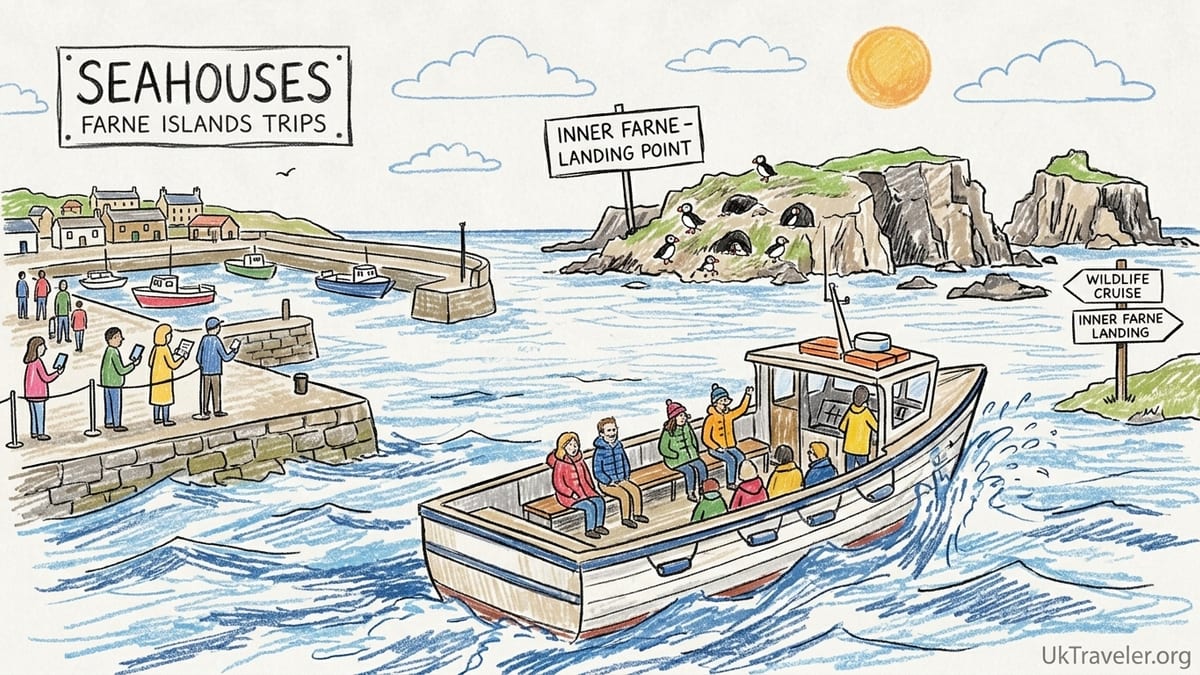
All Farne Islands trips start in the same place: Seahouses harbour on the Northumberland coast. The three main names operating here are Billy Shiel’s Boat Trips, Serenity Farne Island Boat Tours and Golden Gate Farne Islands Boat Trips. They share the same stone quays and similar queues of hopeful visitors clutching printed confirmations or phone screens that glow with puffin photos. My chosen sailing was advertised as a wildlife cruise with an Inner Farne landing option, running for around two-and-a-half hours from departure to return.
The vessel itself was a traditional open-deck boat with bench seating and basic shelter around the wheelhouse. These are workhorse boats, not luxury vessels: wooden or GRP hulls, simple toilets if you are lucky, and room for a few dozen passengers. On a busy summer day it feels as if every company wants to leave at the same time, and you find yourself funneled along the quay while staff call out boat names and departure times. It is not chaotic, but it is certainly not the calm, contemplative wildlife expedition the brochures suggest.
Sea conditions on my late August sailing were what skippers like to call "fresh." The North Sea had a short, restless chop, with spray blowing back over the bow whenever we turned into the wind. People who had assumed a gentle cruise began reaching for the handrails and zipping jackets up to their chins. A few quietly fumbled for seasickness tablets they had not thought to take earlier. There is nothing unusual about this; it is simply the North Sea behaving like the North Sea. Yet the promotional material rarely matches the reality of cold wind, spray and the physical effort of staying steady on a crowded deck while trying to hold a camera.
Expectation, though, was the real gulf. I heard fellow passengers talking confidently about puffins as if they were guaranteed, because that is what the marketing implicitly suggested. Almost nobody around me seemed to realise that by late August most Farne Islands puffins have already left their burrows and headed back out to the open sea, invisible from the cliff edges and often well beyond the range of a short coastal cruise.
Which Islands We Touched and the Inner Farne Question
The Farne Islands are not a single destination but a scatter of rocky islets split into inner and outer groups. Names like Inner Farne, Staple Island, Brownsman, Longstone and Big Harcar appear in the literature, but in practice the exact islands you see often depend on weather, tide and which product you booked. On my trip the route threaded around several of the inner group, with slow passes by bird cliffs that, in August, looked surprisingly bare of seabirds. Guillemots and razorbills were already thinning out, and the real spectacle had clearly peaked weeks earlier.
The selling point on my ticket was the advertised landing on Inner Farne. In 2026 that matters more than ever, because landing access has only recently restarted after several seasons of disruption. Inner Farne reopened for visitor landings from 1 April 2026, with access managed by the National Trust, time limits on shore, and a requirement that visitors stay on waymarked paths to protect both birds and fragile terrain. Landings sound straightforward in the brochure. In practice, they are conditional and sometimes quietly dropped if sea conditions or conservation needs change even slightly.
Our skipper explained, as we approached, that landings were “subject to conditions” and that the final decision would be made on arrival. The swell against the quay, the wind direction and tide would all be factors. This is the honest safety reality of any small-boat operation. But many visitors hear the word "landing" in the product name and assume it is guaranteed. On my particular sailing, we did step ashore on Inner Farne, but only for a tightly controlled hour. We were shepherded along the main loop path, watched over by staff and volunteers, and reminded frequently of the time remaining before we needed to be back on the jetty.
The experience on land was restricted and, in late August, also noticeably quieter in bird terms. The famous aggressive Arctic terns had already gone, leaving only a scattering of late lingerers and a colony in transition to autumn. Puffins were virtually absent on the paths and burrow banks. A few distant specks remained offshore, low on the water and impossible to photograph well without serious lenses. Those around me who had mentally banked on arm’s-length puffin portraits came away deflated, even though the operators could reasonably argue that they had delivered the promised landing.
Sightseeing Cruise vs Landing Trip: A Crucial Distinction
If there is one distinction that visitors routinely misunderstand, it is the difference between a sightseeing cruise and a landing trip. From Seahouses you can buy short non-landing cruises that simply circle the islands, perhaps focusing on grey seals or general seabird watching. These tend to last around ninety minutes to two hours and remain entirely boat based. Then there are combined products that include time ashore on Inner Farne or, in previous seasons, Staple Island. These usually block out two-and-a-half to three hours, part on the water and part on land.
The problem is that many people see “Farne Islands wildlife cruise” and treat all options as interchangeable. A cheaper non-landing ticket can look like a bargain until you realise, too late, that you will never set foot on an island. Conversely, some pay extra for a landing at a time of year when most of the marquee wildlife has already departed. On my boat a number of passengers admitted they had not noticed whether their ticket included an island landing or not; they had simply clicked the puffin photo online and entered their card details.
There is also the subtle issue of how landing time is framed. An operator may advertise a three-hour tour, but the actual landing window on Inner Farne can be only one hour, limited by the National Trust and island logistics. The rest of the time is taken up by loading at Seahouses, slow cruising between islands, and re-embarkation. Nothing about that is dishonest, but it means that the immersive hour on land you thought you had bought is more like forty to fifty minutes once everyone has disembarked, listened to the welcome talk and found their bearings.
Most critically, a boat trip that never lands is a very different experience for photography and wildlife encounters. On my sailing, the choppy water and tightly packed passengers meant that anyone without a fast shutter speed and strong sea legs struggled to get clear shots. When puffins are present in peak season, they often sit at burrow entrances or flutter low over the cliffs. Observing them from a boat is charming, but it is not the same as kneeling a few metres away with the bird at eye level from a boardwalk on Inner Farne earlier in the summer.
The Separate National Trust Landing Fee: An Easy Way to Overpay
Another frequent point of confusion is money. The price displayed by your chosen boat operator is almost always the boat fare only. Any landing on Inner Farne is subject to a separate National Trust island admission charge. In 2026, the published non-member landing tariffs are explicit: adults pay 17 pounds in May, June and July, and 13 pounds in April, August and September. Children pay lower but still significant amounts. These fees are set by the National Trust and are paid at a kiosk on Seahouses harbour or, on some tours, handled by staff before you step onto the island.
In practice, this means that if you buy, say, a 32 pound adult island-landing ticket from a boat company, you may also need to add the National Trust landing charge on top. Your day’s puffin pursuit can therefore climb well past 45 pounds per person once both components are counted. That might be good value in mid-June when cliffs are exploding with life. It feels far less compelling at the end of August when the puffins are effectively gone and you are paying full price to walk around a quieter, more muted colony.
I watched more than one family at the harbour kiosk blanch when they discovered the extra charge. Some had already stretched their budget to buy boat tickets online and had simply not spotted that the website mentioned a separate conservation fee. The information is there, but it is often buried beneath wildlife photos and broad-brush wording about “landing charges may apply.” In my view, that is not transparent enough when the additional cost is double digits per person.
This separation of fares can also lead to an odd sense of sunk cost. Once you have paid the boat operator, there is a strong psychological push to pay the National Trust fee too, even if you have just been told by staff that the puffins are mostly offshore now. Few visitors are willing to turn back and convert their expensive outing into a harbour-side afternoon solely because the marquee species is absent. So people pay, go, and come home slightly disappointed, not quite sure where their planning went wrong.
Puffin Season on the Farne Islands: The Reality, Not the Brochure
At the heart of this misunderstanding is a basic ecological fact: puffins are seasonal breeders, not resident mascots. On the Farne Islands they return from the North Sea in late March or early April, dig or refurbish burrows, lay eggs and raise chicks. By late July the majority of those chicks, often called pufflings, have fledged. At that point the adults begin to depart in waves, heading back out to sea where they spend the rest of the year on the open water, far from easy tourist access.
Local naturalists, long-term wardens and independent wildlife guides all repeat the same rule of thumb: the main puffin viewing window on the Farne Islands is April to late July. There is always some annual variation. In some years you might see small rafts of lingering birds just offshore into early August. In others, a spell of fine weather or food availability may nudge the timetable a week earlier or later. But arriving in mid or late August expecting dense burrow banks and puffins posing beside the boardwalk is, quite simply, a misunderstanding of the colony’s life cycle.
This is where marketing edges into mis-selling. Many operator websites use photographs taken in peak season, often on sunny days when the birds are at their most charismatic. There is nothing inherently wrong with that; every destination showcases itself at its best. The problem arises when those same images appear on booking pages for late-season departures, with no equally prominent wording to say that the birds in the photo are only present in those numbers in spring and early summer. A casual visitor could easily assume that puffins are a core feature of any Farne trip right through August.
My own late August landing made the point starkly. Burrows were visible, turf was dotted with the white splatter that betrays a busy colony in recent weeks, and interpretive panels gestured to a spectacle that had clearly just ended. Yet the birds themselves were largely absent, replaced by a scattering of gulls and the occasional shag or cormorant loafing on rocks. Standing beside another visitor who clutched a camera with a brand-new telephoto lens, I listened as they whispered, "Are we too late?" The honest answer was yes, at least for massed, close-up puffins on land.
Operators Compared: Billy Shiel’s, Serenity and Golden Gate
There are genuine and important differences between the three big operators out of Seahouses. Billy Shiel’s is the long-established name, running a fleet of traditional boats with open decks and a mix of wildlife, landing and special-interest trips. Serenity Farne Island Boat Tours tends to emphasise more modern vessels, sometimes with slightly better seating and viewpoints, and has picked up awards from regional tourism bodies. Golden Gate is closely associated with National Trust messaging for Inner Farne landings, often singled out as a primary operator for those trips.
In terms of capacity, many of the traditional boats carry several dozen passengers. On a busy summer afternoon deck space becomes premium real estate, and those who boarded early get the best rail positions for photography. A modern catamaran-style boat, such as those used by Serenity on some departures, can feel more stable in a swell and may offer raised viewing platforms. However, more stability and more space do not necessarily mean fewer people; popular sailings can still feel crowded at the rail when everyone leans out for the same seal or passing bird.
Pricing across the three operators for 2026 Inner Farne landing products has converged around the low 30 pound mark for standard adult boat fares, excluding National Trust island charges. Non-landing wildlife cruises are cheaper, sitting roughly in the low 20 pound range. All three stress that sailings are weather dependent and that landings, in particular, are at the skipper’s discretion. Refund and cancellation terms vary: some allow changes or refunds up to a set cut-off time, while others treat late cancellations as non-refundable. Bad-weather cancellations initiated by the operator are generally refunded or rebooked, but the specifics are worth reading carefully when you book.
Accessibility is another factor that glossy photos tend to gloss over. The National Trust’s own access documentation makes clear that landings involve steep harbour steps, potentially wet slipways and uneven surfaces on the islands. For anyone with limited mobility, the combination of a moving boat, a narrow gangplank and exposed boardwalks can be challenging. Boat operators may assist, but they are constrained by safety rules and the physical nature of the harbour. None of this is a reason not to go; it is simply an argument for honest, practical information rather than dreamy wildlife montages.
Avian Influenza, Conservation Closures and Changing Rules
Recent years have brought a layer of complexity that no traveler brochure from a decade ago had to consider: avian influenza. Outbreaks of highly pathogenic bird flu along UK coasts have already forced conservation bodies to restrict access to sensitive seabird colonies, including the Farne Islands. Whole seasons have seen landings reduced or suspended to reduce stress on affected birds and limit potential spread. These decisions are not made lightly. They balance the conservation duty to vulnerable species with the economic importance of tourism to coastal communities.
For visitors, the key point is unpredictability. Access rules for a given season can change between the time you book and the day you sail. Inner Farne’s reopening for landings from 1 April 2026 is a significant positive step, but it is not an ironclad guarantee for future years. If monitoring data suggests renewed risk, conservation closures could return. In those circumstances, your carefully chosen "Inner Farne landing" might revert to a non-landing wildlife cruise with little notice. Operators generally offer refunds or alternatives if the entire purpose of the trip vanishes, but frustrations are inevitable when holidays are short and expectations high.
There is also the quieter issue of reduced seabird numbers. Even when landings go ahead, some colonies have been hit hard by disease, altering the density and behaviour of birds. That can translate into thinner rafts of puffins on the water, more gaps on ledges, and an overall sense that the spectacle has shrunk. No ethical operator can control that, but they can control the way they communicate about it. I would much rather read a blunt update on a booking page explaining that numbers are currently lower than historic highs than be sold a vision of endless birds that no longer quite matches reality.
In this context, the National Trust landing fees are not just another tourist surcharge; they are part of the funding that pays for rangers, monitoring and habitat management. It is reasonable to charge for access to a fragile site. It is also reasonable for paying visitors to expect crystal-clear, current information about any restrictions or reduced wildlife presence before they commit their money.
Cold Winds, Queasy Stomachs and the Limits of Deck-Rail Photography
Marketing copy for Farne Islands tours often leans heavily on serene images of people in light jackets, smiling at puffins in evening sun. My actual experience was very different: hat jammed down over my ears, fingers going numb around the camera, eyes watering from wind-blown spray. Even on a dry afternoon the wind over open water can cut through spring and summer clothing. Standing at the rail for an hour or more takes stamina, and you share that narrow strip of space with dozens of other passengers trying to do exactly the same thing.
As the sea built slightly during our circuit, the boat began to pitch and roll in a way that felt perfectly ordinary to the crew but clearly stretched a few of those on board. I watched people quietly sit down, eyes fixed on the horizon, conversation fading as they dealt with motion sickness. The company had done nothing wrong; the sailing was entirely within normal conditions. Yet I could not shake the feeling that many customers had been sold a "gentle cruise" when what they really needed to picture was a working boat in changeable North Sea weather.
Photography in these conditions was challenging. The upper deck was crowded, elbows and telephoto lenses jostling for space whenever a seal popped its head up or a late puffin skimmed across the surface. Every small lurch blurred long-lens shots, and the best views went to those who had staked out prime positions before we had even left Seahouses. On Inner Farne itself, the absence of close puffins meant that most cameras swung instead toward the lighthouse, views back to the mainland and the last terns drifting across the sky.
None of this made the trip worthless. The islands remain atmospheric and beautiful, and the sight of grey seals loafing on rocks at low tide would be a highlight on many coastlines. But for those who came specifically for iconic puffin portraits, and who had paid premium high-season prices to do so, the reality felt out of alignment with the promise they had inferred from pictures and vague descriptions.
What I Would Choose Next Time and How to Book Smarter
If I were planning again with the benefit of experience, I would be far more specific. I would pick a landing trip that clearly states Inner Farne access, travel in the core puffin window between May and mid-July, and check that the booking page explicitly distinguishes between sightseeing cruises and landings. I would budget for both the boat fare and the National Trust landing fee from the outset, accepting that a realistic per-person cost for a prime-time landing visit will typically sit somewhere north of 45 pounds by the time all charges are in.
I would also pay close attention to departure times. Early morning sailings can offer softer light, slightly smaller crowds and cooler temperatures that suit both birds and people. Late afternoon trips may have more atmospheric sun but are also more vulnerable to sea breezes building through the day. For anyone prone to seasickness, the calmer window is usually earlier. And I would never again book a puffin-focused trip in the second half of August, however tempting the availability and accommodation prices on the mainland might be.
When comparing operators, I would look beyond headline price and puffin photos to concrete details: vessel type, maximum passenger numbers, whether there is an upper deck, what the cancellation policy says about partial trips if landings are cancelled, and how clearly the company communicates about seasonal wildlife changes. A website or booking staff member who plainly says, "By late July most of the puffins will be starting to leave" earns my trust, even if it costs them a booking for a late-summer date.
Above all, I would view any wildlife image in advertising as an example, not a promise. Puffins are wild seabirds, not performers on a timetable. They respond to ocean conditions, food availability and long-term environmental pressures. In some years the spectacle is overwhelming; in others it is merely good. No honest operator should imply otherwise. The role of responsible tourism is to make it possible to witness these birds without harming them, not to guarantee their presence on demand.
The Takeaway
My Farne Islands trip from Seahouses was not a disaster. The boat was seaworthy, the crew professional, and the islands remain a special place by any reasonable coastal standard. Yet as a puffin-focused experience, bought late in the season and framed by enthusiastic marketing, it fell well short of the expectations that many of us carried onto the quay. The core problem was not the weather or the birds’ choices; it was a muddle of vague language, glossy imagery and incomplete information about timing, prices and access.
If you genuinely want to see puffins on the Farne Islands at their best, you need to visit in the right months, understand the difference between a boat-only cruise and a landing trip, and factor in the separate National Trust landing charges. You also need to mentally prepare for cold winds, a moving deck and limited photography angles on busy sailings. These are not luxury wildlife safaris; they are local boat trips into a working seabird colony that happens to be accessible.
Next time, I would book a May or June Inner Farne landing with a clear, written acknowledgment from the operator that wildlife sightings are never guaranteed. I would prefer a slightly smaller, more stable vessel with transparent capacity limits, even if it cost a little more. And I would want to see candid wording about puffin season on every page where puffin photos appear, not hidden away in a footnote.
Operators, for their part, need to resist the temptation to let marketing overrun biology. They should never imply guaranteed puffin encounters, never bury separate landing fees in small print, and never gloss over the genuine possibility that conservation closures or disease outbreaks will curtail access. Visitors can handle nuance and uncertainty when it is presented honestly. What undermines trust is discovering those realities only after you have stepped aboard and handed over your money.
FAQ
Q1. When is the best time to see puffins on the Farne Islands?
The main puffin season on the Farne Islands runs from about April to late July, with peak burrow activity and close views usually in May and June.
Q2. Are puffins still around in August?
By early August most puffins have left their burrows and many have already headed back out to sea, so late July and August trips often see only a few birds offshore, if any.
Q3. What is the difference between a sightseeing cruise and a landing trip?
A sightseeing cruise stays on the boat and circles the islands, while a landing trip includes time ashore on Inner Farne or another island, usually around one hour on land.
Q4. Do boat tickets include the National Trust landing fee?
Generally they do not. The boat fare is separate from the National Trust island landing charge, which in 2026 is 17 pounds in May to July and 13 pounds in April, August and September for non-members.
Q5. Which operators run Farne Islands trips from Seahouses?
The three main operators are Billy Shiel’s Boat Trips, Serenity Farne Island Boat Tours and Golden Gate Farne Islands Boat Trips, all departing from Seahouses harbour.
Q6. How long do Farne Islands boat trips usually last?
Non-landing wildlife cruises are typically around ninety minutes to two hours, while trips that include an Inner Farne landing generally last between two-and-a-half and three hours.
Q7. Is Inner Farne open for landings again?
Yes. Inner Farne reopened for visitor landings from 1 April 2026, although access remains controlled, and landings always depend on sea conditions and conservation requirements.
Q8. Can operators guarantee puffin sightings?
No. Puffins are wild seabirds and their presence depends on season and conditions, so any implication of guaranteed sightings should be treated with caution.
Q9. What should I wear for a Farne Islands trip?
Expect it to feel colder and windier at sea than on shore. A warm, windproof layer, hat, gloves and waterproof outer shell are sensible even in midsummer.
Q10. Is a Farne Islands boat trip suitable if I get seasick?
The boats are generally stable but sail on open water where chop and swell are common. If you are prone to motion sickness, take precautions and consider an earlier, calmer sailing or a shorter cruise.