


I thought I knew how to handle a Northumberland coast road trip. Bamburgh in the morning, Holy Island for lunch, Berwick by late afternoon. It looked elegant on paper, pencilled neatly between two castles like just another scenic stop. Then I tried to execute it on an autumn day when the safe crossing window to Holy Island Lindisfarne was barely four hours long, the weather turned from drizzle to driving rain, and the reality of tides, ticket prices and limited opening times collided with my optimistic itinerary. I will not make the same mistake twice.
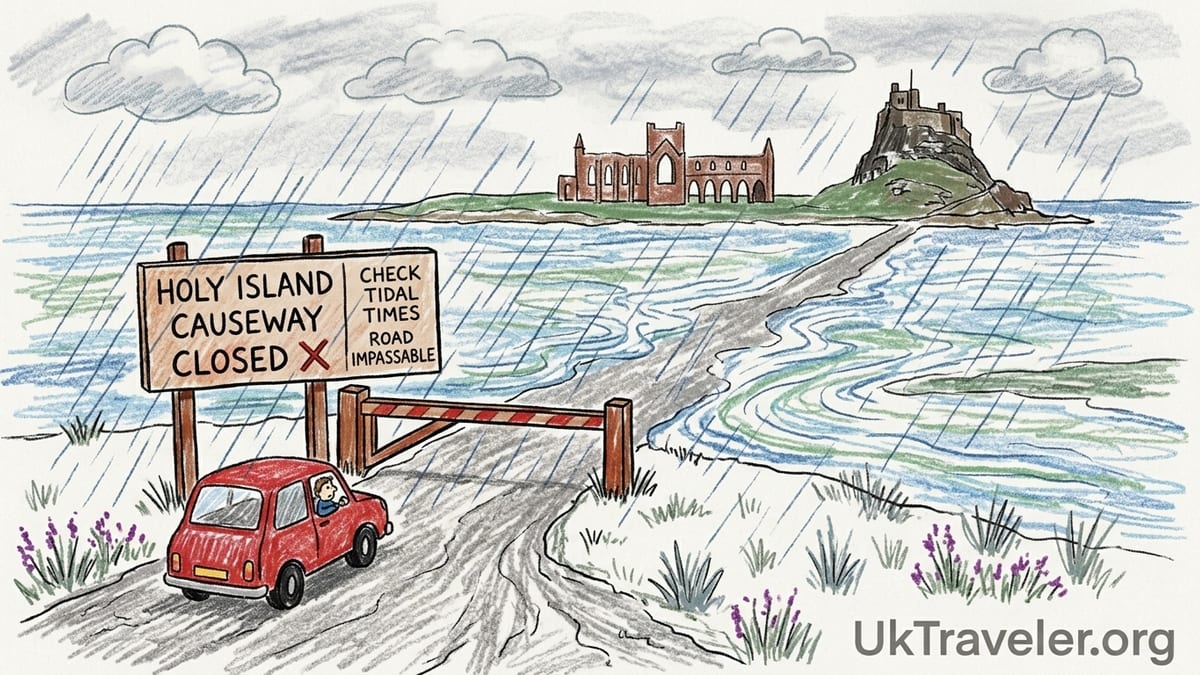
Arriving With a Perfect Plan That Fell Apart at the Causeway
My visit began, as many Holy Island stories do, on the approach road from the A1 near Beal. I had left Bamburgh later than planned after a longer-than-expected wander around the castle and village, confident that I still had “loads of time” within the advertised safe crossing period to nip across to Lindisfarne, see the priory and castle, grab a bowl of soup, and push on towards Berwick-upon-Tweed before dark. The Northumberland County Council tidal timetable that day showed a late morning to early afternoon window for safe causeway crossings, roughly four and a half hours in total. That felt generous when I was reading it with a coffee in Alnwick. At the barrier, watching the wind push sheets of water across the saltmarsh, it felt very different.
The tidal signs near the causeway entrance were blunt. Safe to cross up to a specific time, unsafe after. The Council also recommends that drivers build in an extra 30 minutes either side of the published window as a safety margin, advice that makes immediate sense once you see how fast water moves over the mudflats. Put that into practice and the usable driving window shrinks noticeably. On my day, that turned a 10:15 to 15:00 advertised crossing period into something more like 10:45 to 14:30 in my notebook. That might still sound adequate, but by the time I had queued behind cautious drivers and crawled onto the island, nearly an hour had already vanished.
Mistake number one was treating the causeway like an ordinary rural road with slightly quirky signage. It is not. It is a tidal crossing that sits below sea level twice a day and behaves on the sea’s schedule, not yours. You do not arrive when it is convenient for a café lunch or a National Trust timeslot. You arrive when the tide and Northumberland County Council collectively decide you can, and you leave when they decide you must. Everything else in your day bends around that simple reality, or you will find yourself rushed, disappointed, or worse, stranded.
The weather compounded the miscalculation. Drizzle at Seahouses had become horizontal rain by the time I pulled into the main car park outside the village. Wind on a tidal flat feels more serious than wind in a sheltered town square. Every minute spent adjusting waterproofs and boots at the car, or negotiating puddles on the path, was a minute of my already shrinking safe window. The sea does not pause the tide because you are fiddling with your hood.
The Tidal Timetable: What It Really Does and Does Not Cover
Before this visit, I had skimmed the Northumberland County Council Holy Island causeway timetable without really digesting its implications. The table gives daily “safe to cross” times for vehicles using the road causeway, based on local high and low tides. Crucially, buried in the explanatory text is a line that matters enormously in practice: the published times apply to the road only, not to the traditional walking route over the sands, sometimes called the Pilgrims’ Way. There is a separate line of posts across the sands that experienced walkers use at low water, but the Council is explicit that the road-safe period does not automatically make that route safe.
The Council warns that anyone walking the sands should plan to have completed their crossing before the midpoint of the road safe period, when the tide is at its lowest and the flats are most exposed. In other words, if the timetable says it is safe to drive from 10:15 to 15:00, the ideal time to be finishing a walk over the sands is around the middle, not setting out from shore with your boots freshly laced. That advice alone should stop anyone casually adding “we might walk across if the mood takes us” to a sightseeing day built primarily around driving.
My own plan did not involve walking the sands, but the distinction matters because it shapes the whole character of Lindisfarne. There are essentially three ways to visit: drive over the causeway at a permitted time, take public transport timed to the tide, or walk via the Pilgrims’ Way within a much tighter safety envelope. The road timetable is the most visible guidance, yet there is a danger in assuming it covers every kind of crossing. It does not. If you want to follow the posts across the mud, you need to be more conservative than the road drivers, start earlier, and be prepared for wet sand and changing conditions underfoot.
Local walking guides suggest that a one-way crossing via the Pilgrims’ Way can take around two hours under decent conditions. That means four hours if you are tempted to walk both ways, and those hours must lie snugly around the low tide. Superimpose that on a car-based itinerary from Bamburgh or Newcastle and the practical conclusion is stark. For most visitors on a short coastal road trip, the romantic idea of striding across shimmering sand to Lindisfarne is simply incompatible with also trying to “pop in” between other stops. Either you dedicate the day to the crossing and the island, or you stick to the causeway road. Compromise creates risk.
Strandings, Warnings and Why “Just Five Minutes” Is Never Worth It
The Council and local authorities share occasional images of vehicles marooned on the causeway as the tide rises, and local news outlets periodically report on the latest driver who tried to beat the sea and lost. It is important not to sensationalise this; hundreds of cars cross safely on most days. Serious incidents are not an hourly occurrence. But that relative rarity does not make the behaviour that causes them any less reckless. Vehicles that become stuck often do so because their drivers have treated the posted times as “rough guidelines” rather than boundaries and have attempted to cross toward the very end or outside the recommended period.
What shocked me in person was how quickly the water began to encroach as the safe window moved toward its close. On my visit I left before the advisory margin expired, yet even in that conservative timeframe, shallow streams were already building under the bridge and swirling across the lower sections of tarmac. It did not take imagination to see how thirty extra minutes, a minor delay, and one wrong judgment call could leave a low-slung car in trouble. The idea of pausing to photograph the view from the middle of the causeway, or deciding you can “squeeze in” an extra cup of tea on the island and still make it, looks absurd when you have watched the water rising minute by minute.
Documented strandings come with real costs. Drivers may require rescue by local emergency services, and recovery vehicles have to negotiate the same tides to retrieve stranded cars. There is embarrassment and expense for the individuals involved, and a drain on public resources that are already stretched. Crucially, none of it is necessary. There is nothing on Holy Island so essential or so urgent that it justifies crossing outside the official safe period. If the times do not work for your plans, you change the plans, not the physics of the North Sea.
On the island itself, many residents and tourism businesses quietly build their lives around this reality. Shop owners schedule deliveries for safe windows. Accommodation providers brief guests repeatedly about checking the timetable. Signs near the village remind visitors that, while it may look like any other English village with pubs and gift shops, everyone here is bound to the tide. The least a visitor can do is respect that rhythm, rather than treating it as an inconvenience to be gamed.
Parking, Walking and the Compressed Sightseeing Experience
Once I finally rolled onto the island and followed the stream of vehicles into the main public car park outside the village, the tidal constraint translated into another, more prosaic limitation: time on foot. From the car park it is a short but definite walk into the village centre. On a dry, still day it is an easy and pleasant stroll. In heavy rain and strong wind, it feels longer, as you skirt puddles and adjust hoods while trying not to be clipped by vehicles. Already aware of the ticking clock on the causeway, I found myself hurrying instead of looking.
The first major heritage site you encounter is Lindisfarne Priory, managed by English Heritage. The priory ruins sit just beyond the parish church and museum. On my day, admission for an adult non-member was a little under ten pounds, with various concessions and family tickets available. It is a moving site, layered with early medieval history and the story of the Lindisfarne Gospels, but it is not enormous. Even walking slowly and reading every panel, most visitors will cover the main area in under an hour. Under normal circumstances, that would feel like good value. Under time pressure, I found myself calculating backwards from the safe departure time instead of sinking into the atmosphere.
From the priory to Lindisfarne Castle is a further walk along the shoreline and up toward the rocky outcrop at the eastern end of the island. It is roughly fifteen to twenty minutes at a moderate pace from the village, but again, the weather and your own fitness can stretch that. There is no longer a regular shuttle bus from the car park to the castle, so visitors who want to see the interior must budget enough time and energy to walk there and back. Entry to the castle, cared for by the National Trust, is priced separately from the priory. A standard adult ticket for a non-member is in the region of thirteen pounds, with National Trust members entering free.
Put those pieces together, and a simple half-day of sightseeing begins to look more complicated. In my case, by the time I had parked, walked into the village, visited the priory, taken shelter from a squall in a café on the main street, and slogged out toward the castle, the tide timetable felt uncomfortably close. I chose not to pay for castle entry because I knew I would be glancing at my watch throughout the visit. Instead, I walked around the exterior and along the nearby lime kilns, then turned back. In theory, I had enough minutes left to sprint through the interiors and make it off the island safely. In practice, it would have been a rushed, anxious experience that did not do justice to the building or the fee.
Tickets, Seasons and When the Numbers Stop Adding Up
Holy Island is often marketed through iconic images of Lindisfarne Castle perched on its crag and evocative shots of priory arches at sunset. The implication is that you arrive, see both, and leave satisfied. In reality, access is segmented by both tickets and seasons. The priory and the castle are operated by different organisations with separate admission charges. On the day I visited, buying both tickets as a non-member would have meant paying somewhere in the region of twenty to twenty-five pounds for two relatively compact sites, before I even bought a coffee or a bowl of soup.
For some travellers that is acceptable. For others, especially families, it is a significant extra spend on top of fuel, parking and perhaps a longer journey from Newcastle or Edinburgh. The value equation shifts again when you factor in seasonal opening hours. Both the castle and priory operate reduced hours in winter, and there are days when one or both are closed entirely. The castle, in particular, has varied opening days, and when it is closed you can only appreciate it from outside. If your chosen day also happens to coincide with a short tide window, you may find you can technically drive onto the island, but cannot actually enter the site you hoped to see.
This is where treating Lindisfarne as a roadside detour becomes most problematic. I met a couple in the car park who had driven from York, planned to be on the island for barely two hours between safe crossing cut-offs, and had not realised that the castle was operating on limited opening that week. They faced a blunt choice. Either pay for the priory alone, swallow the sunk fuel and time costs, or push their luck on the tide for a longer visit. To their credit they chose the safe option, curtailed their plans and left early. It was hard not to think how much better their day would have been with a tide-first planning mindset.
In my own case, I found the priory ticket worthwhile even in a compressed window. The interpretation boards are well written, and the site retains a powerful sense of place even in bad weather. By contrast, paying separately for castle entry would have felt poor value given the time I had left. Several regular visitors I spoke to that day, including National Trust members, commented that the castle’s interiors can feel sparse compared with the strength of its exterior silhouette. Without membership to dilute the cost, it is worth asking yourself whether you have enough unhurried time to explore the interior fully, or whether appreciating it from the outside and investing more time in the priory and the coastal paths would serve you better.
Self-Drive Rush Versus Public Transport and Staying Overnight
My day on Holy Island was shaped by the car keys in my pocket. Like many travellers driving the Northumberland coast, I treated the causeway as simply another stage in a road trip. In theory, driving gives you maximum flexibility. In practice, it can encourage over-ambitious scheduling. The temptation is to think you can always “make up” time on the road. The tide timetable does not care how fast you drive between Bamburgh, Beal and Berwick. It is a fixed gate in your day that only opens and closes at specific hours.
Public transport options to Holy Island are more limited but also more honest about the power imbalance between visitors and the sea. A local bus service from Berwick-upon-Tweed operates on selected days, carefully timed to fit within safe crossing windows. Some travellers use a combination of mainline train to Berwick and pre-booked taxi over the causeway, again structured around the Council’s timetable. When you plan this way, the tide becomes the first entry in your diary, not an afterthought to be squeezed between other attractions.
The most relaxed experiences I have seen on Lindisfarne belong to those who stay overnight in local guesthouses or small hotels. They arrive on one safe crossing and knowingly accept that they will be “trapped” on the island once the tide rises. Instead of anxiously watching the clock during an afternoon visit, they walk the harbour at dusk, listen to the sudden quiet when the last day-trippers leave, and wake early to explore the beaches or nature reserve before the first wave of vehicles returns. Yes, overnight stays add accommodation costs, but they also transform Holy Island from a rushed checklist item into the main event.
Comparing my own rushed self-drive afternoon with the accounts of travellers who stayed overnight, I am convinced that Lindisfarne rewards slowness. Public transport or a planned overnight stay forces you to accept the island’s rhythm. A car, in contrast, can enable the illusion that you control the schedule. Until you meet the tide.
A Corrected Tide-Based Half-Day and Overnight Plan
If I were to repeat my visit with the lessons learned, I would begin with the tide table and build everything else around it. For a tide-friendly half-day trip by car, I would choose a date where the safe crossing window creates either a clear morning or clear afternoon on the island, with at least six hours between the recommended start and end times once I have applied the extra thirty-minute safety margin on both sides. That sort of gap gives you realistic space to park, walk into the village, visit at least one paid site unhurriedly, and still have time for a meal and a short coastal walk.
On such a half-day plan, I would buy a ticket for Lindisfarne Priory as my primary paid heritage experience. It is closer to the car park and village, its opening hours are often slightly more forgiving than the castle’s, and the connection to early medieval Christianity and the Viking raids gives it a depth that does not rely on elaborate interiors. I would walk to the castle exterior, enjoy the view back across the island and out to sea, but I would only pay the separate castle admission if I were either a National Trust member or confident that I had at least ninety relaxed minutes to explore inside. The aim would be to leave the island well before the advisory end of the safe window, accepting that missing a second coffee or a final photograph is preferable to any hint of risk.
For an overnight plan, I would shift the focus entirely. Instead of trying to combine Holy Island with both Bamburgh and Berwick in a single day, I would treat Lindisfarne as the anchor. I would arrive on a late afternoon safe crossing, check into local accommodation, and skip any paid sites that day. Instead, I would wander around the harbour, walk a section of the coast as the light changes, and watch the causeway disappear under water. Dinner would be in one of the island pubs, followed by a quiet evening stroll once the day visitors have departed. The sense of being separated from the mainland is far more pronounced at high tide than during a rain-lashed lunch hour.
The next morning, after breakfast, I would use the first safe crossing window and morning opening hours to visit both the priory and, if open, the castle. This staggered approach allows you to spread ticket purchases across two days and to experience the sites when they are quieter. It also means that if the castle happens to be closed that morning due to season or maintenance, you have still had a rewarding island experience built around landscape, village life and the priory. In this scenario, paying for both priory and castle feels like better value, because they are no longer competing with the anxiety of a looming departure time.
The Takeaway
Holy Island Lindisfarne is not a failure of a destination. It is a failure of planning when treated as a casual roadside attraction between Bamburgh and Berwick. My own visit worked on paper and unravelled in practice because I treated the tidal timetable as an administrative detail instead of the backbone of the day. I underestimated how much time would leak away in parking, walking, sheltering from weather, and simply adjusting to the landscape. I overestimated the value of squeezing both priory and castle interiors into a narrow window, and underestimated the quiet richness of just being on the island without a ticking clock.
If there is one clear verdict from my experience, it is this. The paid heritage experience most worth prioritising on a short, tide-bound visit is Lindisfarne Priory. It is compact, powerful, and logistically easier to fit around the constraints of parking and walking. Lindisfarne Castle, with its striking silhouette, is best appreciated either by National Trust members who are not counting every pound of admission or by visitors who have deliberately allowed themselves enough time on the island, ideally by staying overnight. What is never worth paying is the hidden price of complacency about tides and times.
I would never again plan a Holy Island visit without first consulting the Northumberland County Council crossing timetable, reading the small print about the walking route, and sketching my day around those immovable numbers. The island deserves that respect. So do the people who live and work there, and so does your own safety. Lindisfarne rewards those who arrive on its terms. The sea will not negotiate.
FAQ
Q1. Do the official Holy Island safe crossing times apply to both the road and the Pilgrims’ Way walking route?
The Northumberland County Council times are calculated for the road causeway only. Walkers using the Pilgrims’ Way across the sands should aim to finish their crossing before the midpoint of the road safe period and be more cautious than drivers.
Q2. How much extra time should I allow beyond the published safe crossing window?
The Council advises building in an additional safety margin of around 30 minutes at the beginning and end of the published safe period. In practice, this means arriving at the causeway early, not driving onto it at the last permissible minute.
Q3. Is it ever acceptable to “quickly” cross outside the safe times if the road still looks dry?
No. Conditions can change extremely quickly as the tide turns, and shallow water can become deep and fast-moving in minutes. There is no sightseeing goal that justifies crossing outside the official safe window.
Q4. How long do I realistically need on Holy Island for a first visit by car?
To park, walk into the village, visit at least one paid site without rushing, and have a meal, you should aim for a usable window of around six hours within the safe crossing period once safety margins are applied.
Q5. Is Lindisfarne Castle worth the separate admission fee?
Many visitors enjoy the castle, but given the separate ticket and tidal time pressure, it represents best value if you are a National Trust member or have allowed at least ninety relaxed minutes on top of the walk from the village.
Q6. Which sites should I prioritise if I only have a short time on the island?
For a brief visit, Lindisfarne Priory is the most practical paid site to prioritise, as it is close to the village and richly interprets the island’s early Christian history. You can then walk to view Lindisfarne Castle from outside.
Q7. How do seasonal opening hours affect a visit?
Both the priory and castle operate reduced hours and occasional closures in winter and shoulder seasons. A short safe crossing window can feel like poor value if one of the attractions is closed, so you should check current opening times as well as tides.
Q8. Is public transport a good option for visiting Holy Island?
Public transport options are limited but can work well when combined with train travel to Berwick and a bus or pre-booked taxi timed to the tide. These services are scheduled around safe crossing times, which encourages more realistic planning.
Q9. What are the advantages of staying overnight on Holy Island?
Staying overnight removes the pressure of having to leave before the end of a single safe window. You can enjoy the island when it is quieter, walk in the evening and early morning, and spread visits to the priory and castle over two days.
Q10. Can I include Holy Island as a simple stop between Bamburgh and Berwick?
You can drive that loop in a day, but treating Holy Island as a casual roadside stop often leads to rushed visits, missed sites, or risky decisions around the causeway. It is far better to plan the entire day, or an overnight stay, around the tide timetable.