


I arrived in York on a soft Friday afternoon in October, stepping off the train and straight into the sense that this was a compact city where the past had never fully let go. York railway station curves elegantly around the tracks, and as I walked out through its iron and glass I could already see the city walls and the towers of York Minster rising beyond the trees. The air smelled faintly of wet stone and leaf mould after a passing shower. It felt like the right kind of weather for a weekend built around medieval streets, Viking ghosts and stories in the dark.
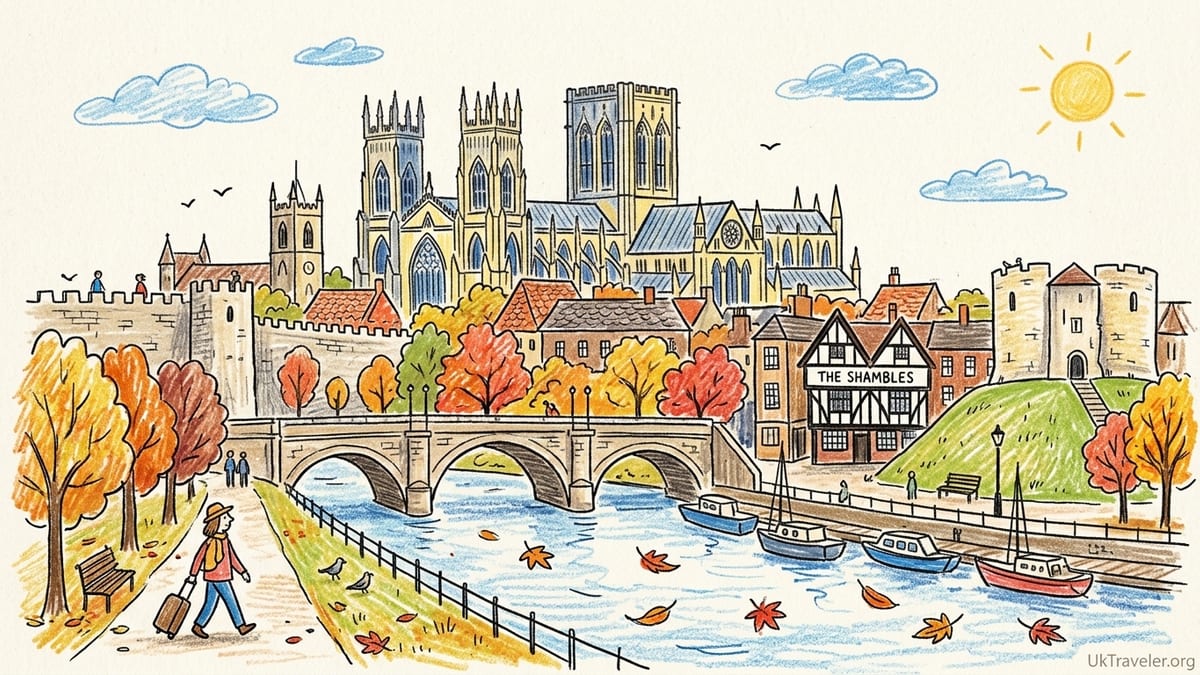
First Impressions and Checking In
From the station I followed the flow of luggage wheels over the bridge towards the walls, crossing the River Ouse with its moored boats and autumn leaves drifting in the current. York’s city walls really do wrap the old centre in stone. Sections rise just beyond the traffic, yet once you climb the steps and step onto the parapet, the noise drops and the view opens to tiled roofs, church towers and snaking alleyways. Knowing that the walls are free to walk and usually open from 8 in the morning until dusk made them feel like an open invitation rather than a set attraction with a ticket barrier.
For this weekend I based myself at a simple, modern hotel about five minutes’ walk outside the walls, near Micklegate Bar. My double room cost just under £120 per night on a flexible autumn weekend rate, without breakfast, which felt about average for York in October. The room itself was functional rather than memorable, but the location mattered more than the décor. I could walk into the historic centre in under ten minutes, and I never once needed a taxi during the stay.
Dropping my bag, I walked back out while there was still daylight to get my bearings. Passing through Micklegate Bar gave me my first close encounter with the medieval gateways. These heavy stone bars once controlled access to the city and in places have timbered buildings perched above the arch. I was struck by how abruptly the modern city outside gave way to narrow streets of brick and half-timbered houses inside. York does not slowly build to a historic core; you cross under the bar and you are in it.
That first wander was not about ticking off sights. I followed whatever lane looked most atmospheric, turning right towards the Minster whenever I caught a glimpse of its pale stone above the rooftops. The bells were ringing for a late-afternoon service, and the sound bounced between shopfronts selling fudge, Viking souvenirs and second-hand books. I had expected York to be pretty. I had not expected it to feel this enclosed and theatrical, as if the whole city were a single, sprawling stage set.
Saturday Morning: York Minster From Floor to Tower
I started Saturday with York Minster, partly because it is one of the few paid attractions in the city that really does justify a ticket, and partly because I wanted to experience it before the streets filled up. I joined a short queue at the main entrance on Minster Yard just after opening, bought a standard adult sightseeing ticket at £20, and confirmed that the ticket would be valid for a full year from the date of my visit. With under-18s entering free with a paying adult, that price made more sense if you think of the Minster as a place to return to rather than a one-off museum visit.
The nave swallowed me as soon as I stepped inside. It is not just the height of the Gothic vaulting that impresses, but its length and light. The pale stone columns carry the eye down to the distant high altar, while the floor pattern draws you forward in quiet stages. I spent the first twenty minutes simply walking the main axis, pausing to tilt my head back until the ribbed vault dissolved into abstraction. The stained glass glowed in bands along the sides, much of it more delicate and pastel than the jewel tones I had imagined, a reminder that this is a northern church where muted daylight and grey skies are part of the design.
I joined one of the free guided tours that loop through the nave, choir and chapter house. The guide combined dates and stories with a dry northern humour that suited the building better than hushed reverence alone. We walked around the Great East Window, currently protected yet still imposing, and then into the chapter house with its umbrella roof and carved stone seats. This was where the Minster felt most intimate, almost like a side room that had grown too ornate for its own good.
After the tour I headed down into the Undercroft, included in the sightseeing ticket. This museum space beneath the Minster brings you closer to the layers under the current floor. Excavations for structural repairs revealed Roman foundations, early church remains and even traces of the fortress that pre-dated the cathedral. The interpretation panels and small artefact displays are concise and focused. Rather than overwhelming with objects, the Undercroft works as a story of how the current building almost collapsed in the twentieth century and had to be saved from below. Seeing the concrete supports holding up the central tower makes the climb above feel very real.
On my way back to the nave I decided to add the Central Tower climb. The combined Minster and tower ticket is currently £26 for adults, so for me it was a £6 top up from what I had already paid. The climb is not theatrical; it is narrow, stone and honest about the 275 steps. You pause halfway to catch your breath in an open gallery looking over the roof, then spiral up again to reach the viewing platform. The payoff is a full sweep of the city, walls looping around, the River Ouse cutting through, and the patchwork of rooflines broken by church spires and the occasional modern block. Looking down on the Minster’s own pinnacles at near eye level is a rare perspective that made the cost and effort worthwhile.
Streets, Snickleways and an Afternoon in the Museum Gardens
From the Minster I drifted south into one of York’s tightest clusters of medieval lanes. Stonegate, with its gold and black signage, felt like the spine of this area. The street is lined with independent shops, chocolatiers and a mix of pubs and jewellery stores. I ducked into a small café just off Stonegate for a late-morning flat white and a slice of lemon drizzle cake, which came to around £7.50. Sitting by the window at a tiny marble-topped table, watching groups funnel past on guided tours, was a reminder that York is a place people listen to as well as look at. Snippets of commentary about guilds, ecclesiastical politics and executions drifted in whenever someone opened the door.
A few lanes later I reached the Shambles, arguably the most photographed street in York. Its timbered upper stories lean so close together in places that they almost touch, and the cobbled roadway is narrow enough that modern crowds quickly fill it. I understood the complaints about over-tourism here, but I also understood the fascination. Looking up rather than at the shopfronts helped: the wonky beams, narrow upper windows and overhanging eaves give you a better sense of what a working medieval street might have felt like. I stopped by the Shambles Market for a quick lunch at the Los Moros stall, paying just under £10 for a generous box of spiced lamb with couscous and salad eaten at a standing table.
In the afternoon I crossed over to the Museum Gardens, set between the river and the Minster. They are a mix of lawns, formal planting and evocative ruins, and they are free to enter. Families were kicking a football on the grass while couples wove between the flowerbeds, and students sat in small circles with takeaway coffees from the nearby booths. The most striking feature is the remains of St Mary’s Abbey, a line of gothic stone arches and walls left open to the sky. Standing beneath them, with York’s everyday life continuing only a few metres away, felt like being allowed backstage at history.
The gardens also give some of the best relaxed views of the Minster, framed by trees rather than by shops. I found a bench near the river and sat for a while, listening to the mix of birdsong, chatter and occasional boat horns. It is easy in York to get pulled from landmark to landmark. The Museum Gardens offered a necessary pause, a reminder that part of experiencing a historic city is letting it pass by you for half an hour without agenda.
Viking York and JORVIK’s Blend of Museum and Theme Ride
Late in the afternoon I walked towards Coppergate for my timed entry slot at the JORVIK Viking Centre. I had booked an adult ticket online in advance at £17.50, slightly cheaper than the £18.50 standard walk-up price. The ticket, like York Minster’s, included free return visits for twelve months, which makes it better value for visitors who expect to be back in the city within a year. Coppergate itself is a modern shopping street, but the centre is built directly over the archaeological dig that uncovered a Viking-age settlement here.
The visit begins not with artefact cases but with a short descent to a glass floor overlooking part of the original dig site. You can see post holes, worn timbers and dark, preserved soil. Audio explains what was found and why the conditions here preserved leather, textile and even organic waste. This was the most conventionally educational part of the experience, and it helped anchor what came next.
The heart of JORVIK is its suspended capsule ride through reconstructed Viking streets. You sit in a small car, which moves slowly through a dimly lit series of scenes, with narration and conversation in Old Norse and English. The smell of woodsmoke and fish is pumped into the air and animatronic figures go about daily tasks: weaving, trading, tending fires and slaughtering animals. It is highly theatrical, closer to a theme-park dark ride than a typical museum gallery. Yet the scenes are based on the archaeological evidence from this very site, and the commentary points out where details like combs, ice skates or game pieces were recovered.
Stepping off the ride returns you to a more familiar museum environment of display cases and interactive screens. Here, real artefacts take centre stage: shoes, tools, jewellery, and a famous pair of preserved human coprolites that reveal the Viking diet in unglamorous detail. Panels explain the social structure of Viking York, trade networks and craftsmanship. For me, JORVIK sat squarely between education and theatre. The ride felt designed to capture imagination and senses, while the final galleries provided the context and depth. I left feeling I had learned something tangible about Viking-era York, yet I was also aware that the staging shaped my emotional response as much as the facts.
One important practical note emerged when I checked my booking confirmation: JORVIK is scheduled to close for maintenance from 2 to 8 November 2026. It was open during my October weekend, but that closure window is a sharp reminder that dates matter. In a city where so many highlights, like the walls and Museum Gardens, are always open and free, it is easy to assume that a paid attraction will be accessible on any given date. It is worth checking the official pages for updates before building a tight itinerary around a specific time slot.
Evening Pubs, Ghost Walks and York After Dark
York in the evening softens but does not entirely empty. After JORVIK I headed back towards the Shambles area for an early dinner. I chose a cosy bistro just off Petergate where a main course of slow-cooked beef with mash and seasonal vegetables, plus a pint of local bitter, came to around £24 before tip. The dining room was candlelit and low-ceilinged, with a mix of locals and visitors, and the soundscape was gentle enough that conversations from neighbouring tables turned into a pleasant background murmur rather than a roar.
With an hour to spare before the ghost walk I made a pilgrimage to the Golden Fleece pub on Pavement, often cited in local ghost stories. The interior is a maze of small rooms, dark wood panelling and sloping floors that seem to tilt you subtly towards the bar. My pint of ale cost just under £6 and came in a heavy glass that felt right for the surroundings. Sitting beneath portraits of former landlords and listening to the rise and fall of voices, it was not hard to imagine why storytellers latch onto this place.
At 8 pm I joined the Original Ghost Walk of York, gathering with around 40 other people near one of the central meeting points inside the walls. The walk cost £10 for adults and £6 for children or students, payable in cash at the start. There was no booking system for the night I joined; you simply turned up, which added a slightly old-fashioned, informal charm. Our guide arrived in a long dark coat, carrying only a cane and his voice, and immediately started to size up the crowd with a few pointed jokes.
The walk itself moved through a series of locations rather than following a strict circuit. We stopped in shadowy corners of lanes, under overhanging timber, beside the Minster and near the river. The emphasis was firmly on storytelling rather than historical lecture, but the guide clearly knew the documented background to many of the tales and wove those details in without breaking the mood. His delivery balanced humour and tension; children in the group were never genuinely terrified, yet there were enough pauses and shifts in tone to raise the hairs on the back of my neck more than once.
Compared with other ghost walks I have joined in British cities, what stood out here was the lack of props. There were no jump scares from accomplices, no theatrically staged apparitions. Everything relied on the guide’s voice and the setting itself. The large group size occasionally made it hard to hear at the back, and I sometimes wished for a smaller, more intimate circle. But there was also a communal thrill to being part of a crowd holding its breath together in a narrow alley while a story reached its climax. York’s compact, crooked streets do half the work for any ghost guide; the best ones, like ours, know when to keep quiet and let the city speak.
Sunday: Walls, Markets and Quiet Corners
On Sunday morning I headed straight for the walls. The nearest access steps to my hotel were by Micklegate Bar, and the gates had opened by 8 am. In October the closing time is around dusk, roughly 6 pm, but walking early meant I had entire stretches almost to myself. The walls undulate gently as they circle the city, about two miles in total, and in places they are bordered by school playing fields, back gardens or railway lines. In others they brush right up against churchyards and narrow medieval streets.
From the ramparts I could look back towards the Minster, its central tower constantly realigning with each new angle. Information boards along the way explain how the stone defences evolved over centuries, from Roman beginnings to medieval rebuilds. I was struck by how porous the walls feel today. They no longer divide inside and outside; they connect neighbourhoods with flights of steps and occasional passageways where the line between city and suburb blurs.
Dropping back into the centre late in the morning, I wandered again through the Shambles and surrounding streets, but this time I resisted the urge to photograph every crooked doorway. Instead I looked for quieter corners: a small churchyard behind Holy Trinity where the grass grew slightly long between gravestones, a side alley where an old sign for a printer’s workshop still clung to the brick, a bookshop where the floorboards creaked like the deck of a ship. York rewards this second layer of attention. Once the major landmarks are familiar in your mental map, you begin to notice the incidental details that give the city its true character.
For lunch I returned to the Shambles Market food court, which had a completely different energy from the night before. Locals queued at stalls selling coffee, bao buns and fish tacos, mingling with day-trippers from Leeds and families from further afield. I chose a falafel wrap with salad and tahini for around £9 and found a perch on one of the shared benches. A busker played acoustic guitar nearby, his case open for coins. Looking up, I could see washing lines strung behind upper windows, a reminder that real life continues above the tourist flow.
My final hours in York were deliberately unscheduled. I circled back to the Museum Gardens for another slow walk past the abbey ruins, then took a short detour to peer into the riverside bars where Sunday roasts were being carved. It was tempting to squeeze in one more paid attraction, perhaps a small city museum or house, but it felt more honest to let the weekend end with a simple walk and a last look at the Minster from Dean’s Park, where children were chasing each other between benches and adults were finishing takeaway coffees before afternoon trains.
A Practical Two-Day York Itinerary and What I Would Revisit
Looking back, the weekend formed itself into a natural two-day itinerary that I would happily recommend to others. On Day One I would suggest arriving by late morning, checking into a hotel within walking distance of the walls and then heading straight to York Minster for the afternoon. Buy the £20 adult sightseeing ticket, add the tower climb to bring it up to £26 if you are comfortable with heights and narrow stairs, and give the building at least three hours including a guided tour and the Undercroft museum. Follow that with a gentle wander along Stonegate and the surrounding lanes, taking coffee or a slice of cake as an excuse to pause and people-watch, then dinner in the historic centre and an evening ghost walk.
Day Two can start on the walls, ideally early when they are quiet and the light is soft. Walk at least one substantial section, perhaps from Micklegate Bar around towards Bootham Bar for repeated views of the Minster and glimpses into gardens and courtyards that you cannot see from street level. Drop down for a late breakfast or early lunch at Shambles Market, then spend the afternoon between JORVIK and the Museum Gardens, where you can decompress between timed entries or simply enjoy free time on the grass. If you are catching an evening train, the walk back to the station from the gardens is short enough that you can stay in the historic core until almost the last minute.
If I were returning to York, there are places I would revisit in a heartbeat. York Minster belongs at the top of that list, especially now that I hold a year-long ticket that would allow me to dip back in for an hour on another trip without paying again. The Museum Gardens and St Mary’s Abbey ruins would be my default place to decompress on any future visit, while the walls offer a perspective I would not tire of repeating in different seasons. I would also happily join another ghost walk, whether with the same Original Ghost Walk or a smaller group focused more tightly on a particular character, just to hear different voices tell different versions of the city’s stories.
In terms of trip length, I came away convinced that York merits at least two nights rather than a single rushed overnight stay. With two nights you can follow the outline above without hurrying, leave room for changes in weather and build in plenty of pauses. If you are particularly drawn to churches, small museums or food, three nights would make even more sense. That would allow for side trips to places like the National Railway Museum or a boat trip on the Ouse without sacrificing unstructured time inside the walls. York is compact, but its layers of history and atmosphere reveal themselves best when you give them space.
FAQ
Q1. How much did it cost to visit York Minster during this weekend?
I paid £20 for a standard adult sightseeing ticket, which included the nave, chapter house, Undercroft museum and year-long re-entry. I then added the Central Tower climb, bringing the total to £26 for combined access.
Q2. Is the Central Tower climb at York Minster worth the extra money?
For me, yes. The additional £6 bought a 275-step climb that delivered sweeping views over the city, the walls and the Minster’s own pinnacles. It was physically demanding but felt like a memorable way to understand York’s layout from above.
Q3. How expensive was JORVIK Viking Centre and did it feel good value?
I booked an advance adult ticket online at £17.50, slightly cheaper than the £18.50 walk-up price, and it included free return visits for twelve months. Given the mix of immersive ride and well-presented artefacts, it felt like reasonable value for at least one visit, especially for travellers interested in Viking history.
Q4. Did the JORVIK ride feel more like a theme park or a museum?
The suspended capsule ride through the reconstructed streets felt distinctly theatrical, with sound, smell and animatronics. However, the scenes are grounded in archaeological evidence from the site, and the post-ride galleries supply solid interpretation, so overall it sits somewhere between theme park attraction and serious museum.
Q5. How much did the Original Ghost Walk of York cost and what was the group size like?
The walk cost £10 for adults and £6 for children or students, paid in cash on the night. My group was around 40 people, which sometimes made it hard to hear at the back, but the guide’s storytelling was strong enough to carry most of the time.
Q6. Are York’s city walls free to walk and how long do you need?
Yes, the walls are free and usually open daily from around 8 am until dusk, subject to weather and maintenance closures. Walking the full circuit of roughly two miles at a relaxed pace with photo stops takes about two hours, but even a shorter section offers rewarding views.
Q7. Where did you stay in York and did the location help with sightseeing?
I stayed in a modern mid-range hotel a short walk outside the walls near Micklegate Bar, paying just under £120 per night for a double room in October. Being within a ten-minute walk of the Minster, Shambles and Museum Gardens meant I never needed public transport or taxis during the weekend.
Q8. How much should I budget per meal in central York based on this trip?
For casual daytime eating I spent between £7.50 and £10 on coffee-and-cake stops or substantial market lunches. An evening main course in a atmospheric bistro with a drink came to roughly £24 before tip. Pubs averaged just under £6 for a pint of local ale.
Q9. Why is it important to check dates and closures for York attractions?
Some major sites occasionally close for maintenance or special events. For example, JORVIK Viking Centre is scheduled to close from 2 to 8 November 2026. Checking dates in advance helps avoid building plans around an attraction that may not be open when you visit.
Q10. Is two nights in York enough, or would you recommend three?
Two nights are enough to experience the Minster, walls, Shambles, Museum Gardens, JORVIK and at least one ghost walk without rushing. If you also want to add extra museums, day trips or more leisurely meals and shopping, three nights would allow for a deeper, more relaxed exploration.