

On a cool, bright Tuesday in early September 2026, I boarded the 10:05 service from Pickering to Goathland on the North Yorkshire Moors Railway, clutching a freshly printed Day Rover ticket that had just cost me £44.06 with an advance online discount. The train was steam hauled, a handsome locomotive filling Pickering’s period canopy with drifting smoke, and my ticket entitled me to a full day of unlimited travel along one of Britain’s most famous heritage lines. By the time I stepped off again in the late afternoon, I had enjoyed the scenery, admired the engineering and inhaled more than enough coal smoke. I had also started to question whether I, and many other casual visitors, really needed to pay for the full Day Rover at all.
A Real Journey: What I Actually Booked and What It Felt Like
For this trip I travelled on a Blue timetable day, one of the North Yorkshire Moors Railway’s busier operating patterns, with several trains in each direction between Pickering and Whitby. I bought my ticket four days ahead through the railway’s own booking system, which applied the standard 10 percent advance discount on the adult Day Rover. The headline Day Rover fare in 2026 sits just under the fifty pound mark if you pay on the day, but my advance purchase brought it to £44.06, plus a £1.50 booking fee that applies to online and phone transactions. It was not a trivial sum before breakfast.
At Pickering, the station atmosphere went a long way toward justifying the price. The long island platform, the cream and brown footbridge and the period enamel signs create an almost film-set quality, and not by accident. Volunteers in NYMR fleeces were helping families find their coaches, the bookstall was doing a steady trade in railway annuals and children were queuing to peer at the steam locomotive simmering at the head of the train. The smell of hot oil and coal smoke under the glass canopy is exactly what steam enthusiasts pay for.
I found a compartment in one of the heritage coaches. The seats were upholstered in slightly faded moquette, the kind of hard-wearing fabric you remember from British Rail in the 1970s and 80s. The cushions were springy enough to be comfortable for an hour or two, but you would not mistake this for modern intercity padding. The opening windows were a mixed blessing: excellent for photography and fresh air through the moors, less pleasant when the locomotive slowed on gradients and smoke was drawn back along the train. On a cool September morning I appreciated the breeze and could imagine it feeling very different at the height of a wet April.
The run from Pickering to Goathland took a little over half an hour, climbing steadily into the North York Moors National Park. After the fields and hedgerows beyond Pickering, the line enters wooded cuttings and then opens onto the heather moorland, with film-worthy views on the approach to Levisham and again as you cross the high ground towards Goathland. It is undeniably scenic, even from a slightly grubby carriage window. Yet as we rolled into Goathland’s famously picturesque station and I stepped down with dozens of day trippers who would go no further, it struck me that many of us had already extracted most of the value we actually wanted from the ticket.
Steam, Scenery, Heritage and Harry Potter: Why People Value the Line
Talking with fellow passengers on the platform and listening to snatches of conversation in the café, I heard the same motivations repeated. Some visitors were here purely for the steam heritage. A retired couple from the Midlands had come specifically to ride behind a particular locomotive that had been overhauled for the 2026 season. For them, the locomotive roster and the chance to ride multiple trips in one day mattered far more than how many times they got off at intermediate stations. A Day Rover that allowed them to shuttle up and down between Pickering, Goathland, Grosmont and Whitby was easily justifiable.
Others were primarily interested in the moorland landscapes. The NYMR gives you long, slow views into valleys and over ridges that you cannot see from the main roads, even if you drive the same general route. For these travelers, the ride itself is the attraction. They are usually content to sit still, gaze out of the window and perhaps step off once or twice for photographs. A return journey between Pickering and Goathland, or Goathland and Whitby, already delivers that scenic hit without needing an all-day rover ticket.
A third group comes for conservation reasons. The NYMR is a registered charity that spends heavily on track, bridges, rolling stock restoration and lineside management. Passengers often mention that they are happy to pay a little more than a normal rail fare because they view part of their ticket as a donation toward the continued survival of the line. If you see your ticket as a form of charitable support, the Day Rover premium stings less, though you might still want to understand exactly what flexibility and mileage you get for your money.
Then there are the film and television fans. Goathland station, in particular, has a double life as both Aidensfield from the long-running series Heartbeat and Hogsmeade Station from the early Harry Potter films. On my train a family from Germany had booked specifically so their children could stand where Harry and his friends once did. For them, the essential product was a ride into Goathland behind real steam, a wander around the village and perhaps a café stop, not a full day of crisscrossing the line. These film-motivated visitors are the ones most likely to overpay if they default to a Day Rover when a much cheaper short-hop ticket would cover everything they actually intend to do.
Understanding the 2026 Ticket Menu: Day Rover Versus Short-Hops
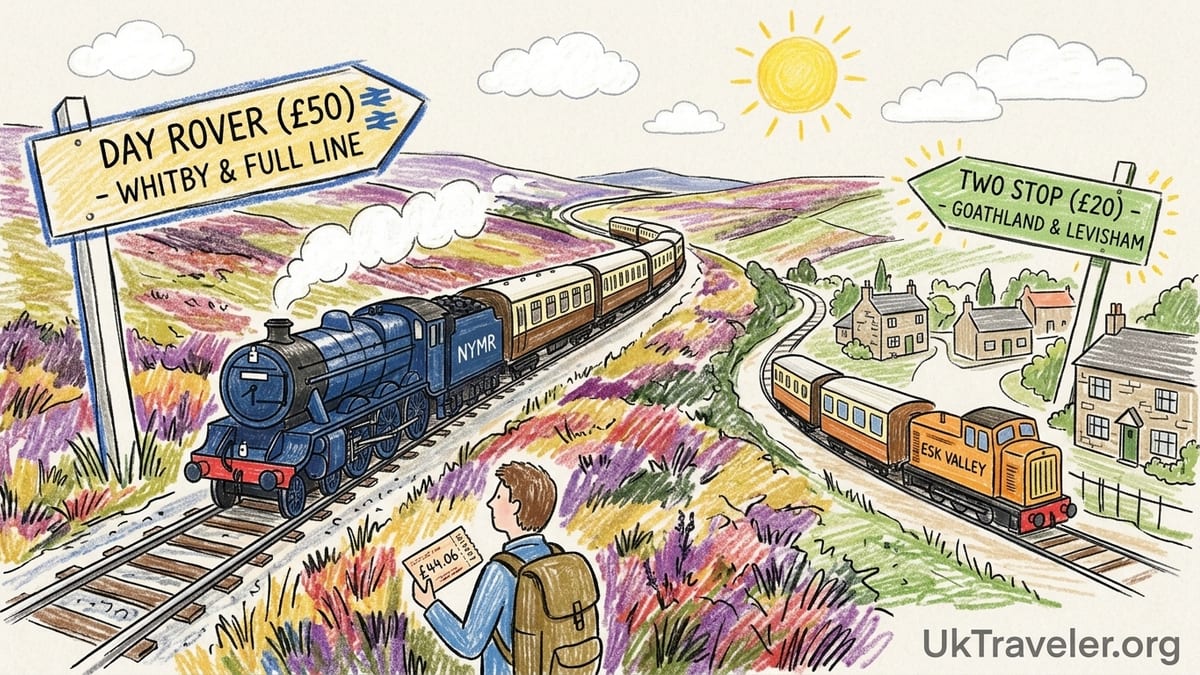
The North Yorkshire Moors Railway’s 2026 ticket structure is clearer than in previous seasons but still easy to misunderstand, especially if you are booking in a hurry. At the top of the tree is the all-line Day Rover. The standard adult fare purchased on the day now sits just below £50, and the railway advertises around a 10 percent saving if you buy online several days in advance, which is how my own ticket ended up costing £44.06. That Day Rover covers unlimited standard-class travel along the whole NYMR route between Pickering and Whitby for the day, with the ability to hop on and off at Levisham, Newtondale Halt, Goathland and Grosmont as often as the timetable allows.
Beneath that are shorter products: One Stop, Two Stop and Three Stop tickets, sold as Singles and Returns. In practice, “one stop” means travelling between two adjacent stations, like Goathland and Grosmont. “Two stops” might be Pickering to Goathland, while “three stops” covers journeys such as Pickering to Grosmont. In 2026, an adult One Stop Return sits in the low teens, a Two Stop Return in the high teens or very low twenties, and a Three Stop Return not far below thirty pounds if you pay on the day, with slightly lower advance prices. Children’s short-hop fares are much lower again, and one child aged 4 to 15 can travel free with each fare-paying adult on standard services.
For a solo adult who only wants to travel from Pickering to Goathland and back, that Two Stop Return undercuts the Day Rover by a very noticeable margin. Even if you add the £1.50 booking fee for buying online, you can often save the price of a light lunch by not overbuying. Go one stop further to Grosmont without continuing to Whitby and the Three Stop Return still compares very favourably to the all-line Day Rover, especially if you know that you are unlikely to ride more than one return trip in the day.
The key catch is that some very popular journeys, especially anything running through to Whitby, automatically push you into Day Rover territory. Pickering to Whitby covers four distinct sections of the line, and the railway has chosen to require Day Rover tickets for that full run. If your heart is set on a single long steam ride from Pickering to Whitby and a wander around the harbour, the Day Rover becomes obligatory, whether or not you use any of the hop-on, hop-off flexibility that should make a rover good value.
Does the Day Rover Really Work in Practice?
On paper, the Day Rover sounds ideal for explorers. The 2026 timetable on peak Blue days typically shows around five NYMR services in each direction between Pickering and Whitby, with some terminating at Grosmont and others running through. At the height of summer there can be near-hourly departures from the main stations. In reality, stitching together multiple village stops into a relaxed day takes more planning than the rosy marketing suggests.
On my September visit, I arrived into Goathland mid-morning, spent just under two hours walking the village and the waterfall path, then caught a lunchtime train on to Grosmont. That was pleasant but already felt slightly hurried. I then had to choose between travelling onwards to Whitby for a brief dash through the town, or staying in Grosmont long enough to look properly at the engine sheds and riverside walks before heading back to Pickering. To do everything at an unhurried pace would have required a much earlier start than most holidaymakers with children are likely to manage.
Service frequency and capacity also matter. During busy school holiday weeks, trains can be quite full out of Pickering in the morning, with compartments and open coaches filling quickly. While I found a seat without difficulty, solo travellers boarding later in the route occasionally had to split up from their groups. The railway strongly encourages advance booking on peak days and can close sales when a particular train reaches its comfort capacity. That makes the hop-on, hop-off promise a little theoretical if you are anxious about whether you will definitely get a seat on the next service from a quieter intermediate station.
There is also the question of steam versus diesel. NYMR rightly points out that it is primarily a steam railway, and at the height of the season most trains are scheduled to be steam hauled. However, locomotive failures, crew availability and summer fire risk all mean that diesel substitutions do occur. In very dry spells, the line has reduced or suspended steam to avoid lineside fires, relying instead on heritage diesels and railcars. If your Day Rover is justified in your mind by multiple long steam runs, it is worth checking the planned traction on the timetable and understanding that it is always subject to change. A two-stop return that turns out to be diesel hauled may feel disappointing, but a nearly fifty pound Day Rover under the same circumstances will feel worse.
Families, Parking, Food and the Hidden Extras
Although the Day Rover can feel expensive for solo adults or couples, the 2026 Kids Go Free policy significantly changes the equation for families. One child aged 4 to 15 can travel free with each fare-paying adult on standard services. That means a family of four with two adults and two children could cover both children on free places, paying only the two adult fares. Additional children still benefit from reduced child fares, and under fours travel free when sharing a seat. For a clan keen on railways, that makes the headline cost far less alarming when you divide it per person per mile.
Parking and food, however, will quickly erode any apparent saving. Car parking at Pickering and Goathland is charged, with daily rates that edge into double figures near the height of the season. Arrive late on a sunny day and you may find the main station car park full, pushing you into town car parks or roadside spaces that require a walk. Cafés at the main stations are charming, often in restored railway buildings, but prices reflect the captive audience. A round of coffees, soft drinks and cakes for a family can easily reach into the twenties. If you repeat that at both ends of the line, your day out begins to approach three figures even before you count ice creams and souvenirs.
Premium events amplify the bill again. Themed services like wartime weekends, steam galas or festive trains often carry special fares or seat reservations on top of the basic ticket. These are not poor value in themselves, because you are buying more than just a train ride, but they tilt the calculation further toward “this is a special treat” rather than “this is a routine way of getting from A to B.” The NYMR’s Pullman dining trains, for instance, bundle a fine meal with the journey and include free travel on ordinary services the same day, which may justify the cost for a celebration but not for a simple sightseeing hop.
For budget-conscious travelers who still want a heritage experience, one practical approach is to pair a shorter NYMR ticket with cheaper food and parking off the railway. Park in Pickering town, grab breakfast at a local café, then walk to the station and buy a Two Stop Return to Goathland. Picnic using supplies from a supermarket or bakery instead of the station tea room. You will still contribute to the line’s finances and enjoy the same scenery, but the overall cost for a half-day excursion will be significantly lower than a full Day Rover day out.
Comparing NYMR to the Esk Valley Line, Buses and Driving
At this point it is important to admit that the North Yorkshire Moors Railway is, first and foremost, a heritage attraction rather than a practical transport service. If you only want to travel between Whitby and inland hubs like Middlesbrough or York as cheaply and efficiently as possible, the Esk Valley Line and connecting mainline trains with Northern or other operators are usually better value. Advance fares on the Whitby to Middlesbrough section can start in the low single digits, and even walk-up tickets on the national rail network are generally cheaper per mile than a NYMR Day Rover.
The Esk Valley Line between Middlesbrough and Whitby runs modern diesel multiple units through some very attractive scenery of its own, calling at villages like Glaisdale, Lealholm and Ruswarp. As of recent timetables, there are several trains per day in each direction, sufficient for day trips and shopping journeys. The carriages are functional rather than romantic, with airline-style seating, no steam, and none of the historical trappings that make NYMR special. For many visitors, that is exactly the point: the Esk Valley train is about getting somewhere, not stepping back into a different era.
Local buses and self-driving sit somewhere between these two poles. Bus routes across the North York Moors, often branded for the national park, connect Pickering, Goathland, Whitby and other villages at modest fares, and English concessionary passes are widely accepted. Driving, meanwhile, gives you complete flexibility over stops and timings, and parking in some moorland car parks is cheaper than the NYMR station lots. However, both buses and cars place you firmly in twenty-first-century traffic, sharing narrow roads with other holidaymakers.
For me, the real question is not whether NYMR equals the Esk Valley Line or the bus in price per mile. It does not, and is not designed to. The more useful question is whether you, personally, will get enough extra emotional value from the heritage trappings and the slower, more deliberate pace of travel to justify paying a premium of two or three times what a purely functional journey would cost. If you are only travelling one or two stops for the scenery and a café, a short-hop NYMR ticket paired with a bus or Esk Valley train for the rest of your day may offer a sweet spot of cost versus experience.
So, Was My Day Rover Worth It?
By late afternoon I had ridden from Pickering to Goathland, on to Grosmont, and back the same way, breaking my return at Goathland for another short walk. I never made it to Whitby because doing so would have left me with under an hour in town before I had to turn around to catch the last service back to Pickering. In other words, I did not fully exploit the geographic scope of the Day Rover, nor its potential for repeated rides behind different locomotives.
Financially, if I toted up the equivalent short-hop fares for the journeys I actually made, my spend on the Day Rover probably came out only slightly above break-even. Emotionally, however, I was too aware of the unused potential baked into the ticket. I had paid for complete flexibility but, like many visitors who combine the railway with walking or village sightseeing, I had neither the inclination nor the timetable space to ride enough extra miles.
Would I buy a Day Rover again? Yes, but only in more specific circumstances. If I returned for a dedicated railway day, with the intention of boarding the first train out of Pickering, riding through to Whitby, lingering only briefly at intermediate stops and finishing with a late afternoon return, the calculations would look different. A Day Rover also makes strong sense if you are a keen steam enthusiast chasing particular locomotives or cab rides, or if weather or mobility issues mean you are likely to treat the train itself as your primary activity rather than a component of a wider day out.
For the kind of relaxed Yorkshire holiday where the railway is one pleasant element among several, my conclusion is sharper. A one-, two- or three-stop return, chosen carefully to match where you truly want to get off and explore, provides better value for most casual visitors. You can still see and feel the steam, still take the photos at Goathland, still contribute to the preservation of the line, but without paying for an entire day of flexibility that you may never use.
The Takeaway
If you are planning a visit to the North Yorkshire Moors Railway, start not with the ticket menu but with your real priorities. Do you dream of a full-day immersion in steam, riding up and down the line until the last whistle? Or do you mostly want one memorable journey into the moors, a stroll through a pretty village and a late-afternoon pub stop? Be honest, because your answer should determine whether the Day Rover is a smart purchase or an expensive indulgence.
In my case, on that early September day, I enjoyed the experience but concluded that I had slightly overspent. My ideal product for a future visit would be a Two Stop Return between Pickering and Goathland, timed to allow a long lazy lunch and a walk, with perhaps a bus or Esk Valley train used for any onward travel to Whitby or back inland. I would reserve a Day Rover for days when I was either travelling with keen railfans who wanted to squeeze every mile from the line, or when I intended to ride from Pickering to Whitby and back with minimal breaks.
The premium that NYMR charges over ordinary public transport is justified when you truly take advantage of what makes the railway unique: the heritage stations, the restored locomotives, the ability to design a day of slow travel through the moors. When you use it as a simple shuttle between two nearby stations, you pay that premium largely for atmosphere and nostalgia. That can still be money well spent, as long as you choose the right ticket.
So, the exact ticket I would buy again for a typical relaxed Yorkshire holiday is a shorter return, most likely Pickering to Goathland, with just enough flexibility for one or two well-chosen trains rather than a whole day of chasing timetables. I would save the Day Rover for a deliberately train-focused itinerary, treat premium dining or event trains as special-occasion splurges, and happily recommend that most casual visitors do the same.
FAQ
Q1. Is the North Yorkshire Moors Railway Day Rover good value for solo travelers?
For solo travelers who only plan one or two return trips, the Day Rover often costs more than equivalent short-hop returns. It becomes better value only if you ride several long legs or use it to travel all the way to Whitby and back with limited time off the train.
Q2. When does it make sense to pay for a full Day Rover ticket?
A Day Rover makes sense if you want a full day focused on the railway, for example riding from Pickering to Whitby, breaking the journey at a couple of stations, and possibly making an extra round trip on a favourite section of the line.
Q3. What ticket is best if I only want to visit Goathland from Pickering?
If you only want to travel between Pickering and Goathland and return the same day, a Two Stop Return is usually the most economical choice, giving you the same scenery and steam experience without paying for unnecessary extra mileage.
Q4. How does Kids Go Free affect value for families?
The Kids Go Free offer means one child aged 4 to 15 can travel free with each fare-paying adult on standard services, which significantly improves value for families. A family of four with two adults can often pay only the adult fares and still travel together.
Q5. Will my train definitely be steam hauled?
Steam is the aim, but not a guarantee. Diesel locomotives or railcars can replace steam at short notice because of mechanical issues, staffing, or fire risk during very dry spells, so you should always be prepared for the possibility of diesel haulage.
Q6. Can I realistically visit multiple villages in one day using a Day Rover?
On busy timetable days you can visit two or three stations, but fitting in long walks and leisurely meals at each stop is difficult. Most visitors find that they comfortably explore one or two villages without rushing, rather than the whole line.
Q7. How does NYMR compare with the Esk Valley Line on price and experience?
The Esk Valley Line is usually cheaper and geared to everyday travel, with modern diesel units and simpler stations. NYMR is more expensive but offers historic trains, restored stations and a heritage atmosphere that many visitors consider part of the attraction.
Q8. Are there extra costs I should budget for besides the ticket?
Yes. Station car parking, café food, drinks, souvenirs, and any premium events or dining services can add substantially to your total spend, sometimes matching or exceeding the ticket cost on a full day out.
Q9. Is it worth visiting NYMR if I am not a railway enthusiast?
It can be. The line passes through beautiful North York Moors scenery and attractive villages like Goathland, so you may still consider a short return journey worthwhile as a scenic excursion even if you are not especially interested in locomotives.
Q10. Which ticket would you personally buy again for a relaxed holiday?
For a relaxed Yorkshire holiday where the railway is one highlight among many, I would buy a shorter return ticket such as Pickering to Goathland, and reserve the more expensive Day Rover for days devoted mainly to the railway itself.