


The North East coast of England runs from the Scottish border to the mouth of the Tees, and packs a surprising variety of beaches into a relatively short stretch of shoreline. You can walk for miles under Northumberland’s big skies, surf shore breaks in Tynemouth or Saltburn, hunt for sea glass in Seaham, or ride a Victorian cliff lift down to the sand in Redcar. This guide compares the region’s main beaches side by side, using the latest 2025 bathing water classifications, recent RNLI lifeguard information and real examples of surf schools, parking and accommodation to help you choose the right stretch of sand for your trip.
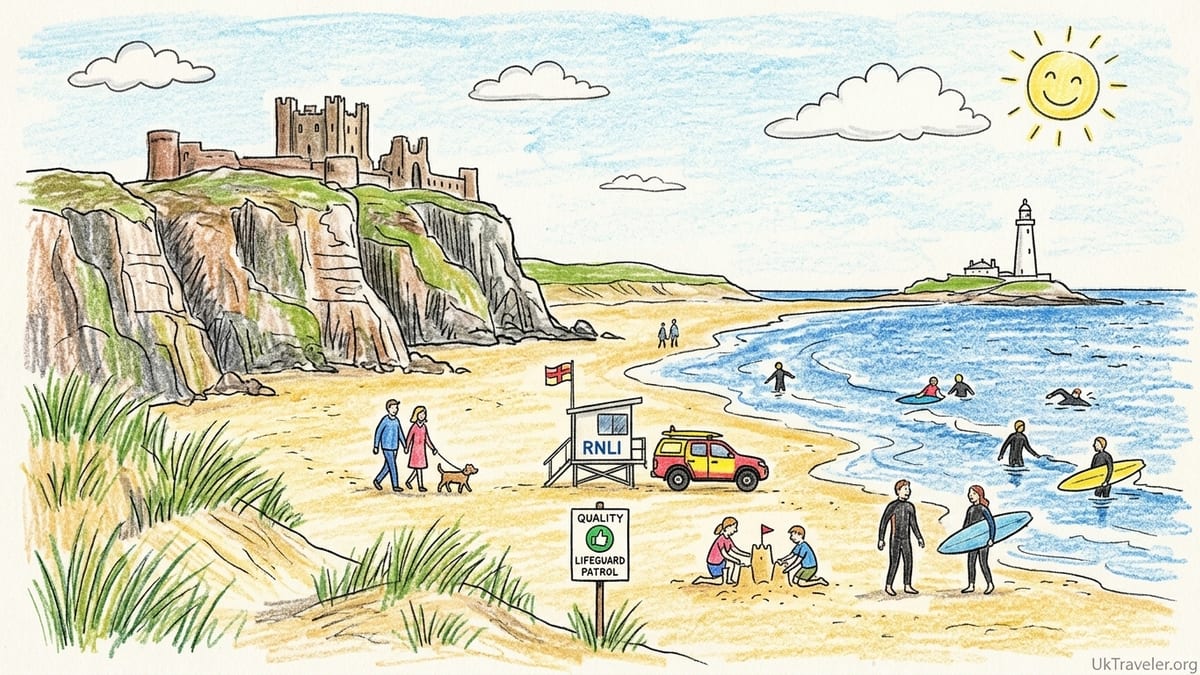
How bathing water ratings and safety work on the North East coast
Before comparing individual beaches it is worth understanding how bathing water quality and safety are measured. In England the Environment Agency samples designated bathing waters between May and September and gives each site an annual classification of Excellent, Good, Sufficient or Poor. The rating published for the 2025 season is based on bacteria results from the previous four bathing seasons combined, so it is a long term view rather than a snapshot of one bad week. In 2025 more than nine in ten English bathing waters fell into the top three bands, but a minority, including a couple in the North East, were classified as Poor.
An Excellent classification means the site consistently has very low levels of bacteria associated with sewage and agricultural run off when sampled during the bathing season. Good indicates slightly higher but still relatively low levels, while Sufficient meets the legal minimum standard. Poor means the water has failed to meet the minimum standard based on the previous four years of data. A Poor rating does not mean the sea is dangerous every day, but it does mean there is a higher risk of short term pollution after heavy rain or in certain tidal conditions, and official advice is not to swim when pollution alerts are in force. At Cullercoats, for example, the 2025 classification remained Poor, after several years of work to trace and reduce sources of bacteria.
Safety on the beach is covered separately by lifeguard patrols and local hazard information. In the North East many of the busier bathing beaches are patrolled by RNLI lifeguards from late spring to early autumn. A recent RNLI report for 2025 listed lifeguards at Tynemouth Longsands, King Edward’s Bay, Cullercoats, Whitley Bay, South Shields’ Sandhaven beach, Roker, Seaburn and several Tees Valley beaches including Saltburn and Redcar during the main season. Patrol dates and hours vary year to year, but in practice peak cover tends to run from late May around the school half term to early September, with red and yellow flags on the sand marking the supervised swimming and bodyboarding area.
The North Sea is cold even in summer, with typical temperatures of around 14 to 16 degrees Celsius in July and August and cooler shoulder seasons. That makes cold water shock a real risk for anyone running straight in, particularly early in the season. Lifeguards and local surf schools routinely advise entering slowly, keeping initial dips short, and wearing a full-length wetsuit for anything beyond a brief paddle. Rip currents can occur at several of the surfier beaches including Tynemouth Longsands, Saltburn, parts of Druridge Bay and Marsden near South Shields. They are not dramatic whirlpools but stronger flows that pull water back out to sea. On lifeguarded beaches, swimmers are advised to stay between the red and yellow flags and ask lifeguards if in doubt. On unpatrolled stretches it is safer to stay shallower than waist deep and avoid swimming alone.
Northumberland: dune-backed castles and wide walking beaches
Northumberland’s coast between Berwick and Druridge Bay feels very different from the rest of the North East. Here you find long, pale sandy beaches, backed by marram grass dunes and punctuated by castles, estuaries and small harbours. The atmosphere is rural and low rise, with a few caravan parks and classic stone villages rather than amusement arcades. For many visitors this is the part of the coast that feels most like an escape.
Starting in the far north, Spittal Beach just south of Berwick has a wide strip of sand, a promenade with a small splash park and an Environment Agency classification of Good for 2025. It is convenient for families staying in Berwick and gives easy access to shops and cafes in town, though waves can be choppy when the wind is up. Further south, Bamburgh Castle beach carries a 2025 Excellent water rating and is one of the most photographed views in England, with honey coloured sand, low dunes and the castle rising directly behind the shore. The waves here can be punchy in a northerly swell and the open aspect means it can feel exposed in winter, but in summer it is ideal for picnics, sandcastles and long shoreline walks towards Seahouses or Budle Bay. Parking is available in pay-and-display car parks close to the village and near the castle, and a handful of inns and guesthouses in Bamburgh give the option of waking to sea views.
The section between Seahouses, Beadnell and Embleton Bay is particularly good for exploring on foot. Seahouses itself is a busy harbour village and the launching point for boat trips to the Farne Islands. The designated bathing water at Seahouses North has an Excellent 2025 classification, with golden sand and moderate waves that are popular with novice surfers on smaller days. A short drive or walk south brings you to Beadnell Bay, another Excellent-rated beach, which curves in a gentle arc backed by dunes and low grassland. This is a favourite with watersports enthusiasts, including kitesurfers and paddleboarders, and has a mix of holiday parks and small B&Bs tucked just inland. A typical family might book a static caravan at Beadnell Bay holiday park for a week, walking to the shore with bodyboards and using the small village shop and cafes for supplies.
Embleton Bay, with the ruins of Dunstanburgh Castle at its southern end, is not separately classified but sits between the Excellent-rated sites of Low Newton and Craster’s neighbouring waters. The beach here is sandy and gently shelving, ideal for paddling and beach games, with low, regular waves that attract bodyboarders in small swell. Access is usually from the tiny car park at Low Newton-by-the-Sea or from the coastal path near Dunstan Steads, so it feels more remote than its popularity suggests. Accommodation is mostly in self-catering cottages in the villages or small inns like the pub at Low Newton, where you can walk back up for lunch after a morning on the sand.
Further south again, Warkworth, Amble Links and Druridge Bay North and South all hold Excellent 2025 bathing water classifications. Warkworth’s wide sandy beach sits just beyond the River Coquet estuary, with a large pay-and-display car park in the dunes and a pleasant mile-long walk from Warkworth village if you prefer to leave the car behind. The shoreline here is quiet even in summer, used mainly by dog walkers and families who appreciate its space and shallow entry. Amble Links is a slightly narrower sandy beach backed by a holiday park, good for families who want direct access from static caravans or lodges. Druridge Bay stretches for around seven miles, with long unbroken sands and several access points, including Druridge Bay Country Park where there is a visitor centre, lake and campsite. Sections of the bay can experience stronger currents, so it suits confident paddlers and walkers more than dedicated swimmers, but the feeling of space and sky is hard to beat.
Compared with the busier urban beaches further south, Northumberland’s coast has limited public transport and fewer on-beach facilities. There are no RNLI lifeguard patrols on most of these stretches, and toilets and cafes are concentrated around villages and holiday parks rather than dotted every few hundred metres. The trade-off is tranquillity. For couples and photographers, dawn at Bamburgh, sunset at Embleton or winter light on Druridge Bay can be breathtaking, and the Northumberland Coast Path links almost all of these beaches, making multi-day walking routes an attractive option.
Tyne and Wear: surfable urban sands and compact bays
Crossing into Tyne and Wear the character of the coastline changes. North Tyneside and South Shields offer broad, sandy beaches that are firmly part of day to day city life. Here you can step off the Metro at Tynemouth, walk past independent coffee shops and be on the sand at Longsands within ten minutes. The seafronts are lined with promenades, fish and chip shops, arcades, and a growing number of cafes that cater to the year round cold water swimming and surf community.
Tynemouth Longsands is the region’s best known surf beach and is split into two designated bathing waters, Long Sands North and Long Sands South, both rated Excellent in 2025. The beach is sandy throughout, with a fairly steep profile that produces consistent beach break waves. On a typical autumn swell you will see a mix of shortboarders, longboarders and beginners in surf school groups, especially close to the central access ramps. Several surf schools operate here, offering group beginner lessons that in 2026 were typically advertised at around 40 to 45 pounds per person for a two hour session, including board and wetsuit hire. Car parking is available along the seafront, usually pay-and-display, and the beach is reachable by Metro via Tynemouth or Cullercoats stations followed by a short downhill walk, making it one of the most public transport friendly surf beaches in England.
King Edward’s Bay is a small, sheltered sandy cove immediately below Tynemouth Priory. It also holds an Excellent 2025 water quality rating and is patrolled by RNLI lifeguards in the main summer months. Because the high cliffs wrap around the bay, waves tend to be smaller than on Longsands, and the enclosed setting can feel warmer on calmer days, which families with younger children often appreciate. There are steps down from the headland rather than ramped access, so buggies require some lifting, and parking is street based around Tynemouth village. The compact size means it can feel busy on hot weekends, but the setting, with historic buildings on the cliff tops, is one of the most atmospheric in the region.
Just north, Whitley Bay is another long sandy beach with an Excellent 2025 classification. It is framed at one end by the white St Mary’s Island lighthouse and at the other by Spanish City’s domed frontage. The central section is popular with day trippers and families thanks to its promenade, play areas and cafes. Waves here can be surfable in the right conditions but are generally smaller than Tynemouth, making it more of a paddling and walking beach most days. Cullercoats, between Whitley Bay and Tynemouth, is a different prospect. The bay is a small horseshoe of sand, enclosed by piers and rock walls. It looks ideal for families, with shallow water and a slipway, but the 2025 bathing water classification is Poor, repeating a pattern of recent years as investigations continue into sources of pollution in wet weather. On dry, settled days local swimmers still use the bay, but visitors who want to minimise risk often choose Whitley Bay or King Edward’s Bay instead for sea swimming until the rating improves.
On the south side of the Tyne, South Shields offers a mix of wide sandy seafront and more rugged cliffs. Sandhaven Beach, which includes the designated South Shields bathing water rated Good in 2025, is a broad, gently sloping strand backed by dunes, play parks and seafront attractions. It is patrolled by RNLI lifeguards in peak season and is well set up for families, with large car parks, toilets, cafes and amusements close by. The waves are generally smaller and less consistent than Tynemouth but can still be fun for bodyboarders and novice surfers with soft boards in the right conditions. Further along the coast towards Marsden and Souter Lighthouse, smaller coves and rockier shores take over, popular for walks rather than swimming.
At Sunderland, Roker and Seaburn form a linked sweep of seafront. Roker is a mix of sand and rock with an Excellent 2025 classification and a promenade that has seen significant investment in recent years. Seaburn’s sandy beach is slightly more open, with a Good 2025 water quality rating and a string of modern cafes, restaurants and a large hotel overlooking the sea. Both beaches have RNLI lifeguard cover in the main summer season, and seasonal events like air shows and fireworks add to the urban resort feel. For visitors based in Newcastle or Sunderland city centres, Roker and Seaburn are easily reached by bus and car, and accommodation ranges from seafront hotels to guesthouses a couple of streets back.
County Durham: Seaham’s cliffs, sea glass and improving waters
South of Sunderland the coast becomes less obviously resort focused. Much of County Durham’s shoreline is a Heritage Coast, with high cliffs and former colliery sites that have been cleaned up and rewilded over the past few decades. Seaham is the main accessible beach town here, and in recent years it has reinvented itself as a place for short breaks, sea glass hunting and coastal walks.
Seaham Hall Beach and the main Seaham Beach both have Good 2025 bathing water classifications. The sand here is mixed with pebbles and rock platforms, particularly around the mid tide mark, reflecting the industrial history of the area. The cliffs behind are striking, with grassy tops and clear evidence of the old railway lines and collieries that once sent waste straight onto the shore. Today visitors come in search of the wave-rounded, multicoloured sea glass that still washes up, a legacy of local glassworks that dumped cullet into the sea many decades ago. Families can spend a low cost day combing the tideline for blues and reds, then warming up in one of the cafes on the regenerated seafront.
Wave conditions at Seaham are generally less regular than Tynemouth or Saltburn, and there is currently less formal surf infrastructure. On larger swells experienced surfers sometimes make the trek for more powerful waves near harbour walls or reef sections, but for most visitors this is a walking and exploring coast rather than a surf training ground. There is no RNLI lifeguard patrol on the main beaches, so swimming is at your own risk, and extra caution is advised around rocks and in bigger seas. Parking is available on the clifftop, often in council-run pay-and-display car parks, and steps and ramps lead down to the shore. Accommodation locally ranges from spa hotels on the outskirts, offering packages that combine coastal walks with treatments, to simple guesthouses and small hotels near the town centre, making Seaham a good base for couples looking for a quieter alternative to Tynemouth or Whitley Bay.
Beyond Seaham the Durham coast has stretches of undeveloped clifftop paths and hidden coves such as Blast Beach and Hawthorn Hive. These are more about dramatic scenery and birdlife than conventional beach days, and access can involve steep paths without formal facilities. For visitors prepared to walk, this section of coastline offers some of the most atmospheric views in the region, but for swimming and easy family access Seaham itself is the practical choice.
Tees Valley: Victorian promenades, surf spots and family sands
Once you cross the Tees, the coast curves around a series of Victorian and Edwardian seaside towns and industrial headlands. The Tees Valley beaches combine wide sands with a stronger sense of town life, promenade culture and, in places, views of offshore industry. They are also some of the best served by rail, with stations close to Redcar and Saltburn offering car free access from inland towns and cities.
Saltburn by the Sea is the standout surf and holiday spot here. The beach is a generous expanse of firm sand, backed by high cliffs and the town’s classic pier and Italianate buildings on the slopes. The designated bathing water at Saltburn normally receives high classifications, and the beach is patrolled by RNLI lifeguards in the main season according to recent RNLI lifeguard reports. A surf school based near the bottom promenade offers group beginner lessons that, as of late 2025, were advertised at around 40 pounds for a two hour session, including equipment, with private lessons costing more per person. This makes Saltburn and Tynemouth roughly comparable on price for someone booking their first surf lesson. In summer you will see lines of students practising pop ups on the sand before heading into the whitewater zone under the guidance of instructors.
Saltburn’s waves are consistent by North Sea standards, with beach breaks that work through much of the tide in the right swell direction. The sand is forgiving for beginners who fall frequently, though care is still needed around groynes and against strong rip currents at larger sizes. Families who are less focused on surfing can enjoy the cliff lift that connects the town top to the lower promenade, the small amusement arcades and cafes, and rockpooling nearer the pier at lower tides. Parking is in pay-and-display car parks both on the cliff top and near the seafront, and the rail station is a short, steep walk from the beach, making it straightforward to visit from inland Teesside or even Newcastle with a change of trains.
West of Saltburn, Marske and Redcar offer long, predominantly sandy beaches with a slightly flatter profile and a mixture of residential and resort frontage. Redcar’s beaches are split into several designated bathing waters, including Redcar Coatham, Redcar Lifeboat Station and Redcar Granville, with classifications in 2025 ranging from Good to Excellent. The promenade runs for a considerable distance, with play areas, fish and chip shops and shelters that recall the town’s heyday as a classic working seaside resort. Surfable waves appear here too, particularly near the pier and reef sections, but the vibe is more about dog walking, jogging and family paddling. Accommodation in Redcar includes budget hotels, guesthouses and small self-catering flats, suiting travellers who prioritise value and rail access over postcard scenery.
Across the Tees estuary, Seaton Carew provides Hartlepool’s main stretch of sand. It has three designated bathing water sections: Seaton Carew North and Centre, both Good in 2025, and Seaton Carew North Gare, which holds an Excellent classification. The shore is sandy with some sections of shingle and grassed dunes at the edges. The traditional promenade has cafes, fish and chip shops and amusements, and the beach is lifeguarded in peak season. Swell here is less consistent than Saltburn but can offer fun waves for bodyboarding and occasional surf days. The big advantage for families is the straightforward road access from the A19 and A689 and plentiful on street and car park options close to the prom.
Overall the Tees Valley beaches strike a balance between functionality and recreation. You are more likely to see industrial structures on the horizon, particularly from parts of Redcar and Seaton Carew, than on the Northumberland coast, but you also gain more robust public transport, a choice of budget accommodation and a lively, year round local population that keeps cafes and shops open outside the peak holiday weeks.
Surf, scenery, access and dogs: choosing the right North East beach
With such a variety of coasts, it helps to match your priorities to the right stretch of shoreline. For surfing and formal lessons, Tynemouth Longsands and Saltburn stand out. Both have consistent beach break waves, RNLI lifeguard patrols in summer and established surf schools offering group lessons at broadly similar prices in the 40 to 45 pound range for a two hour beginner session including equipment. Tynemouth has the better connection to a major city via the Metro, which means you could feasibly stay in central Newcastle and day trip to the surf without a car. Saltburn offers a more self contained seaside town experience, with surf shops, cafes and the pier all clustered near the sand, and rail connections into Teesside and beyond.
If scenery and walking are the priority, Northumberland’s Bamburgh, Embleton Bay, Druridge Bay and the quieter Berwick area beaches are more compelling. The combination of castle silhouettes, wide dune backed sands and relative lack of development keeps them feeling wild even in peak summer. These are the places where you can walk your dog for hours with only a handful of other people in sight outside school holiday weekends. Dog restrictions are generally lighter here than on urban resort beaches, though seasonal bans or zoned areas can apply near villages and nature reserves, so checking local signage is important. Many holiday parks and cottages in Northumberland explicitly market themselves as dog friendly, making it straightforward to plan a walking focused break.
For families with young children who value easy parking, toilets, lifeguards and nearby food options, the leading candidates are South Shields’ Sandhaven, Whitley Bay, Roker, Seaburn and the central parts of Redcar and Seaton Carew. These have broad, gently shelving sands, seafront play areas and multiple cafes or kiosks directly overlooking the beach. Water classifications here are Good or Excellent in 2025, and the presence of RNLI lifeguards in peak season adds a layer of reassurance. A typical family day might involve arriving mid morning, setting up near the flagged bathing zone, alternating paddling with time on the promenade play equipment, then finishing with fish and chips eaten on a bench as the sun drops.
Accessibility and car free travel are important considerations. Tynemouth, Cullercoats and Whitley Bay are all reachable on the Tyne and Wear Metro, with a short walk from station to sand. Saltburn and Redcar have rail stations within easy reach of the beach, making them realistic options for visitors arriving from York, Leeds or Newcastle by train with a single change. Northumberland’s quieter beaches, by contrast, are much harder to reach without a car. Bamburgh, Beadnell and Embleton can be approached by occasional coastal bus services and long distance walking routes, but bus times are limited outside summer and journeys from Newcastle or Alnwick can be slow. Seaham and Seaton Carew sit somewhere in the middle, with nearby rail stations but sometimes a longer walk or bus ride from platform to sand.
Dog owners need to navigate a patchwork of seasonal rules. Many urban beaches introduce summer dog bans or restrict dogs to certain sections between May and September, particularly in front of main resort promenades. For instance, parts of Whitley Bay, Tynemouth Longsands and Saltburn usually have marked zones where dogs are not allowed during peak months, steering dog walkers towards the ends of the beaches. In contrast, much of the Northumberland coast is dog friendly year round, with only sensitive wildlife areas and the most central village-front sands subject to tighter rules. Seaham, Redcar and Seaton Carew also allow dogs on significant stretches outside limited restricted zones. The safest approach is to look for up to date council signs in car parks, particularly if you are visiting in high summer.
A three day coastal route for different types of traveller
If you have three days to explore the North East coast, you can link very different beaches into a satisfying short itinerary. One practical route for travellers with a car starts in Northumberland, moves through Tynemouth and finishes in Tees Valley, sampling castle shores, urban surf and Victorian promenades in turn. For those using public transport, a variation using rail and Metro connections is also possible, though reaching the most remote Northumberland beaches without a car requires more planning and walking.
On Day 1, base yourself around Bamburgh or Seahouses. Spend the morning walking from Bamburgh Castle along the dune backed sands towards Seahouses, watching for seabirds and, on clear days, the Farne Islands offshore. After a picnic in the dunes or lunch in a village pub, head to Beadnell or Low Newton for a quieter afternoon on the sand or a walk along Embleton Bay towards Dunstanburgh Castle. Overnight options include small hotels and inns in Bamburgh, guesthouses in Seahouses or self catering cottages in villages like Beadnell and Embleton. This first day suits couples, photographers and dog owners especially well, with long vistas and soft evening light.
Day 2 shifts the focus to Tyne and Wear. Drive or take the train to Newcastle and Metro on to Tynemouth, or arrive directly by car and park along the seafront. In the morning, book a group beginner surf lesson at Tynemouth Longsands through one of the local surf schools, budgeting around 40 to 45 pounds per person. After warming up with coffee and food from one of the beachfront cafes, explore Tynemouth village, its market and the ruins of Tynemouth Priory. In the afternoon, walk or take the Metro to Whitley Bay for a more traditional promenade atmosphere, or cross the Tyne to South Shields’ Sandhaven if you want a family friendly beach with playgrounds and amusements. Overnight, you can stay in a seafront hotel at Whitley Bay, a guesthouse in Tynemouth or a city centre hotel in Newcastle or Sunderland, depending on whether you prefer nightlife or a quieter coastal feel.
Day 3 takes you south to Tees Valley. If you are driving, follow the A19 and local roads to Saltburn for a final day of sand and surf. Car free travellers can take a train from Newcastle or Durham, changing in Middlesbrough for the Saltburn branch line. Spend the morning on the beach, either surfing with a local school, bodyboarding in the whitewater or simply walking under the pier and along the shoreline. In the afternoon, ride the historic cliff lift, stroll the promenade and, time permitting, drive or take the train to Redcar to experience a more traditional working resort with long sands and a different skyline. End the trip with fish and chips on the seafront before heading back inland.
Within this broad route there are particular highlights for different types of traveller. Families might prioritise a night in Tynemouth or Whitley Bay, combining playgrounds and lifeguarded beaches, plus a day in Saltburn where children can ride the cliff lift and try a supervised surf taster. Surfers will focus attention on Tynemouth Longsands and Saltburn, building in flexibility for conditions and perhaps adding a quick stop at South Shields or Seaton Carew if swell angles look promising. Couples may choose to spend two nights in Northumberland, using Tynemouth and Saltburn as day trips rather than bases, to maximise quieter evenings in coastal pubs and village restaurants.
Budget travellers can save considerably by staying a street or two back from the seafront in towns like Redcar, Whitley Bay or Sunderland, using frequent buses or walking to reach the beach each day. Self catering flats in Redcar or Seaton Carew can be particularly economical for small groups, and combining them with free activities like beach walks, sea glass hunting at Seaham, and watching surfers at Tynemouth or Saltburn keeps daily costs low. In contrast, premium seafront hotels in Bamburgh, Tynemouth or Saltburn charge higher nightly rates but offer memorable sea views and the convenience of strolling from bed to beach in minutes.
FAQ
Q1. Is it safe to swim at North East beaches given the cold water and some Poor ratings?
Most designated North East bathing waters are rated Excellent or Good in the Environment Agency’s 2025 classifications, which indicates consistently low levels of bacteria. However, a few, such as Cullercoats and Littlehaven at South Shields, are classified as Poor. At those sites the official advice is to follow Environment Agency and local council warnings, and many visitors choose to paddle or avoid immersion when short term pollution alerts are active. Wherever you swim, the North Sea is cold even in summer, so entering gradually, wearing a wetsuit for longer swims and choosing lifeguarded beaches during patrol hours all significantly improve safety.
Q2. Which North East beaches are best for beginner surfing lessons?
The main surf lesson hubs are Tynemouth Longsands in Tyne and Wear and Saltburn in Tees Valley. Both offer sandy beach breaks, RNLI lifeguard patrols in the main season and established surf schools. Group beginner lessons of around two hours, including board and wetsuit hire, are typically advertised at about 40 to 45 pounds per person. South Shields and some Tees Valley beaches also have smaller surf operations, but for a first lesson most visitors head to Tynemouth or Saltburn.
Q3. Where can I find the quietest, most scenic beaches for long walks?
Northumberland is the best bet for quiet, scenic walking. Bamburgh, Embleton Bay, Druridge Bay, Warkworth and the Berwick area beaches all offer wide, largely undeveloped sands backed by dunes and fields. It is common to walk for an hour outside peak dates and see only a handful of other people. These beaches suit dog owners, photographers and couples who prefer seclusion and big skies to promenade attractions, though they lack the on-beach facilities and lifeguards found around Tynemouth, Sunderland and Redcar.
Q4. Which beaches are easiest to reach without a car?
Tynemouth, Cullercoats and Whitley Bay are directly served by the Tyne and Wear Metro, with stations a short walk from the sand. Saltburn and Redcar in Tees Valley have rail stations close to the seafront, making them realistic day trips from inland cities with a change of trains. Seaham and Seaton Carew also have nearby stations, though you may need a short bus ride or a longer walk to reach the main sands. By contrast, Northumberland’s best walking beaches like Bamburgh, Embleton and Druridge Bay are not well served by frequent public transport, so a car or long distance walking route is usually needed.
Q5. How should I interpret an Excellent or Good bathing water classification when planning a trip?
An Excellent 2025 classification means that over the previous four bathing seasons the water has consistently had very low levels of tested bacteria during the monitoring period. Good indicates slightly higher but still generally low levels. Both ratings reassure most swimmers that, under normal conditions, the risk from waterborne bacteria is low. However, classifications do not account for very recent rainfall or one-off pollution events, so it is still wise to check on the day for any short term pollution alerts, avoid swimming near obvious outfalls and consider postponing a dip after heavy rain, particularly near urban areas or harbours.
Q6. Are dogs allowed on North East beaches in summer?
Dog rules vary by council and by beach. Many urban resort stretches, such as parts of Tynemouth Longsands, Whitley Bay and Saltburn, have seasonal bans or dog free zones on the central sections of sand between roughly May and September, while still allowing dogs at either end of the beach or on promenades. Much of the Northumberland coast remains dog friendly year round, although some nature reserves and village-front sands have restrictions. Seaham, Redcar and Seaton Carew also permit dogs on substantial sections outside limited restricted zones. Checking local signage in car parks is essential, especially during school holidays.
Q7. Which beaches are most suitable for families with small children?
For families who want easy access, toilets, food options and lifeguards, the best choices are Whitley Bay, Tynemouth Longsands, King Edward’s Bay, South Shields’ Sandhaven, Roker, Seaburn, Saltburn and the central stretches of Redcar and Seaton Carew. These beaches have gently sloping sands, promenades with play areas and seasonal RNLI patrols. For a quieter day, Bamburgh or Warkworth offer wide sandy spaces with less commercial development, but lack lifeguards and seafront amusements, so they suit slightly older children who are happy with walks, sand dunes and picnics.
Q8. Is Cullercoats suitable for swimming given its Poor classification?
Cullercoats is an attractive, sheltered sandy bay that looks ideal for swimming, but its 2025 bathing water classification remains Poor, reflecting ongoing water quality challenges. Local regulars still enter the water, particularly during settled dry spells, but many visiting swimmers and families choose nearby Whitley Bay, Tynemouth Longsands or King Edward’s Bay for higher rated water and similar convenience. If you do visit Cullercoats, treating it primarily as a place for walking, paddling at the edge and enjoying the cafes is a cautious approach until sustained improvements in the classification are confirmed.
Q9. When are lifeguards usually on duty at North East beaches?
RNLI lifeguard patrols typically operate between late spring and early autumn, with peak cover from around late May to early September. Exact dates and hours vary by beach and year, and can be affected by funding and staffing. In Tyne and Wear, Tynemouth Longsands, King Edward’s Bay, Cullercoats, Whitley Bay, Sandhaven at South Shields, Roker and Seaburn have all had seasonal RNLI patrols in recent years. In Tees Valley, Saltburn, Redcar and Seaton Carew are among the patrolled beaches. Checking the RNLI’s own information or local council notices before you travel will give the most current details.
Q10. How can I stay safe from rip currents and cold water when swimming or surfing?
To reduce risk from rip currents, choose a lifeguarded beach and always swim or bodyboard between the red and yellow flags, which mark the supervised zone. If you feel yourself pulled out to sea, try to stay calm, float, signal for help and avoid swimming directly against the current; instead, attempt to move at an angle towards the breaking waves if you are close to shore. To manage cold water, enter gradually rather than diving straight in, keep early season dips short, and wear a well fitting full length wetsuit, plus boots and gloves outside mid summer. Avoid swimming alone, especially on unpatrolled or remote beaches, and consider local advice from lifeguards or surf schools before going further than you can comfortably stand.