


I went to Alnwick in October 2026 for one very specific reason: I wanted to stand where the first Harry Potter broomstick lesson was filmed. Everything else, from medieval towers to water features and poisonous plants, came second. By the end of the day I had experienced both Alnwick Castle and The Alnwick Garden, spent far more on tickets and snacks than planned, and come away with a clear idea of what I would do differently next time.
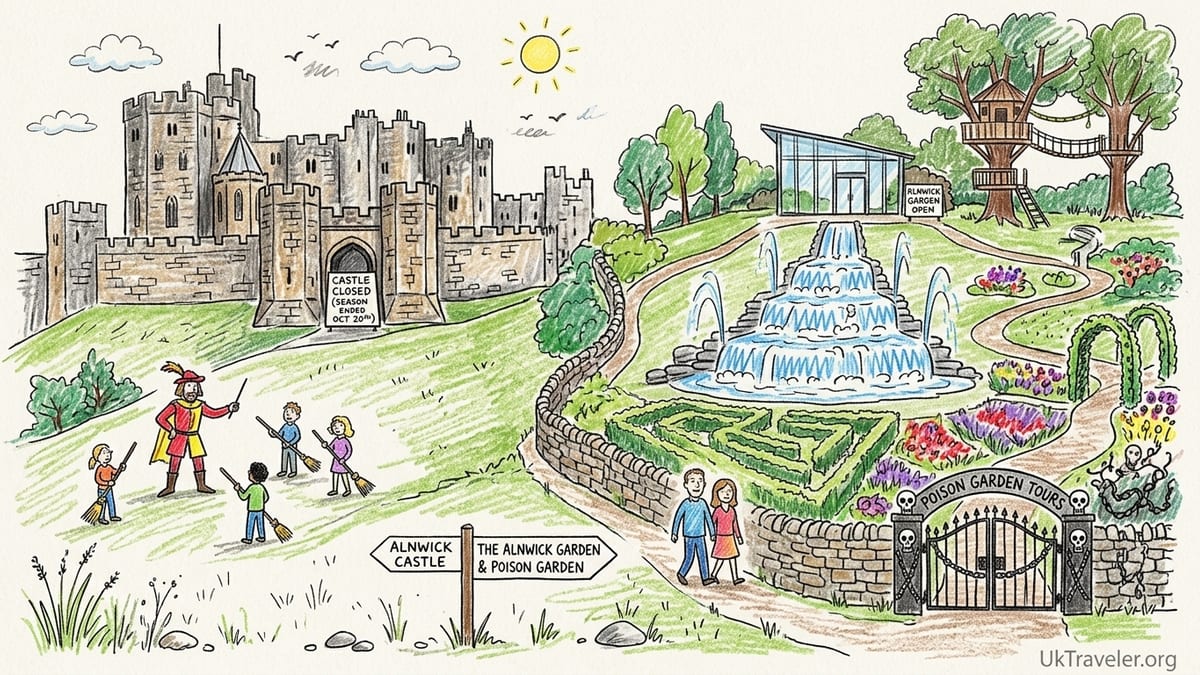
Alnwick Castle and Alnwick Garden Are Separate Visits
The first surprise when I started planning my trip was that Alnwick Castle and The Alnwick Garden are run as completely separate attractions. They share the same hillside in the Northumberland market town of Alnwick and are often mentioned together, but they have different entrances, ticket systems and opening calendars. My online booking basket filled up quickly once I realised I needed one ticket for the castle and another for the garden, and that the playful-looking Lilidorei play village is a third product again, not part of the standard garden ticket.
For the 2026 main season, Alnwick Castle’s own information explained that it welcomed visitors from spring through to autumn and that the 2026 season ended on 20 October. After that date the castle moved into winter closure with only specific festive events, not standard daytime entry. I visited in late October, so by the time I arrived the castle’s normal season had already finished, and I could only explore the exterior from public viewpoints and the town. If you are planning a visit after 20 October 2026, you need to check the castle’s official opening times before you set your heart on going inside.
The Alnwick Garden, by contrast, was still very much open. Its 2026 autumn information gave opening hours into late October and early November, with seasonal events such as a pumpkin-themed garden. That meant my full paid experience was in the garden, while my castle visit was limited to walking the perimeter, viewing the walls from the Lion Bridge and Potter filming viewpoints, and talking with staff about how broomstick training works during the open season. This imbalance coloured my impressions and costs, but it also made the contrast between the two attractions very clear.
Because of the separate operation, you cannot buy a simple combined Alnwick Castle and Alnwick Garden day ticket from a single provider. The garden does sell its own Alnwick Garden plus Lilidorei combination ticket, but that does not include the castle across the road. Practically, that means a family trying to “do Alnwick in a day” has to juggle at least two, and often three, different bookings and time slots.
Pricing in Late 2026 and What I Actually Paid
When I checked official prices before travelling, the castle’s online ticket page listed adult admission at £22. This is the reduced online rate, described as saving around 10 percent compared with the gate price of £24.45. Concessions were £17.90, children aged 5 to 16 were £11.60, and there were family bundles. The important detail is that online castle tickets function as a season pass. They are valid for 12 months from the first visit and allow unlimited standard daytime re-entry during opening periods, as confirmed in the castle’s visitor information and FAQs. I had planned to buy an adult online ticket at £22 and treat it as a pass for a later return in 2027.
The Alnwick Garden’s own pricing for early autumn 2026 showed adult day tickets from £17.90 online for a non Gift Aid standard adult. The Gift Aid option on the booking page was £19.70. One useful feature is that up to four children aged 0 to 16 can enter free with each paying adult on the garden only ticket. That means a family visiting purely for the garden can pay only for adults and still bring several children without additional entry cost. On the other hand, if you choose the combined Garden and Lilidorei product, children have their own ticket price and a three year old pays the full child rate for Lilidorei access.
In practice, my late October timings meant I did not end up purchasing the castle ticket. The 2026 season had closed on 20 October and my arrival was later that week, so the standard ticket page clearly advised that public daytime visiting had ended. There were separate listings for festive events, but none matched my dates. As a result I only bought an Alnwick Garden adult day ticket at the non Gift Aid online rate of £17.90. That one decision cut my expected spend for the day almost in half, but it also meant I could not test the castle interior, the State Rooms or any of the seasonal Harry Potter entertainment from the inside.
If all three sites had been fully open and I had booked them in advance, my basket for one adult in late 2026 would have looked roughly like this: £22 for Alnwick Castle, £17.90 for The Alnwick Garden, and about £16.65 for a Lilidorei afternoon ticket. That comes to just over £56 for one adult without including food, parking or any souvenirs. For a family with two adults booking the Garden only and Castle tickets online, the combined admissions could quickly approach or exceed £80, even before Lilidorei. That comparison is worth keeping in mind when you decide how to allocate a single day in Alnwick.
Castle Grounds from the Outside and the Harry Potter Context
Even without going inside, Alnwick Castle is an imposing presence. The curtain walls rise above the green slopes and the old access routes from town, and the towers that Potter fans know from the first two films are visible from various public paths. From the Lion Bridge, a short stroll from town, I could see the outer walls and the grassy area in front of them where broomstick training takes place in season. Information panels and guidebooks confirm that this is where the first flying lesson and some of the Quidditch practice scenes from Harry Potter and the Philosopher’s Stone and Harry Potter and the Chamber of Secrets were filmed.
The castle’s own material notes that it dates back to the late 11th century and is still the seat of the Percy family, now the Dukes of Northumberland. When the castle is open, visitors can access State Rooms filled with art and furniture, as well as various medieval interpretation spaces that explain the building’s military and domestic history. On my October visit, none of that was available. The main gate was closed to general visitors, information boards displayed the end-of-season message, and staff at the edge of the grounds politely confirmed that only specific pre-booked events were operating now.
Because I could not enter, I avoided making assumptions about the State Rooms or the Great Hall interiors. Instead, I used my time to walk the exterior route that many day trippers follow without buying a ticket. That took me along Bailiffgate, down towards the river, over the Lion Bridge and back up past the edge of The Alnwick Garden. From several points you can photograph the castle above the River Aln and frame the towers in a way that clearly matches establishing shots from the films. For Potter fans on a tight budget, this free circuit already delivers some recognition and atmosphere, although it does not replace the more playful experiences inside.
The lack of interior access did, however, sharpen my awareness of how seasonal Alnwick Castle is. Unlike many city museums that simply shorten their hours in winter, the castle closes for several months. For 2026, that cutoff fell on 20 October, which meant that anyone planning a late autumn half term Harry Potter day would have needed to time their trip before that date. Future seasons may shift slightly, so it is essential to verify the latest opening calendar on the official site before buying non refundable rail tickets or accommodation.
How Broomstick Training Actually Works
Because broomstick training is the main Harry Potter experience at Alnwick Castle, I spent time in the visitor information area and spoke with staff about the practicalities, even though no sessions were running during my visit. The castle’s own description calls broomstick training one of its famous activities and states clearly that sessions are included with castle admission, but require a separate timed slot ticket. Those tickets are free and issued on a first come, first served basis on the day, not booked months in advance with your general admission.
Had I visited a week earlier while the season was still running, the system would have worked like this. After entering with a valid castle ticket, I would have gone straight to the designated kiosk or staff desk in the courtyard area near the training field. There, I could ask for broomstick training slots. On busy days, especially during school holidays, staff advise that the earlier you ask, the better your chances of getting a suitable time. Families I chatted with outside the gate mentioned that in summer they had seen late morning slots already taken by 11am. The time slot ticket is a simple paper or card stub with your session time printed on it, and you present it at the field shortly before your lesson.
The training itself, based on official descriptions and other visitors’ accounts, lasts around 20 to 25 minutes. Groups gather on the grass, each person given a wooden broomstick. Costumed instructors play the role of wizarding professors, leading warm up stretches, basic techniques such as mounting, starting and stopping, and the all important “Up” command that film fans will recognise. The tone is deliberately light and silly, with plenty of encouragement for adults to join in and pose for photos. The castle explicitly invites visitors of all ages, not just children, to take part, and many adults report that the experience exceeded their expectations because the instructors leaned into the fun rather than delivering a dry talk.
Because the sessions are outdoors, they depend on reasonable weather and safe ground conditions. Information near the field notes that broomstick training may be reduced or cancelled in high winds, heavy rain or when the grass is too slippery. There is no extra fee per person. The cost is absorbed into the general castle admission, which makes the need to queue for a time slot more understandable from a crowd management perspective. Based on what I learned, my conclusion is that if broomstick training is your primary reason for visiting Alnwick Castle, you should treat it like a timed show: arrive close to opening, secure your slot before anything else, and then arrange State Rooms or lunch around that appointment.
Inside The Alnwick Garden: Grand Cascade, Paths and Cafés
With the castle closed, my day shifted focus to The Alnwick Garden. After presenting my online ticket at the main entrance near the large contemporary pavilion, I stepped into a design that feels deliberately modern next to the medieval castle skyline. The centrepiece is the Grand Cascade, a vast tiered water feature with flights of stone steps on either side and water jets arranged in patterns. In 2026 it carried the name of a financial sponsor, but the effect remains that of a formal, almost theatrical water staircase. Every so often, the jets run in choreographed sequences. On my autumn visit the water was still flowing, though with a more muted surround as many of the deciduous trees had turned or dropped their leaves.
From the central axis I wandered out through the various ornamental garden rooms. These included rose walks, hornbeam tunnels and small hidden seating areas that felt surprisingly peaceful given how family-friendly the overall attraction is. Paths are mostly wide, surfaced with compacted material or paving, and signposted in a way that made it difficult to get seriously lost. Accessibility information from the garden notes that many areas are suitable for wheelchairs or pushchairs, although some routes are steeper than others. I saw several families with prams and a number of mobility scooters on the main loop without obvious difficulty.
Food and drink options at The Alnwick Garden in 2026 were concentrated in and around the Pavilion Café near the entrance, and the famous Treehouse Restaurant set among the trees on the edge of the site. During my visit, the Treehouse operated primarily as a booked restaurant, while the Pavilion provided more casual counter service: coffee, sandwiches, tray bakes and seasonal treats like pumpkin-spiced drinks linked to the autumn events programme. Prices were on the high side compared with Alnwick town cafés, which means that a budget conscious visitor might prefer to eat in town before or after rather than relying on the on-site options for a full meal.
Queues at the garden entrance were modest on my late October weekday visit, partly thanks to the online ticket system that encourages pre booking. There was a short line for people who needed to purchase on the day, but nothing compared with the crowds described during summer holidays. Once inside, the space absorbed visitors well. Apart from short waits at the Pavilion counter and at the entrance to the Poison Garden tours, it never felt congested.
The Treehouse and Why I Skipped Lilidorei
One of the most eye catching structures associated with The Alnwick Garden is the Treehouse, which twists among mature trees on timber walkways and rope bridges. From the outside paths you can see the walkways and get a sense of its scale without needing a separate ticket. For dining inside, however, advance table reservations are strongly advised, especially at weekends. I walked up onto the publicly accessible walkway section, which has a gently sloping ramp and some small steps. The perspective from the platform lets you look back towards the Grand Cascade and across to the castle towers, which is particularly atmospheric in soft afternoon light.
I did not eat in the Treehouse Restaurant itself on this trip, largely because I was already conscious of my ticket spend. Menus posted outside listed mains broadly in line with mid market UK restaurants, which would have turned my day into a more expensive outing than I was comfortable with on a solo visit. Instead, I grabbed a coffee and pastry at the Pavilion and later walked into town for a simpler pub dinner. For visitors looking for a special-occasion meal, the Treehouse is undeniably memorable. For those counting pounds, the views from the publicly accessible bridges provide a free taste of the experience.
Lilidorei, the whimsical play village created near the garden, is marketed heavily towards families with children. Its own pre visit information and the garden’s ticket page make clear that it is operated with separate tickets, and that the combined Garden and Lilidorei product is just that: a combination of two distinct entries, not an all-in-one with the castle. During my visit I chose not to buy a Lilidorei ticket. As an adult visitor without children, the value proposition did not make sense, particularly as the day ticket there costs only slightly less than my garden entry and is designed around climbing structures, story worlds and play.
Keeping Lilidorei separate from general garden admission is logical for both pricing and crowd reasons, but it can catch visitors off guard who assume that “Alnwick Garden” automatically includes everything they have seen in promotional photos. If you are visiting with children and they have their hearts set on the huge Lilidorei towers, it is worth budgeting specifically for that third ticket and checking its separate time restrictions, which in 2026 included an afternoon only slot for day visitors.
The Poison Garden: Timed Tours and Strong Warnings
The most distinctive part of The Alnwick Garden, and the section I was most curious about after broomstick training, is the Poison Garden. From the main paths you see only a black gate decorated with skulls and warning signs. Official material and multiple guides stress that the garden contains a collection of toxic and narcotic plants, and that access is only possible on a guided tour. Visitors are not allowed to wander freely among the beds for safety and liability reasons.
On my visit, the Poison Garden tours were running several times an hour in the middle part of the day. A staff member just outside the gate checked reservations and allowed each group inside once the previous group had exited. Current information from the garden describes these as timed guided tours that require a reservation in addition to a valid general garden ticket. I booked my slot at the same time as my garden entry through the official booking system, so by the time I arrived I already had both elements in place. For anyone deeply interested in the Poison Garden, I would recommend securing that timed slot before fixing your train times, because numbers are controlled and tours can fill.
Each tour lasted around 20 to 25 minutes. Our guide combined theatrical delivery with clear safety instructions, repeatedly reminding us not to touch, taste or even sniff particular plants too closely. The route wound past beds of familiar species such as foxglove and yew, and less obvious dangers that many visitors would not recognise as hazardous. Some plants were behind mesh or within small cages, more to prevent casual contact than for any dramatic effect. The stories ranged from historical poisonings to modern pharmaceutical uses, and the emphasis was on respect rather than fear.
Group sizes felt sensible. There was enough space to see and hear without jostling, and the guide positioned people carefully around each plant so that children could stand at the front but under close adult supervision. Accessibility wise, the paths inside the Poison Garden are compacted gravel and relatively level, but the space is more confined than the main garden, and the gate is kept closed between groups. Anyone with claustrophobia or strong scent sensitivity might find it challenging, although during my autumn visit the air felt fresh and I did not see any obvious discomfort among participants.
Entry to the Poison Garden tour was included in my general garden ticket, but required the separate timed reservation. That distinction is crucial for planning. You cannot simply buy a day ticket to The Alnwick Garden and expect to walk into the Poison Garden at your convenience. If that particular experience is a priority, secure the time slot reservation before committing to a specific date, or at least before travelling a long distance, as there is no overspill standing area for extra people once a tour is full.
Practicalities: Parking, Queues and Accessibility
From a practical point of view, Alnwick is set up as a drive-in destination for many visitors. There is shared parking near the castle and garden, with pay and display machines. During my October weekday visit, there were plenty of spaces and payment was straightforward, using coins and card, though tariffs are subject to change and worth checking just before you go. Because the castle was already closed for the season, the car park felt notably quieter than many online summer reviews describe.
Arriving by public transport is also possible. Alnwick is connected by buses from Newcastle and other regional centres, and both the castle and garden offer promotions for visitors who come by bus or train. The castle in particular has a green travel discount that offers reduced admission for those who present a qualifying public transport ticket on arrival. I could not take advantage of that because I had already decided to focus on the garden and the castle interior was closed, but for future visits within the open season it is a useful way to trim costs if the bus times work for you.
In terms of accessibility, my impression was that The Alnwick Garden is more straightforward for visitors with mobility issues than the medieval castle would be. The garden paths are broad and mostly step free, and the pre visit information mentions accessible toilets and a visual guide to help neurodivergent visitors plan their route. The castle, by nature of its age and design, has more stairs, uneven surfaces and narrow passages. The official castle FAQs acknowledge this and suggest that not all areas are suitable for everyone, although they do offer free carer tickets for visitors who need support.
Queues were not a major feature of my late October experience, but the systems in place are clearly designed with peak days in mind. At the castle, broomstick training has its own queue structure via time slot tickets. At the garden, the Poison Garden operates with tight capacity control. Food outlets have queuing lanes marked. If you are visiting in school holidays or on a sunny weekend in summer, it would be wise to treat each of these as fixed points in your schedule and to build quieter exploration time around them to avoid frustration.
Costs, Trade Offs and How I Would Plan One Day Next Time
Putting the whole day together, my actual spend in October 2026 was relatively modest because of the castle closure. I paid £17.90 for the online non Gift Aid adult ticket to The Alnwick Garden, a few pounds for parking, and around £7 in the Pavilion Café on a drink and slice of cake. Everything else, including my walk around the castle exterior and photographs from the river, was free. If I had added a full price Treehouse lunch and a Lilidorei ticket, the total would have climbed easily beyond £60, most of it concentrated in less than eight hours.
Looking ahead to a future visit in a fully open season, my ideal one day plan in Alnwick would focus on quality rather than trying to tick every box. For a solo adult Potter fan, I would buy the £22 online adult castle ticket and treat it as a season pass, then book only the garden day ticket at £17.90, leaving Lilidorei for another time. I would aim to arrive at the castle just before opening, go straight to the broomstick training kiosk to secure a time slot, and then tour the State Rooms and medieval walls at a relaxed pace before my lesson. After broomstick training and a simple cafe lunch, I would walk across to the garden for a mid to late afternoon slot that includes a pre booked Poison Garden tour.
For a family watching their budget, I would pivot the emphasis slightly. One strategy would be to choose either the castle or the garden as the main paid attraction for that particular day, and to use the historic town, free castle viewpoints and public play areas to round things out. Because the garden allows up to four children in free with each paying adult on the garden only ticket, a cost focused family might decide to spend the day there, budget carefully for food, and skip Lilidorei this time. Another family might decide that broomstick training and the castle’s seasonal activities offer better value for their children and keep the garden for a future trip.
Where I would definitely not overspend again is on piling multiple premium extras into a single short visit. It is tempting to book the Treehouse Restaurant, Lilidorei and two separate day tickets all at once, but unless you have a full day from opening to closing and a generous budget, you may find yourself rushing from slot to slot without really enjoying the spaces. Alnwick rewards slowing down, watching the patterns on the Grand Cascade, and taking time on the broomstick field rather than sprinting between checkpoints.
The Takeaway
My October 2026 visit to Alnwick ended up being more about the realities of opening calendars and ticket structures than the pure Harry Potter immersion I had expected. Because Alnwick Castle’s 2026 season had ended on 20 October, I could not experience the broomstick training or State Rooms for myself, and my main paid experience shifted to The Alnwick Garden with its Grand Cascade, Treehouse walkways and the memorably intense Poison Garden tour. That mismatch underlined the importance of checking exact dates and understanding that castle and garden operate entirely separately.
The most disappointing aspect of the day was missing the castle interior by a matter of days. Standing outside the closed gates knowing that broomstick training sessions had been running only a week earlier was a lesson in not leaving date checks until the last minute. A smaller frustration was the cumulative cost once I started adding up what a full three ticket day would have looked like, especially when combined with premium dining. Neither the castle nor the garden is cheap for a family, although both offer clear value if you use your time well and focus on their strengths.
If I had the chance to redo the trip in season, the tickets I would buy again without hesitation are the online adult entry to Alnwick Castle for broomstick training and the standard adult day ticket for The Alnwick Garden with a reserved Poison Garden tour. I would skip Lilidorei as a solo adult and treat the Treehouse Restaurant as an optional extra rather than a core part of the day. I would also plan travel to arrive early enough to secure broomstick training slots and to avoid feeling rushed between castle and garden.
For anyone planning one full day in Alnwick without overspending, my advice is simple: pick your priority, check the dates, and build everything else around that. If broomsticks and battlements matter most, centre the castle in your plan, buy tickets online in advance and aim for an early broomstick slot. If water features, free child admission and the Poison Garden appeal more, spend the bulk of your time and budget in The Alnwick Garden. Use the free exterior views of the castle and the town’s cafes to balance the day and the budget, and you will come away with strong memories rather than just a dented wallet.
FAQ
Q1. Are Alnwick Castle and The Alnwick Garden run by the same organisation?
They share the same general location in Alnwick but are separate attractions with different entrances, management teams, ticket systems and opening calendars.
Q2. Can I buy one ticket that covers Alnwick Castle, The Alnwick Garden and Lilidorei?
No. You need a separate ticket for Alnwick Castle and a separate ticket for The Alnwick Garden. Lilidorei also has its own ticket, sometimes sold in a combination with the garden but never including the castle.
Q3. How much did an adult ticket cost for Alnwick Castle in late 2026?
In late 2026 the official online adult admission for Alnwick Castle was listed at about £22, with a higher gate price and various concession and family options.
Q4. How much did an adult day ticket cost for The Alnwick Garden in late 2026?
For autumn 2026, The Alnwick Garden’s standard online adult day ticket started at around £17.90 for the non Gift Aid option, with a slightly higher Gift Aid price.
Q5. When did Alnwick Castle’s 2026 main season end?
Alnwick Castle’s own visitor information stated that the 2026 main visiting season ran from spring until 20 October 2026, after which the castle closed for winter apart from special events.
Q6. How does broomstick training at Alnwick Castle work?
Broomstick training sessions are included with castle admission but require a free timed slot ticket collected on the day. Groups meet on the lawn where Harry’s first flying lesson was filmed and follow a short, instructor led lesson.
Q7. Do I need a separate reservation for the Poison Garden?
Yes. Access to the Poison Garden is only on a guided tour with a timed reservation, which you book alongside a valid general ticket for The Alnwick Garden.
Q8. Is Lilidorei included in The Alnwick Garden ticket?
No. Lilidorei is a separate play village with its own ticket. The garden does sell a combined Garden and Lilidorei product, but the standard garden only ticket does not cover Lilidorei.
Q9. Is Alnwick suitable for visitors with limited mobility?
The Alnwick Garden has broad, mostly step free paths and accessible facilities, so it is relatively friendly for wheelchairs and pushchairs. The medieval castle has more steps and uneven ground, so access is more limited inside.
Q10. How can I keep costs down on a one day visit to Alnwick?
Decide whether the castle or the garden is your main priority, book that ticket online, and use free exterior views, town cafes and careful food choices to avoid stacking up multiple expensive extras in a single short visit.