


I arrived in Haworth on a cool, bright morning with a question in mind. Was Brontë Country still a place of real literary encounter, or had it become just another photogenic village wrapped in souvenir tea towels and Instagram angles? Over a long weekend in spring 2026, I set out to answer that question on foot, by heritage railway and in the quiet rooms of the Brontë family home.
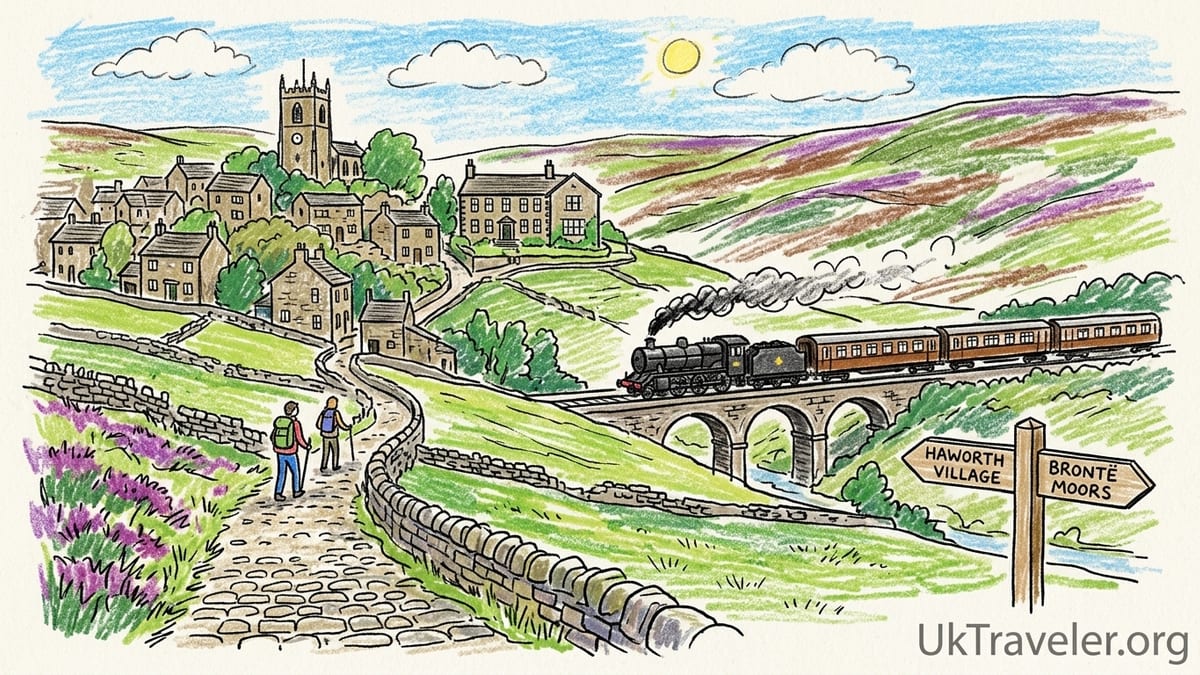
Getting to Haworth: A Real Journey Into Brontë Country
My journey began at Leeds station, coffee in hand, joining the commuter crowds heading for Bradford and Skipton. The most straightforward public transport route into Brontë Country in 2026 is still the Northern service from Leeds to Keighley via Bradford Forster Square. The train rolls through the old industrial towns of West Yorkshire, chimneys and stone terraces sliding past the windows, and after about 40 minutes I stepped off at Keighley, already seeing signs for the Worth Valley and the heritage railway platforms.
From Keighley you have a choice. Regular buses run up the valley to Haworth, and for many visitors this is the simplest route, especially in bad weather or if you are watching your budget. On my outward journey, however, I chose the slower, more evocative option: the Keighley and Worth Valley Railway, a separate heritage line that connects Keighley with Haworth and Oxenhope. Its Worth Valley platform sits just beside the mainline station. Walking through the underpass and onto the older platform feels like stepping back several decades, with enamel signs, wooden benches and the slightly oily smell of engines.
That first leg already framed the rest of my stay. Haworth is remarkably close to major urban centres, yet arriving by this valley route felt like a deliberate leaving-behind of everyday Yorkshire. I watched commuters disappear towards Leeds while I waited among day-trippers, walkers with poles and rucksacks, and families queuing for hot drinks from the station kiosk. It set the tone for a visit that is as much about journey and landscape as it is about a small stone house at the top of a hill.
First Impressions of Haworth: Beyond the Picture-Perfect Main Street
The heritage train set me down at Haworth station, below the village. From here, the real work is the climb up the steep streets to the famous cobbled Main Street. It is an ascent that the Brontë sisters themselves would have known, though they would not recognise the modern parade of bookshops, gift boutiques and tearooms catering to visitors from as far afield as Japan and the United States.
Main Street is as picturesque as the postcards promise: stone cottages leaning into the hill, hanging baskets, chalkboard menus advertising Yorkshire rarebit and cream teas. There are Brontë-branded tote bags, scented candles and even Wuthering Heights themed chocolates. On a sunny weekend it can be very busy, and by late morning the pavement feels more like a slow-moving queue than a leisurely stroll. If you come in high season and value quieter moments, an early start or a weekday visit outside school holidays makes a real difference.
Commercialisation is hard to miss. There are at least two shops devoted almost entirely to Brontë souvenirs and literary merchandise, and a number of pubs and cafés trade directly on the connection. Yet as I climbed higher, past the pubs and galleries and towards the churchyard, I began to feel the balance tilting. The crowds thin as you near St Michael and All Angels Church and the Parsonage behind it, and the sense of village life begins to reassert itself. Schoolchildren cut across the churchyard, locals pause to chat under the yews, and the noise of the Main Street fades into the wind over the hill.
If you worry that Haworth might be no more than a tourist façade, it is worth standing for a moment by the church tower and looking back down the slope to the valley. The line of the Keighley road, the enclosing moors and the tight knot of houses are very real. This is not an invented theme village but a working community that has learned to live with its fame.
Inside the Brontë Parsonage Museum: Rooms, Relics and Quiet Emotion
The heart of any serious visit to Haworth is the Brontë Parsonage Museum, housed in the actual family home where Charlotte, Emily and Anne wrote their novels and poetry. In 2026 the museum’s adult standard admission from April 2026 to March 2027 is set at 15 pounds, with concessions for over-65s and various discounted categories, and crucially it is closed on Tuesdays. It is essential to check that detail when planning, because turning up on a Tuesday to find the gate locked is a surprisingly common tale among would-be visitors.
Inside, the curators have taken great care to recreate the feel of the mid-19th-century household without turning it into a frozen stage set. The famous dining room, where much of Jane Eyre and Wuthering Heights were drafted, is modest in size. The central table is laid with manuscripts and writing paraphernalia, and it is not difficult to picture the sisters walking round it together by lamplight discussing their plots. This is the room where, according to documented family accounts, they paced in the evenings sharing their imaginative worlds. Standing there as other visitors fell suddenly silent around me was one of the most moving literary experiences I have had.
Upstairs, the bedrooms tell a more intimate and sometimes uncomfortable story. Charlotte’s room, later shared with her husband Arthur Bell Nicholls, contains personal objects that bring her startlingly close: a tiny pair of shoes, delicate gloves, letters with her distinctive handwriting. Branwell’s room, by contrast, has a darker feel, with references to his struggles with alcoholism and mental health. It is a reminder that the Brontë myth often softens the harsher realities of this isolated family’s life. The museum does not romanticise the toll of illness, poverty and early death that shaped their world.
The collection of manuscripts and personal artefacts is extensive. Tiny handmade books created by the siblings in childhood, with print so minuscule it requires magnification, speak to the intensity of their imaginative play. There are first editions, corrections in the authors’ own hands, and items such as inkstands and portable writing desks that make the act of creation feel physically present. For anyone who has read the novels, seeing these tools of the trade in the actual house where they were used is a powerful experience. Even if you are not steeped in Brontë scholarship, the sense of creative work unfolding in cramped, candlelit rooms comes across strongly.
Brontë Lives, Sources and Myths: What the Landscape Really Gave Them
One of the strengths of the Parsonage Museum in 2026 is how clearly it distinguishes between well-documented biography and later legend. The basic outline of the family’s life is known from letters, parish records and contemporary accounts. The Rev Patrick Brontë moved his family to the Haworth parsonage in 1820, and his surviving daughters spent most of their lives there. Charlotte, Emily and Anne all worked as governesses and teachers, and they published their first joint volume of poetry in 1846 under the pseudonyms Currer, Ellis and Acton Bell.
The sisters’ most famous novels followed in rapid succession. Jane Eyre appeared in 1847, quickly followed by Wuthering Heights and Agnes Grey. These works undoubtedly drew on the emotional pressures and class tensions of their working lives, on their intense reading, and on the religious and social landscape of early Victorian Yorkshire. The moors, which stretch away from the back of the parsonage, clearly fed Emily’s sense of drama and scale. The museum provides contemporary reviews, fragments of their correspondence, and early biographical materials that allow visitors to trace these connections without sliding into fantasy.
At the same time, the curators emphasise that many of the neat one-to-one associations that the tourist industry loves are not historically secure. We do not, for example, have direct evidence that any single farmhouse was the precise model for Wuthering Heights, or that one path to the moor is “the” Catherine and Heathcliff route. The sisters walked widely over the moorland, and they knew local houses and families, but they transformed these materials through imagination rather than copying them. The museum and on-site interpretation panels gently correct the misconception that literature is simply thinly disguised autobiography.
For a visitor, this distinction matters because it changes how you walk out into Brontë Country. Instead of hunting for exact locations, you can focus on the broader character of the landscape that shaped the novels: the sudden drops into cloughs, the long, bare ridges, the way weather sweeps unimpeded across the heather. It becomes less a scavenger hunt for specific stones and more an exercise in feeling the mixture of exposure and enclosure that runs through the books.
Walking the Moors: Penistone Hill, Brontë Waterfalls and Top Withens
After leaving the Parsonage one early afternoon, I followed the stone lane behind the house and out towards Penistone Hill Country Park. This is the easiest way to step abruptly into open moorland. Within twenty minutes the village drops away and you are among rough grass, low heather and former quarry workings, with views across the valley to Oxenhope. The paths here are well trodden and generally suitable for reasonably fit walkers in sturdy shoes, though after rain they become muddy and uneven.
From Penistone Hill I continued on a popular circuit to the Brontë Waterfalls, a route that forms part of the waymarked Brontë Way. The full loop from Haworth and back via the waterfalls is around 6 to 9 kilometres depending on the exact variant you choose, and it took me just under three hours with plenty of stops. The path drops gradually to a small clough where South Dean Beck tumbles over rocks under a stone bridge. In dry weather the falls are modest rather than dramatic, but the setting among gritstone boulders and wind-bent trees is atmospheric. Knowing that the sisters walked this way, often in the company of their dog Keeper, adds a layer of imaginative companionship.
From the waterfalls there is the option to press on to Top Withens, the lonely ruin that has become shorthand for Wuthering Heights. Continuing from the Beck, the signed path climbs more steeply onto the open moor. Distances given on local leaflets vary slightly, but it is roughly 2 kilometres from the waterfalls to Top Withens, with a total out-and-back distance from Haworth of about 11 to 13 kilometres. This turned my afternoon into a solid full-day walk of four to five hours including breaks, over ground that was mostly clear but stony and occasionally boggy. In poor visibility, navigation requires more care, and this is not a route to underestimate in winter weather.
Top Withens itself sits high and exposed, the roofless stone farmhouse flanked by a couple of wind-hardened trees. On my visit the wind carried a steady drizzle that blurred the distant hills. On the wall a plaque installed by the Brontë Society makes an important clarification. It notes that while the situation of the house is thought to have inspired Emily Brontë, the building as it stands is not believed to be a direct architectural model for the fictional Wuthering Heights. That distinction is key. Standing among the ruins, it is easy to feel how the bare ridge, constant wind and isolation could have fed the novel’s atmosphere, without needing to pretend that Heathcliff ever walked through these particular doorways.
Steam, Diesel and Nostalgia: Riding the Keighley & Worth Valley Railway
I returned to Haworth village tired but exhilarated, and the next day turned my attention to the Keighley and Worth Valley Railway itself. This five-mile preserved line runs between Keighley and Oxenhope, with Haworth roughly in the middle, and in 2026 it continues to operate a mix of steam-hauled and diesel services depending on the timetable and season. On my visit, a spring Saturday, most trains were steam-hauled, with one diesel multiple unit filling in some quieter mid-afternoon slots.
To get a sense of value and flexibility, I opted for a Day Rover ticket, which in 2026 for adults is priced in the low twenties if bought on the day, with a small saving for advance purchase. This allowed unlimited travel on all trains running that day, including steam and diesel, and included entry to the small Rail Story museums at Ingrow. There is also a cheaper Full Line Return ticket that covers a single round trip along the entire route, which may suit visitors who simply want one scenic journey between Keighley and Oxenhope. For families, rover-style tickets can work out better value, particularly when children’s fares and family combinations are taken into account.
Heritage operations are not cheap to run, and some travellers used to regular UK rail prices may find the fares high for a short line. It is worth remembering that you are paying for an experience as much as a means of transport. The steam-hauled train that took me back down to Keighley was a lovingly maintained set of vintage carriages, with polished brass, wood panelling and the rhythmic sway and hiss that modern trains lack. As we climbed back up the valley later in the day, sheep scattered from the line, smoke drifted over stone farmhouses, and walkers on the paths paused to wave. There was a tangible sense of community around the railway, from volunteers in period dress to local families using the train for a day out to Oxenhope’s park and pubs.
Operating dates in 2026 follow the familiar heritage pattern. There are regular services at weekends and bank holidays, with extended timetables during school holidays and special events like vintage weekends or beer festivals. If your primary reason for visiting Haworth is to ride behind steam, you should check the railway’s current timetable and locomotive roster in advance and aim for a day when steam is scheduled for most services. On quieter weekdays outside high season, diesel operation is more common, though even then the nostalgic atmosphere of the line, with its small stations and wooded cuttings, still makes the trip worthwhile.
Eating, Drinking and Sleeping in Haworth: What Felt Genuine
Haworth’s hospitality scene has gently expanded in recent years, and in 2026 visitors can choose from traditional pubs, modern bistros, cosy tearooms and small hotels and guesthouses. During my stay I based myself in a stone-fronted inn just off Main Street, which offered small but comfortable rooms, decent soundproofing against evening pub chatter, and the essential hearty breakfast before walking the moors. Prices in spring hovered in the mid-range bracket for rural Yorkshire, higher than nearby Keighley but broadly in line with other popular tourist villages in the Dales and Pennines.
For meals, I tended towards places that felt more like locals’ haunts than themed attractions. One evening I ate in a pub near the church that served a straightforward menu of steak pie, fish and chips and vegetarian chilli, washed down with a pint from a West Yorkshire brewery. Portions were generous, prices reasonable for a tourist village, and the clientele a comfortable mix of visitors and residents. On another day I stopped at a café lower down Main Street for soup and a sandwich, grateful to escape a sudden shower that had swept off the moor. Here the Brontë branding was gentle rather than overwhelming, limited to framed prints on the walls and a few literary-themed cakes.
That said, Haworth does have its share of overtly themed experiences. You can drink cocktails named after Brontë characters, buy cupcakes iced with quotations, and browse shelves of scented items whose connection to the novels is sometimes tenuous. It is perfectly possible to enjoy these playful touches without taking them too seriously, but if your taste runs more to unselfconscious village life, you may find yourself gravitating towards the simpler pubs, the Co-op store on the hill, or the unbranded cafés down side streets. Weekend evenings on Main Street can be lively, especially when the railway is running special events, so light sleepers may wish to choose accommodation a little way from the busiest stretch.
Breakfasts deserve a final mention, because in a walking destination like Haworth they matter. Most guesthouses and inns include a cooked option, from full English plates to vegetarian and lighter choices, and several cafés open in time for walkers to fuel up before tackling the moors. On my last morning, I ate a plate of poached eggs and grilled tomatoes by a window looking up towards the church tower, watching early visitors climb the hill towards the Parsonage. It was a quiet, reflective moment that captured what I liked most about Haworth: the way daily life and literary pilgrimage intersect without quite overwhelming each other.
Crowds, Paths and Practical Realities: A Candid Look
Any honest account of Haworth and Brontë Country in 2026 has to acknowledge the pressures of popularity. On a fine Saturday in late spring, the village is busy from late morning onward. Parking on the streets close to Main Street is limited and time-restricted, so most drivers use the larger pay-and-display car parks further down the hill. These can fill by midday, and there is sometimes a short queue to enter. If you are driving, aim to arrive by mid-morning or consider leaving the car in Keighley or another nearby town and using public transport for the last stretch.
The moorland paths themselves have also felt the weight of increased footfall. On the main Brontë Waterfalls and Top Withens routes, the most heavily used sections are well surfaced, often with stone pitching, but there are still stretches where erosion has left muddy hollows, exposed roots and loose stones. After heavy rain, some flagstones collect standing water and become slippery. Good walking shoes or boots, and a willingness to get your ankles splashed, make the experience more pleasant. I met more than one visitor gingerly picking their way along in smooth-soled fashion trainers and regretting the choice.
Weather is another reality that shapes the experience more than any romantic image. The moors around Haworth are beautiful in sunshine, with far-reaching views and purple heather in late summer, but they are also frequently windy, cool and wet. During my Top Withens walk, a forecast of light showers turned into several hours of steady drizzle and gusts strong enough to push me sideways on exposed sections. Visibility dropped, the ruins emerged and vanished in mist, and the temperature felt several degrees lower than in the village. With a waterproof jacket, warm layer and hat, it was exhilarating. Without them, it would have been miserable. This is not a landscape to treat as a casual park stroll, especially in the shoulder seasons.
Yet these inconveniences come with compensations. Away from the main honeypot stretches, the moors can feel remarkably empty. Once I left the Brontë Waterfalls and took a slightly less trodden variant via a higher contour path, I walked alone for nearly an hour, hearing nothing but the wind, the occasional skylark and the distant rumble of a heritage train in the valley. At such times, the tourist bustle of Main Street felt far away, and the imaginative connection to the novels deepened precisely because the landscape was not softened or prettified.
One-Day and Overnight Itineraries: How I Would Do It Again
Having now pieced together trains, museum time, moorland walks and the heritage railway, I have a clear sense of how I would structure a return visit depending on the time available. For a single day trip from Leeds or Bradford, I would catch a mid-morning train to Keighley, connect either by bus or by a Keighley and Worth Valley Railway service up to Haworth, and aim to reach the village before lunch. I would walk up to Main Street, have a simple meal in one of the cafés, and then devote a solid two to three hours to the Brontë Parsonage Museum and churchyard, leaving time to absorb as well as skim the exhibits.
After the Parsonage, there might just be time for a shorter moorland taster: perhaps a 60 to 90 minute out-and-back stroll to Penistone Hill and back, which gives a feel for the open country without risking missed trains. I would then either ride a late-afternoon heritage train back to Keighley if the timetable allowed, or simply use the regular bus back down the valley in time to connect to an evening service to Leeds or Bradford. This one-day plan prioritises interiors and manageable walking and suits visitors who are curious about the Brontës but unsure about longer hikes.
For an overnight stay, I would flip the emphasis. Arriving by early afternoon, I would check into accommodation, take a leisurely walk along Main Street and perhaps visit the churchyard and some of the smaller shops, then enjoy a pub dinner and an early night. The next day would begin with the Parsonage as soon as it opens in the morning, maximising the chance of quieter rooms, followed by a full afternoon walk to the Brontë Waterfalls and, if energy and weather permitted, Top Withens. Returning in late afternoon, with tired legs and wind in my hair, I would reward myself with tea and cake before taking an evening train or bus home the following day.
In both versions, the key is to remember the regular Tuesday closure of the Parsonage and the variable operating days of the heritage railway, and to treat the moor walks as genuine outdoor excursions rather than simple add-ons. Packing layers, waterproofs and solid footwear is more important here than bringing your smartest outfit for dinner. The literary magic, when it comes, often arises not in the curated displays but on a lonely stretch of path when the weather and the light happen to mirror a line you half remember from a novel.
The Takeaway
So does Haworth in 2026 offer a meaningful literary experience beyond its picturesque Main Street and shelves of souvenirs? For me, the answer is yes, with a qualification. If you stay only on the cobbles, browse a few shops and peer at the Parsonage from the outside, you may come away feeling you have visited an attractive but slightly over-packaged destination, one more stop on the circuit of English literary villages. The commercial elements are very visible, and on busy weekends they can dominate first impressions.
However, the moment you cross the Parsonage threshold and step into the rooms where the Brontës lived and wrote, something shifts. The museum’s careful balance of artefacts, manuscripts and contextual information conveys a sense of disciplined, determined work carried out in a small, often oppressive space. It makes clear that the novels are not simply products of wild scenery but of intense intellectual and emotional labour. The emotional impact is not melodramatic, but in the quiet of the dining room or on the threshold of Emily’s room, you may well feel a prickle at the back of your neck.
Walking out then onto the moors extends that encounter. Whether you choose the gentler loop via Penistone Hill and the Brontë Waterfalls or push on to the windswept ruins of Top Withens, you experience at least a fragment of the exposure, solitude and sudden beauty that fed the sisters’ imaginations. You also come face to face with the un-romantic aspects of the landscape: wet boots, aching thighs, and weather that can change in minutes. That combination of inspiration and discomfort feels truer to the spirit of the novels than any amount of themed merchandise.
For visitors unfamiliar with the books, Haworth is still rewarding as a compact blend of heritage, countryside and nostalgic railway travel. You can treat it as a characterful Yorkshire village with first-rate walking on its doorstep and a thought-provoking small museum at its heart. Yet even if you arrive as a casual traveller, you may well leave wanting to read, or reread, at least one of the Brontë novels. That in itself is proof that Brontë Country remains more than a backdrop. It is a place where the line between life and literature is still, at moments, genuinely porous.
FAQ
Q1. How much time do I need for the Brontë Parsonage Museum?
Most visitors are comfortable with about two hours inside the Parsonage, which allows time to see the permanent displays, temporary exhibitions and the churchyard without rushing. Literary enthusiasts or researchers may want three hours or more.
Q2. Is Haworth worth visiting if I have not read any Brontë novels?
Yes. Haworth offers a mix of atmospheric village streets, a well-presented historic house museum, excellent moorland walks and a heritage railway. You can enjoy the setting and history on their own terms and perhaps be inspired to read the books afterwards.
Q3. How difficult are the walks to the Brontë Waterfalls and Top Withens?
The Brontë Waterfalls circuit from Haworth is a moderate walk of roughly 6 to 9 kilometres on uneven paths with some slopes. Continuing to Top Withens makes it a more demanding outing of 11 to 13 kilometres with steeper, more exposed sections. Good footwear and weather-appropriate clothing are important.
Q4. Can I visit the Brontë Parsonage Museum on a Tuesday?
No. As of the April 2026 to March 2027 season, the museum is regularly closed on Tuesdays. On other days it usually opens from late morning to late afternoon, but you should check current hours before travelling.
Q5. Is the Keighley and Worth Valley Railway always steam-operated?
No. The railway runs a mix of steam and diesel services depending on the timetable, season and maintenance needs. Weekends and special event days are more likely to feature steam trains, while quieter periods may rely more on diesel units.
Q6. Are the heritage railway tickets good value compared with regular trains?
Heritage tickets are more expensive than standard rail fares for a similar distance, but they include the experience of vintage carriages, historic stations and, on many days, steam haulage. Day Rover tickets offer unlimited travel and can be good value if you plan to ride several times.
Q7. Do I need a car to explore Brontë Country properly?
No. Haworth is accessible by train to Keighley and then by bus or heritage railway, and the main walking routes to the moors, waterfalls and Top Withens all start from the village. A car can be convenient but is not essential and parking can be busy on peak days.
Q8. What should I pack for walking the moors around Haworth?
Sturdy shoes or walking boots, a waterproof jacket, warm layers, a hat, and water are sensible basics. Even in summer the weather can change quickly, and sections of path can be muddy or exposed to strong winds.
Q9. Is Haworth very crowded?
Main Street and the Parsonage can be busy at weekends, bank holidays and school vacations, especially in good weather. Early mornings, late afternoons and weekdays outside peak seasons are noticeably quieter, and the moors thin out quickly once you leave the most popular paths.
Q10. Can I enjoy Haworth on a tight budget?
Yes, with some planning. Walking the moors is free, and you can keep costs down by using regular buses instead of the heritage railway, choosing lower-priced cafés or picnics, and opting for budget-friendly guesthouses or day trips rather than staying in the village at weekends.