


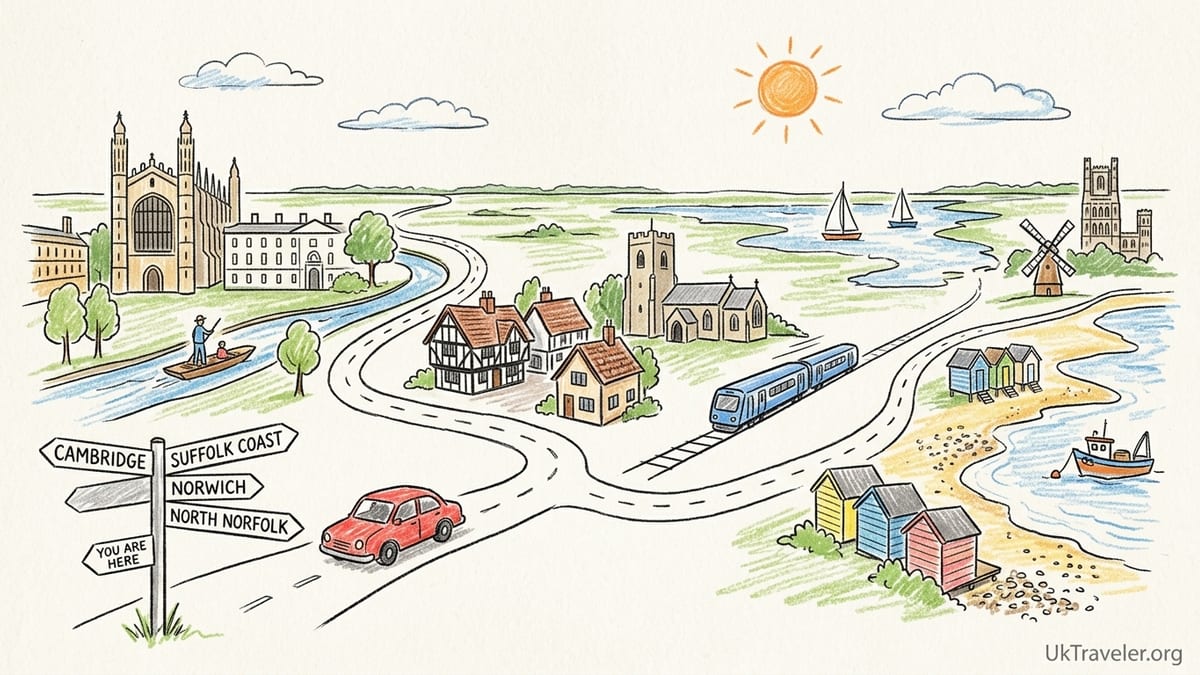
East Anglia rewards travelers who take things slowly. This is a region of medieval market towns, reed-fringed rivers and wave-cut coasts, where journeys between places can be as enjoyable as the destinations themselves. Rather than one long, fixed itinerary, the strongest East of England road trip is modular. You connect a series of short, characterful stays: Cambridge and Ely, the Suffolk countryside and coast, Norwich, the Norfolk Broads and the North Norfolk coast, with optional extensions into Essex or Hertfordshire. This guide shows you how to link those building blocks in a way that suits your time, budget and appetite for driving, while being honest about where a car adds value and where a train or boat does the job better.
How to Use This Modular East Anglia Route
Think of East Anglia as a set of overlapping zones rather than a single point-to-point route. A practical backbone is Cambridge or Ely to Bury St Edmunds, then out to the Suffolk Coast, up to Norwich, into the Norfolk Broads and finally along the North Norfolk coast. Many official East Anglia itineraries already suggest separate two to three night stays in the Suffolk countryside, the Suffolk Coast, “Royal Norfolk” around Sandringham and the Norfolk Coast, and you can mix and match those blocks depending on how long you have.
A typical one-week road trip might give you two nights around Cambridge and Ely, two on the Suffolk Coast near Southwold or Aldeburgh, two in or around Norwich for the city and Broads, and two on the North Norfolk coast near Wells-next-the-Sea or Blakeney. With ten days, you could add Bury St Edmunds and a countryside stay near Lavenham or Dedham Vale, or push south into Essex for Constable Country and seaside towns like Walton-on-the-Naze. With just four or five days, you might base yourself in Norwich and add a car only for a couple of coastal days.
Because the region is relatively flat and distances are short, almost every leg is under two hours by car in normal traffic. Cambridge to Bury St Edmunds is usually around 45 minutes, Bury St Edmunds to the Suffolk Coast about one hour via the A14 and A12, Norwich to the Broads boat hubs such as Wroxham roughly 25 to 35 minutes, and Norwich to Wells-next-the-Sea on the A1067 and A148 about one and a half hours. That makes it realistic to design your own pattern of stays while avoiding the fatigue of constant one-night stops.
The key planning decision is where to mix driving with rail. Cambridge, Ely and Norwich all sit on good rail lines, and certain stretches like London to Cambridge or London to Norwich are usually easier and cheaper by train than by car once you factor in city-centre parking. Many travelers arrive by train into Cambridge, pick up a hire car on the edge of the city for the rural and coastal sections, then drop it before taking the train home.
Cambridge and Ely: When to Park, When to Take the Train
Cambridge looks like an obvious place to start a driving trip, but it is not a car-friendly city in the centre. Street space is tight, cycling is common and several roads are restricted for through traffic. City-centre car parks such as Grand Arcade or Queen Anne usually charge at a premium, and leaving a car there for a multi-night stay quickly adds up. For most visitors, the pragmatic solution is to leave the car on the outskirts and use public transport or walking to get into the historic core around King’s Parade and the Backs.
Cambridge’s Park and Ride sites at Madingley Road, Trumpington, Newmarket Road and Milton are designed for this. You park on the edge of town and take a frequent bus into the centre, usually in under 20 minutes in off-peak times. Current arrangements typically allow parking for up to 18 hours as part of the bus ticket, with an option to pay extra on site for longer stays of up to around 72 hours. That means you can realistically base yourself for two nights in the city while leaving the car at a Park and Ride rather than trying to thread it through one-way streets and congestion.
If you prefer to stay overnight near the historic core, some hotels and guesthouses include a small number of parking spaces, often charged separately and needing advance reservation. Meeting House Lane and Park Terrace, for example, have guesthouses that either offer limited parking or point guests toward nearby multi-storey facilities. For budget-conscious travelers, another strategy is to overnight in Ely, which has cheaper or easier parking around its compact centre, then day trip by train into Cambridge. Ely to Cambridge by rail can be around 15 minutes, making it simple to visit the colleges, the Fitzwilliam Museum and the riverfront without worrying where the car is.
In both cities, a car is least useful when you are doing purely urban sightseeing. You will mostly be on foot, punting on the Cam, climbing Ely Cathedral’s Octagon Tower or wandering along the riverside paths. Reserve your car time for the surrounds: the fenland villages, Wicken Fen Nature Reserve, the Imperial War Museum at Duxford near the M11, or the quiet B-roads that lace through thatched hamlets like Grantchester and Burwell.
Through Bury St Edmunds and the Suffolk Countryside
The short hop from Cambridge or Ely to Bury St Edmunds showcases why a car can add value in this region. There are trains from Cambridge to Bury, but having your own vehicle lets you roam beyond the tidy grid of the town and into the half-timbered villages that give Suffolk its storybook reputation. Coming from Cambridge, most drivers follow the A14 east, diverting into Bury for a night or two, then looping south toward Lavenham, Long Melford and the Stour Valley before heading for the coast.
Bury St Edmunds itself works well as a two-night stop within a modular itinerary. You can park at one of several signposted long-stay car parks on the edge of the compact historic core, then explore on foot the Abbey Gardens, the ruins of the medieval abbey, and the Georgian streets around Angel Hill. Many visitors take a couple of hours for a tour of the Greene King Brewery which looms above the town, or fit in a performance at the Theatre Royal. Once you have ticked off the main sights, you can use the car to follow hedge-lined lanes to chocolate-box villages like Lavenham, often considered one of England’s best-preserved wool towns, where crooked medieval houses lean over the market square.
Driving also helps you stitch together the rural landscapes of Dedham Vale and the Stour Valley, made famous by the paintings of John Constable. This stretch along the Suffolk and Essex border is awkward to explore by public transport alone, with infrequent buses and long walks from village bus stops to footpaths. With a car, you can park at spots like Flatford or Dedham, walk a riverside loop, then detour to places like Sudbury, whose old cloth-merchant houses overlook water meadows still grazed by cattle. This “Suffolk countryside” module is a natural two or three night block that many official itineraries recommend on its own and that you can either keep or drop depending on your time.
When you are ready for the sea, you can follow minor roads north and east through villages such as Kersey and Peasenhall, then link back to the A12 which leads directly to the Suffolk Coast. Here, having a car opens up multiple small stops in a single day: a coffee in Aldeburgh, fish and chips in Southwold and a birdwatching walk at RSPB Minsmere or Dunwich Heath, all stitched together at your own pace.
Suffolk Coast: Coastal Roads, Parking and Rail Alternatives
The A12 is the main coastal artery of Suffolk, running from London up to Lowestoft and passing close to Ipswich, Saxmundham and Blythburgh before continuing to the Norfolk border. For much of its length through Suffolk it is single carriageway and threads directly through villages, so speeds can drop below the national limit, particularly at busy times or in holiday season. That slower pace can be frustrating if you are expecting a fast trunk road, but it works for a leisurely coastal road trip where you want to peel off frequently for beaches and viewpoints.
Many of the most appealing Suffolk seaside towns sit a short way off the A12 along smaller A-roads and lanes. Aldeburgh, for example, is reached via the A1094 from the A12 at Friday Street, while Southwold connects via the A1095. These spurs are part of the charm: ten minutes down a narrower road and you step into a different world of pastel beach huts, shingle beaches and high-street butchers selling local sausages. Having a car makes it simple to base yourself in, say, a cottage near Walberswick or a farmhouse inland, then day trip up and down the coast with stops for smoked fish at Orford, pier amusements in Southwold or a walk in the Suffolk Coast and Heaths Area of Outstanding Natural Beauty near Blythburgh.
Parking on the Suffolk Coast is generally easier than in Cambridge or Norwich, though you will pay in the most popular spots. Southwold, Aldeburgh and Walberswick all have signed car parks near the seafront or village centres, and smaller villages often have modest pay and display areas by the beach. In high summer weekends, certain car parks can fill by mid-morning, particularly during school holidays, so arriving before 10am or after 4pm is wise. Outside peak season, you may well pull into Southwold on a Tuesday in October and find plenty of space on the seafront or common.
Rail can occasionally be the easier option for reaching the coast without a car. The East Suffolk Line connects Ipswich with Lowestoft via Woodbridge, Saxmundham and Halesworth, with branch-line style services that feel part of the landscape. From London Liverpool Street, you can take a mainline train to Ipswich and connect onward, making it possible to spend a few nights on the Suffolk Coast without driving at all. Once there, however, buses are infrequent and walking distances can be longer than they look on the map. A hybrid strategy is to hire a car in Ipswich for the coastal section, then return it before catching the train north to Norwich.
Norwich and the Norfolk Broads: City by Train, Water by Boat
Norwich is the obvious urban counterpoint to Cambridge on an East Anglia itinerary: a compact cathedral city with a lively food scene, medieval lanes and a castle-turned-museum. Its centre is a tight knot of one-way streets and bus lanes, with several multi-storey car parks around the inner ring road. For drivers, the most straightforward arrangement is usually to choose accommodation that either includes parking or sits near a long-stay car park, then ignore the car for most of your Norwich time. Once parked, you can walk between the cathedral close, Elm Hill, the market and the Lanes with ease.
The city also operates several Park and Ride sites on the outskirts, connecting by bus into the centre in around 15 to 25 minutes depending on traffic. For many day visitors, especially in the lead-up to Christmas or during festival events, it is less stressful to leave the car at a Park and Ride than to crawl along the ring road hunting for space. Drivers approaching from the Suffolk Coast might park on the south side and bus in, then retrieve the car a day or two later when they head to the Broads or North Norfolk.
Rail is also an efficient way in and out. Fast trains from London Liverpool Street usually reach Norwich in around two hours, and there are regular services from Cambridge and Ely via the cross-country line. That means one modular approach is to return your hire car on the Suffolk Coast or in Ipswich, take the train to Norwich for a couple of car-free nights, and only hire again if you want freedom for the Broads or coast. Within the city, you simply do not need a vehicle day to day, and many streets in the historic centre are friendlier to pedestrians and cyclists than drivers.
For the Norfolk Broads themselves, water rather than wheels is the main attraction. The Broads are a network of shallow lakes and slow rivers, much of it within a protected national park that straddles Norfolk and Suffolk. Towns like Wroxham, Stalham, Potter Heigham and Beccles host busy boatyards, where you can hire day boats by the hour or full day, often with simple controls and tuition aimed at first-timers. In peak summer, day boat hire can be popular, so advance booking is often recommended, but there are usually walk-up options in shoulder seasons. A typical day might involve collecting a small cruiser mid-morning, pottering along reed-fringed channels past mills and thatched boathouses, mooring at a riverside pub for lunch and returning by late afternoon.
North Norfolk Coast and the A149 “Coast Road”
The North Norfolk coast feels like a different chapter in the same book: big skies, tidal marshes and sandy beaches, punctuated by villages whose high streets are lined with flint cottages and independent delis. While there is limited bus service along parts of the coast, this is the section of East Anglia where having your own wheels unlocks the most variety. The A149, commonly known locally as the “Coast Road,” runs from King’s Lynn to Great Yarmouth, passing many of the classic seaside stops: Hunstanton, Burnham Market, Wells-next-the-Sea, Blakeney, Cley-next-the-Sea, Sheringham and Cromer, among others.
For drivers heading north from Norwich, a common pattern is to reach the A148 around Fakenham or Holt and then drop onto the A149 for the main coastal strip. From here, you can roll between saltmarsh viewpoints, beach car parks and harbours in short hops of ten or twenty minutes. Wells-next-the-Sea has a large car park behind the beach with a boardwalk leading over the dunes to miles of sand and pines, while Holkham’s estate has managed parking near its famously wide bay. Blakeney and Morston offer access to boat trips to see the seal colonies offshore, and both have pay and display car parks that fill around departure times for the tours in school holidays.
Traffic along the A149 swells in midsummer and on sunny weekends, and you can find yourself trundling behind campervans and tractors. Yet it remains relatively relaxed compared with some better-known coastal circuits elsewhere in Britain. The road’s slower pace encourages impromptu stops: pulling into a lay-by to watch birdlife over the marshes, or detouring inland a couple of miles to small villages whose only obvious amenity is an old coaching inn and a parish church. Many travelers choose a single base such as Wells-next-the-Sea, Sheringham or Cromer for two or three nights, then spend their days exploring by car along this stretch.
If you prefer to keep driving to a minimum, you could base yourself in a coastal town with a railway station such as Sheringham or Cromer. The Bittern Line connects these to Norwich with regular services, so you can combine a few car-free days at the seaside with a city break in Norwich. However, rail alone will not connect you efficiently with the more scattered villages and nature reserves, which is why drivers often treat the North Norfolk segment as distinctly “car-forward” compared with the more rail-accessible Cambridge and Norwich modules.
Optional Extensions into Essex and Hertfordshire
For travelers arriving via London Stansted Airport or looking to pad out their trip with more countryside, Essex and Hertfordshire make natural southern extensions. Stansted itself sits roughly halfway between London and Cambridge, so many visitors either begin or end their East Anglia trip with one or two nights nearby, exploring villages like Saffron Walden, with its medieval market square and maze, or the half-timbered houses of Thaxted. Both are more enjoyable with a car, as public transport links between small villages, especially in the evenings, are limited.
Further east, the Essex coast offers a quieter, marshier complement to Suffolk. Following the A12 from Colchester, you can detour toward the Blackwater Estuary, Maldon, Mersea Island or the Dengie Peninsula. These areas are not as heavily touristed as Southwold or Aldeburgh, but they reward slow exploration: creeks lined with sailing barges, broad mudflats at low tide and small pubs where oysters or local fish might appear on the menu. Driving is the only practical way to link several of these in one day, as bus services can be infrequent and often oriented around commuting rather than leisure travel.
Hertfordshire, meanwhile, offers parkland estates and historic towns within an hour or so of London. St Albans, with its Roman remains and enormous cathedral, is on a fast rail line from the capital, making it easy to visit car-free as part of a wider trip. However, if you want to combine it with smaller villages, canal walks or rural pubs, a car once again adds flexibility, turning train-accessible hubs into gateways to surrounding countryside. Travellers with ten to fourteen days might, for example, start with two nights in Hertfordshire, collect a hire car, then move on to Cambridge, Suffolk and Norfolk before looping back to return the vehicle near a rail station.
Because these southern extensions sit closer to major motorways and London commuter routes, they can experience heavier traffic at peak times. When building them into a modular itinerary, it can pay to schedule your driving legs outside weekday rush hours. Starting late morning from Stansted to Cambridge, or from Colchester toward the Suffolk Coast, often results in a gentler experience than battling early rush-hour queues.
The Takeaway
The strength of an East of England road trip lies less in ticking off a prescribed list of stops and more in combining flexible building blocks that suit your style. A core spine of Cambridge or Ely to Bury St Edmunds, then the Suffolk Coast, Norwich, the Norfolk Broads and the North Norfolk coast gives you a satisfying mix of city, countryside, river and sea. Around that spine, you can add or subtract modules: two or three nights in the Suffolk countryside, a detour into Essex’s estuaries, an opening chapter in Hertfordshire or a few fully car-free days in Cambridge or Norwich reached entirely by rail.
At every step, think about where a car genuinely improves your trip and where it simply becomes a burden. City centres like Cambridge and Norwich often work best without a vehicle, relying on Park and Ride schemes or trains, while the Suffolk countryside, the Broads’ boatyards and the string of North Norfolk villages come into their own when you can move independently by road and, on the water, by boat. With realistic driving times, smart parking choices and a willingness to shift modes, you can build an East Anglia journey that feels both relaxed and richly varied rather than rushed.
FAQ
Q1. How many days do I need for this East of England road trip?
For a balanced itinerary connecting Cambridge or Ely, the Suffolk Coast, Norwich, the Norfolk Broads and North Norfolk, plan at least seven to eight days. That allows two nights in the Cambridge or Ely area, two on the Suffolk Coast, two in or near Norwich and two on the North Norfolk coast. With only five days, you might focus on Cambridge, Norwich and a single coastal base, while ten to fourteen days lets you add countryside modules around Bury St Edmunds, Lavenham or Dedham Vale plus optional extensions into Essex or Hertfordshire.
Q2. Do I really need a car or can I do this trip by train and bus?
You can visit Cambridge, Ely, Norwich and some coastal towns entirely by rail, but a car adds significant flexibility in rural areas and along the North Norfolk coast. Trains serve key hubs like Cambridge, Ipswich, Norwich, Cromer and Sheringham, and there are branch lines to parts of the Suffolk Coast. However, public transport between villages, nature reserves and small harbours can be infrequent, especially in the evenings or outside summer. Many travelers choose a hybrid approach: train into Cambridge or Norwich, then hire a car for several days to explore countryside and coast before returning it and taking the train home.
Q3. What is the best way to handle parking in Cambridge and Norwich?
In both cities, the simplest option is to use Park and Ride sites on the outskirts and take a bus into the centre, especially for day visits. In Cambridge, Park and Ride locations such as Madingley Road, Trumpington, Milton and Newmarket Road are set up for this, and typical arrangements allow you to leave your car for much of the day as part of the bus ticket, with extra payment for longer stays. Norwich also has several Park and Ride sites feeding buses into the city centre. If you are staying overnight, look for accommodation that either includes on-site parking or sits near a long-stay multi-storey car park so you can leave the vehicle parked and explore on foot.
Q4. Are the coastal roads in Suffolk and Norfolk difficult to drive?
Most coastal roads in Suffolk and Norfolk are straightforward, but they are often single carriageway and can be narrow in places, especially on minor lanes leading to beaches and villages. The A12 through Suffolk and the A149 along the North Norfolk coast both slow down as they pass through settlements, and traffic can build up behind slower vehicles in high summer. Allow extra time, be prepared for occasional tractors or campervans and expect to use village car parks rather than roadside parking in busy spots. Outside peak holiday periods, many drivers find these roads relaxed and scenic rather than challenging.
Q5. When is the best time of year to plan this road trip?
Late spring, early summer and early autumn are often ideal for this route, typically offering milder weather, longer daylight and fewer crowds than the peak school holidays. May and June see countryside greenery at its best and can be comfortable for walking and boating on the Broads, while September often brings warm sea temperatures and quieter beaches. July and August can still be enjoyable but expect busier car parks, more traffic on the coastal roads and higher accommodation prices, especially in popular spots like Southwold, Wells-next-the-Sea and Blakeney. Winter can be atmospheric but some attractions and seasonal services reduce their hours.
Q6. How should I split my nights between the different areas?
A common pattern for a week is two nights in Cambridge or Ely, two on the Suffolk Coast, two in or near Norwich and two on the North Norfolk coast, trimming or adding nights depending on your total time. If you are especially interested in countryside villages and historic wool towns, you might add a night or two around Bury St Edmunds and Lavenham and slightly reduce your city time. Birdwatchers and walkers may prefer extra nights on the Suffolk or Norfolk coasts to take in reserves and long-distance paths, while those keen on museums and restaurants may linger longer in Cambridge or Norwich and treat the coast as a shorter module.
Q7. Is it easy to hire boats on the Norfolk Broads for a day?
Yes, day boat hire on the Norfolk Broads is well established, with boatyards in places like Wroxham, Stalham, Potter Heigham and Beccles offering small motor boats by the hour or full day. First-time boaters receive basic tuition on controls and safety, and most day boats have simple steering and low speeds suited to the Broads’ calm waters. In peak summer and holiday weekends, it is wise to book ahead, especially for full-day hires, while in shoulder seasons you can often arrange a boat on the day. A typical itinerary is to cruise gently between riverside pubs and nature reserves, returning to the same yard by late afternoon.
Q8. Can I base myself in one place and do day trips instead of moving every night?
Yes, the relatively short distances in East Anglia make single or double bases practical. Many travelers choose to stay several nights in Norwich and add day trips by car or train to the Broads, the North Norfolk coast and even parts of the Suffolk Coast. Another approach is to have one inland base, such as Bury St Edmunds or a village near Lavenham, and one coastal base, such as Southwold or Wells-next-the-Sea, staying three to four nights in each. This reduces packing and unpacking while still allowing a diverse mix of city, countryside and seaside experiences within comfortable day-trip ranges.
Q9. How expensive is parking along the Suffolk and Norfolk coasts?
Parking costs vary by location and season but are generally moderate, especially compared with major UK cities. Many coastal car parks use pay and display machines or mobile apps, with typical charges for a few hours that are manageable for most travelers. Premium or all-day parking near very popular beaches, such as Southwold, Holkham or Wells-next-the-Sea, can add up over a week-long trip, particularly in peak season. To manage costs, some visitors combine paid seafront lots with free or cheaper inland parking where allowed, and time their visits to busier resorts earlier or later in the day when turnover frees up spaces.
Q10. Is this route suitable for drivers from outside the UK?
This route is suitable for overseas drivers who are comfortable adapting to driving on the left and to narrow rural roads. East Anglia’s roads are generally less intense than those around major cities, but first-time visitors should allow extra time, avoid driving immediately after a long flight and choose smaller town or village centres rather than big city rush hours for their first experiences. Renting a medium-sized car rather than a very large vehicle can make village streets and car parks easier to manage. Many international travelers find that once they adjust over the first day or two, the flat landscapes, clear signage and short journey times make this region a gentle introduction to driving in Britain.