


The English Midlands is one of the best regions in the UK for combining big-city culture with country-house hotels and wide open countryside. Deciding whether to hire a car from Birmingham, Birmingham Airport, Nottingham, Leicester or another transport hub is one of the biggest choices that will shape your trip. This guide explains, in practical terms, when a rental car genuinely improves your Midlands itinerary and when trains and buses are the smarter choice.
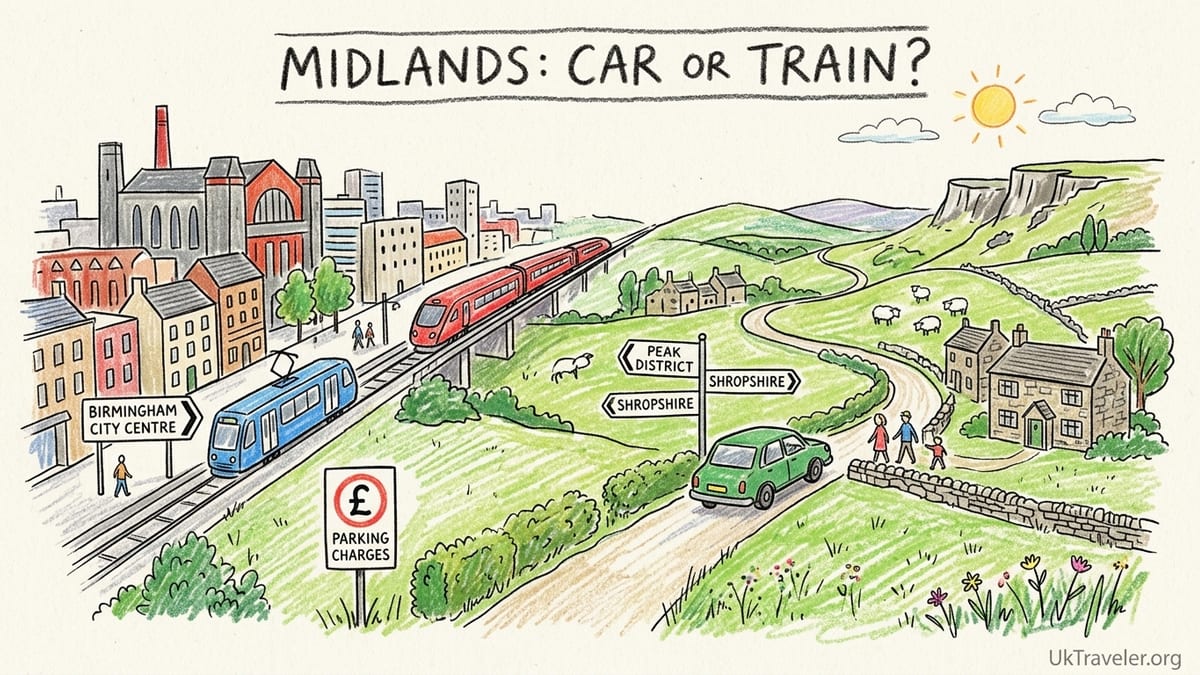
Where a Midlands Rental Car Really Makes Sense
If your plans focus on Birmingham, Nottingham, Leicester or Derby city centres, a hire car is usually more trouble than it is worth. All four cities have central railway stations with frequent intercity services from London and cross-country links between them, plus dense local bus and tram networks. For example, the train from Birmingham New Street to Nottingham typically takes around 1 hour 15 minutes and drops you in the middle of the city, while parking in Nottingham city centre car parks can quickly exceed a modest daily train fare once you factor in fuel and any clean air or congestion charges.
A car comes into its own once you step away from the main rail corridors and want to explore the Peak District, Shropshire, rural Warwickshire or the quieter corners of Staffordshire. Think of long weekends based in Bakewell with walks around Monsal Head and Stanage Edge, or a country-house stay outside Ludlow with vineyard visits and farm shops that lie well beyond bus routes. In these cases, public transport can reach a gateway town, but a rental car lets you combine villages, viewpoints and stately homes in a single day that would otherwise require complex and infrequent bus connections.
Another situation where a car is valuable is multi-stop family itineraries. If you are flying into Birmingham Airport on a Saturday morning and want to visit Warwick Castle, Stratford-upon-Avon, the Black Country Living Museum and Ironbridge over four or five days, a hire car allows you to string these places together efficiently. Travelling solely by rail and bus is possible, but journey times mount up and you may find yourself cutting sights simply because the last bus back to your base leaves mid-afternoon.
For travellers who value late-evening flexibility, a car is also appealing. Many buses into rural Derbyshire and Shropshire taper off after early evening. If you like long summer dinners in village pubs, or sunrise and sunset walks on the edges of the Peak District, having your own wheels reduces the stress of watching the last bus timetable.
Birmingham Airport vs City Centre Pick-Up
Birmingham Airport is the main gateway for many international visitors and a very practical car hire hub. The airport has a compact, single-terminal layout, and the major rental desks sit a short walk from arrivals, with cars parked in an adjacent multi-storey car park rather than at a remote shuttle lot. That means you can often be on the A45 heading for Birmingham or the M42 within 30 to 40 minutes of clearing immigration, provided you have pre-booked and your paperwork is in order.
Airport branches, however, usually carry an additional location surcharge compared with downtown depots. In practice, a small hatchback that costs, for example, around a certain amount per day at a Birmingham city branch can easily be a modest percentage more at the airport in high season. On the other hand, arrivals at Birmingham Airport can step directly into the hire car and avoid buying separate train tickets into the city before collecting a vehicle. If you are two or more travellers carrying large bags or travelling with children, that convenience often outweighs a moderate daily price premium for an airport pick-up.
City-centre locations in Birmingham, Nottingham and Leicester tend to have slightly lower base rates and can be ideal if you are spending your first couple of days car-free. A common pattern is to arrive by train, enjoy two nights based near Birmingham New Street or Nottingham city centre, then collect a car from a downtown branch on the morning you head into the countryside. This saves two or three days of rental costs, hotel parking fees and any clean air or controlled zone charges that might apply to driving in the core of the city.
Do check branch opening hours when planning your pick-up. Many city locations close early on Saturdays and may not open on Sundays, while airport desks generally mirror flight schedules and offer longer hours or out-of-hours key collection for late flights. If your flight lands at 22:00 into Birmingham, an airport hire is usually your only realistic option that night; picking up from a city branch the following morning may be cheaper but will require an extra night’s accommodation near the airport or in town.
Automatic vs Manual Cars in the Midlands
In the UK, manual transmission is still the default, and most hire fleets in Birmingham, Nottingham and Leicester reflect that. Compact and mid-size manual cars are usually the best-value options on comparison sites. If you are comfortable driving a manual on the left-hand side of the road and navigating roundabouts, choosing a manual can keep rental costs down and gives you the widest choice of models, including small hatchbacks that are easier to park in tight village streets or multi-storey car parks.
For many North American and Asian visitors, though, the stress of adapting to a manual gearbox on unfamiliar roads, plus driving on the left, can outweigh any savings. Automatic cars are widely available at Birmingham Airport and major city branches, but they tend to be priced higher than their manual equivalents and are often grouped with slightly larger, more premium models. In peak summer or around Easter, automatics in popular classes can sell out, so early booking is advisable if you know you will only drive an automatic.
The driving you plan to do should influence your choice. If you expect long motorway runs between Birmingham, Nottingham and the Peak District, an automatic can reduce fatigue and makes stop-start traffic on the M6 or M42 easier. On the other hand, for short hops around the Cotswolds fringe of Warwickshire or into steep-sided Peak District lanes, a compact manual often feels more nimble and is less daunting to squeeze into small car parks outside tearooms and trailheads.
Fuel efficiency plays a role too. Many modern UK petrol and diesel cars, manual and automatic alike, deliver good mileage on motorway runs, but smaller manual models are still often the most economical choice for mixed driving. If you plan to drive several hundred miles around Shropshire and Derbyshire, this can translate into noticeable savings at the pump compared with a heavier automatic SUV.
Motorways, the M1/M6/M40/M42 and Realistic Drive Times
From Birmingham and its airport, you are well placed to access the main Midlands motorway network. The M6 runs north-west towards Staffordshire and Cheshire, and south towards Coventry and the West Midlands conurbation. The M40 links the region to Oxford and London, while the M42 curves around the south-east of Birmingham, connecting the M6, M40 and major A-roads towards the East Midlands. The M1 skirts east of Derby and Nottingham, forming the primary north-south spine on that side of the region.
Realistic drive times depend heavily on time of day. From Birmingham Airport, you can often reach central Birmingham in around 25 to 35 minutes outside peak hours, using the A45 and inner ring roads. In rush hour, that same journey can stretch to 45 minutes or more, particularly around junctions feeding the city centre. Birmingham to Nottingham via the M6, A38 and A52, or using the M42 and A42, typically takes around 1 hour 15 minutes in light traffic, but Friday afternoons or holiday getaways can easily add half an hour.
The motorway network makes it easy to combine several bases in one trip. A week-long itinerary might start with two nights in Birmingham, followed by three nights in the White Peak around Bakewell, then two nights outside Shrewsbury. From Birmingham to Bakewell via the M1 and A38 you might allow around 1 hour 45 minutes, while the onward leg from Bakewell to Shrewsbury could take a similar time across cross-country A-roads. Having a hire car for this kind of triangular route saves you from juggling rail timetables between several small towns.
One point to remember is that some stretches, such as the M6 around Birmingham and the M1 near Nottingham, can be prone to roadworks and average-speed camera zones. Build in buffer time if you are driving back to Birmingham Airport for a flight. Returning your hire car at least two to three hours before a short-haul departure, and earlier for long-haul, is advisable so that heavy traffic does not translate into missed flights and expensive rebooking.
Parking Costs and City-Centre Friction
Parking is a central factor in deciding whether a rental is worthwhile for city stays. Birmingham city centre multi-storey car parks commonly charge by the hour, with daily caps that can approach a significant fraction of your car rental cost for the day. Nottingham and Leicester have a mix of council-run and private car parks, often charging tiered rates that escalate sharply after three or four hours. Early-bird deals sometimes offer cheaper full-day parking if you arrive before a set morning time, but these are more useful for commuters than visitors who prefer leisurely starts.
Beyond the fees, you need to consider traffic management schemes. Birmingham has a Clean Air Zone inside its inner ring road. While many newer petrol and diesel hire cars will comply, some budget models and certain vans may not, incurring daily charges each time you drive into the zone. If your hotel lies inside this area, it may be cheaper to stay slightly outside the boundary, using trams and buses, rather than driving in every day and paying repeated fees.
Parking in smaller Midlands market towns is often more forgiving, but still not negligible. Towns such as Warwick, Stratford-upon-Avon, Ashbourne or Ludlow have central council car parks where a day’s parking might be comparable to the cost of a modest rail fare for one person from Birmingham. For couples or families, the economics tilt more in favour of driving, as the same parking cost is shared, while four rail tickets quickly add up. In rural Peak District and Shropshire locations, many beauty spot car parks now use pay-and-display or app-based systems, with flat day rates that are easier to absorb as part of your overall trip budget.
If you are planning a mixed itinerary, one effective strategy is to keep the car for your countryside days and hand it back before moving into the city. For example, you might return the car at a Birmingham city branch after a loop through the Peak District and Shropshire, then spend your final two nights car-free in Birmingham, using local transport to the airport on departure day. This approach keeps parking costs under control and blends the advantages of both modes.
Peak District, Shropshire and Rural Warwickshire: Car vs Rail
The Peak District has decent public transport for a national park, but it is concentrated on specific corridors. Trains from Sheffield and Manchester run to gateway stations such as Hathersage, Edale and Hope, and there are regular buses from Derby and Nottingham to towns like Matlock and Bakewell. If your plan is to base yourself in one or two of these hubs and enjoy local walks, cafés and well-trodden trails, you can manage comfortably without a car, especially if you are happy to stick to popular routes.
Once you want to string together several valleys and smaller villages in a single day, a hire car becomes much more attractive. A driver based near Bakewell could visit Chatsworth House in the morning, stop at Monsal Head for an afternoon walk and late-lunch pub stop, then detour via the reservoirs above Bamford at sunset, all without worrying about the last bus. Covering that combination on public transport in one day is awkward and can mean sacrificing flexibility or rushing visits to meet a fixed timetable.
Shropshire leans even further towards car travel. The county is served by rail lines through Shrewsbury, Telford and Ludlow, and these towns make good car-free bases with attractive centres. However, some of the most evocative landscapes and historic sites lie outside the immediate rail catchment. The Ironbridge Gorge museums, the Long Mynd above Church Stretton, rural stretches of the River Severn and tiny black-and-white villages north of Ludlow are far easier to explore by car. Buses exist but often run only a handful of times a day, which limits spontaneity.
Rural Warwickshire sits somewhere in between. Warwick and Leamington Spa are well-connected by train from Birmingham and London, and Warwick Castle can be reached on foot from the station. But the surrounding countryside of stone-built villages, farm shops and small manor houses is lightly served by buses. If your trip includes a country-house hotel stay, vineyard tours or wedding venues outside town, a rental car gives you the freedom to come and go without relying on local taxis, which can be patchy and need booking well ahead on busy weekends.
One-Way Rentals and Multi-City Itineraries
One-way rentals can make a lot of sense for travellers weaving the Midlands into a longer UK itinerary. For instance, you might arrive by train in Birmingham, collect a car downtown, spend several days in the Peak District and Shropshire, then drop the car in Nottingham before continuing by rail to York or Edinburgh. This avoids retracing your steps solely to return a vehicle and can save both time and accommodation costs.
Most major hire companies with branches in Birmingham, Nottingham, Leicester and Derby allow one-way rentals within England, though they typically apply a drop fee. The amount varies by company, distance between branches and season, but it is common to see flat surcharges that may be equivalent to an extra day’s rental on a small car. On longer trips, the time and fuel saved by not looping back can easily justify that fee.
For travellers arriving at Birmingham Airport and departing from another gateway such as Manchester or London Heathrow, a one-way rental is often the cleanest solution. You could land at Birmingham, explore the southern Peak District, continue via the Yorkshire Dales and hand back the car at Manchester Airport before flying out. In these cases, you should compare the one-way fee against the cost and time of a separate repositioning journey by rail, especially if you would otherwise need to spend an extra hotel night just to tidy up logistics.
Do read the rental conditions carefully. Some smaller city branches have limited parking and may refuse returns outside office hours, which could scupper an early-morning train departure. Airport branches are more likely to support out-of-hours key drops and 24-hour access to the return car park, a detail that matters if you are catching a 06:00 flight after a late drive along the M1 or M6.
When Rail and Public Transport Are the Better Choice
Despite the advantages of a car in rural areas, there are many Midlands journeys where rail is clearly the better tool. Intercity links between Birmingham, Coventry, Leicester, Nottingham and Derby are frequent, reasonably fast and drop you right in the centre. The Birmingham to Leicester line, for example, typically takes under an hour, while driving between the two at peak times can take a similar amount of time once you factor in traffic, parking and walking from the car park to your final destination.
Rail also shines on straight-line trips where you do not plan to deviate much en route. If your itinerary is two nights in Birmingham and two nights in Nottingham, with museum visits and city strolling, a car simply sits idle most of the time. Trains connect the cities directly, and both have compact centres that reward walking and tram or bus use. You avoid navigating ring roads, pay-and-display machines and clean-air zones, along with any stress about minor bumps or parking scrapes on a hire car.
For airport transfers, trains and coaches can be an easy choice if you are not carrying excessive luggage. Birmingham Airport has a frequent people-mover link to Birmingham International railway station, from which direct trains run to Birmingham New Street, Coventry and beyond. If you are staying near one of these stations, a rail transfer is often quicker in practice than collecting a car late at night, especially after a long-haul flight when concentration is low.
Finally, rail is often more relaxing for solo travellers who want to avoid driving long distances after a transatlantic or overnight flight. A reasonable compromise is to arrive by train, rest for a night or two in a city hotel, and begin any intensive driving segment only once you are over the worst of the jet lag. This approach cuts risk as well as stress, particularly on busy routes like the M6 and M1.
The Takeaway
In the Midlands, a rental car is not a blanket necessity but a targeted tool. It adds the most value when you are stringing together rural bases in the Peak District, Shropshire or Warwickshire, staying at country-house hotels, visiting multiple stately homes in a day or travelling as a family group that would otherwise buy several rail tickets per leg. In these situations, starting or ending your rental at Birmingham Airport or a major city hub can unlock a flexible, deeply rewarding itinerary.
On the other hand, if your focus is city-centre culture in Birmingham, Nottingham or Leicester, with perhaps a single day trip to a nearby attraction, trains and buses are generally more efficient, less stressful and often cheaper once you include parking and potential clean-air charges. The smartest Midlands itineraries often blend both approaches, using rail for straight-line hops between major cities and a hire car for high-impact countryside segments where public transport thins out.
Before booking, sketch your route on a map and mark the places that lie beyond easy rail and bus links. If most of your red dots cluster along main lines, stay car-free. If they scatter across green and grey areas of the map, a carefully timed rental from Birmingham, Birmingham Airport, Nottingham or Leicester will likely turn a good holiday into a great one.
FAQ
Q1. Is it better to hire a car at Birmingham Airport or in Birmingham city centre?
Hiring at Birmingham Airport is more convenient straight after a flight and offers longer opening hours, but daily rates can be higher than downtown branches. City-centre pick-up is ideal if you plan a couple of car-free days first and want to avoid parking charges, provided your arrival time fits branch opening hours.
Q2. Do I really need a car for the Peak District from Nottingham or Birmingham?
You can reach Peak District hubs like Matlock, Bakewell or Edale by train and bus, so a car is not essential for a single-base walking trip. A rental car becomes very useful if you want to visit several valleys, villages and houses such as Chatsworth and Haddon Hall in one day, or stay in hamlets away from main bus routes.
Q3. Is Shropshire possible by public transport from Birmingham?
Yes, Shrewsbury, Telford and Ludlow are well linked by train from Birmingham. However, rural highlights like the Long Mynd, Ironbridge’s outlying sites and small black-and-white villages have infrequent buses, so a hire car makes exploring wider Shropshire much easier.
Q4. Are automatic hire cars common in the Midlands?
Automatic cars are widely available at Birmingham Airport and major city branches but form a smaller share of the fleet and cost more than manuals. If you only drive automatics, book early, especially for summer and school holidays, to secure the right size and avoid last-minute shortages.
Q5. How bad is parking in Birmingham, Nottingham and Leicester for visitors?
All three cities have extensive multi-storey and surface car parks with hourly and daily caps, but costs add up quickly for full days. Add in clean air or similar zone charges and city-centre driving often becomes less attractive than arriving by train and using local public transport for sightseeing.
Q6. Are one-way rentals between Birmingham, Nottingham and other UK cities expensive?
Most major companies allow one-way rentals within England and charge a flat drop fee, often comparable to an extra day’s rental on a small car. For longer itineraries, such as Birmingham to Manchester or London via the Peak District, the time and rail fares saved by not backtracking can outweigh the surcharge.
Q7. Which Midlands journeys are clearly easier by train than by car?
Direct routes between major cities, such as Birmingham to Nottingham, Leicester, Coventry or Derby, are usually simpler and quicker by train. You avoid motorway congestion, parking costs and city-centre driving, and arrive within walking distance of most cultural sights, hotels and restaurants.
Q8. What motorways will I use most when driving in the Midlands?
Typical routes include the M6 around Birmingham, the M42 linking Birmingham Airport with the M40 and A42, the M1 near Nottingham and Derby, and the M40 towards Oxford and London. Many itineraries mix these motorways with A-roads into the Peak District, Shropshire and rural Warwickshire.
Q9. Is a small hatchback enough for Peak District and Shropshire roads?
For most couples or small families, a compact hatchback is ideal. It is easier to manoeuvre through narrow village streets, around tight bends and into small car parks at viewpoints and trailheads, and usually offers better fuel economy than larger SUVs on the hilly, winding roads of these regions.
Q10. How should I time my car return at Birmingham Airport before a flight?
Plan to be back at the airport car rental return at least two to three hours before a short-haul flight, and earlier in peak periods or for long-haul. This allows for motorway delays, refuelling, the inspection process and the short walk back to the terminal without rushing check-in or security.