


The English Midlands has quietly become one of the country’s most versatile short-break regions. Within a few hours of London, Manchester or Leeds you can be eating your way around Birmingham’s canalside restaurants, walking Peak District ridges, soaking in a Worcestershire spa hotel or wandering Shakespeare’s streets in Stratford-upon-Avon. This guide compares the main weekend options, looking at where works best for one-night or two-night stays, how to get there by rail or road, rough accommodation costs and what you can realistically experience from Friday night to Sunday afternoon.
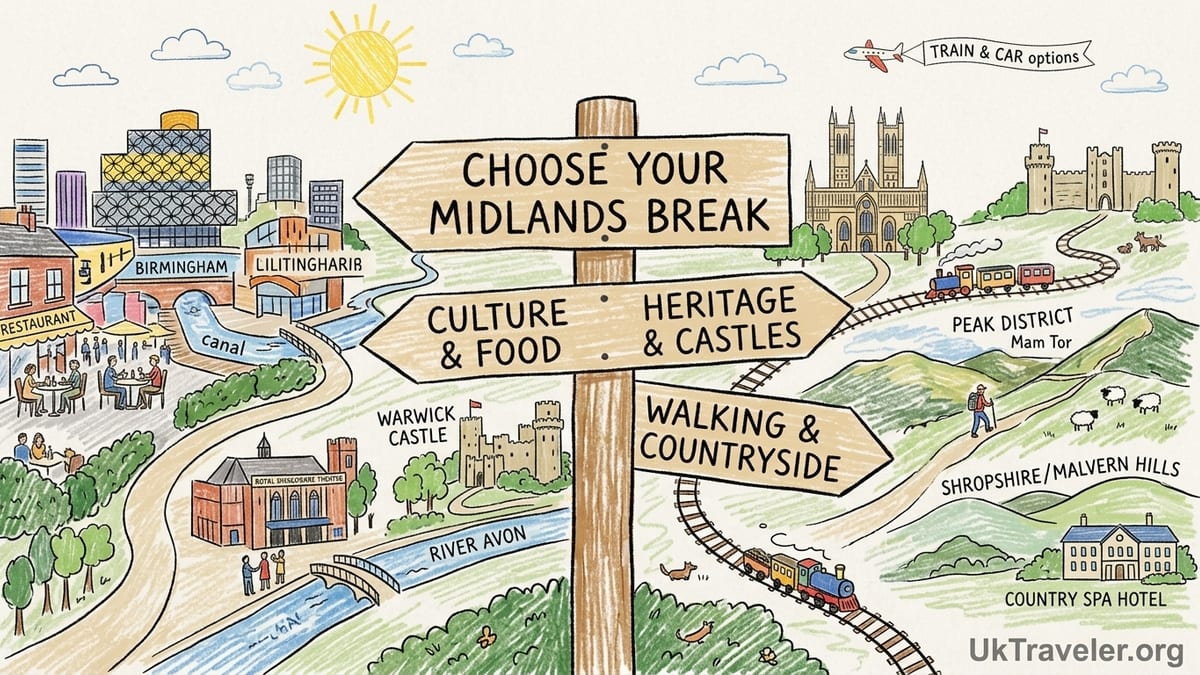
How to Choose the Right Midlands Weekend Break
Before picking a destination, be clear on what you want your weekend to feel like. The Midlands can deliver high-energy city nights, quiet village rambles, heavy-hitting heritage or all-out spa relaxation, but not usually all of those in a single short break. Birmingham suits travellers who want food, galleries and nightlife within walking distance. Stratford-upon-Avon and Warwick are compact historic centres where you park the car or arrive by train and largely forget about transport until you leave. The Peak District works for walkers prepared for early starts and some planning, while Shropshire and Worcestershire are gentler countryside escapes that reward a slower pace.
Time matters. If you are arriving after work on a Friday from London, Birmingham, Nottingham or Lincoln are straightforward for one-night stays because rail connections are direct and frequent, and you can step straight into the city centre from the station. Smaller historic towns such as Stratford and Warwick work well for one night if you focus on a theatre performance or castle visit, but their real charm emerges with two nights when you can add riverside walks or nearby villages. The Peak District and rural Shropshire are far better with two nights, giving you at least one full day on the hills or in the countryside without clock-watching.
Budget is another useful filter. Central Birmingham, Nottingham and Lincoln have a wide spread of prices, from simple chain hotels around major stations at roughly budget to mid-range nightly rates through to boutique stays above that, depending on date and demand. In classic honeypot areas such as the Peak District, weekend rates in popular villages can be higher than cities, especially in summer and school holidays, so you may get better value in nearby market towns with an easy drive or short train hop into the hills. Shropshire and Worcestershire often sit in the sweet spot: characterful inns or small hotels in historic towns can come in below big-city prices yet deliver a more individual feel.
Transport shapes what is realistic. This article assumes you have a maximum of two nights and are travelling primarily by train, with some car hire or driving options where useful. For each destination you will find a broad idea of rail journey patterns from London or major northern cities, and whether you need a car on the ground. Use these to check what your own departure city would look like in terms of timing and connections. In general, if you cannot arrive before about 8pm on Friday, focus on compact, walkable places where you can make the most of Saturday and not lose time to transfers.
Birmingham: Food, Culture and Big-City Energy
Once stereotyped as purely industrial, Birmingham now markets itself, with some justification, as one of England’s most interesting food cities. VisitEngland’s own itineraries highlight a two-day foodie break that hops between Indian restaurants in areas like the Balti Triangle, canalside bistros in Brindleyplace and Michelin-starred dining in the city centre. In Digbeth’s creative quarter, regular street food events such as Digbeth Dining Club bring together independent traders in old warehouses, while new developments like Alfred Works showcase modern Korean and fusion kitchens in characterful spaces. You can comfortably spend an entire weekend moving from brunch spots to craft beer bars and not repeat yourself.
A one-night Birmingham break works if you want an intense hit of city life. You could arrive late afternoon on Saturday, check into a central hotel near New Street station and be by the canals within minutes. A realistic plan would be a pre-dinner wander past the Library of Birmingham and Centenary Square, canalside drinks, a long dinner in the Jewellery Quarter or Digbeth, then a leisurely Sunday of coffee, the Birmingham Museum and Art Gallery when fully reopened, or the Ikon Gallery, before an early evening train home. With two nights you can stretch out: add a daytime trip to the Black Country Living Museum by tram and bus, a tour of Villa Park or Edgbaston if you like sport, or an afternoon exploring indie shops in Moseley and Kings Heath.
Birmingham is straightforward by rail from most of England. Direct services from London Euston, Manchester, Leeds, Bristol and many other cities arrive at Birmingham New Street, which sits under the Bullring and a short walk from many hotels. For a practical example, a typical off-peak advance return from London can be competitive with what you might pay to reach northern cities farther away, and the journey time is usually around 1 hour 20 to 1 hour 30 on faster services. Once there, you do not need a car: trams and buses supplement walking, and taxis or ride-hailing cover late nights.
Accommodation runs from national budget chains beside the station through to design-led hotels on the canals and boutique conversions in the Jewellery Quarter. At peak times such as big events or Christmas markets, rates can jump, so booking ahead is wise. For food-focused travellers, it is worth paying a little more for a central base so you can walk to dinner and home again, rather than relying on late buses. Overall, Birmingham is best for travellers wanting food, culture and nightlife in an easy, walkable package, with one- or two-night stays both viable.
Stratford-upon-Avon and Warwick: Heritage Weekends
Stratford-upon-Avon and nearby Warwick concentrate centuries of English history into a small area. Stratford is Shakespeare country: timber-framed houses, the River Avon with its swans, and the cluster of Shakespeare Birthplace Trust properties that interpret his life. For many visitors, the Royal Shakespeare Company’s theatres beside the river are the main draw, with regular productions and backstage tours giving a deeper look at how the plays are staged. In Warwick, the star is Warwick Castle, a substantial medieval fortress reworked as a visitor attraction, plus quiet Georgian streets, churches and riverside walks that round out a weekend.
If you are planning a one-night break, it is realistic to focus on either a theatre-focused Stratford visit or a concentrated Warwick Castle experience, rather than both towns together. For example, you might arrive in Stratford by mid-afternoon, wander the historic centre, visit one Shakespeare property such as his birthplace or New Place, then have an early dinner before an evening performance at the Royal Shakespeare Theatre. The next morning, a riverside stroll and perhaps a tower climb for views would comfortably fill your remaining hours before an afternoon train home. Attempting Warwick Castle and multiple Shakespeare sites in a single overnight trip will feel rushed.
With two nights, you can sensibly combine both towns. A workable plan is to stay in Stratford, use Friday evening and Saturday for Shakespeare-related visits and theatre, then take the short train or bus to Warwick on Sunday for the castle, returning home from Warwick or Leamington Spa. Alternatively, base in Warwick, spend a full day exploring the castle and town, then day-trip to Stratford for theatre or riverside walks. Travel between the two takes roughly 30 minutes by local train or bus plus walking time, so you need to allow for that in your schedule.
From London, trains to Stratford-upon-Avon usually involve a change, often at Leamington Spa or Birmingham, and take around two to two and a half hours depending on the route. Warwick and Leamington are on mainline routes and can be a little faster. Once you arrive, both towns are compact enough to explore on foot, and you will not need a car unless you want to reach more rural corners of Warwickshire. Accommodation ranges from riverside hotels opposite the RSC in Stratford to small guesthouses and chain hotels in both towns. Weekend rates hover in the broadly mid-range bracket in high season, especially for central, characterful properties, although budget options exist slightly farther from the centre.
Peak District: Walkers’ Weekends from the City
The Peak District is Britain’s original national park and remains one of the most accessible walking areas from major cities. For a weekend break, most travellers focus on well-connected valleys such as the Hope Valley, Edale or the market town of Bakewell. Visit Peak District promotes a 48-hour itinerary that takes advantage of the Hope Valley railway line between Sheffield and Manchester, encouraging visitors to hop off at villages like Hope, Edale or Hathersage and walk directly from the train to the hills. Routes such as the Great Ridge from Mam Tor, circular walks around Castleton’s caverns, or gentle riverside paths between villages are all possible without a car.
A one-night visit to the Peaks can work if you are already based in the Midlands or north of England and can reach the area quickly on Saturday morning. For example, leaving Manchester or Sheffield on an early train on Saturday, hiking during the day around Edale or Hope, staying overnight in a village inn, and walking again on Sunday before heading home is realistic. If you are coming from London or the south, the time spent reaching Sheffield or Derby and then connecting into the national park means a one-night trip will feel compressed, with more time on trains than on the hills. In that case, two nights are strongly recommended.
With a full weekend, pick one corner and explore it properly rather than trying to cover the whole park. Hope and Castleton are ideal for first-time visitors, with show caves, ridge walks and varied pubs. Bakewell and nearby Chatsworth serve those who want historic houses and gardens as much as walking. Buxton offers spa-town architecture, gardens and an indoor option if the weather deteriorates. Public transport within the park is workable but irregular in some areas, so walkers relying on buses and trains should favour the Hope Valley line or towns such as Buxton that have regular services. Drivers have more flexibility but need to plan for narrow lanes, limited parking in honeytrap spots and busy car parks on fine weekends.
From Birmingham, reaching the Peak District by rail usually involves travelling via Derby or Sheffield and then transferring to local services, with total journeys often taking around two to three hours depending on the exact route and destination. From Manchester or Sheffield the approach is far quicker, often under an hour to villages in the Hope Valley. Budget and mid-range accommodation is spread across the park, from youth hostels and simple B&Bs to upmarket inns and boutique hotels. Expect popular villages to book out early for bank holidays and school breaks, while shoulder seasons in spring and autumn can be better value. The Peaks reward travellers prepared to be outside for long stretches and to accept that weather may alter plans.
Lincoln: Compact City History on Foot
Lincoln is one of the most rewarding small-city breaks in the Midlands for visitors who value history and atmospheric streets over big-city buzz. The uphill historic quarter around the cathedral and castle is the highlight: steep cobbled streets, independent shops, half-timbered buildings and a skyline dominated by the Gothic cathedral, which was once among the tallest buildings in the world. Lincoln Castle adds a second major attraction, with medieval walls, an old prison and exhibitions that often include a copy of Magna Carta. Between them, you can easily spend a full day exploring without venturing far.
A one-night Lincoln weekend works particularly well if you stay in or near the uphill area. Arriving early afternoon on Saturday, you could walk up Steep Hill from the modern Brayford waterfront, visit the cathedral, take a late-afternoon castle wall walk if time allows, then enjoy dinner in one of the restaurants tucked around Castle Hill. Sunday morning might be set aside for a guided cathedral tour, a final look at the castle exhibits or a gentle explore of the shops before a mid-afternoon train home. Because everything is close together, you avoid long local transfers and maximise sightseeing time.
Two nights give you scope to slow down and add extras. You might take a boat trip from the Brayford waterfront, explore the Museum of Lincolnshire Life for social history, or wander farther into the lower town for more conventional shopping. For those with a car, a second day could involve drives into the surrounding countryside or to aviation heritage sites in Lincolnshire, though this stretches beyond a pure city break. Lincoln’s compactness means that even with two nights, you are unlikely to run out of things to do if you enjoy revisiting favourite spots at different times of day.
Trains from London to Lincoln usually run via Newark or other East Coast Main Line hubs, with a change onto local services; the overall journey time sits around two hours if connections line up. From Nottingham, Sheffield and other Midlands cities, regular regional trains feed into Lincoln. Once you arrive, you do not need a car unless you plan to explore rural Lincolnshire. Accommodation prices are comparable with other small cathedral cities, with a mix of waterfront chain hotels at the lower end of the city and smaller, often more characterful properties near the cathedral and castle that command mid-range weekend rates.
Shropshire and Worcestershire: Countryside and Spa Escapes
Shropshire is often described as one of England’s quietest counties, a place of rolling hills, black-and-white villages and market towns that feel largely untouched by mass tourism. For a weekend, most visitors choose a base in Ludlow, Shrewsbury or around the Ironbridge Gorge. Ludlow combines a ruined castle, handsome Georgian streets and serious food credentials, with several long-established restaurants and regular markets. Ironbridge offers a cluster of industrial museums along the River Severn, anchored by the famous cast-iron bridge. Shrewsbury, encircled by the river, gives a larger town experience with Tudor streets, parkland and easy rail access.
Worcestershire, immediately to the east, suits travellers who want greenery plus gentle hills and spa-style relaxation. The Malvern Hills form a low dramatic ridge of common land with walking trails and viewpoints, close to the town of Great Malvern which grew as a Victorian spa. Rural Worcestershire is dotted with manor-house hotels and country inns with on-site spas or pools, many of which market weekend packages that bundle dinner, treatments and late check-out. These are well suited to couples or small groups who want to do very little beyond an easy hill walk, a long lunch and time in the spa.
Both counties are more satisfying with two nights, especially if you are travelling from London or the southeast. For Shropshire, a realistic two-night plan might involve arriving in Shrewsbury early Friday evening by direct or one-change train from Birmingham or Manchester, spending Saturday exploring the town and taking a short train or bus to nearby countryside, then dedicating Sunday to a visit to Ironbridge before returning home. If you prefer Ludlow’s food scene, two nights allow one full day for castle, markets and long lunch in town, plus a second day for a walk in the surrounding hills or visits to nearby villages. In Worcestershire, a two-night spa weekend means you can arrive Friday evening, have a full day of treatments and walking on Saturday, then enjoy a slow breakfast and short stroll in the Malverns before heading home on Sunday.
One-night breaks in these areas are possible but work best if you have a car and already live within the wider Midlands region. For example, someone based in Birmingham could drive to a Worcestershire country hotel on Saturday morning, enjoy lunch, a spa session and a sunset walk, stay overnight and drive home after a leisurely Sunday breakfast. Without a car, reaching rural hotels or smaller Shropshire villages often involves combinations of train plus taxi, which eats into precious time. Rail travellers might therefore focus on Shrewsbury, Ludlow or Great Malvern themselves, where stations are close to the centre and you can experience most of the charm on foot.
Nottingham: Nightlife and Urban Culture
Nottingham has long had a reputation for lively nights out, and for many travellers that remains the core attraction of a weekend here. The city centre is dense with bars, pubs and clubs, from historic venues near the castle and lace market to contemporary cocktail spots and live-music spaces. A typical Saturday night for visitors might run from casual food in the Hockley area through to late-night dancing or live bands, with most venues within a short walk of each other. Because the centre is compact, you rarely need taxis apart from very late returns to outlying hotels.
Beyond nightlife, Nottingham offers enough daytime interest to fill a weekend. Nottingham Castle, reimagined as a visitor attraction with art and history displays, crowns a sandstone outcrop with panoramic views. The city’s network of man-made caves, some of which can be toured, underline its unusual geology. Robin Hood associations crop up at attractions and events, providing an extra narrative layer if you are travelling with children or simply enjoy the legend. Independent shops and cafes in areas like Hockley and the Creative Quarter add to the mix, giving you reasons to linger between late breakfasts and afternoon coffee stops.
Nottingham is straightforward by rail, with direct trains from London, Leicester, Sheffield and other cities, and the station sitting at the edge of the city centre. Durations from London are generally around 1 hour 40 to 2 hours depending on service. Once you arrive, everything in the core centre is walkable, and a tram network covers outlying districts. A one-night break is perfect if your primary goal is a big Saturday night out: arrive by early afternoon, check into a central hotel, wander the castle and caves, then focus on the evening. With two nights, you can stretch things out by adding a daytime trip to nearby attractions or simply giving yourself space to recover with a lazy Sunday brunch.
Accommodation runs from national chains close to the station and arena through to small boutique properties in older buildings. Weekend rates are often reasonable compared with London or some southern cities, although big events and university terms can affect prices and availability. For visitors who want an energetic city break with nightlife as the main event but still value some culture and history on the side, Nottingham stands out as a strong Midlands option.
Practicalities: Costs, Trains and What You Can Do in a Weekend
Across the Midlands, accommodation and travel costs vary by season and demand, but most visitors can plan on city-break hotels in Birmingham, Nottingham and Lincoln starting in the broadly budget to mid-range brackets for centrally located chain properties, with characterful boutiques and prime-position hotels priced higher. In heavily touristed areas like the Peak District or Stratford-upon-Avon at summer weekends, popular inns and riverside hotels can command mid-range rates even for relatively standard rooms. Shropshire and Worcestershire often offer better value in terms of space and setting, with characterful rooms in market towns or countryside inns frequently undercutting the most sought-after national park villages.
Rail is the backbone of short-break travel in the region. Major hubs such as Birmingham New Street, Nottingham and Sheffield handle fast intercity services, with local lines splintering off towards Stratford, Warwick, Lincoln, Shrewsbury, the Peak District and the Malvern Hills. When planning, look not only at direct travel time but also at how far your hotel is from the station. In Birmingham, Nottingham and Lincoln you can realistically reach many central hotels on foot in 10 to 15 minutes. In places like Stratford, Warwick and Shrewsbury, smaller stations often sit just outside the compact centre, making walking straightforward. In rural Worcestershire and parts of Shropshire, by contrast, many spa hotels and inns sit several miles from the nearest station, so you will need a taxi or car.
As for what you can honestly accomplish in a weekend, err on the side of doing less but doing it properly. In Birmingham, Stratford, Warwick, Lincoln and Nottingham, a one-night stay can deliver a satisfying snapshot: one or two key attractions, a good dinner and an unhurried wander. Two nights allow a deeper experience and side trips, but you do not need to overfill your schedule. In the Peak District, Shropshire and Worcestershire countryside, two nights are strongly recommended if you are travelling from outside the region. That gives you at least one full day in the hills or villages plus travel time at the beginning and end, rather than feeling as though you spent your break on the motorway or in train carriages.
VisitEngland and regional tourism bodies actively promote the Midlands as a short-break destination, which means you will find ready-made itineraries for many of these places. These can be useful planning tools, but use them as a framework rather than a checklist. The most successful weekends tend to include a mix of one or two pre-booked anchor activities such as a theatre performance, castle visit, guided hike or spa session, plus generous unscheduled time for wandering, cafe stops and simply enjoying where you are.
The Takeaway
The Midlands suits almost every style of weekend traveller, from food-obsessed couples and culture lovers to hikers and families craving countryside air. Birmingham leads for food and big-city culture; Stratford and Warwick condense centuries of heritage into walkable centres; the Peak District pulls in walkers with its open moorland and ridges; Lincoln offers a compact cathedral city on a human scale; Shropshire and Worcestershire specialise in peace, views and spa comforts; Nottingham brings nightlife and urban energy. The key is to match your limited time to the right place and resist the urge to overpack your itinerary.
For one-night breaks, focus on cities and compact historic towns where you can step off the train and straight into the heart of things, spending your precious hours on experiences rather than transfers. For two-night stays, look to the Peaks, Shropshire and Worcestershire, or slow down in city bases and allow yourself to linger in galleries, cafes and hilltop viewpoints. With realistic expectations about what you can see, a rough sense of rail patterns and costs, and one or two anchor activities booked in advance, the Midlands rewards you with a weekend that feels both refreshingly different and logistically manageable.
FAQ
Q1: Which Midlands destination is best for a first-time weekend visit?
Birmingham is usually the easiest first choice thanks to frequent trains, lots of accommodation and a mix of food, culture and nightlife, but smaller cities like Nottingham or Lincoln can be more relaxing if you prefer a slower pace.
Q2: Is the Peak District realistic for a one-night weekend break?
It can be if you already live in the Midlands or north of England and can arrive early on Saturday, but travellers coming from London or the southeast will get far more value from a two-night stay.
Q3: Do I need a car for Stratford-upon-Avon and Warwick?
No, both towns have stations within walking distance of the centre and local buses or short taxi rides can handle any longer hops, so you can comfortably manage a weekend using only trains and walking.
Q4: How expensive are Midlands weekend breaks compared with London?
Accommodation and day-to-day costs in Birmingham, Nottingham, Lincoln and most countryside towns are generally lower than central London, though peak dates and very popular areas such as the Peak District can narrow the gap.
Q5: Where should I go for the best Midlands food weekend?
Birmingham is the standout choice, combining a strong restaurant scene, lively street food in areas like Digbeth and a wide range of international cuisines, while Ludlow in Shropshire also offers an excellent food-focused stay on a smaller scale.
Q6: Which place in the Midlands is best for spa and relaxation?
Rural Worcestershire, especially around the Malvern Hills, has several country-house hotels with spas and packages that bundle treatments, dinner and late check-out, making it ideal for low-effort, high-relaxation weekends.
Q7: Can I combine Stratford-upon-Avon and Warwick in a single weekend?
Yes, with two nights you can comfortably spend one full day on Shakespeare sites and theatre in Stratford and another on Warwick Castle and the town, travelling between them by short train or bus rides.
Q8: Is Nottingham a good choice if I am mainly interested in nightlife?
Yes, Nottingham’s compact centre concentrates bars, pubs and clubs within easy walking distance, and you can still add daytime culture like the castle and caves to round out the trip.
Q9: What is the most budget-friendly way to do a Midlands weekend break?
Choosing cities with a lot of hotel competition such as Birmingham or Nottingham, travelling off-peak by train and staying slightly away from the most central streets usually keeps costs more manageable.
Q10: How far in advance should I book for a popular summer weekend?
For the Peak District, Stratford-upon-Avon and spa hotels in Worcestershire, aim to secure accommodation several months ahead for summer or bank holiday weekends, while big cities like Birmingham often have more last-minute availability except during major events.