


I had wanted to visit Kielder Observatory for years, but it was only this May that I finally committed. I booked a ticket, cleared a weekend, and pointed my car toward one of the darkest corners of England. This is what it was really like to drive into Northumberland International Dark Sky Park after sunset, attend a Kielder event in changeable weather, and decide whether the long journey and ticket price were worth it.
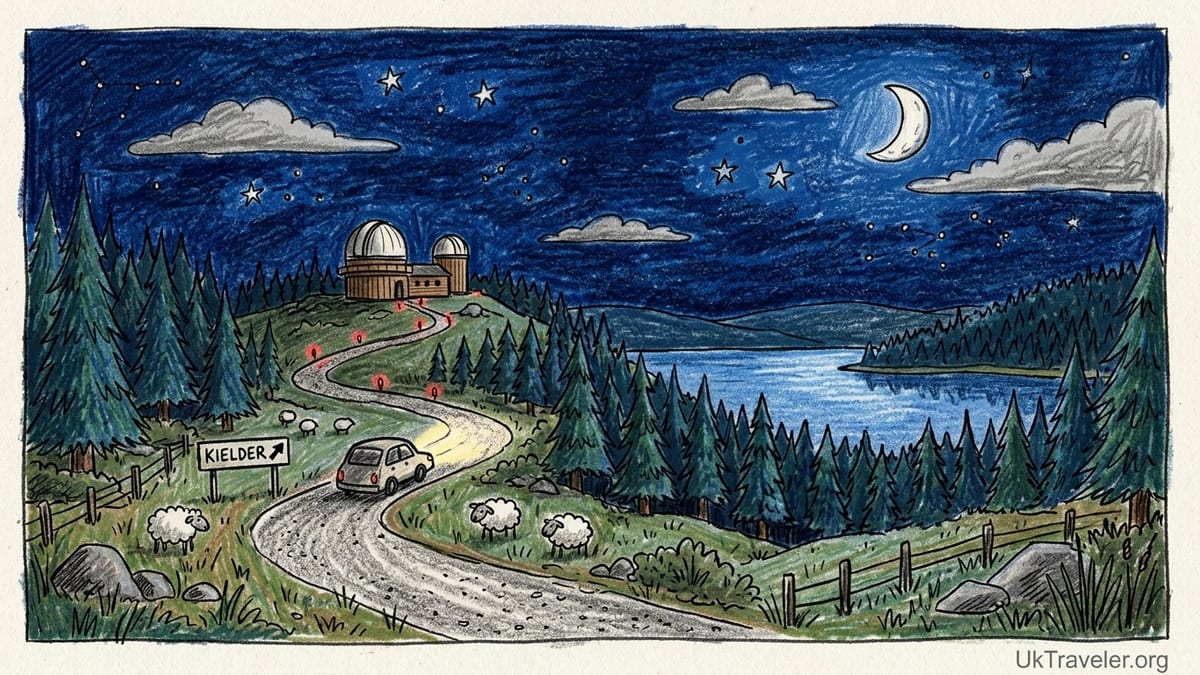
Arriving in the Dark: The Long Road into Kielder
My Kielder Observatory experience began long before I saw a telescope. I left Newcastle at about 18:00 on Sunday 17 May 2026, giving myself a comfortable two-hour window to cover a drive that usually takes around 1 hour 40 minutes. Once past Hexham the streetlights vanished, mobile signal began to flicker, and the road narrowed into that familiar Northumberland mix of forest, sheep and sharp bends. By the time I reached Kielder Water, twilight was fading and the sky was turning a deep, inky blue.
The event I had booked was "Our Celestial Neighbourhood," one of Kielder’s main evening programmes. It was a 21:00 to roughly midnight slot, priced at £39 per adult, and by May it was already marked as sold out on the observatory’s own booking calendar. I had picked it because it promised a broad introduction to the solar system and night sky rather than chasing a specific phenomenon like the aurora, which I knew could vanish behind a single cloud bank. The confirmation email made it very clear that the event would go ahead in all weather, clear or cloudy, with a mix of talks, telescope time and indoor demonstrations.
Accommodation had been a real consideration. Rather than risk a late-night drive all the way back to Newcastle after midnight on unlit forest roads, I booked a simple B&B in Kielder village itself, about a 15-minute drive from the observatory access track. Some visitors choose to stay further south around Bellingham or Wark and combine Kielder with a stay at a country inn, but I wanted the shortest possible journey after the event finished. When you are planning a dark-sky trip, that final drive home in the small hours is one of the most under-estimated parts of the whole experience.
From the village, there is an access road up to the observatory on Black Fell. The observatory sits within the Northumberland International Dark Sky Park, a Gold Tier International Dark Sky Park created in 2013 and now widely described as the largest protected dark-sky area in Europe. Driving up felt like leaving the last traces of civilisation behind: no house lights, no roadside lamps, just the dull glow of my headlights and a strip of gravel road climbing into the forest. By the time I parked at the lower car park, real night had fallen.
First Impressions: Red Lights, Low Voices and Thick Cloud
From the car park, staff were waiting to guide us up the final stretch to the observatory itself. On some winter nights the team even use 4x4s to shuttle visitors when there is snow or ice, but in mid-May the path was simply dark, damp and slick from showers earlier in the afternoon. Low red lights marked the way, preserving night vision. Conversations dropped to a murmur as people adjusted to the darkness and the sense of being genuinely remote. There is something quietly unnerving about hearing nothing but wind in the trees and your own footsteps.
When we emerged onto the observatory deck, my heart sank a little. The sky above was a uniform grey-black, with only the faintest suggestion of a brighter patch where the Moon was trying to push through. This is the reality of stargazing in the UK, even in a world-class dark-sky park. You can plan for the Moon phase, drive for hours, and still meet a bank of cloud at exactly the wrong time. One of the resident astronomers greeted us almost immediately and addressed the elephant in the room. "We are hoping for some breaks," he said, "but even if the sky stays like this we will still take you on a tour of the universe tonight."
Inside, the atmosphere was informal and welcoming. The main warm room was lit dimly with red lighting, with rows of chairs facing a projector screen and a wall map of the night sky. There was tea, coffee and hot chocolate included in the ticket price, which quickly became essential comforts as everyone shrugged off damp jackets and hats. The staff ratio felt generous for the group size of around 40 people, with at least three astronomers plus volunteers circulating, answering questions and quietly managing expectations about what we might (or might not) see through the telescopes that night.
That frankness impressed me. Before the first presentation even began, one astronomer explained that no amount of expensive equipment could punch through a solid cloud layer. The large telescopes in the domes are incredible tools, but they are not magic. No one could promise us Saturn’s rings or a meteor shower on demand, and he gently reminded the room that Kielder Observatory is about experiencing the dark-sky environment as much as ticking off objects from a checklist.
The "Our Celestial Neighbourhood" Programme in Practice
The advertised "Our Celestial Neighbourhood" event is described as a guided journey through our solar system and nearby universe, with telescope observing when conditions allow. In practice, my evening followed a rhythm of indoor talks punctuated by hopeful dashes outside whenever a gap appeared in the cloud. The first presentation was a wide-ranging tour of the solar system, delivered in clear, accessible language that kept both complete beginners and more experienced amateurs engaged.
Our lead astronomer used a combination of high-resolution images, short video clips and a live planetarium-style software display. On the night of 17 May, the programme focused particularly on the Moon and Jupiter, which were both above the horizon and theoretically well placed for viewing if the clouds shifted. He showed us where they were in the sky using a real-time digital star chart, explaining how, on a truly clear night, you might step outside and see the Milky Way arching over the forest with naked eyes.
The second part of the presentation moved beyond the solar system to touch on nearby star systems and bright deep-sky objects that are regular targets on clear Kielder nights. The Orion Nebula, the Andromeda Galaxy, the Pleiades and popular globular clusters all featured on screen, with comparisons to what you would realistically see through Kielder’s instruments compared with glossy, long-exposure astrophotography. That honesty was valuable. The astronomers stressed that what you view with your own eyes at the eyepiece is often more subtle, but also more immediate and personal, than the saturated images that dominate social media.
Throughout, there were questions from the audience. People asked about light pollution at home, phone apps for finding constellations, the impact of satellite constellations on dark skies and even basic equipment choices for beginners. The answers were practical rather than salesy: start with binoculars if you can, find a dark local viewpoint, and use places like Northumberland International Dark Sky Park as an occasional treat rather than imagining you need to move there to enjoy astronomy.
What We Actually Saw Through the Telescopes
About an hour into the evening, one of the volunteers slipped into the back of the room and gave a discreet thumbs-up. A small gap had opened in the clouds to the south-west, and we were invited to head outside in small groups. On the deck, the staff had already slewed one of the large telescopes toward the clearer patch, while several portable telescopes and binocular tripods were trained on specific targets.
The first celestial object I saw that night was the Moon, low and blurry but undeniably there. Through a break in the cloud, the telescope revealed a sharply detailed crescent with crisp craters along the terminator. In my eyepiece time, the view held for perhaps twenty or thirty seconds before softening as the cloud thickened again. It was fleeting, but it made the long drive feel instantly more worthwhile. There is a huge difference between seeing the Moon as a bright disc overhead and resolving individual crater rims and mountain peaks with your own eye.
Later, another gap allowed us to turn a smaller telescope toward Jupiter, which was shining dimly through the cloud veil. In good conditions, Kielder’s instruments can show banding on the planet and a neat line of Galilean moons. On this particular night, the view was compromised by fast-moving haze, yet I could still pick out a pale disc and at least two tiny pinpricks of light beside it. It was not the classic textbook view, but it was real and happening above us in that moment.
The most surprising sight of the evening came not from the telescopes, but with the naked eye. At around 23:00, the cloud thinned sufficiently overhead to reveal a patchwork of stars. The Milky Way was not visible as a bold band, but the sheer number of fainter stars compared with my city sky was striking. The astronomers quickly took advantage of the conditions, leading a laser-pointer tour of the constellations that had managed to burn through the haze: the curve of the Plough, the "W" of Cassiopeia, and a ghostly Polaris marking north. That constellation walk probably lasted ten minutes before the clouds knitted back together, but it gave us a genuine taste of what Kielder is famous for on a fully clear night.
We did not see any meteors, no aurora shimmered on the northern horizon, and most of the deep-sky showpieces remained hidden. In that sense, my evening was an honest reflection of stargazing in a maritime climate: snatched views between long cloudy interludes. The staff made sure everyone had some eyepiece time, rotating people efficiently and keeping spirits up with explanations and humour when the sky refused to cooperate.
Comparing Event Types: Dark Sky Discovery, Aurora Nights and Themed Evenings
In the weeks before my visit, I had browsed a lot of Kielder’s event listings trying to decide which format to book. The observatory runs a variety of themed nights, from broad introductions like "Our Celestial Neighbourhood" to more specialist topics such as cosmology or exoplanets. There are also family-focused "Space Kids" sessions held earlier in the evening and later-night experiences that stretch towards midnight or beyond.
Some events are billed as "Dark Sky Discovery" style sessions, echoing the wider network of Dark Sky Discovery Sites across the UK. These evenings focus on helping you navigate the night sky, find constellations and appreciate the significance of dark-sky conservation. Others, like "Aurora Nights," are very explicit about chasing a specific spectacle. Aurora-focused events usually run in autumn and winter and make clear that even in Northumberland International Dark Sky Park, where light pollution is very low, the Northern Lights are never guaranteed. They require both strong solar activity and clear northern horizons, something that local astronomers know not to promise lightly.
In choosing "Our Celestial Neighbourhood" at £39, I consciously sidestepped the temptation to chase the Northern Lights or a meteor shower. My reasoning was simple: if you book an aurora-themed night and the sky is cloudy, the disappointment can feel sharper, even if the talks and indoor programme are just as good. A broad solar system themed evening, by contrast, is easier to deliver in any weather, relying on a rich mix of images, simulations, meteorite samples and hands-on demonstrations as well as any live views that the sky allows.
Having now experienced one event, I can see why Kielder stresses that all of its programmes are weather dependent. No ticket includes a guarantee of planets, meteors, galaxies or aurora, no matter how impressive the telescope line up. If anything, the nights that advertise a specific natural spectacle need even more mental flexibility from visitors. On my cloudy May evening, the combination of realistic expectations, good storytelling and short windows of observing felt like the right balance.
The £39 price point for "Our Celestial Neighbourhood" places Kielder comfortably in the middle of the UK dark-sky experience market. Similar-length sessions at Battlesteads Observatory near Wark, within the same dark-sky region, often list adult prices a little lower, while premium packages that combine multi-course dinners, private guiding or very small groups can climb significantly higher. The important comparison is not just the ticket cost, but what happens on a cloudy night. In Kielder’s case, I felt that the three-hour mix of talks, Q&A, short observing windows and access to staff expertise represented fair value.
Dark Sky Park vs Paid Observatory: Knowing the Difference
Spending an evening at Kielder Observatory highlighted a key distinction that first-time visitors to Northumberland sometimes miss: there is a difference between enjoying the dark sky park itself and buying a ticket to a specific observatory experience. Northumberland International Dark Sky Park covers a huge area, including Northumberland National Park and Kielder Water and Forest Park. Much of that land is freely accessible via lay-bys, forest tracks and hill paths where you can pull over, turn off your lights and simply look up.
These free viewpoints, some of which are recognised Dark Sky Discovery Sites, are fantastic for spontaneous stargazing, astrophotography and camping experiences. You might carry a pair of binoculars, set up a small personal telescope, or just lie back on a camping mat. On a dry, moonless night, the Milky Way can be spectacular from such sites, and many local photographers routinely share images taken from spots near Kielder Water, the Otterburn ranges or Hadrian’s Wall country.
A paid observatory event like the one I attended adds several layers on top of that base experience. First, you get access to large, permanently mounted telescopes that would be impossible for most people to own or transport. Second, you benefit from the knowledge of professional and highly experienced amateur astronomers who can guide you to targets, explain what you are seeing and answer detailed questions. Third, you gain shelter, warmth and structure, which become more important than you might think on a cold, damp or windy night.
However, the observatory experience does not change the weather, and it does not privatise the sky. On my drive back to the village after midnight, there were still patches of thinning cloud that revealed stars over the forest, exactly the same sky visible to anyone parked at a lay-by a few miles away. What the ticket buys you is a curated encounter with that sky, framed by human expertise and equipment, not a guarantee of specific celestial objects.
Alternatives: Battlesteads, Twice Brewed and DIY Dark-Sky Nights
Kielder is the most famous name in Northumberland’s dark-sky scene, but it is not the only option. On my way north I passed signposts toward Wark, home to Battlesteads Observatory. Battlesteads combines a village hotel and restaurant with an on-site observatory and is recognised as a Dark Sky Discovery Site. Their programme includes regular stargazing evenings, family sessions and special events tied to meteor showers or lunar phases, often priced in the £20 to £30 range for adults. Staying at the hotel means you can walk from the bar to the telescopes in a matter of minutes, a very different logistical experience from the more remote Kielder hilltop.
Further east, near Hadrian’s Wall, the Twice Brewed Inn has developed its own observatory and a small planetarium. In 2026, Kielder Observatory formally expanded its partnership with Twice Brewed, providing astronomers and integrating programming across both sites. That means travellers who want a mix of Roman heritage by day and stargazing by night can base themselves at Twice Brewed, enjoy pub comforts, and still tap into the same expert guidance that operates at Kielder itself. The skies there are still part of the wider Northumberland International Dark Sky Park, though the feel is more roadside inn than forest outpost.
There are also independent dark-sky viewpoints that require no tickets at all. Car parks near Kielder Water, high roadside lay-bys on the A68, and quiet spots around Bellingham and Elsdon are popular with local stargazers and astrophotographers. For many, a DIY night under the stars with a flask of soup and a camping chair offers better value than any formal event, particularly if they already own binoculars or a small telescope and know how to use a star atlas or phone app.
Having now experienced Kielder, I can see the appeal of all three approaches. For a first deep dive into dark skies, especially if you are nervous about being alone in a remote spot, a structured observatory event is reassuring. Once you have built some confidence and learned your way around the sky, it becomes easier to use free sites or choose an inn-based observatory like Battlesteads or Twice Brewed, where the emphasis can shift towards a wider weekend away rather than a single flagship experience.
Logistics, Weather and the Realities of Night Driving
No review of Kielder would be honest without talking about logistics. Even from Newcastle, which is relatively close by UK standards, the drive to Kielder involves long stretches of unlit road. On the way in, you may arrive in lingering twilight depending on the time of year. On the way out, you are almost guaranteed full darkness. After our event wrapped up shortly after midnight, I walked back down to the lower car park in a fine drizzle, wiped condensation off the windscreen and steeled myself for the winding return to the village.
The cold was penetrating rather than brutal on my May visit, with temperatures hovering just above single digits. In winter, visitors can find themselves in sub-zero conditions with frost underfoot and ice patches on the track, which is why Kielder sometimes insists that non 4x4 cars remain at the lower car park while staff shuttle guests in Land Rovers. Layering up, bringing proper waterproofs and warm boots, and carrying a hat and gloves are non-negotiable, even if the forecast looks mild when you leave home. The wind on the observatory deck can feel far colder than the car temperature gauge suggests.
Weather flexibility is the biggest factor in whether a trip like this feels worth it. If you can base yourself in the region for several nights, watching forecasts and booking events with short notice, your chances of catching a fully clear evening increase dramatically. Many people link a Kielder visit with a broader Northumberland holiday, staying in self-catering cabins, glamping pods or inns that advertise dark sky viewing from hot tubs and private decks. That way, even if one booked observatory night is cloudy, you might still enjoy clear conditions on another evening from a hilltop or lakeshore nearby.
For my single-night trip, there was an unavoidable sense of gambling with the weather. I had bought the £39 ticket weeks in advance to secure a place on a specific date, arranged time off work the next morning, and paid for accommodation on top of fuel and food. When the clouds rolled in, I briefly wondered if I had made a mistake. By the end of the night, though, the combination of knowledgeable staff, partial views of the Moon and Jupiter, and the visceral feeling of being under one of Europe’s darkest skies left me glad I had gone. But I would plan differently next time.
The Takeaway
So was my Kielder Observatory experience worth the journey and the cost? For me, yes, but not in the picture-perfect way travel brochures sometimes imply. I did not get a sweeping Milky Way arch or a blazing aurora. Instead, I had a night of partial cloud, brief telescope views, and a lot of learning. The £39 "Our Celestial Neighbourhood" ticket bought me three concentrated hours with passionate astronomers, access to serious telescopes, and the shared thrill and frustration of trying to outwait Northumberland’s weather on a remote forest hill.
If I were to book again, I would still choose a broad, generalist event like "Our Celestial Neighbourhood" or one of the Dark Sky Discovery style introductions rather than a strongly weather-dependent speciality such as "Aurora Night." I would plan a two or three night stay in the area, perhaps mixing a Kielder session with a more comfortable inn-based evening at Battlesteads or Twice Brewed, giving myself multiple chances at clear skies. I would watch the Moon phase more carefully, aiming for a near-new Moon date to maximise darkness, and I would treat the observatory as a highlight of a wider Northumberland escape rather than a single, all-or-nothing experience.
Ultimately, the value of a trip like this depends on your expectations. If you need guaranteed spectacle, you may be disappointed. If you are willing to embrace uncertainty, ask questions, and celebrate even brief windows of clarity as small miracles, then driving into Northumberland International Dark Sky Park after sunset can feel transformative. The remoteness, the red-lit path up Black Fell, the low murmur of voices in the dark and the sudden snap of a cratered lunar edge coming into focus are all part of a story you cannot replicate in a city planetarium.
On the drive back toward Newcastle the following morning, sunlight glinting off Kielder Water and the forest rolling past, I realised that my main memory was not any single object I had seen through a telescope, but the feeling of being somewhere that values darkness as a resource. In an age of constant illumination, that alone felt worth the journey.
FAQ
Q1. Is a Kielder Observatory event worth it if the weather is cloudy?
It can still be worthwhile on a cloudy night if you are interested in learning about astronomy as well as looking through telescopes. Staff run detailed talks, use high-quality images and simulations, answer questions and, if any gaps appear in the cloud, quickly move guests outside for brief observing. You lose the full "wow" factor of a clear sky, but you still gain knowledge, context and some genuine, if fleeting, views.
Q2. Which Kielder event should first-time visitors book?
For a first visit, a broad introductory session such as "Our Celestial Neighbourhood" or a Dark Sky Discovery style event is usually the best choice. These programmes are designed to be rewarding in all weather, with a balanced mix of talks and observing when possible. Highly specialised nights that focus on phenomena like the aurora or specific meteor showers can be spectacular, but they carry more risk of disappointment if conditions do not cooperate.
Q3. How much does a Kielder Observatory ticket cost?
In 2026, main evening events such as "Our Celestial Neighbourhood" are priced at around £39 per adult. Family and concession rates are available for some sessions, and shorter family-oriented "Space Kids" events tend to be a little cheaper. Prices can change, so it is essential to check the observatory’s current booking information when planning your trip.
Q4. Where is the best place to stay for a Kielder visit?
If you want the shortest possible drive after a late event, staying in or near Kielder village works well, with simple B&Bs and lodges within about 15 minutes of the observatory access track. Travellers who prefer more facilities often base themselves further south in places like Bellingham or Wark, or choose hotels with their own observatories such as Battlesteads or Twice Brewed. The key factor is reducing long, unfamiliar night-time driving after midnight.
Q5. How does Kielder compare with Battlesteads and Twice Brewed?
Kielder offers the most remote, wilderness-style experience, with a hilltop observatory deep inside the dark sky park and very little surrounding light. Battlesteads Observatory in Wark pairs stargazing with an on-site hotel and restaurant in a village setting, while Twice Brewed Inn combines an observatory and planetarium with easy access to Hadrian’s Wall. All three benefit from dark skies, but Kielder feels more like a dedicated astronomy outpost, and the others like inns with excellent stargazing attached.
Q6. Do I need my own telescope to enjoy Kielder?
No, you do not need any equipment of your own. Ticketed events include access to Kielder’s large observatory telescopes and smaller portable instruments, all operated by experienced astronomers. Bringing binoculars can enhance the experience, especially during gaps in the programme or on the drive back through the dark sky park, but they are optional rather than essential.
Q7. How cold does it get at Kielder Observatory?
Temperatures can feel much colder than forecast, especially when you are standing still on the exposed observatory deck. Even in late spring and early autumn, evening temperatures commonly drop into single digits, and in winter they can fall below freezing with ice and snow on the access track. Visitors should bring multiple warm layers, waterproof outerwear, hats and gloves, regardless of what the weather looked like when they left home.
Q8. Can I stargaze in the dark sky park without buying a ticket?
Yes. Northumberland International Dark Sky Park covers a large area of public land with many lay-bys, car parks and trails where you can enjoy the night sky for free. Recognised Dark Sky Discovery Sites and informal viewpoints around Kielder Water, Hadrian’s Wall and the Cheviot hills are all accessible without charge. A paid observatory ticket adds guided use of large telescopes, expert explanations and indoor facilities, but the sky itself remains open to everyone.
Q9. How far in advance should I book a Kielder event?
Popular evening sessions, especially around new Moon weekends, school holidays and dark-sky festivals, can sell out weeks or even months in advance. Booking early gives you more choice of dates and event types. However, travellers who can be flexible sometimes prefer to wait until closer to the date to pick a night with a promising forecast, though this carries the risk that specific sessions may already be full.
Q10. What would improve my chances of a great stargazing night?
To maximise your chances of clear, dark skies, aim for dates near a new Moon, allow at least two or three nights in the area, and stay flexible with your plans. Combining a Kielder Observatory event with time at alternative sites like Battlesteads, Twice Brewed or free dark-sky viewpoints increases your options if one night turns cloudy. Above all, go in with realistic expectations, plan for cold and darkness, and treat any minutes of perfect clarity as a bonus rather than a guarantee.