


The Midlands is often treated as a single blob in the middle of England, but for travelers the East Midlands and West Midlands can feel like two very different trips. One leans toward wide skies, national parks and historic market towns, the other toward industrial heritage, big-city buzz and day-trip friendly castles. If you are planning a first visit and wondering where to base yourself, this guide breaks down how the two regions compare in real travel terms and which side of the Midlands line is likely to suit your style.
Getting Your Bearings: What Do “East” and “West” Midlands Mean for Travelers?
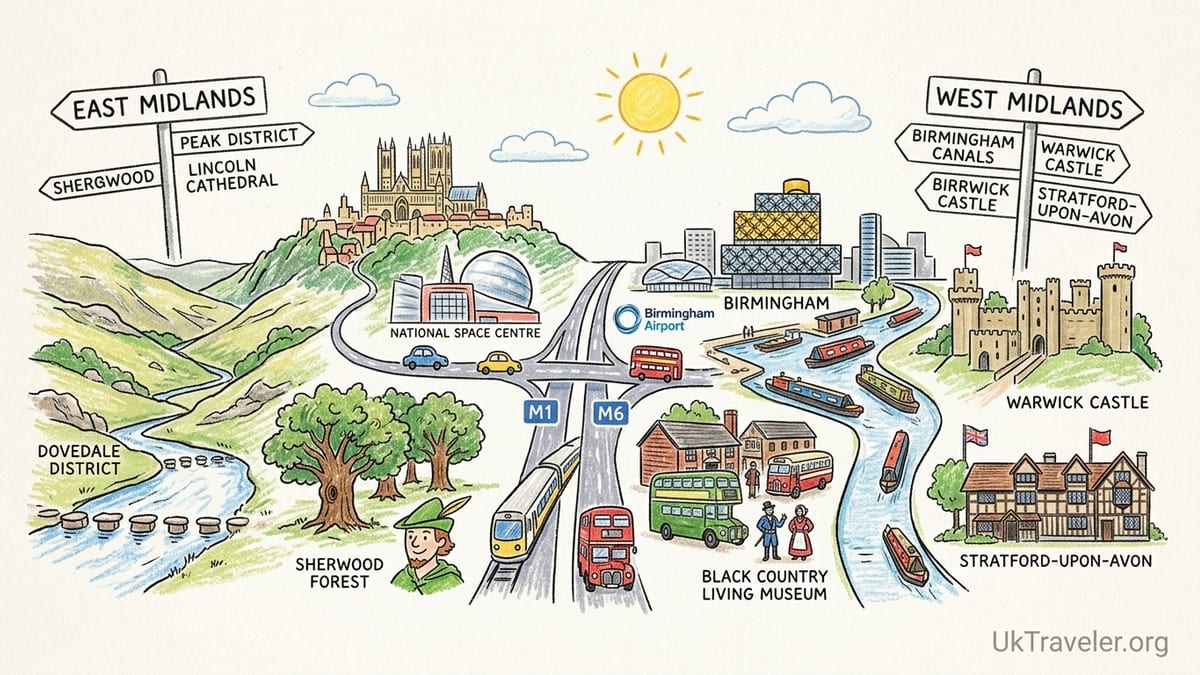
On a map, the East Midlands typically covers counties such as Derbyshire, Nottinghamshire, Leicestershire and Lincolnshire. For visitors, that translates into the Peak District National Park on Derbyshire’s western edge, the culture and nightlife of Nottingham, the multicultural food scene of Leicester and the cathedral city of Lincoln surrounded by big open countryside. In contrast, the West Midlands travel experience is centered on the metropolis of Birmingham and its surrounding towns and counties, including Coventry, Warwick, Stratford upon Avon in Warwickshire, the Black Country around Wolverhampton and Dudley, and the rural landscapes of Worcestershire and Staffordshire.
Both areas sit roughly in the middle of England and are well connected by rail and motorway. From London, Nottingham is around 1 hour 45 minutes by train, while Birmingham can be reached in about 1 hour 20 minutes on fast services from London Euston. For international visitors flying in, Birmingham Airport effectively serves both regions, with direct trains to Birmingham New Street in under 15 minutes and onward rail connections to places like Derby and Nottingham.
In practical terms, choosing between East and West Midlands often comes down to whether you want a nature-heavy, small-city base with easy access to the countryside, or a large urban hub with big museums, shopping, nightlife and multiple day trips by train. Both regions are very doable without a car, but some of the most scenic corners of Derbyshire and the Peak District are easier if you are driving.
Scenery and Outdoor Vibes: Peaks and Dales vs Canals and Castles
If dramatic landscapes are high on your list, the East Midlands generally has the edge. Much of the Peak District National Park lies in Derbyshire, with classic scenery like the gritstone edges above Hathersage, the green valleys around Castleton and Edale, and the gentler limestone dales near Bakewell. The area has long been a magnet for walkers and climbers, and even casual visitors can manage short loops like the circuit around Ladybower Reservoir or a stroll through Dovedale with its famous stepping stones. Public buses and trains run to towns such as Matlock, Buxton and Edale, but having a car opens up remote viewpoints and lesser-known villages.
Further east, Lincolnshire offers a different sort of landscape: huge skies, flat fens, low wolds and a classic English coast at places like Skegness. Lincolnshire’s countryside feels slow and spacious, ideal if you want to drive country lanes, visit farm parks with kids, or explore nature reserves and aviation heritage sites scattered across the county. Nottinghamshire adds legends to the mix, with Sherwood Forest’s ancient oaks and Robin Hood lore just north of Nottingham, combining woodland walks with family-friendly trails and visitor centers.
The West Midlands might not have a single headline national park inside its borders, but it makes up for it with green pockets and historic settings. Warwickshire countryside around Stratford upon Avon is all rolling fields, river meadows and small villages, great for gentle cycling or riverside walks after touring Shakespeare sights. Worcestershire and Staffordshire provide the stepping stones to the Malvern Hills and Cannock Chase, both popular for hiking and biking. For something more urban-nature, Birmingham’s extensive canal network offers surprisingly tranquil waterside walking and kayaking from restored depots like the Roundhouse near Brindleyplace, and big parklands such as Sutton Park and Cannon Hill Park feel almost rural despite being in the city.
Headline Attractions and City Experiences
For major attractions packed close together, the West Midlands tends to win. Birmingham, the UK’s second-largest city, concentrates a lot within a compact center: the Birmingham Museum and Art Gallery with its Pre-Raphaelite collection, the family-friendly National SEA LIFE Centre, the Library of Birmingham and its viewing terraces, plus big venues such as the Utilita Arena for concerts. Food is a major draw, from the famous Balti Triangle for curry houses to high-end dining in areas like the Jewellery Quarter. On the western fringe of the conurbation, the Black Country Living Museum in Dudley immerses visitors in recreated Victorian streets, 20th-century shops and underground canal tunnels, a standout day out that appeals as much to adults as to children.
Warwickshire and neighbouring counties add more crowd-pleasers within an hour or so of Birmingham by train or car. Stratford upon Avon combines Shakespeare’s birthplace, riverside gardens and theaters with a compact town center that can fill a relaxed weekend. Nearby Warwick Castle offers costumed history shows, towers to climb and family-friendly attractions that often run on timed tickets and seasonal events. Staffordshire, though just outside the strict West Midlands county, is commonly included in visitor plans for its big-name theme park Alton Towers, reachable in around 90 minutes by car from Birmingham and popular with families and thrill-seeking groups.
The East Midlands has its own heavy hitters, just more spread out. Nottingham is a lively university city with a strong nightlife scene, independent bars and live music, anchored by Nottingham Castle on its sandstone rock and a network of historic caves beneath the streets that you can tour. It is also the gateway to Sherwood Forest. Leicester has built a profile on science and history, with the National Space Centre for families and the King Richard III visitor centre exploring the rediscovered king whose remains were found beneath a local car park. Further north, Derby serves as a quieter base for the Peak District, with industrial heritage museums, riverside walks and frequent trains into the national park.
Lincoln, meanwhile, feels like a medieval hill town dropped into the flatlands. Its steep “Steep Hill” street, lined with independent shops, climbs from the lower town to a Gothic cathedral and a castle that once housed a copy of Magna Carta. It makes an excellent weekend break in its own right, especially at Christmas when the city is known for its festive markets and illuminated cathedral precincts.
History, Culture and Nightlife: Industrial Stories vs Old Streets
Historically minded travelers will notice different narratives on each side of the Midlands. The West Midlands wears its industrial past on its sleeve. Birmingham grew as a powerhouse of the Industrial Revolution, and that heritage seeps through in museums, canals and factory sites repurposed as cultural venues. The Black Country Living Museum, the canal-side Gas Street Basin and small museums such as Soho House or the restored Back-to-Backs show how the region’s metalworking and manufacturing shaped modern Britain. Coventry brings another layer of 20th-century history, with its bombed-out cathedral left standing beside the modern replacement as a powerful symbol of wartime destruction and reconciliation.
In contrast, the East Midlands often feels older in its storytelling. Derbyshire and Nottinghamshire tap deep into folklore and early industrialization, from the stately homes of Chatsworth and Haddon Hall to the mill complexes of Cromford and Belper that played a part in the early factory system. Sherwood Forest leans into the Robin Hood myth, while Lincoln’s Roman remains, Norman cathedral and castle create a compact time capsule of English history. Leicester blends medieval and Tudor stories with the more recent chapter of Richard III, which you can explore at the visitor center and nearby cathedral.
For nightlife, Birmingham and Nottingham are the clear heavyweights. Birmingham’s city center and Digbeth area pack in bars, late-night food and music venues, drawing a diverse crowd most nights of the week. Prices are often lower than London; as a rough guide, expect a pint of beer in a central bar to be around the mid-single to high-single pounds depending on venue, with late-night street food and casual restaurants catering to students and office workers. Nottingham offers a slightly smaller but very lively scene around the Lace Market and Hockley, with plenty of craft beer bars, cocktail spots and live-music pubs, making it popular with younger visitors and groups of friends.
Family Travel: Theme Parks, Forests and Hands-on Museums
Families will find good options on both sides of the Midlands, but the emphasis differs. In the West Midlands, big-ticket days out are easy to stack: a morning at the National SEA LIFE Centre and afternoon in Birmingham’s Thinktank science museum, a full day roaming Warwick Castle, or a trip to West Midlands Safari Park for drive-through animal viewing followed by walking trails and rides. The Black Country Living Museum is frequently recommended by local parents as a top choice for school-age children, who can ride vintage buses, taste traditional sweets and chat with costumed guides in recreated shops.
Logistics also help in the West. Many of these attractions sit close to each other or to rail lines, so a family staying near Birmingham New Street station can visit multiple venues in three or four days without needing a car. Day tickets that combine bus, tram and local train travel across the West Midlands county help keep costs predictable, especially for larger families traveling on public transport.
In the East Midlands, the experience skews more outdoorsy. Sherwood Forest’s walking trails and play areas, the Peak District’s short hikes to caves and viewpoints, and the family-oriented farm parks and adventure centers scattered across Lincolnshire provide space to burn off energy. Lincolnshire’s seaside towns add classic beach days with arcades and promenades, especially in summer. City-based options still exist, such as the National Space Centre in Leicester and cave tours in Nottingham, but itineraries here often mix one indoor attraction day with several in the countryside.
For younger children or those who tire quickly, parents may find the shorter travel times between West Midlands attractions more forgiving. For teenagers who enjoy hiking or photography, the Peak District or the wide beaches and nature reserves of Lincolnshire may prove more rewarding.
Transport, Driving and Classic Road Trips
Both regions are threaded by motorways and mainline rail, but the user experience is slightly different. Birmingham is the central rail hub of the West Midlands, with frequent services to Coventry, Wolverhampton, Worcester and beyond. From Birmingham, you can reach Warwick or Stratford upon Avon in roughly 30 to 45 minutes by train, making them straightforward day trips. Local bus networks, including operators like Stagecoach in Warwickshire, fill in the gaps between smaller towns and attractions, and integrated day tickets covering bus, tram and train within the county are widely used by residents and visitors.
In the East Midlands, rail routes tend to fan out from Nottingham and Derby. From Nottingham you can reach cities like Leicester and Lincoln in around an hour, as well as smaller stops on the way to coastal or rural areas. Derby acts as a gateway for services into the Peak District, with trains to Matlock, Buxton and other stations that place you close to hiking routes. However, some of the most scenic valleys and upland roads remain poorly served by buses, especially in the evening, which makes a car more attractive if you want a flexible schedule or are traveling as a group.
For self-drive road trips, the East Midlands can feel more traditionally scenic. A loop might start in Derby, head through the Peak District via Bakewell, continue to the stately home of Chatsworth, then drop down through Nottinghamshire to explore Sherwood Forest before curving east to Lincoln and the Lincolnshire Wolds. Country hotels, inns above pubs and farmhouse B&Bs provide overnight stops, and you can end with a night in Nottingham or Lincoln for dining and nightlife. In summer, adding a side trip to the Lincolnshire coast gives you a mix of inland and seaside landscapes.
West Midlands road trips are more about stringing together history and urban culture. One classic circuit begins in Birmingham, continues to Coventry for its cathedrals and transport museum, then on to Warwick and Stratford upon Avon for castles and Shakespeare, before looping back via Worcester’s cathedral and riverside. Another option heads into the Black Country for the open-air museum and canal tunnels, then north to the industrial and pottery heritage of Stoke-on-Trent and the countryside around Cannock Chase. Distances are short, so you can change bases less frequently and spend more time exploring than driving.
Accommodation and Trip Atmosphere
In both East and West Midlands you will find the full range of accommodation: international chain hotels around stations, independent boutique properties, countryside inns and self-catering cottages. Birmingham has the highest concentration of big-name hotels, handy if you value reliable standards, late check-in and loyalty points. Areas around New Street station, Broad Street and the Mailbox offer plenty of mid-range business-style hotels starting around mid-double figures per night in off-peak periods, rising at busy times such as major sport or conference dates.
Smaller cities like Nottingham, Leicester and Lincoln tend to have a good mix of chain hotels near the center plus a scattering of boutique stays in historic buildings. In Lincoln, for example, you can choose between modern hotels in the lower town near the Brayford waterfront or characterful guesthouses up by the cathedral and castle, trading a climb up Steep Hill for atmospheric views. Derby and Nottingham both have budget-friendly business hotels near their stations, convenient for car-free travelers who plan day trips by train or coach.
In the countryside, particularly in Derbyshire and the wider Peak District, country inns and self-catering cottages dominate. These suit families, walkers or couples who want evenings in village pubs after days outdoors. Lincolnshire adds farm stays and holiday parks along the coast, appealing to families who want on-site facilities. In the West Midlands rural belt around Warwick, Stratford and the Worcestershire countryside, country house hotels and B&Bs offer a slightly more polished, heritage-focused atmosphere, often popular with couples on short romantic breaks or travelers combining the Midlands with a wider Cotswolds itinerary.
Atmospherically, the East Midlands often feels more low-key, with quieter streets after dark once you step away from nightlife hotspots in Nottingham or university areas. The West Midlands, anchored by Birmingham, has a more overtly urban pulse, with busier transport hubs, bustling multicultural neighborhoods and denser schedules of events, concerts and festivals spreading across the year.
Who Should Choose Which Region?
For first-time visitors to England who want a single, easily understood base, the West Midlands is often the simpler choice. Staying in central Birmingham gives you big-city amenities, straightforward airport access, and effortless day trips by rail to Warwick Castle, Stratford upon Avon and Coventry. If you are only in the country for a week or less and want to minimize logistics, basing in Birmingham or nearby makes it easy to sample multiple flavors of English life: urban canals, industrial heritage, small historic towns and green countryside, all without renting a car.
The East Midlands shines for travelers who put scenery and slower-paced exploration ahead of major city buzz. If the idea of waking up in a stone village, hiking through moorland or dales, then finishing with a pub dinner appeals, Derbyshire and the Peak District are a strong fit. Pair that with a night or two in Nottingham or Lincoln for urban contrast and you have a well-rounded itinerary. This side of the Midlands is also attractive for repeat visitors to England who may have “ticked off” London and the big-name cities and now want something more rural and less crowded without heading to remote corners of the country.
For travelers flying into London and traveling mainly by train, the East Midlands cities of Nottingham and Leicester are almost as easy to reach as Birmingham, but the onward connections into deep countryside are less seamless without some planning. If you dislike changing trains or buses, or you are nervous about rural schedules, the West Midlands will likely feel more straightforward. If you enjoy piecing together routes and are comfortable with occasional longer walks to trailheads, the East Midlands rewards the effort with some of the best landscapes in lowland England.
The Takeaway
So which region is “better” for your trip: East Midlands or West Midlands? For many travelers, the right answer is not an objective winner but the region that lines up with what they most want to remember when they go home.
If you are a first-time visitor to England with limited time, the West Midlands is usually the more efficient choice. Base in Birmingham for 3 to 4 nights, use the fast trains and local buses to reach Warwick Castle, Stratford upon Avon and the Black Country Living Museum, and finish your days in canalside bars and restaurants. You will experience a cross-section of English history from medieval castles to industrial canals with minimal logistics. Couples looking for a mix of culture, dining and atmospheric towns should also lean West, perhaps splitting their stay between Birmingham and a night or two in Stratford or Warwick for riverside walks and romantic, historic hotels.
Families with school-age children will likely find the West Midlands slightly stronger overall, thanks to the concentration of big-ticket attractions like castles, science museums, aquariums and theme parks within relatively short travel times. That said, if your children love space, forests and beaches more than castles and rides, an East Midlands itinerary built around the National Space Centre in Leicester, Sherwood Forest, the Peak District and a day or two on the Lincolnshire coast can be just as memorable.
For travelers without a car, the deciding factor is ease of movement. Car-free visitors who want simple, frequent train and bus options should favor the West Midlands, where Birmingham acts as a powerful hub and many key attractions sit on or near rail lines. If you are determined to experience the Peak District or the wide-open landscapes of Lincolnshire without driving, it is certainly possible, but you will need to plan around specific train times, local buses and occasional taxis, and you may be more limited to popular valleys and towns.
If you already know you are happiest in hiking boots or behind a camera in quiet landscapes, choose the East Midlands and design your route around Derbyshire, Nottinghamshire and Lincolnshire, adding just enough city time in places like Nottingham or Lincoln for dining and museums. If you are more drawn to cafés, galleries, live music and historic sites you can enter rather than view from afar, then the West Midlands will likely feel like the richer, more convenient choice. In the end, both regions show very different sides of middle England, and either can anchor a rewarding trip once you match their strengths to your own travel style.
FAQ
Q1. Is the East Midlands or West Midlands better for a first trip to England?
The West Midlands usually works better for a first trip because Birmingham provides an easy base with airport access, frequent trains and a dense cluster of major attractions like Warwick Castle and Stratford upon Avon within simple day-trip range.
Q2. Which region is best if I want to focus on hiking and scenery?
The East Midlands, especially Derbyshire and the Peak District, is stronger for hiking and varied scenery, with accessible trails around towns like Bakewell, Edale and Matlock, plus gentler countryside in Nottinghamshire and Lincolnshire.
Q3. Can I explore either region without renting a car?
Yes, but it is easier in the West Midlands. Birmingham’s rail and bus network makes it simple to reach Coventry, Warwick, Stratford upon Avon and the Black Country Living Museum. In the East Midlands you can still visit places like the Peak District, Sherwood Forest and Lincoln by public transport, but services are less frequent and you will need more detailed planning.
Q4. Where should couples stay for a romantic short break?
Couples who enjoy history and riverside walks often favor Stratford upon Avon or Warwick in the West Midlands for half-timbered streets, theaters and characterful inns. In the East Midlands, staying in or near a village in the Peak District or in Lincoln’s cathedral quarter offers a quieter, atmospheric alternative.
Q5. Which side of the Midlands is more family friendly?
Both regions are family friendly, but the West Midlands slightly edges ahead because big-name attractions like Warwick Castle, West Midlands Safari Park, the National SEA LIFE Centre and the Black Country Living Museum sit within relatively short journeys of each other, making it easy to build a varied family itinerary.
Q6. Is Birmingham or Nottingham better as a city base?
Birmingham is larger, with more museums, shopping and dining and excellent connections across the West Midlands and beyond, so it suits visitors who want a big-city feel and simple day trips. Nottingham is smaller and walkable with strong nightlife and easy access to Sherwood Forest and parts of the East Midlands, appealing to those who prefer a compact city with a strong student and creative scene.
Q7. How many days do I need to see the highlights of each region?
Allow at least three full days in the West Midlands to see Birmingham plus one or two nearby towns such as Warwick or Stratford upon Avon. In the East Midlands, four to five days lets you combine city time in Nottingham or Lincoln with one or two days in the Peak District or Sherwood Forest, especially if you are using public transport.
Q8. Are hotels generally cheaper in the East or West Midlands?
Prices vary by city and date, but in broad terms both regions are more affordable than London or major tourist hotspots like Bath or York. Business-style hotels in Birmingham can be good value at weekends outside major events, while smaller East Midlands cities and rural areas often offer competitive rates on inns, guesthouses and self-catering cottages, especially outside school holidays.
Q9. Which region is better if I am interested in industrial history?
The West Midlands is stronger for industrial history. Birmingham’s canals and museums, the Black Country Living Museum and Coventry’s transport and wartime heritage provide a concentrated look at how the Industrial Revolution and 20th-century industry shaped Britain.
Q10. If I have a week, can I visit both East and West Midlands?
Yes, a week is enough to sample both. A practical approach is to spend three nights in Birmingham for West Midlands highlights, then move to an East Midlands base such as Derby, Nottingham or Lincoln for three or four nights to explore the Peak District or Sherwood Forest and at least one historic city.