


I arrived in the East Midlands on a grey Sunday afternoon with a five-day rail pass, one rental car reservation, and the lazy assumption that this part of England was mainly motorways, middling cities and a lot of flat fields in between. I came in on an East Midlands Railway service from London St Pancras to Nottingham, changed hotels three times, picked up a car after two days, and tried to stitch together a route that would link Nottingham, Lincoln, rural Derbyshire, Sherwood Forest and Rutland Water into something coherent. By the time I rolled my suitcase back onto the platform at Nottingham station at the end of the trip, my sense of the region had been completely reset. The East Midlands turned out to be trickier to cross than it looks on a map, more varied than its reputation, and full of small surprises that only reveal themselves when you actually move between city, forest and reservoir at walking pace.
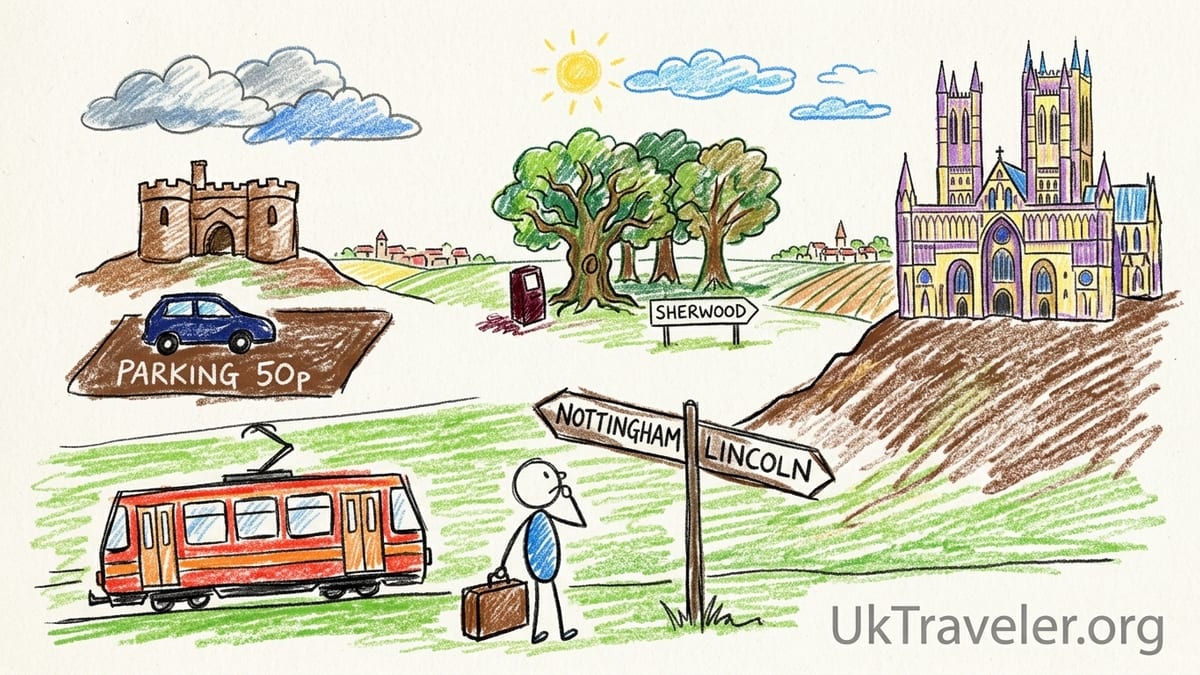
Arriving in Nottingham and Realising Distances Lie
My trip started at Nottingham station, which sits on the southern edge of the city centre, a few minutes’ walk up the hill to the tram stop and into the main streets. The train from London took a little under two hours, and I had deliberately arrived mid afternoon to avoid both commuter rush and late-night platform restrictions that now apply on the station footbridge. Inside, everything felt functional rather than grand, but the big surprise was how quickly the city asserted itself as soon as I walked out onto Carrington Street. I had imagined something smaller and less self-assured. Instead there were trams, students, office workers and delivery riders all crowding the junction, and I realised this was a real regional hub rather than a sleepy provincial stop.
I stayed the first two nights in a mid-range hotel a short walk from the station, just far enough up the hill that I felt the pull of my suitcase. The location was convenient for evening walks into the Lace Market and Hockley, but it was the logistics that set the tone for the rest of the week. On paper, Nottingham to Lincoln is only about 35 miles, and Derby and Leicester look even closer. On the ground, you discover that an “easy hop” still means checking East Midlands Railway timetables, leaving time to navigate station footbridges, and accepting that one delayed local service can throw off an afternoon planned around a cathedral visit or country walk.
That first evening, in drizzle that came and went without ever committing to real rain, I walked from the hotel up through the city centre and out towards Nottingham Castle. The climb is short but steeper than maps suggest, cobbles slick in places, buses nudging past you on narrow streets. I had expected shabby, post-industrial edges; instead the city felt youthful and lived-in, with independent bars tucking themselves under old brick viaducts. My first meal was a simple pub dinner in the city centre, a pie and pint at a place filled with locals arguing about football fixtures rather than tourists comparing guidebooks. It was not spectacular, but it was honest and cheap compared with London, and it made clear that in the East Midlands you rarely feel pushed toward a “visitor experience” menu.
The immediate lesson from Nottingham was scale. It is large enough to warrant trams and late-opening chains, but small enough that you quickly orient yourself around the spine from station to Old Market Square. The surprise came when I looked at train times that night and realised that despite being so central, “popping over” to places like Lincoln or Matlock would still eat serious chunks out of each day. Traveling through the East Midlands, I learned, is less a smooth loop and more a series of deliberate hops.
From Nottingham to Sherwood Forest: The Romantic Image Meets Real Car Parks
On day three I collected a compact rental car from near Nottingham station and headed north towards Sherwood Forest. This was the part of the trip I had quietly romanticised. I pictured pulling off a quiet lane straight into an ancient forest, wandering under the Major Oak on soft leaf litter and birdsong. The reality involved more traffic, more signage and more tarmac, but it was rewarding once I adjusted my expectations.
The drive from central Nottingham to the Sherwood Forest Visitor Centre near Edwinstowe took about 50 minutes in light weekday traffic, longer than the half hour I had naively pencilled in. Once you leave the ring road, the route threads through a mix of housing estates, light industrial units and patches of woodland that appear and vanish quickly. The famous forest does not announce itself with a sudden wall of trees. Instead you roll into Edwinstowe, follow brown heritage signs, and eventually reach the main car park, now set a walk away from the visitor centre. Official information confirms that the parking is pay and display, with machines that accept cards and contactless as well as cash, and during busy events the charge can rise noticeably for the day.
What really surprised me here was the walk from the newer main car park to the forest itself. Trip reports in 2026 mention it taking around 15 to 20 minutes each way at a leisurely pace, and that matched my experience. You cross the road via a controlled crossing, follow a surfaced path lined with sculptures and interpretation boards, and only gradually feel the woodland close in. It is not unpleasant, and it probably helps manage traffic within the forest, but anyone expecting to step from car door straight onto an ancient trail will need to recalibrate. I watched families juggling pushchairs, picnic bags and excited children, and felt thankful I had worn walking shoes rather than trainers.
Once you reach the Sherwood Forest Visitor Centre itself, the atmosphere finally aligns with the legend. There is a modern building with a café, toilets and information boards, managed in partnership with the RSPB, and from here waymarked trails fan out into the reserve, including the popular route to the Major Oak. Surfaces vary from compacted gravel to bare earth that can turn muddy after rain, and that day a showery forecast made some of the side paths slippery but manageable. I spent around three hours walking, looping past veteran oaks and quieter sections where the traffic noise dropped away. In the end, what I underestimated was not Sherwood’s romance but its scale and infrastructure. This is a protected national nature reserve threaded with multi-use trails, not a single storybook glade, and your visit is shaped as much by car parks and trail design as by Robin Hood mythology.
Derbyshire and Bakewell: Pretty Streets, Tricky Parking
From Sherwood Forest I cut west on a mix of A-roads toward Derbyshire, where I had booked a night in Bakewell to get a taste of the White Peak. The distance from the forest to Bakewell is under 40 miles, but with slow sections through Mansfield and Chesterfield and then tight, bending roads into the Dales, the journey took nearly an hour and a half. This was my first real glimpse of how abruptly the East Midlands can shift from industrial estates to stone villages and upland pastures.
Arriving in Bakewell mid afternoon, I ran headlong into one of the region’s more frustrating realities: parking in small, popular towns. The public car parks around the Market Place and riverfront are pay and display sites used heavily by day-trippers, and local council information makes clear that charges apply for most of the daytime and early evening. On my visit, machines offered card and app payment, but several drivers around me complained that mobile signal dropped out between stone buildings, forcing them to hunt for coins or move the car. I circled once before squeezing into a space in a council-run car park up a short, steep ramp, and it took a few minutes to figure out the tariff and maximum stay. By the time I had hoisted my bag up to the small guesthouse above town, the charm of arriving in a romantic stone village had been slightly dulled.
The reward, once settled, was a very different East Midlands from the urban grids of Nottingham. Bakewell in early evening feels almost like a stage set after the audience has gone home. Day visitors retreat, shop fronts close, and the riverside paths become quiet except for dog walkers. I ate at a pub steps from the water, a solid plate of fish and chips with a decent local ale, and listened to farmers comparing field conditions while a few walkers checked maps for the next day. The surprise here was how quickly the town emptied. I had assumed there would be more nightlife, but by 9.30 pm most places were winding down, and I was glad my accommodation was within easy walking distance rather than back across dark lanes.
The next morning I visited the Bakewell Visitor Centre, housed in a historic building and run with support from the Peak District National Park Authority. Staff here can provide walking maps and local advice, and they confirmed that car parks associated with the National Park reinvest their fees into path maintenance and facilities across the White Peak. That small conversation changed how I felt about the previous day’s parking headache. It also underscored a broader truth about traveling through the East Midlands countryside: infrastructure is often under pressure, especially in pretty honeypots, and if you arrive by car you need patience, coins or a functioning payment app, and a willingness to park a little further out and walk in.
Lincoln: A Hilltop Surprise Above a Flat Landscape
After Derbyshire I drove back east, dropping the hire car at Nottingham and returning to trains for the next leg. The service from Nottingham to Lincoln Central runs roughly hourly under the current timetable, taking about 50 to 60 minutes along a line that threads past the River Trent and through small Nottinghamshire and Lincolnshire towns. The train I boarded was busy with commuters and students as well as visitors with small suitcases, and this mix gave a good sense of Lincoln’s role as both university city and county capital.
Lincoln station sits on the southern edge of the centre, not unlike Nottingham, with a short stroll taking you into a tangle of shopping streets. At first glance it confirmed my old assumption that the East Midlands is largely low-rise and level. Then you look north and see the hill. The cathedral and castle stand high above the lower town, and if you underestimate that climb, as I did, you will feel it in your calves. I chose to walk rather than take a bus or taxi, following signs for the cathedral and eventually tackling the aptly named Steep Hill, a cobbled lane lined with independent shops and tea rooms.
The weather that afternoon shifted between sun and heavy clouds, and underfoot the stones were slick in patches. I saw at least one visitor slip slightly while distracted by a shop window, and I was grateful again for decent shoes. The reward for the climb is a quite different atmosphere at the top. Around the cathedral close and castle walls, traffic thins and the streets open out, with views rolling away over the flat farmland and drainage dykes of Lincolnshire. It was here that my mental map of the East Midlands really changed. I had pictured endless flatness punctuated by small towns. Instead, Lincoln presents a dramatic, almost coastal-feeling panorama, with its medieval core perched above a sea of low land.
I spent the night in a modest guesthouse a short walk from the cathedral, which meant wheeling my bag up Steep Hill in the late afternoon heat and back down again the next day. I would not recommend this for anyone with mobility issues or heavy luggage. A taxi from the station would have made far more sense and cost relatively little for the distance. That small planning mistake captured something essential about traveling here. Distances look minor on the map, but gradients, cobbles and the way historic centres sit above modern stations can turn a ten-minute walk into a genuine effort, especially in bad weather.
Evening in uphill Lincoln felt atmospheric but muted. The pubs along Bailgate were busy in a low-key way, serving a mix of locals and visitors lingering after cathedral evensong. I opted for a simple pub meal again, and noticed prices slightly higher than in Nottingham but still reasonable compared with larger UK cities. The surprise was how quickly I relaxed into the slow pace. There is not a huge choice of venues, but what exists feels grounded. Looking back, this was one part of the region I underestimated. I had allowed only one night in Lincoln, thinking the cathedral and castle would be a quick tick. In reality I could easily have filled another day exploring museums, walking along the old walls and perhaps venturing along the nearby canals and waterways.
Rutland Water: Lakeside Leisure in England’s Smallest County
The final stage of my loop took me to Rutland Water, a sprawling reservoir and recreation area in England’s smallest historic county. I left Lincoln by morning train, changed at Nottingham, and continued to Oakham, a compact market town with a station a short walk from its centre. From Oakham I picked up another rental car for two days, because while some buses link the town to Rutland Water’s various shores, frequencies are not ideal for tight sightseeing schedules.
Driving from Oakham station to Sykes Lane, one of the main access points on the north shore, took about 15 minutes. Here you find a visitor centre with staff, toilets, a playground and seasonal refreshments, and one of several large car parks operated by Anglian Water around the reservoir. Official visitor information in 2026 lists a daily car park ticket valid across the main sites, with updated prices that reflect rising maintenance costs. Machines here accept cards, and barriers use a ticket system, which felt more straightforward than some of the small-town car parks earlier in the week.
What surprised me most about Rutland Water was not the facilities, which are well developed, but the breadth of activities and how they shape each shoreline’s character. Around Sykes Lane families clustered near the beach-style play areas and café. A short drive away at Whitwell, car parks served bike hire outlets, watersports centres and longer walking and cycling routes that follow the 25-mile perimeter. On the south shore, near Normanton, the tone shifts again, with the partially submerged church of St Matthew standing as a photogenic landmark poking out into the water. Distances between these car parks are only a few miles, yet each feels like its own small resort, and it quickly becomes clear why local authorities ask visitors not to park in surrounding villages but to use official sites instead.
Walking conditions varied over the two days I spent here. The main paths close to the visitor centres are surfaced and suitable for pushchairs and most wheelchairs, although some slopes can be tiring. Further out, especially on sections linking the nature reserves and quieter viewpoints, surfaces shift to compacted gravel and earth, and after a light shower one afternoon, my shoes picked up a fair amount of mud. Wind was a constant presence, funnelling across open water, and even in late summer layers were essential when moving between sunny car parks and exposed dam walls. Traveling here in any season means thinking in loops: you park, walk or cycle a circuit, then drive on to the next shore. Public transport will bring you to the area, but to really stitch together multiple viewpoints in a single day, a car or full-day bike hire is almost essential.
Accommodation around Rutland Water is scattered in small hotels, inns and lodges rather than large resorts. I stayed one night in a family-run inn just outside Oakham, reached by a short drive along narrow lanes. Arriving back after dark, I was reminded again that village street lighting can be limited, pavements non-existent, and even finding your parking bay at the rear of a building can involve reversing nervously between stone walls. Yet the reward was a quiet, starry evening, the sound of owls carrying from the hedgerows, and a breakfast the next morning that felt firmly rooted in local produce.
Driving, Trains and the Subtle Effort of Getting Around
Across five days, I used both rail and road to criss-cross the East Midlands, and by the end I felt I had a more honest answer to the question of what traveling here is actually like. In the cities, trains work well. Nottingham, Derby, Leicester and Lincoln all sit on important lines, and East Midlands Railway timetables in 2026 show regular services between them and to London, Sheffield and beyond. Station car parks often use number plate recognition systems operated with partners, allowing you to pay by app or card rather than paper tickets. This combination makes city-to-city travel straightforward as long as you keep an eye on timetable changes and occasional disruption.
The complexity begins once you step away from railway corridors. Places like Sherwood Forest, Bakewell and Rutland Water are not remote in absolute terms, but buses can be infrequent or indirect, and journeys that look short on a map can take a surprising amount of time. My drive from Sherwood to Bakewell was slow going on A-roads and narrow lanes. The hop from Oakham to different Rutland Water car parks involved multiple short drives, each requiring parking, payment and a mental reset of where paths began and ended. If I had tried to do the same purely on buses, I would have lost huge stretches of the day waiting at rural stops.
At the same time, this effort creates a particular rhythm. You learn to plan days around clusters of activity rather than single sights. Nottingham pairs naturally with Sherwood Forest and, with a slightly longer drive, Sherwood Pines Forest Park near Kings Clipstone, which offers signposted cycling and walking trails and accessible facilities. Bakewell acts as a base for wider Peak District exploring rather than a standalone destination. Lincoln becomes a base from which you might explore nearby villages and waterways. Rutland Water invites you to choose one or two shores per visit rather than attempting a full circumnavigation unless you are cycling.
If there is something I would organise differently, it would be the number of hotel changes. I shifted base three times in five nights, which meant packing, parking and check-in admin ate into sightseeing time. On a repeat trip I would probably choose two hubs, perhaps Nottingham and either Bakewell or Oakham, and accept slightly longer day trips in exchange for fewer check-outs. I would also book rural stays with parking explicitly confirmed, and I would not underestimate steep streets between stations and historic centres, particularly in Lincoln. The region rarely feels hostile to visitors, but it does require more logistics than its modest distances suggest.
The Takeaway
Before this trip, the East Midlands to me was a blur of names on train departure boards: Nottingham, Derby, Leicester, Lincoln, plus vague notions of Sherwood Forest somewhere out there and a reservoir called Rutland Water that cyclists seemed to like. After five days moving through cities, woodland, former industrial landscapes and soft countryside, I came away with a set of more grounded impressions.
I learned that Nottingham is busier and more confident than its reputation, that Sherwood Forest’s magic sits inside a managed nature reserve reached by a practical walk from a busy car park, and that Derbyshire’s stone towns can be as much about ticket machines and full car parks as about pretty bridges and tearooms. I realised that Lincoln’s hilltop core deserves more time than a quick cathedral stop, and that Rutland Water is not one site but a ring of distinct shores, each with its own mood and facilities.
I also found that travel here is rarely glamorous but often quietly rewarding. Train windows frame power stations and warehouses as often as meadows. A-road lay-bys sit near nature reserves. The weather shifts quickly, turning dry paths to slick cobbles and muddy tracks within an hour. Yet if you give the region the patience it quietly demands, the payoffs are real: unexpected views over patchwork fields from a cathedral yard, ancient oaks looming out of morning mist, a reservoir turning pink at sunset while dog walkers make their last circuit.
Most of all, the East Midlands reminded me that “between” regions matter. This is not the Lake District or the Cotswolds, neatly packaged for postcards, nor is it an anonymous corridor between London and the North. It is a place where working cities, ex-mining villages, farms, woods and wetlands knit together into a landscape that rewards actual travel rather than armchair assumptions. If you come ready for real distances, imperfect parking, a few unexpected climbs and the need to look twice at maps, you will likely leave, as I did, surprised at how much you underestimated it.
FAQ
Q1. Is it better to explore the East Midlands by car or by train?
Both have advantages. Trains link cities like Nottingham, Derby, Leicester and Lincoln efficiently, but a car is very helpful for reaching Sherwood Forest, Bakewell and Rutland Water in a single trip.
Q2. How many days do I need to see the highlights mentioned here?
Five days felt like a reasonable minimum to visit Nottingham, Sherwood Forest, Bakewell, Lincoln and Rutland Water without rushing, although a week would allow a more relaxed pace.
Q3. Is parking difficult in East Midlands towns and at countryside sites?
Parking is usually available but can be busy and often pay and display. Popular spots like Bakewell, Sherwood Forest and Rutland Water fill up on weekends and holidays, so arriving early helps.
Q4. Are walking conditions suitable for all abilities?
City centres have pavements but sometimes steep streets and cobbles, especially in Lincoln. Countryside paths vary from smooth surfaces near visitor centres to uneven, muddy trails after rain.
Q5. Can I visit Sherwood Forest without a car?
Yes, there are bus services from Nottingham and nearby towns, but they are less frequent than city routes. A car gives more flexibility, especially if combining Sherwood with other stops in one day.
Q6. Is Rutland Water worth visiting if I am not into watersports?
Yes. There are level lakeside paths, birdwatching hides, picnic areas and viewpoints around the reservoir, as well as the photogenic Normanton church on the water’s edge.
Q7. When is the best time of year to travel through the East Midlands?
Late spring to early autumn offers longer days and generally milder weather, although rain is possible year round. Winter can be atmospheric but colder, with shorter daylight hours.
Q8. Do I need to book attractions and car parks in advance?
Most sites such as Sherwood Forest and Rutland Water allow walk-up visits. However, it is wise to check current information for special events or peak holiday periods when parking can reach capacity.
Q9. Are East Midlands cities like Nottingham and Lincoln safe to walk around in the evening?
Central areas in Nottingham and uphill Lincoln felt busy but generally comfortable in the early evening. As in any city, staying in well-lit streets and being aware of your surroundings is sensible.
Q10. What would you do differently on a second trip?
I would use two main bases instead of three, book accommodation with clear parking arrangements, allow an extra night in Lincoln, and set aside more time for quieter walks in Sherwood and around Rutland Water.