


I went into the East Midlands with one big mistake: I treated it like a compact city break instead of a spread-out region. On the map, Nottingham, Lincoln, the Peak District and Sherwood Forest sit temptingly close together. In practice, trains only run once an hour on some routes, car parks in beauty spots fill before mid-morning, and village roads and weather combine to swallow huge chunks of sightseeing time. This guide is not a fantasy hour-by-hour schedule. It is how I would now divide 3, 5 or 7 days in the East Midlands after actually trying to stitch too much together.
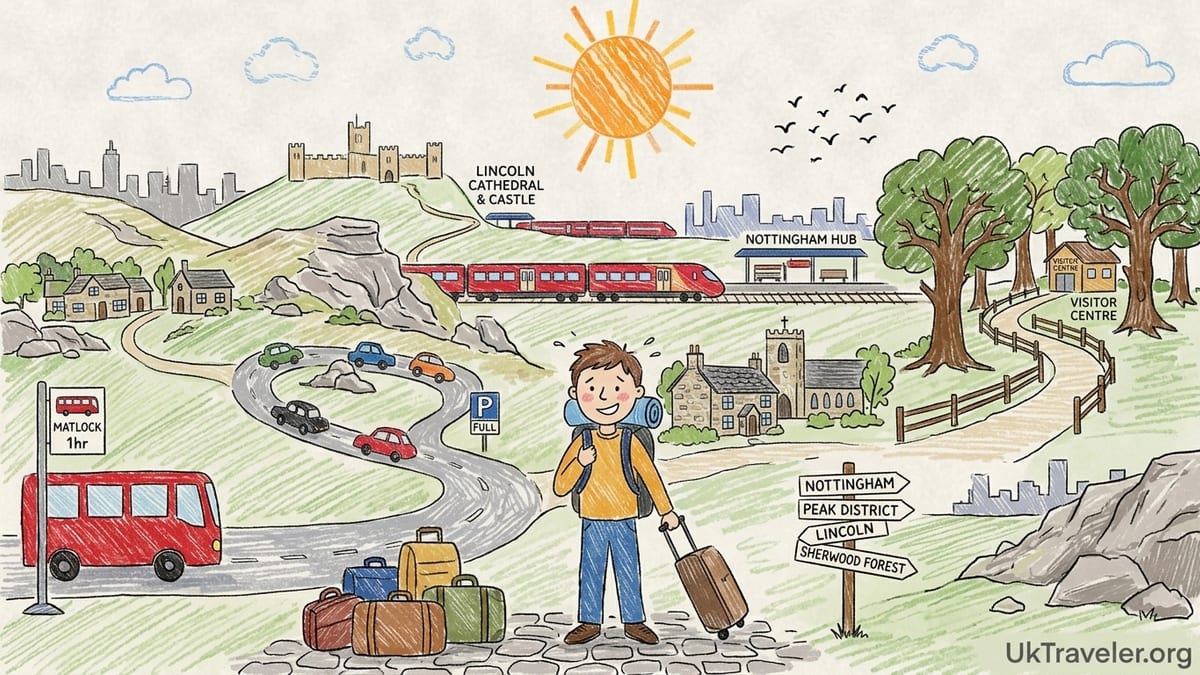
What I Tried to Do in One Overstuffed East Midlands Loop
On my first serious East Midlands trip, I landed in Nottingham with seven nights to play with and what I thought was a clever plan. I booked three different hotel bases: two nights in Nottingham, three in a Peak District village, and two in Lincoln. On paper, the triangle looked efficient. Nottingham to Lincoln is about an hour on the Castle Line regional trains that run roughly once per hour off-peak according to East Midlands Railway schedules, and Nottingham to Matlock, on the edge of the Peak District, is also around an hour by train on a separate line. Trains fan out neatly from Nottingham station, the region’s main hub, so it felt logical to bounce in and out of the city between countryside forays.
The reality was choppier. The first day I tried to combine a Nottingham walking tour, a late-afternoon train to Matlock and an evening stroll along the River Derwent. A minor delay on the Nottingham to Matlock service shrank the daylight window, and by the time I had dragged luggage across cobbles to the guesthouse, the light had gone and so had my energy. I repeated that pattern throughout the week: optimistic morning check-outs, one or two train changes, and then half a wasted afternoon as I navigated unfamiliar streets and settled into yet another room.
When I switched to a hire car for the Peak District stretch, a different set of constraints appeared. Honey-pot spots such as Bakewell, Castleton and the Hope Valley concentrate a lot of visitors. Recent visitor surveys for the national park highlight these areas as some of the busiest places in the Peaks, with parking pressure a constant theme. Arriving in Castleton after 11:00 on a dry Saturday, I found the main pay-and-display car park edging towards full. Side streets were tightly regulated, and a steady stream of cars circled for spaces. That 20 or 30 minutes of “just finding somewhere to park” ate into the time I thought I had for a short walk up Cave Dale.
Further east, Sherwood Forest felt deceptively simple. The official RSPB-managed visitor centre near Edwinstowe has a large car park signposted from the main road and published all-day parking charges for cars. In 2026, standard all-day parking for non-members is advertised at around 7 pounds on some days, with 4 to 5 pounds quoted in other local guidance depending on events, and free parking for RSPB members. The woods themselves are free to enter. Yet even with clear signposting and a single car park, my half-day visit overran. Sherwood’s paths invite long meanders, and the visitor centre closes around late afternoon, with typical posted opening hours between roughly 09:00 and 17:00 in summer and shorter hours in winter. I underestimated how much time I would want simply to wander, and I had not added a buffer for queueing at the café or browsing the exhibition at the end.
Where the Plan Broke: Time Losses You Only Notice on the Ground
Looking back at that week, the biggest miscalculation was not mileage but friction. Each element of travel introduced a small delay: waiting for hourly trains instead of turn-up-and-go frequencies, paying for parking in rural car parks that still rely on coins or basic card machines, and crawling behind traffic near beauty spots where councils have had to introduce new red route restrictions to curb verge parking. Around Castleton and Mam Tor in the Peak District, for example, Derbyshire County Council has begun rolling out double red lines and other controls to tackle congestion and unsafe roadside stopping. That kind of measure is good for the landscape but it means that you cannot assume you will pull into a lay-by at the last minute.
Then there were opening hours. In a city, it is easy to walk from one museum to another if a planned visit falls through. In the East Midlands countryside, many attractions run with limited seasonal hours. Sherwood Forest’s visitor facilities trim back to roughly 10:00 to 16:00 in the winter months. Stately homes such as Chatsworth House or other Derbyshire estates, which many visitors combine with the Peaks, also work on timed entries and defined closing times that shift across the year. One foggy midweek day, slow driving conditions meant I reached a country house ticket desk only forty minutes before last entry, which cut the tour to a hurried jog.
Weather exaggerated all of this. The Peak District is a national park with exposed ridges and moors, and conditions can change quickly. On my planned Mam Tor and Great Ridge hike, low cloud rolled in during late morning. I lost half an hour debating whether to push on, another twenty minutes retreating to the café, and by early afternoon my carefully stacked list of viewpoints had evaporated. Those few miles of walking became the entire focus of the day. Translating that into practical itinerary terms, any rural walking or viewpoint day in the East Midlands needs at least two hours more than you think, both to allow for slow going in mud and to wait out showers.
Hotel changes did the rest of the damage. Three bases in seven nights sounded reasonable when I booked, yet every move cost nearly half a day when I factored in checkout routines, luggage, and either train or car journeys plus finding the new place. In the Peak District I also discovered that a car park may be close to a village as the crow flies but separated by a steep hill or narrow pavement, which makes shifting bags slower. By the end of the trip I knew I would happily sacrifice a couple of extra sights to avoid more than two accommodation changes in a week.
What Can Realistically Fit Into 3 Days: Choose City or Countryside
With three days in the East Midlands, you have to treat the region as a set of options, not a checklist. After my week-long loop, I would never again advise anyone to attempt Nottingham, Lincoln, Sherwood Forest and the Peak District all in one three-day window. The trap is obvious: on the map, Nottingham to Lincoln is about an hour by train and Lincoln to the Peak District looks drivable in under two hours. But once you build in checkouts, bag storage and local travel, you end up spending most of your short break in transit.
If I were re-running only the first three days of my trip, I would pick one of two themes. The first would be a city-focused long weekend based in Nottingham or Lincoln with perhaps a single countryside taster. Nottingham makes sense as a base because its station has hourly trains to both Lincoln and Matlock, alongside services to smaller towns like Newark. From a hotel near the station or Old Market Square, you can walk to the castle area and the Lace Market, take a tram out to a park-and-ride for the evening, and still manage one day trip without changing beds. A day on the Castle Line to Lincoln gives you just about enough time to walk the uphill stretch to the cathedral quarter, tour the cathedral and castle, and linger in the old streets before an evening train back.
The second three-day option would be to ignore the cities almost completely and sink into one pocket of the Peak District or Sherwood Forest area. Based on how my countryside days really unfolded, a realistic three-day rural stay looks like one travel day, one full walking and village day, and one slower day for a shorter walk plus a country house or woodland visit. For example, you might drive or take the train to Matlock, check into a B&B and settle in on day one, use day two for a circular walk above the Derwent with time in Matlock Bath, and then spend day three on a short hop to a bigger attraction like Chatsworth or a tram museum before returning home. That pattern avoids stacking long hikes back to back or rushing to pack up each morning.
Crucially, three days means one accommodation base only. Shifting hotels on such a short trip wastes the equivalent of a half to three quarters of a sightseeing day once all the small delays are counted. It also encourages unrealistic packing of experiences. Where my own three opening days tried to tack a brisk Nottingham castle visit onto a same-day move to the Peaks and a sunset walk, I would now cut that down to two main focal points and accept that some sights belong to the next, longer trip.
How 5 Days Open Up More Contrast Without Constant Moving
At five days, the East Midlands starts to reward more ambitious combinations, but only if you resist the urge to keep chasing new beds. After my first loop, I re-planned a mental five-day version that trims one accommodation and two long journeys. The sweet spot for me is two bases in five nights, ideally three nights in one and two in another. That gives time for both a city and countryside flavour without diluting each experience.
One version would put three nights in Nottingham and two in a Peak District village or town like Bakewell or Castleton. The first Nottingham day works best kept light: arrive, check in, and wander the compact city centre without fixed tickets. Day two can then be a full Lincoln excursion via the Castle Line train, leaving early enough to enjoy the uphill historic quarter without watching the clock too anxiously. Because the Nottingham to Lincoln train typically runs about once per hour off-peak, it pays to choose a specific outward and return service and plan meals around those times instead of assuming you can improvise.
On day three, I would use the morning for a final Nottingham focus, such as the National Justice Museum or the canal basin, and then transfer north-west by train or car in the afternoon to my Peak District base. Having already made the city-to-countryside pivot once, I learned that this transfer day must be left deliberately under-programmed. Allow an extra hour for slow traffic, for finding your parking in a busy village and for the simple act of orienting yourself. In Castleton, for example, the main car park uses pay-and-display machines, takes coins and some phone payments, and sits at the edge of the village. It is convenient, but if you arrive during a busy spell you may queue at a machine or park a little further out than expected.
The final two days fall into a pattern that worked much better on my second attempt: one big outdoors day and one mixed, easier day. The outdoors day might be a ridge walk such as Mam Tor and Lose Hill, or a river valley stroll like Dovedale or the Monsal Trail from Bakewell. These routes usually combine car parks with limited capacity, popular paths and changeable weather, so I now automatically build in at least a one-hour buffer either side of the actual walking time. That buffer covers circling a car park, using facilities, queuing for snacks and simply pausing at viewpoints that are as compelling as the destination.
Why 7 Days Deserve Only 2 or 3 Bases, Not a New Hotel Every Night
With 7 days, it is tempting to treat the East Midlands as an all-you-can-eat buffet. I certainly tried. My original circuit stacked Nottingham, Matlock, Castleton, a night near Bakewell and then Lincoln into a single week. On the map, none of those hops look large, but by the end I felt I had been packing and unpacking more than exploring. The lesson I took was simple: in this region, seven days should come with a hard cap of two, at most three, accommodation bases.
The reason is that the region’s attractions cluster. Nottingham and Sherwood Forest form one logical cluster, with the city providing rail connections and the forest sitting reachable as a day trip by car or by bus services such as the Sherwood Arrow from Nottingham’s bus stations. The Peak District forms another, with its own internal web of buses, scenic roads and walking routes but relatively few fast connections elsewhere. Lincoln and the surrounding Lincolnshire countryside form a third, loosely linked by the Castle Line train back to Nottingham. Once you are in each cluster, moving within it is usually straightforward. It is the jumps between clusters, with luggage in tow, that chew time.
In a revised seven-day plan informed by lived experience, I would now pick two clusters and explore them in depth rather than skimming all three. That might mean four nights in the Peaks and three split between Nottingham and Sherwood, or vice versa. If I really wanted all three flavours in a single trip, I would still cap the hotel changes at three and accept that each move costs most of a day. That approach leaves space for the kind of unplanned pauses that make rural travel satisfying: an extra tea break in Bakewell after discovering the town centre car parks are busier than expected, or a second loop in Sherwood Forest after deciding to follow a longer waymarked trail.
I also learned not to stack similar days back to back over a week in the East Midlands. Two intense walking days in the Peak District followed by a third day of trudging around a city’s cobbled streets left my legs heavy and my attention span short. Alternating “long” days that revolve around hikes or large historic sites with “short” days focused on one museum, a market town and a café worked far better. Over seven days, that rhythm might look like a big walk, then a village-and-tearoom day, then a city or castle, then a restful woodland or garden visit, and so on.
Practical Rules I Now Use for Time, Parking and Weather Buffers
Beyond the big structural choices, my East Midlands experience left me with several practical rules I now apply every time I return. The first is a simple time multiplier for rural excursions: however long a walk or attraction visit is advertised to take, I now add at least 50 percent. A three-hour circular route in the Peak District, for instance, often expands to four and a half once you account for slower progress on rocky or muddy paths, photo stops at viewpoints, and the extra time needed to navigate waymarks. In Sherwood Forest, a short loop out to the Major Oak and back stretched easily to two hours once I stopped to read interpretation boards and wander down side paths.
The second rule concerns parking and arrival times. In busy honeypots like Dovedale, Bakewell, Castleton or the Monsal Trail trailheads, local councils and the national park authority warn that car parks can reach capacity on fine weekends and holidays. The Peak District National Park’s own parking guidance notes both limited capacity at many sites and the use of phone payment systems such as RingGo, alongside traditional machines. I now treat 09:30 as a soft arrival deadline at popular rural car parks on fine weather days, aiming to be parked and booted up well before the late-morning wave hits. When I cannot arrive that early, I mentally reclassify the outing as a short, flexible stroll rather than a must-do epic hike.
Third, I plan around the most constrained opening hours. City museums in Nottingham or Lincoln often stay open into the late afternoon, while some rural attractions shut earlier. Sherwood Forest’s visitor centre, for example, trims its winter hours and closes the main facilities by late afternoon, even though the woods themselves remain accessible for longer. Stately homes may also use pre-booked time slots. So I now anchor each day around whatever has the earliest last entry and build the rest of the activities around that fixed point. It sounds obvious, but on my first trip I repeatedly reversed that logic and paid for it with rushed visits or missed entries.
Finally, I give weather its own buffer. In the Peaks, low visibility can make some ridges inadvisable for those unfamiliar with the terrain, while heavy rain can transform stepping stones and riverside paths into slow, slippery slogs. Headlines about overcrowding and occasional incidents at beauty spots such as Mam Tor and Dovedale underline that people often underestimate conditions. My practical response is to hold at least one “swing” day in any five or seven-day plan, where activities can be swapped depending on forecasts. If heavy rain appears, that becomes my city or woodland day, with exposed ridge walks pushed to clearer windows.
The Takeaway
My original East Midlands itinerary looks bold on paper and bewildering in hindsight. I tried to combine city heritage in Nottingham and Lincoln, big landscapes in the Peak District, and legendary woodland in Sherwood Forest within a single week, with three separate hotel bases and minimal buffer time. What actually happened was a sequence of small bottlenecks: hourly train timetables, slow rural roads, busy village car parks, and early closing times that squeezed my days far more than the raw distances suggested.
If I could go back and reallocate that time having now travelled the region several times, I would build around how days actually feel, not how they look on a spreadsheet. Three days would become a focused taste of either the cities or a single countryside pocket, not a dash between them. Five days would allow one city and one rural base, with no more than two accommodation changes and alternating long and short days to avoid fatigue. Seven days would cap hotel shifts at two or three and include at least one flexible swing day that can absorb weather or crowd surprises.
In concrete terms, my revised allocation for the same total span of seven days would look like this. For a three-day visit, I would choose either a Nottingham base with a single day trip to Lincoln, or a Matlock or Bakewell base with one full walk and one gentler day. For five days, I would spend three nights in Nottingham and two in the Peak District, using one of the Nottingham days for Lincoln and one of the Peak District days for a headline countryside walk with proper parking and weather buffers. For a full seven-day trip, I would now choose four nights in or near the Peak District and three nights in Nottingham, slotting Sherwood Forest into one of the Nottingham days and leaving Lincoln either to a future visit or as a single carefully planned day trip rather than an extra hotel stop.
That distribution respects the real travel texture of the East Midlands. It acknowledges that rural car parks fill up, that buses and trains follow hourly rhythms rather than metro frequencies, and that weather and opening hours influence your days as much as any checklist. Most importantly, it leaves room for the small moments that made my improved trips memorable: a quiet early-morning lane in Castleton before the crowds, a second slice of cake in a Lincoln tea room because there was no train to rush for, and a slow amble back through Sherwood Forest after deciding that the Major Oak deserved more than a glance.
FAQ
Q1. Can I visit Nottingham, Lincoln and the Peak District in just 3 days?
No, not in any satisfying way. You would spend most of your time in transit and constantly watching the clock. It is better to pick either the cities or the countryside for three days and leave the third area for a later trip.
Q2. How many different hotels or bases should I book for a 7-day East Midlands trip?
Based on experience, two bases are ideal and three is the upper sensible limit. More than that turns your week into a packing exercise and erodes full sightseeing days.
Q3. Is a car essential for exploring the Peak District part of the East Midlands?
A car is not absolutely essential, because there are buses and some train links, but it makes reaching smaller valleys and trailheads much easier. Without a car, you should expect slower transfers and focus on well-served hubs such as Matlock, Bakewell or the Hope Valley.
Q4. How early should I arrive to park at popular Peak District spots?
On dry weekends or holiday periods, aim to be parked by around 09:30 at busy places such as Castleton, Dovedale or Monsal Trail car parks. Arriving later often means circling for a space or being pushed further from your chosen walk.
Q5. Can I do Sherwood Forest as a quick stop on the way between cities?
You can, but it is easy to underestimate how long you will want there. Between parking, visiting the RSPB-managed visitor centre, walking to the Major Oak and exploring side paths, a “quick stop” tends to turn into at least half a day.
Q6. How much buffer time should I add to planned walks in the East Midlands countryside?
A practical rule is to add at least 50 percent to the expected walking time. That extra space covers slower progress in mud, photo stops, weather pauses and the inevitable delays at parking areas or trailheads.
Q7. Are hourly trains a problem when planning day trips from Nottingham?
Hourly trains are workable, but they remove spontaneity. When travelling to Lincoln or Matlock from Nottingham, it is wise to choose specific outward and return departures and build your day around those times instead of assuming you can simply turn up and travel whenever you like.
Q8. Should I stack long hiking days together in the Peak District?
It is better not to. Two or more intense hiking days in a row, followed by a busy city day, can leave you tired and less able to enjoy what you are seeing. Alternating big outdoor days with easier village or museum days works much better.
Q9. How do seasonal opening hours affect East Midlands itineraries?
Seasonal hours are important in rural areas. Attractions like Sherwood Forest’s visitor centre and many historic houses shorten hours in winter, and last entry may be earlier than you expect. Always check up-to-date opening times and plan earlier visits on short-light days.
Q10. If I only have 5 days, which two bases work best for a first visit?
For a first trip, three nights in Nottingham and two in the Peak District is a strong combination. From Nottingham you can explore the city and take a day trip to Lincoln or Sherwood Forest, while the Peak District base delivers the contrasting landscapes and villages that many people come to the region to see.