


The East Midlands is packed with family days out that look irresistible online. On a recent series of trips with two children aged 6 and 10, plus grandparents in tow on some days, we set out to see which attractions genuinely justified the time and money. We focused on the whole day experience rather than ticking off sights, paying attention to access, queues, toilets, food, play spaces, weather back-up and, crucially, how long the children stayed happily engaged before tiredness and boredom crept in.
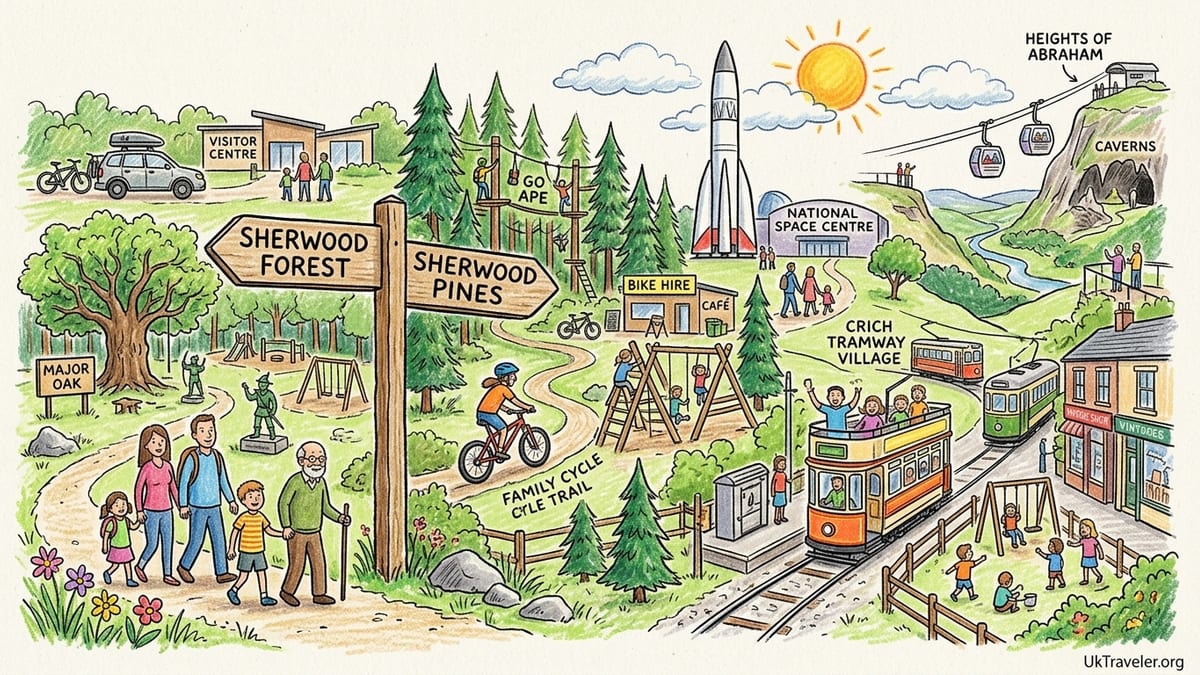
How We Tested Family Days Out in the East Midlands
Across several weekends in spring and early summer 2026, we based ourselves just outside Nottingham and planned a mix of forests, heritage attractions, science centres and hilltop adventures. The core group was two adults with children aged 6 and 10, with a grandparent joining on two of the days. We drove to each site, but we paid close attention to public transport options and how practical they would have been with young children and a backpack of spare clothes.
Each visit lasted at least half a day. We aimed to arrive not long after opening to test parking, queues and toilets at busier times, and we kept notes on when the first “Can we go home now?” surfaced. Some attractions that looked excellent online did not sustain interest past two or three hours, while others surprised us and filled a full day without complaint.
To keep this guide useful for real planning, every section here is based on places we have actually visited as a family, with approximate 2026 prices and conditions checked against the latest official information. We then set these tested experiences against a few researched alternatives to help you decide which kind of East Midlands day out is worth building a whole trip around.
Sherwood Forest vs Sherwood Pines: Two Very Different Woodland Days
We devoted one full weekend to comparing the two big Sherwood woodland names: Sherwood Forest National Nature Reserve near Edwinstowe, and Sherwood Pines Forest Park, a larger recreation forest managed by Forestry England. On paper they sound similar. In practice they provide very different family days.
At Sherwood Forest, entry to the reserve on foot was free for our family. We paid for standard parking near the RSPB visitor centre, which is currently advertised at around 7 pounds for the day, with discounts for members. From the car park it was a short, buggy-friendly walk to the modern visitor centre, toilets and café. We arrived around 10:00 on a dry but cloudy Sunday, and there were still plenty of parking spaces. By late morning, the main car park was near capacity, so early arrival helped.
The walk to the Major Oak, on well surfaced paths, suited both the 6-year-old and the grandparent with a stick. Along the way, low-key Robin Hood themed sculptures and information boards gave the 10-year-old enough to read and photograph. There are informal play opportunities among the trees, but no large built playground on the main route. The visitor centre café offered basic hot meals and children’s lunchboxes at broadly mid-range attraction prices, with clean toilets just off the main foyer. The covered seating area and visitor centre exhibition meant we had a weather back-up if the sky opened, although most of the enjoyment still relied on being outside.
Sherwood Pines, a short drive away, felt more like an activity hub than a nature reserve. Parking charges are higher than a standard country park car park but typical for a Forestry England flagship site, with day parking and an annual Sherwood Pines membership available for frequent visitors. The forest is the largest area of woodland in the region, with clearly marked cycling and walking trails, a bike park, Go Ape high ropes courses, play areas and a central café and bike hire shop. We arrived at 09:30 on a sunny Saturday and found the main car park already filling with families unloading bikes.
For our children, Sherwood Pines offered more structured excitement. We hired two junior mountain bikes from the on-site Sherwood Pines Cycles, which advertises hire from roughly an hour upwards, and spent the morning on the family cycle trail. The 6-year-old needed frequent snack breaks, but the traffic-free route and regular waymarkers made it low stress. After lunch at the café, the children spent over an hour in the main adventure play area, which includes timber climbing structures, slides and plenty of space for running. Toilets near the café were busy but regularly cleaned.
We did not book Go Ape on this visit, as the high ropes courses are usually better value for confident older children and teenagers, but just watching the zip lines added to the sense of adventure. Between the cycling, walking and playgrounds, our two stayed genuinely enthusiastic from 09:30 to about 16:00, with only the 6-year-old fading in the car on the way home. In contrast, Sherwood Forest held their attention for roughly three to four hours, including a café stop and some time in the smaller play areas.
The verdict from our family tests was that Sherwood Forest works very well as a relaxed, lower cost half-day with younger children or mixed ages, especially if you value Robin Hood history and gentler walking. Sherwood Pines, with its cycling infrastructure and activity focus, justified a full paid day trip and felt more like something to build a weekend around, especially for families with primary school children and tweens who like bikes and big playgrounds.
National Space Centre, Leicester: Indoor Science That Earned Its Price Tag
Leicester’s National Space Centre was one of the attractions our children were most excited about after watching online videos of rockets, astronaut suits and immersive dome shows. It also looked like one of the region’s pricier indoor days out, so we were keen to see whether it delivered a full day of engagement. We booked online for a midweek day at the start of the school holidays and drove from Nottingham in about 45 minutes. On-site parking is available beside the building for a flat daily charge, and we had no difficulty finding a space at 09:45, fifteen minutes before opening.
On entering, we passed quickly through ticket checks and found ourselves in a bright atrium with the famous rocket tower visible ahead. The children received paper trail sheets and headed straight for the interactive exhibits. Current ticket information confirms that standard tickets can be upgraded to an annual pass-style return, which increases value if you live within easy reach. During summer 2026, published prices have been slightly adjusted in response to government VAT changes, and the centre has also experimented with special “pay what you can” days and event nights to mark its 25th anniversary.
From a family perspective, the indoor nature of the attraction was the single biggest strength. On our visit, heavy showers rolled through by midday, but once we were inside the weather barely mattered. Across six main galleries, the children could launch air rockets, drive simulated rovers, complete touchscreen challenges and step into mock mission control rooms. The 6-year-old flitted between buttons to press, while the 10-year-old settled into longer tasks such as planning a space mission and learning about Mars rovers.
The planetarium shows, which are scheduled throughout the day, provided valuable sit-down breaks for both children and adults. We pre-booked a family-friendly show included within our tickets and used this as our mid-morning anchor, followed by an early lunch to dodge the busiest queue at the café. Food options in the on-site café were comparable to other major UK science centres, with hot meals, sandwiches and children’s lunchboxes. Prices were not cheap but felt acceptable considering we were on a full-day visit and had brought additional snacks.
Toilets were available on multiple floors, which spared us long hikes across galleries with an urgent 6-year-old. Baby change facilities and lifts were present, and we saw several families with pushchairs navigating without trouble. Noise levels did build up in the afternoon as more visitors arrived, and sensitive children might need occasional quiet breaks in less crowded corners of the galleries.
We left at around 16:30, more than six hours after entering, with both children still talking about favourite exhibits. The 10-year-old rated it the best day of the trip and specifically mentioned that, unlike some museums, “it never got boring because there was always something new to try.” For us, the National Space Centre clearly justified its higher admission cost, especially in unreliable weather and for children roughly 6 and up who can get the most from the interactive science.
Heights of Abraham, Matlock Bath: Spectacular Views With Hidden Snags
The Heights of Abraham above Matlock Bath combines several elements that look ideal in marketing photographs: a cable car ride over the Derwent valley, show caverns, woodland trails and playgrounds. It is also one of the more expensive single-day admissions in the region, with tickets covering both the cable car and hilltop attractions. We visited on a warm, clear Saturday in late spring, with the aim of testing whether the full day lived up to expectations for our mixed-age family.
We arrived in Matlock Bath just after 10:00 and followed signs to the official car parks in the valley. Parking is paid locally, and on busy days spaces can be tight by late morning, so we were glad to have arrived early. The short walk to the cable car base station involved crossing a main road with the 6-year-old in hand. Once at the station, queues for the cable car built quickly, though they moved steadily. Staff loaded cabins efficiently, and the ride itself, up and over the woodland slopes, was a clear highlight for both children and the grandparent.
At the top station, we found an orientation area, café and toilets. The hilltop park includes multiple viewpoints, two main cavern tours and play areas. The guided cavern tours are included in the ticket but operate on timed entry. We joined a late-morning tour that required about fifteen minutes of queuing. Inside, the temperature dropped and paths could be slippery in places, so sturdy shoes were useful. Our 10-year-old listened with interest to the history of lead mining, while the 6-year-old was mostly excited by echoing voices and torchlight. By the end of the tour, the younger child was flagging and asking for snacks.
Lunch options at the hilltop café were scenic but crowded. We waited around twenty minutes for hot food, which felt long with hungry children. Portion sizes were reasonable, and the outdoor seating benefitted from valley views. The playgrounds near the summit helped the children reset after sitting and queuing. One play area is better suited to younger children with slides and lower climbing structures, while another offers more challenging equipment for older ones.
We found that, while the total package offered variety, the day contained a lot of micro-queues: for the cable car both ways, for caverns, for food, and for the toilets at peak times. By around 15:00, both children were tired from climbing slopes and standing in line, and the prospect of queueing again for the return cable car made tempers shorter. The adult view was that the combination of ride, views and caverns felt special and justified a one-off family visit, particularly in fine weather with reasonably active children aged 7 and above. For younger children or those who dislike enclosed spaces or heights, the value is less clear, and by late afternoon our 6-year-old would have happily swapped the caves for a simple riverside playground.
National Tramway Museum at Crich: Heritage That Surprised the Children
Crich’s National Tramway Museum, often still called Crich Tramway Village in visitor materials, was an unexpected hit. We planned it as a gentler day out sandwiched between more obviously exciting attractions. Standard 2026 admission prices are in line with other heritage sites in the region and include unlimited tram rides along the line for the day. A key benefit is that full price day tickets can be converted into free return visits within a defined 12 month period, which significantly improves value for families within driving distance.
We reached the car park shortly after opening on a bright but cool Sunday. Parking was straightforward, with a short walk uphill to the entrance. The recreated village street, with period shopfronts and tram depot, immediately interested the adults, but we half expected the children to be underwhelmed. Instead, the sight and sound of full-size trams rumbling past captured them straight away. Within fifteen minutes we were onboard an open-top tram heading out along the line, with the conductor clipping tickets and chatting with passengers.
The tram ride itself is long enough to feel like a real journey but short enough to avoid restlessness. The line runs through countryside cuttings and past woodland, with a terminus where you can disembark and walk to a hilltop viewpoint. We found that alternating periods of riding with short walks worked well. The 6-year-old enjoyed simply changing seats and looking for sheep, while the 10-year-old liked reading about the different tramway systems represented in the fleet.
Back in the village, there is a well equipped indoor exhibition hall, a small outdoor play area and a soft play space that was particularly useful when a shower passed over in the afternoon. Food options included a traditional pub-style venue, a tearoom and takeaway snacks, which provided flexibility for different budgets. Prices were serviceable rather than bargain, but portion sizes were good, and we appreciated having several choices. Toilets were dotted sensibly around the site, and although there were queues at peak lunchtime, we never had to wait long.
We stayed from about 10:15 until nearly 17:00, helped by the simple joy of “just one more tram.” The heritage aspect that we assumed would appeal mostly to adults turned out to be part of the attraction for the children, who started spotting design differences between early and mid twentieth-century vehicles. Compared with some other heritage properties in the region that rely heavily on static displays and formal gardens, Crich offered a more kinetic day out that kept both age groups engaged and happily tired by closing time.
Free and Low-Cost Outdoor Time: Country Parks and Unstructured Play
Alongside big-ticket days, we deliberately scheduled lower-cost outdoor time to see how it compared in terms of actual enjoyment. In practice, some of the simplest outings delivered disproportionate value, especially when the weather cooperated and we managed expectations from the start.
At Sherwood Forest, the fact that entry to the reserve itself does not carry an admission fee meant that our only fixed cost was parking and whatever we chose to spend on food and souvenirs. We noticed plenty of families arriving with picnics and using the network of waymarked walking trails without setting foot in the café beyond a quick toilet stop. The atmosphere on the main paths can be busy at weekends, but narrower side routes quickly felt quieter and more exploratory.
We also spent time at a smaller Nottinghamshire country park that charged only a modest parking fee for the day. Facilities were basic compared with Sherwood Pines, with a single playground, limited catering and older toilets, yet the children still played for hours by a shallow stream, building dams with sticks and stones. That afternoon cost a fraction of the price of a cable car ticket or indoor science centre, but the level of engagement, especially for the 6-year-old, was comparable. The main trade off was lack of indoor shelter if the weather had turned, and fewer structured activities for the 10-year-old once the novelty of the stream and climbing trees waned.
These experiences highlighted that it is often worth pairing one or two premium attractions, such as the National Space Centre or Heights of Abraham, with simpler, cheaper days that give children space to roam without timetables. In planning a week in the East Midlands, budgeting for parking and the occasional ice cream at forest sites can sometimes deliver better overall memories than stacking every day with paid admissions.
Attractions That Looked Better Online Than On the Day
In an era of polished social media videos and carefully curated websites, it is easy for expectations to run ahead of reality. Across our East Midlands visits, a few experiences that looked very exciting in marketing material did not translate into sustained engagement for our children once we were actually there.
The most obvious example was the cavern element of the Heights of Abraham. Promotional images understandably focus on dramatic lighting in underground chambers and the spectacle of guided tours. While the caves are genuinely atmospheric and historically interesting, our 6-year-old treated them largely as an obstacle to get through before reaching daylight again, and even the 10-year-old felt that one tour was enough. Combined with the queueing and relatively enclosed environment, we realised that the caves, though central to the attraction’s story, were not the repeat highlight the brochures might suggest for younger families.
We also trialled a small local heritage property in the region that promised hands-on history activities and family trails. On arrival, staffing constraints meant that several interactive rooms were closed, and the advertised trail had been reduced to a paper sheet and a box of crayons. The house itself was attractive, but the experience quickly turned into a standard “do not touch” historic interior visit, which lost the 6-year-old within thirty minutes. Since ticket prices were only slightly lower than those of larger, better resourced sites, it felt poor value that day, and we cut the visit short after less than three hours.
Online event listings for seasonal family festivals in rural locations also need careful scrutiny. We attended one advertised as a full day Robin Hood themed celebration near Sherwood Forest. In reality, the paid elements consisted of a small fairground, a handful of craft stalls and performances clustered into short time slots. Without constant spending on rides and snacks, the free entertainment periods left significant gaps. By mid afternoon, both children had exhausted the limited activities, and we retreated to the main forest trails instead. The lesson was clear: whenever an event relies heavily on temporary vendors and fairground rides, factor in the ongoing cost and the possibility that queues and crowds may outstrip actual content.
Which East Midlands Experiences Are Truly Worth Building a Trip Around?
Looking back across our mixed set of days, three experiences stood out as strong anchors for a family trip to the East Midlands: Sherwood Pines, the National Space Centre and the National Tramway Museum at Crich. Each offered at least six hours of varied activity, credible food and toilet provision, and sufficient weather resilience to justify their costs within a holiday budget.
Sherwood Pines proved its worth as an all day outdoor base, particularly for families with bikes or those prepared to hire them on site. The combination of trails, playgrounds and café, wrapped in a vast forest setting, meant that our children could vary their energy levels without ever feeling confined. Paying for parking and optional activities like bike hire did add up, but because much of the appeal lies in exploring the forest itself, it never felt like we were feeding coins into a meter for every enjoyment.
The National Space Centre delivered exceptional value as a weatherproof day, especially for children 6 and older with an interest in science and technology. Its concentrated indoor layout, multiple toilet locations and structured schedule of shows and talks meant that we could plan our energy bursts and rest breaks. The ticketing model that allows for return visits over time further improves its standing if you live within reach, effectively transforming one higher cost day into multiple shorter visits.
Crich’s National Tramway Museum stood out because it combined heritage appeal for adults with simple, repeatable fun for children in the form of tram rides and play spaces. The free return admission within a set period on standard day tickets meant that, for local families, it could easily become a default day out over more than one season. Even for visitors from further afield, it merited a dedicated day rather than a quick stop, and we left feeling we had received solid value for the family ticket price.
By contrast, Sherwood Forest, while atmospheric and inexpensive beyond parking, felt best as a half day addition to a wider itinerary, rather than the sole focus of a holiday day. Heights of Abraham provided memorable views and the novelty of the cable car, and it is worth including if your budget can stretch to a premium experience and your children can handle queues and hill walking. Yet it did not quite match the all day engagement of Sherwood Pines or the National Space Centre for our particular age mix.
The Takeaway
For families planning a trip to the East Midlands, the key question is not just which attractions exist, but which ones will hold your children’s attention long enough to justify the admission price, travel time and inevitable snacks. Our lived experience with children aged 6 and 10 suggests that you will get the most from the region by combining one or two big anchor days with simpler, lower-cost outings in forests and country parks.
If you are choosing only a couple of paid attractions, Sherwood Pines, the National Space Centre and the National Tramway Museum at Crich offered the strongest balance between cost, content and comfort. Each provided clean toilets, workable food options, indoor or sheltered spaces for sudden showers, and enough hands-on activity to keep both children and adults engaged for six hours or more. These are the places we would confidently build a long weekend around.
Sherwood Forest and smaller country parks remain excellent for fresh air and unstructured play, especially when you want a cheaper or quieter day, while Heights of Abraham earns its place as a one-off treat if your family enjoys heights, views and a touch of underground adventure. What looked most exciting online was not always what worked best on the ground. In the East Midlands, the real value often lies where practical details like parking, toilets and play spaces quietly support the headline experiences, leaving children happily tired and adults feeling their money and time were well spent.
FAQ
Q1. How many days should a family spend in the East Midlands to enjoy these attractions?
Most families will be well served by three to five days, combining two or three full day anchor attractions such as Sherwood Pines, the National Space Centre or Crich’s National Tramway Museum with one or two lower cost country park or city exploration days.
Q2. Is it better to have a car, or can you do these days out by train and bus?
A car gives far greater flexibility, especially for Sherwood Pines, Sherwood Forest and Crich, where public transport is limited or involves multiple changes. The National Space Centre is more realistic by train and local bus or taxi from central Leicester, but overall a car makes family logistics much easier.
Q3. What ages will get the most from the National Space Centre?
Based on our visit, children aged 6 and over gain the most from the interactive exhibits and planetarium shows, while older primary and early secondary pupils can spend many hours on in-depth displays. Under 5s will enjoy the lights and buttons but may tire sooner.
Q4. Is Sherwood Forest suitable for pushchairs and limited mobility visitors?
Yes, the main route to the Major Oak from the visitor centre follows a well surfaced path suitable for pushchairs and many mobility aids, though some side trails are rougher. Accessible toilets and level access to the main café further support mixed ability groups.
Q5. How long should we allow for a visit to Sherwood Pines?
If you plan to cycle, use playgrounds and stop for food, a full day from around 10:00 to 16:00 passes quickly. Without bikes, a half day of walking and play still feels worthwhile, but the forest’s scale rewards longer stays.
Q6. Are the caves at the Heights of Abraham appropriate for young children?
The guided cavern tours are family friendly, but can feel dark, cool and sometimes cramped. Children around 7 and up who are comfortable underground tend to enjoy them most. Under 6s may either love the adventure or find it unsettling and tiring.
Q7. Can you bring your own food to these attractions?
Yes, picnics are welcome at Sherwood Forest, Sherwood Pines and Crich’s National Tramway Museum, with plenty of outdoor seating or grassy areas. The National Space Centre and Heights of Abraham focus more on on-site catering, but carrying snacks and water is still practical.
Q8. Which attraction was best on a rainy day?
The National Space Centre was the clear winner in wet weather, as almost all exhibits and facilities are indoors. Crich and Heights of Abraham both have indoor elements, but much of their charm comes from outdoor views and rides, which can be less appealing in persistent rain.
Q9. How early should we arrive to avoid queues?
For cable cars at Heights of Abraham and peak days at Sherwood Pines, arriving within thirty minutes of opening significantly reduced queuing and parking stress. At the National Space Centre, a pre opening arrival helped us secure convenient parking and attend early planetarium shows before the busiest crowds.
Q10. If we are on a tight budget, which single paid attraction should we choose?
If your children are primary school age and enjoy outdoor activity, Sherwood Pines offers the strongest value once parking and optional bike hire are considered, because so much enjoyment comes from simply exploring the forest and playgrounds without constant extra charges.