


When I first planned a long trip around the East Midlands, I pictured headline names and a rushed circuit: a day in Nottingham, a cathedral stop in Lincoln, a quick dash into the Peak District and a Robin Hood photo at Sherwood. What I actually found on the ground was more complicated and much more rewarding. Some places demanded nights, not hours. Others felt strangely hollow once the obvious sight was ticked off. After several multi-week visits, moving mostly by train and car, here is where I would genuinely spend my time if I were planning the perfect East Midlands itinerary from scratch.
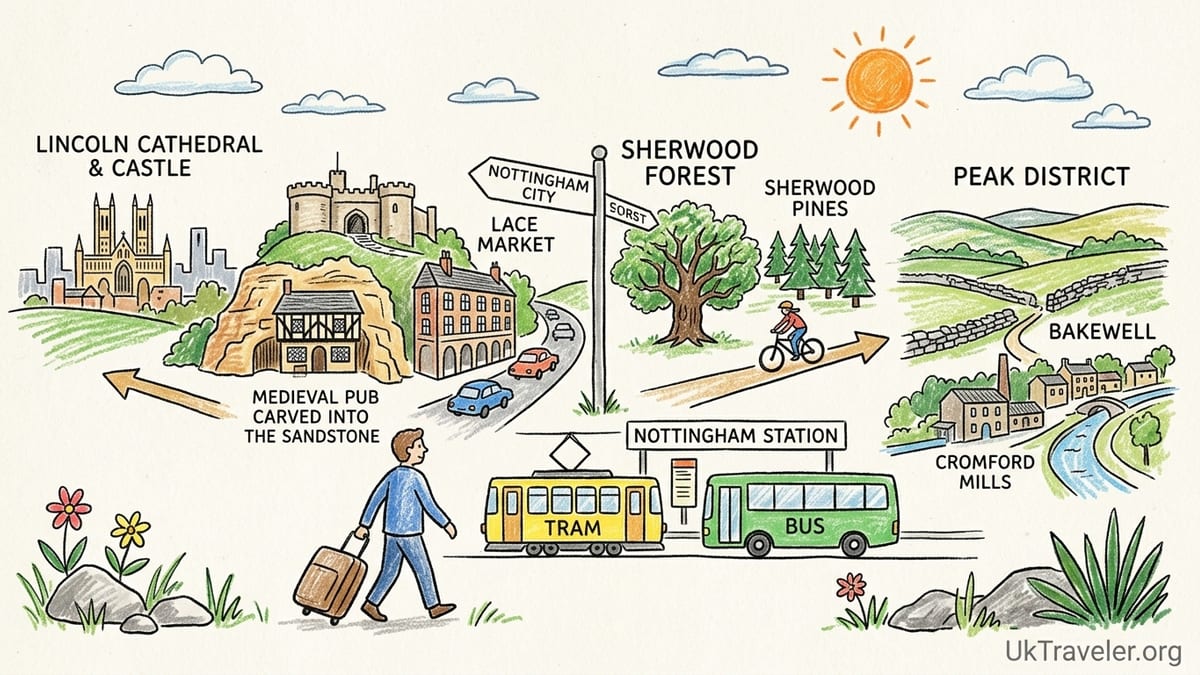
Nottingham as a Base, Not a Box to Tick
I first treated Nottingham as a simple city break. I booked two nights, arrived by train from London St Pancras, and fully expected to move on quickly to the countryside. The direct East Midlands Railway service from London is straightforward and usually takes around 1 hour 45 minutes, so rolling my suitcase out of Nottingham station into the compact city centre felt easy compared with many UK cities. Once I started to explore, I realised Nottingham works far better as a base for several days of regional exploring than as a single quick stop.
Over multiple trips, I have now spent roughly a week of my life in Nottingham, broken into three- and four-night stays. That has been just enough time to use the city as a hub for day trips to Sherwood Forest, the Peak District edges and nearby market towns, while still enjoying its own character in the evenings. The tram network and dense bus services make moving around simple, and the Robin Hood branded tickets allow joined-up travel on local buses, trams and trains within the Nottingham area, which I have used when leaving the car behind to avoid city-centre parking costs. Once the obvious draws such as the castle area and the historic pubs carved into sandstone are done, the city settles into a lived-in feel of independent cafes, students and small arts venues.
From a trip-planning perspective, Nottingham’s real value is connectivity. Direct trains link it with Lincoln to the east and Derby and Leicester to the west and south, so you can day-trip quite widely without touching a car. The bus network reaches Sherwood Forest and Sherwood Pines as well as villages on the edge of the countryside. On one visit I kept the car at my hotel on the edge of the centre and moved exclusively by tram and bus for three days. I did not miss driving, and I avoided the workplace parking levy zone that makes long-term central parking comparatively pricey. For a shorter East Midlands trip, I would still give Nottingham at least two nights and use it as a springboard rather than a mere notch on the list.
Was my original two nights enough? Not really. It covered the surface sights and a wander through the Lace Market and Hockley districts, but my later, longer stay was where Nottingham began to make sense as an anchor. Between late-night trams back from the station after Peak District day hikes, relaxed dinners, and an afternoon escape into Wollaton Hall and its deer park, the city proved it earns an extended stay more than some of its noisier marketing might suggest.
Lincoln’s Hilltop Heritage: Worth the Climb and a Night
My first experience of Lincoln was a mistake. I tried to treat it as a simple day trip from Nottingham, arriving by mid-morning on the Nottingham–Lincoln line and aiming to be back by early evening. The reality of Lincoln’s topography caught me out. The cathedral and castle sit together on a hilltop high above the modern shopping streets and the train station, connected by the famously steep Steep Hill. Walking up from the station with a daypack was memorable in the wrong way, and I spent the first hour catching my breath instead of enjoying the city.
On my second visit I did what locals quietly recommend. I drove to Lincoln and used the park and ride system that operates from the south of the city, leaving my car near the Waitrose site and taking the dedicated bus that drops you by the cathedral and castle area. Parking there is typically free within set hours, with a modest fare for the bus into town, and it removes the need to hunt for uphill parking or tackle Steep Hill on arrival. That small adjustment transformed the day. I could step straight into the medieval quarter, explore the castle walls and Magna Carta exhibition, then walk gradually downhill later towards the Brayford Waterfront and station.
Across two visits, I have spent a total of about a day and a half in Lincoln, including one overnight stay in a small guesthouse just off the Bailgate. That overnight made a decisive difference. During the day, the cathedral quarter can feel crowded with school groups and coach parties, particularly in warmer months. In the evening, the streets thin out and the close around the cathedral becomes one of the most atmospheric places in the East Midlands, with quiet stone alleys and views over the countryside. Sitting with a simple dinner near Castle Square after the day trippers had gone was as memorable as any famous landmark.
Was a single day enough? For the headline sights, just about. The castle walls, Victorian prison and Magna Carta exhibition, plus the cathedral interior, are manageable with an early start and realistic pacing. But Lincoln also offers smaller pleasures, from independent shops on Steep Hill to waterside bars by the university. Folding those into the experience makes an overnight stay well worth it. For travellers tight on time, I would still prioritise at least one late evening on the hilltop rather than using Lincoln purely as a rush-stop between trains.
Sherwood Forest and Sherwood Pines: Walking Beyond the Robin Hood Story
Like many visitors, I arrived at Sherwood Forest expecting a single photo at the Major Oak and not much else. On my first trip I drove from Nottingham, parked at the main Sherwood Forest Visitor Centre car park outside Edwinstowe and paid the all-day parking charge, which was around four pounds for cars when I last visited, with discounts for RSPB members. The visitor centre is modern, and staff equipped me with a free map of walking trails. At that point I still imagined being back in Nottingham by late afternoon.
That quick-stop idea lasted until I set out on one of the longer circular walking routes. The forest is a designated national nature reserve with around 1,000 acres of oak and birch woodland. Waymarked paths lead beyond the compact loop that most visitors follow to the Major Oak. A moderate 4 mile route, which is promoted as taking roughly two and a half hours, gave me the first sense of the wider landscape beyond the legends. I heard woodpeckers, passed quiet ponds and old boundary banks, and at times walked for several minutes without seeing another person. What I had assumed was a one-hour detour became a full walking day, broken by a simple lunch back at the visitor centre cafe.
On a later trip, I paired Sherwood Forest with Sherwood Pines, which lies a short drive away and is one of the largest forest parks in the region with around 3,300 acres of plantation and mixed woodland. While Sherwood Forest is about ancient oaks and Robin Hood, Sherwood Pines is about outdoor recreation. Here I spent half a day cycling and walking among well-signed trails, with families hiring bikes, children using play areas, and runners following the clearly marked parkrun route. Parking here is more expensive than at Sherwood Forest but includes a full day of access, and on one visit I arrived before 11 am to take advantage of a reduced rate promoted to early parkrun participants and morning visitors.
Across two trips, I have spent roughly one long day and one half day in this Sherwood area. That has just about been enough for walking and woodland time, but if I were traveling with children I would consider two full days to mix forest walks with activity sessions at Sherwood Pines or neighbouring holiday parks. Access by public transport is possible, with buses from Nottingham and Mansfield stopping near Edwinstowe, but in practice I found having a car made it far easier to combine the two forests and to carry wet-weather gear and food. Once the Major Oak selfie and the first loop are done, Sherwood rewards those who keep walking, and it is one of the few places in the East Midlands where I felt I could easily disappear into trees for hours.
Derbyshire Edges and Cromford: Industrial History on the Way to the Peaks
Many travellers leap straight from Nottingham to the central Peak District, bypassing the lower Derwent Valley entirely. I made that mistake on my first trip, driving straight past Cromford on the A6 towards Bakewell. When I finally stopped there on a later visit, I realised how well Derbyshire’s industrial heritage fills a gap between city time and mountain walks. I have now spent the equivalent of two full days in the stretch between Belper, Cromford and Matlock, spread over several short visits, mostly approached by car from Nottingham and occasionally by train to Belper and onward bus.
Cromford in particular stands out. It is widely recognised as part of the Derwent Valley Mills World Heritage Site and is associated with Richard Arkwright’s pioneering textile mills. On my visit, I parked in the village for the day and spent the morning on a guided tour of the mill complex, then followed the canal towpath towards High Peak Junction. The towpath is level and well surfaced, making it suitable for relaxed walks and family cycling, and interpretive boards along the canal explain how this quiet landscape once powered the early Industrial Revolution. A modest parking and tour fee covered an entire day of exploration, which felt like strong value compared with big-city museum tickets.
Matlock Bath, a short distance upriver, was less to my taste. Its riverside strip of fish and chip shops, arcades and motorbikes has a very specific atmosphere that some people enjoy, but after an hour or two I found it overwhelming. Parking can feel competitive on busy weekends, and once you have walked the parade and perhaps taken the cable car up to the Heights of Abraham for views and show caverns, there is not much depth beyond the postcard experience. I now treat Matlock Bath more as a brief diversion when I am already in the area, not as a core destination.
From a planning point of view, this part of Derbyshire is perfect for a one- or two-day segment between Nottingham and the higher hills of the Peak District. It gives you river walking, heritage mills and small-town cafes without the full crowds of the national park honeypots. I would happily spend another full day at Cromford and along the canal. For a shorter East Midlands itinerary, a single long day split between Cromford and a short stop in Matlock or Belper is enough to gain a strong sense of the region’s industrial story.
Bakewell and the Peak District Gateways: Lovely, Crowded and Best with Time
Bakewell, just inside the Peak District National Park, sits on many suggested East Midlands itineraries, even though technically it nudges into the North. I have visited three times, once by car from Nottingham via the A52 and A515 and twice on a longer driving loop through Derbyshire. In total I have spent about two and a half days in and around the town, including riverside walks and a day spent exploring nearby walking routes above the Wye Valley.
Parking in Bakewell is straightforward in principle, with several pay and display car parks managed by the national park authority. However, on Mondays the main market takes over the largest central car park, and signage warns that general parking is not available until early evening. On one visit I arrived ignorant of this and found myself circling the edge of town looking for alternative spaces, eventually ending up in a more distant car park and losing nearly an hour. Since then, I have treated Mondays as a day either to embrace the market fully or to avoid Bakewell altogether and head for quieter dales.
Once you are parked and the first slice of Bakewell pudding has been sampled, the town itself is charming but compact. Stone bridges, riverside flowerbeds and small independent shops provide a pleasant couple of hours, but the deeper reward lies in the walking country that fans out around it. On one trip I spent the morning following a loop up past Ashford-in-the-Water and back along the river, with classic Peak District views and dry stone walls. On another, I used Bakewell simply as a supply point before heading to a nearby car park to walk a section of the Monsal Trail, a traffic-free route along a former railway line with tunnels and viaduct views.
Was the time I spent here justified? Yes, but with caveats. Bakewell is best treated as a soft introduction to the Peak District rather than a base for serious hill-walking. Its crowds can be intense in summer weekends and school holidays, with car parks full and cafe queues stretching out the doors. For that reason, I would not give Bakewell more than a single night or two in a tight overall itinerary. If you only have a few days in the East Midlands, a well-planned day trip from Nottingham or Derby is enough to enjoy a riverside stroll, a local dessert and a nearby walk before retreating to quieter ground.
Leicester and Smaller Market Towns: Good for Context, Not Essential for Everyone
Leicester divides opinion among travellers, and my own experience reflects that. I have visited three times, staying once for a single night and twice for day trips by train from Nottingham. Leicester station sits close to the city centre, and trains between Nottingham, Derby and Leicester are frequent, so reaching the city is logistically simple. The first visit focused squarely on the Richard III story: the cathedral, the visitor centre on the site of the king’s rediscovery under a car park, and a walk through the older streets nearby.
That heritage thread is well interpreted and gave me a strong sense of late medieval England and how archaeology can rewrite history. However, once I had completed the museum, cathedral and a wander through the compact historic core, the rest of Leicester felt more like a modern regional city focused on shopping streets and student life. There are individual highlights, such as the National Space Centre a short bus ride from the centre, but on a practical level I found it harder to stitch all the sights into a single coherent walking day without criss-crossing busy roads and ring roads.
In contrast, smaller market towns across the region often delivered stronger atmosphere for the time invested. I spent a relaxed afternoon in Newark-on-Trent after arriving on a connecting train from Nottingham. The town’s ruined riverside castle, parish church and traditional market square gave a clear sense of place in just a few hours, and I was able to park in a central pay and display car park with minimal stress on another visit by car. The same was true, on a slightly smaller scale, in places such as Melton Mowbray, where food traditions and a compact town centre made for an easy half-day stop.
Across these urban visits, I have probably spent the equivalent of four or five full days in Leicester and various market towns. Was that necessary? For a writer curious about how modern and historic strands weave together, yes. For a first-time visitor with limited days in the East Midlands, not all of it was essential. I would now prioritise one focused day in Leicester, mainly for Richard III and perhaps the space museum, and then choose one or two market towns that fit your route. If you are driving between Nottingham, Lincoln and Derbyshire, it is easy to drop into at least one such town for lunch without detouring dramatically.
The Takeaway
After multiple trips and many miles on trains, buses and footpaths, I now plan the East Midlands as a set of complementary bases and day trips rather than a linear checklist. Nottingham earns at least two or three nights as a flexible hub, especially if you are arriving by train from London or another major UK city. Its tram and bus network, combined with good rail links, makes it easy to reach Lincoln, Leicester and Derbyshire without wrestling with city-centre parking. Use it for evenings, museums, and the simple pleasure of walking back up from the station or tram stop after a day in the countryside.
Lincoln, by contrast, is somewhere I now try to see at dawn and dusk. A single overnight stay near the cathedral or castle transforms it from a crowded hilltop attraction into one of the most atmospheric small cities in England. If you really cannot spare the night, then at least plan your day so that you start uphill, either by using the park and ride bus or a short taxi ride from the station. Explore the castle and cathedral in the morning, then drift downhill through Steep Hill and the lower town in the afternoon, catching a late train back to your base.
Sherwood Forest and Sherwood Pines deserve at least one long day between them, more if you love unhurried walking, family cycling or simply being among trees. The car gives maximum flexibility here, and a modest parking charge at each site covers access to extensive trails, play areas and cafes. If your image of Sherwood is purely storybook, let the longer circular trails change your mind. Similarly, Derbyshire’s lower Derwent Valley from Belper to Cromford is a powerful way to ground your trip in the realities of the Industrial Revolution, especially if you pair a mill tour with a quiet towpath walk.
Finally, the places I would gently demote on a shorter itinerary are the ones that offered less after their headline sights were done. Matlock Bath, for all its exuberant seafront-by-the-river energy, quickly felt repetitive once I had walked the main strip. Bakewell is charming but can be overwhelmingly busy, and I would avoid giving it more than a full day unless you are using it as a walking base. Leicester’s historical core repays a focused day, but beyond that I would allocate time instead to a well-chosen market town or an extra evening in Nottingham or Lincoln. With a week, you can comfortably combine Nottingham, Lincoln, one or two days in Sherwood and Derbyshire, plus a Peak District taster. With less, be ruthless: nights in Nottingham and Lincoln, a single long forest or mill day, and everything else as optional extras instead of obligations.
FAQ
Q1. How many days should I spend in the East Midlands for a first visit?
For a balanced first trip, five to seven days works well. That allows two or three nights in Nottingham, one in Lincoln, and one or two split between Sherwood and Derbyshire without feeling rushed.
Q2. Is it better to travel by car or by train around the East Midlands?
Trains and buses link the main cities well, so you can comfortably visit Nottingham, Lincoln and Leicester without a car. However, a car makes visiting Sherwood Forest, Sherwood Pines and the Derwent Valley mills far easier in a limited time.
Q3. Is Nottingham a good base for day trips?
Yes. Nottingham’s direct rail links to Lincoln, Derby and Leicester, combined with frequent buses towards Sherwood and Derbyshire, make it one of the most practical bases in the region, especially if you prefer not to drive into multiple city centres.
Q4. Do I need to stay overnight in Lincoln?
You can see the cathedral and castle on a long day trip, but staying one night near the hilltop area makes a big difference. Evening and early morning are when Lincoln’s medieval streets feel most atmospheric and least crowded.
Q5. How much time should I allow for Sherwood Forest and Sherwood Pines?
Plan at least one full day to combine a longer walk from the Sherwood Forest Visitor Centre with time at Sherwood Pines for cycling or family activities. If you enjoy woodland walking, you could easily stretch that to two days.
Q6. Is Bakewell worth visiting on a short East Midlands trip?
Bakewell is worth a day for its riverside setting, traditional pudding and access to nearby walks. However, it can be very busy, so I would not prioritise more than a single well-planned day unless you are using it as a walking base.
Q7. Which places are best for industrial heritage in the East Midlands?
The Derwent Valley around Cromford and Belper offers some of the most rewarding industrial heritage, with historic mills, canal towpaths and well-interpreted walking routes that bring the early factory era to life.
Q8. Is Leicester essential on an East Midlands itinerary?
Leicester is worthwhile if you are interested in Richard III or the National Space Centre. For many travellers with limited time, though, one focused day is enough, and extra days might be better spent in Nottingham, Lincoln or the countryside.
Q9. How difficult is Steep Hill in Lincoln for less mobile visitors?
Steep Hill is genuinely steep and can be challenging for anyone with mobility issues. Using the park and ride bus or a short taxi ride to the cathedral quarter lets you enjoy the area without needing to tackle the full climb from the station.
Q10. If I only have three days, where should I focus my time?
With three days, I would spend two nights in Nottingham, using one full day to visit either Sherwood or the Derwent Valley, and then make a long day trip to Lincoln, starting uphill near the cathedral and castle to maximise your time.