


Over the past few years I have worked my way through the East Midlands’ big heritage names, from Chatsworth to Cromford, usually with a pre-booked ticket in one hand and a coffee in the other. What surprised me was not just how different each place felt on the ground, but how sharply the value for money varied once parking, queues, walking distances and the quality of the storytelling were factored in. This is not a directory of every country house. Instead, it is a personal account of the sites that genuinely left a mark, and whether I felt my money and time were well spent.
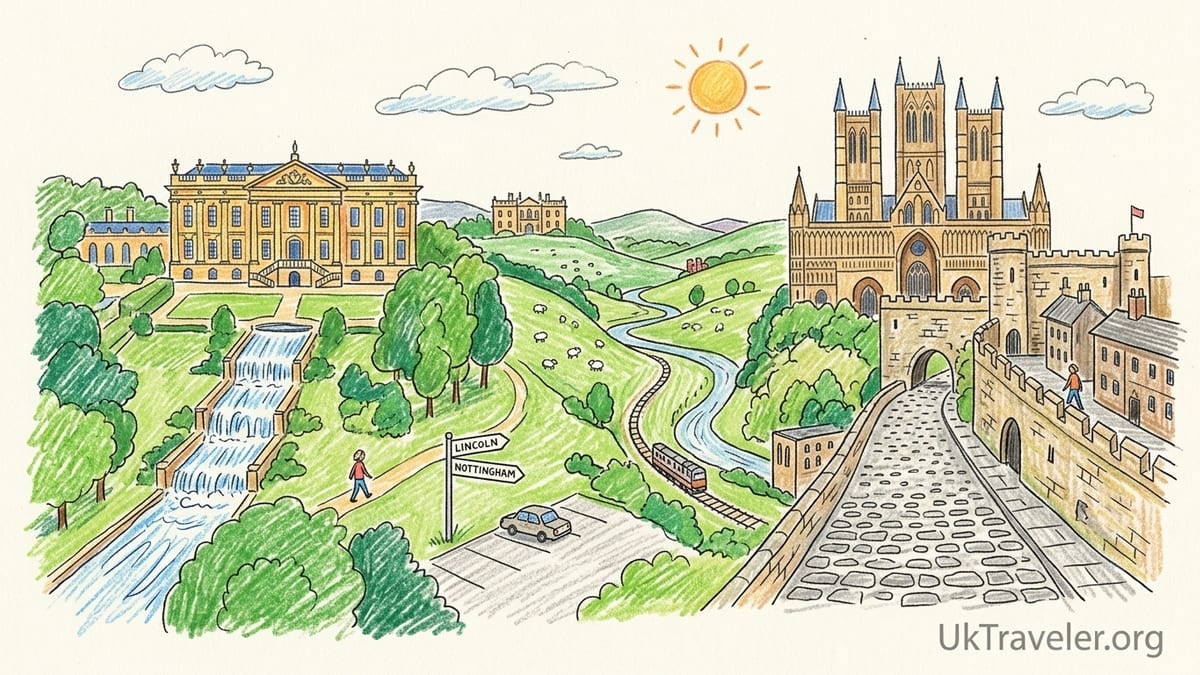
Chatsworth: When A £35 Ticket Feels Justified
Chatsworth House is the obvious heavyweight in the East Midlands, and for good reason. For the 2026 season, a standard adult house and garden ticket is listed at about £35, with off peak prices around £28, and guided tours starting from roughly £55 according to current booking information. That felt eye watering when I first typed my card details into the online system, but pre booking did give me a timed entry slot and free parking included with the ticket, which took some of the sting out of the cost. Arriving by car, I followed clear signage from the main road into a large estate car park, and although the walk from the far end of the parking area to the house is a solid ten minutes slightly uphill, it is on decent paths and gives an impressive first view of the facade across the lawns.
On the day I visited in mid season, entry into the house worked reasonably smoothly. Staff at the entrance scanned my pre booked QR code, checked my time slot and directed me through security in under ten minutes. Inside, the route is mostly one way and manages the crowds fairly well, but there were still pinch points in the Painted Hall and State Apartments where it was hard to linger without being gently shunted along. The information boards are clear without drowning you in text, and there are room stewards who actually seem keen to answer questions rather than simply guard doorways. I chose not to pay extra for a specialist guided tour, but even without it I felt I got a coherent sense of the Devonshire family story and how the collection had evolved.
Where Chatsworth really began to justify that £35 ticket for me was outside the formal rooms. The gardens are extensive and varied, and you realistically need at least two to three hours if you want to do more than tick off the main features. From the gravity fed Cascade to the rock garden and the long view down towards the river, the landscape design feels as carefully choreographed as the interiors. Wayfinding could be better in places, but the freedom to wander and find your own quiet corners more than compensates. There are several places to grab food, from a main cafe near the house to smaller kiosks in the garden, and although prices are on the high side, the quality of coffee and cakes was better than many heritage sites I have visited.
By the time I walked back to the car, I realised that what stayed with me was not a particular room or painting, but the sense of Chatsworth as a lived in estate. The ticket price is steep, but for a full six to seven hour day including the house, gardens and a leisurely lunch, it felt like good value, especially compared with other attractions where you struggle to fill two hours. If your budget is tight, the wider parkland remains free to access on foot, with people picnicking along the river and walking dogs under the same views, and that free landscape experience is one of the best arguments for spending your money here on the full ticket rather than somewhere less distinctive.
Nottingham Castle: Storytelling, Not Turrets
Nottingham Castle can be a shock if you travel in expecting medieval ramparts and arrow slits. The hilltop was indeed a Norman fortress, but the building you now enter is mostly a restored seventeenth century ducal mansion that has been refitted as a museum and visitor attraction. After a long closure and a controversial redevelopment, the site reopened under a simpler model: a single admission that gives you repeat access for a year, with adult prices reported locally at around the low double digits and free entry for accompanying children under a set age. That means a ticket bought on a weekend city break can theoretically be used again if you pass through Nottingham later in the year.
From the city centre, the castle is a five to ten minute uphill walk from Old Market Square, or an even shorter stroll from the tram stop if you come in from the suburbs. There is no large dedicated visitor car park right at the gate, so most drivers use city car parks around the Broadmarsh and Maid Marian Way area and walk up. On my last visit, signage from the lower streets up to the gatehouse had improved, and the compact size of the site meant that once through the ticket check I never felt lost. The real physical effort comes from the steep access to the hill, so anyone with mobility issues should factor in extra time.
Inside, Nottingham Castle succeeds or fails for visitors on the strength of its interpretation. There is a cave tour add on that takes you into the man made tunnels in the rock beneath the castle, and that is arguably the most atmospheric experience on offer, with knowledgeable guides explaining why the hill is riddled with passageways. The main museum galleries focus on the city’s history, lace industry and of course Robin Hood. When I visited, the audio visual elements were working properly and there were staff on hand to chat, but the experience still felt closer to a modern city museum than a castle in the traditional sense. The small cafe in the grounds served decent coffee and light lunches, and there are panoramic views across the city that are free once you are inside.
Was it worth the admission price compared with other East Midlands options? For a single two to three hour visit, especially if you skip the caves, it risks feeling expensive alongside the free museums and historic pubs clustered just below the rock. However, if you treat the ticket as a one year pass and drop in again for events or simply to enjoy the views, the value equation improves. What lingered for me afterwards were not the rooms, which are relatively plain, but the way the castle contextualised Nottingham as a rebellious city, from medieval sieges to the Reform Act riots and modern protests.
Lincoln’s Cathedral and Castle: Twin Anchors of a Skyline
Lincoln is the East Midlands city where heritage still shapes the skyline. The uphill quarter is anchored by the cathedral at one end of a cobbled street and the castle at the other, and crucially you experience them as a pair long before you consider the ticket options. Walking up Steep Hill from the lower town is an attraction in itself, but those with cars can follow signs to dedicated pay and display parking near the castle walls, from where it is only a few minutes on foot to both sites. On my last trip I allowed a full day for the uphill area alone and was glad I did.
Both the cathedral and the castle have their own admissions, and there is usually some form of joint ticket that combines them at a modest saving and often includes the medieval wall walk and access to exhibits such as the Magna Carta. Exact prices change with the season, and should be checked at the time of booking, but for guidance the combined ticket fell into the sort of mid twenty pound range for adults when I visited, with options for family tickets and concessions. Tickets are sold on site, but arriving by mid morning helped me avoid queues and secure timed slots for any guided elements I wanted.
Inside the cathedral, I found the atmosphere more memorable than any single architectural feature. Paid entry includes access to the nave, choir and chapels, and there are often volunteer guides leading short introductory tours at no extra charge. The interpretation balances faith and history without feeling like a museum, and I came away with a visceral sense of how this building has dominated the region’s identity for centuries. The climb up one of the towers is an additional challenge that may be offered on certain days for an extra fee, and if you can manage the stairs, the view across the city and out to the flatlands beyond is one of the great vistas of the Midlands.
Lincoln Castle offers a different type of experience. Once through the ticket gate, the compact inner bailey holds the Victorian prison, exhibitions and the starting point for the wall walk. The audio guide, included with my ticket when I visited, was one of the better ones I have used in the region, with clear segments that matched numbered points around the circuit. The wall walk itself involves uneven steps and narrow sections, but walking the complete loop took under an hour even with frequent photo stops and gave me repeated framed views of the cathedral rising over the red roofs. What stayed with me afterwards was the sense of how defensible the hilltop must have felt to the Normans, and how the later prison buildings told their own uncomfortable story about punishment and reform.
Derwent Valley Mills: When Free Landscapes Rival Paid Sites
The Derwent Valley Mills World Heritage Site stitches together a series of mill complexes and communities along the River Derwent between Matlock Bath and Derby. On paper it can look like a string of relatively small attractions, but in reality it offers some of the richest industrial heritage in the region. The challenge as a visitor is that there is no single gate or combined ticket you can buy to “do” the Derwent Valley. Instead, you build your own itinerary from places like Cromford Mills, Belper and the High Peak Junction, mixing free landscapes with paid tours and exhibitions.
Cromford Mills, at the northern end of the site, became the focus of one of my most rewarding days out that barely dented my wallet. The mill yard itself is free to enter, with parking in a pay and display car park just across the road and additional accessible spaces near the main gate. I pre purchased a ticket for a guided tour through the Arkwright Society, which cost less than many stately home entries and gave me about an hour and a half of focused storytelling inside and around the original water powered cotton spinning buildings. Surfaces underfoot are a mix of cobbles and rolled stone, so sturdy shoes help, but the walking distances within the yard are short and there are benches scattered around.
After the tour, I lingered over lunch in one of the cafes housed in former mill structures, then picked up a simple map for a self guided walk along the canal towards High Peak Junction. The path is mostly flat, and even an amble with photography stops took under an hour each way. Along this section of towpath the industrial archaeology and the natural environment sit side by side: the stone of the wharf buildings, the cast iron relics of the railway incline and the reflection of trees in the canal. It felt like the purest illustration in the East Midlands of how the early factory system changed both landscape and society.
What I appreciated most about the Derwent Valley was the flexibility. If you have the budget and interest, you can stack up paid experiences, from immersive audio visual shows inside the mills to specialist guided walks that delve into workers’ lives. If you are travelling on a strict budget, you can still access the core of the World Heritage story through free access to yards, riverside paths and viewpoints. Compared with a single high priced admission ticket elsewhere, the valley rewarded repeat visits and slow exploration, and I left feeling that my time rather than my wallet had been the main investment.
Country Houses Beyond Chatsworth: When Just Looking Is Enough
Chatsworth inevitably overshadows other East Midlands country houses, but there are numerous estates where I have consciously chosen to enjoy the grounds or exterior rather than pay for full interior access. Partly this is a financial decision in a region where several houses now charge adult admission in the twenty to thirty pound bracket, but it is also about what stays with you once you have left the car park. After several years of visiting interiors filled with similar suites of tapestries, portraits and recreated bedrooms, I found my memory blurring.
One recurring pattern was that the most satisfying visits often involved low or no cost access to parkland combined with a single paid highlight. At some estates, parking is charged at a modest flat day rate while walking in the wider park is free, with only the formal gardens and house behind a paywall. On one winter visit to a well known Nottinghamshire estate, I arrived late in the afternoon, paid only for parking and spent two hours following waymarked paths through deer filled parkland and past lakes that reflected the main house. The cafe near the stable block stayed open into the early evening, and a hot drink at the end felt like money better spent than a rushed house tour.
In contrast, there were a couple of East Midlands houses where I did commit to full interior tickets and came away questioning the value. In one case, a high adult price bought me entry to a house where significant parts of the interior were closed for conservation that day, something that had not been clearly flagged at the point of sale. The rooms that were open were undeniably grand, but the interpretation felt thin, relying on generic plaques and minimal staff interaction. The gardens were pleasant but compact, and I struggled to spend more than three hours on site including lunch. I left with handsome photographs and very little sense of the people who had actually lived there.
These experiences sharpened my sense that in the East Midlands, paying to go inside a country house is only really worthwhile when either the interiors are outstandingly distinctive, or the ticket unlocks substantial gardens and parkland as part of a full day out. Otherwise, the free or cheap access to landscapes, village streets and industrial remnants often delivers a more memorable encounter with the region’s heritage.
Practicalities That Shape Value: Booking, Parking and Walking
Looking back across these visits, the things that most influenced whether a site felt “worth it” were often mundane practicalities rather than architecture. Online booking is increasingly standard, with sites like Chatsworth actively encouraging advance purchase by including free parking with online tickets and sometimes adjusting prices between off peak and peak days. That can work in your favour if you are happy to commit to a date, but it also reduces spontaneity and can be stressful in a region where weather transforms the experience of gardens and hilltop castles.
Parking is another factor that quietly alters the value calculation. At Chatsworth, included or discounted parking made a long stay feel more justifiable, while in city sites like Nottingham and Lincoln the cost of multi hour parking in public car parks quickly stacks up on top of admission. In the Derwent Valley, pay and display parking at multiple small car parks was manageable individually, but over the course of a day of hopping between mills and viewpoints it added up to a non trivial additional spend. Where possible, I started early and aimed for a single base car park combined with walking, particularly around Cromford and High Peak Junction where paths link several points of interest.
Walking distances and gradients are especially important in the East Midlands, where many of the best views sit on hills or require navigating cobbles and uneven steps. Lincoln’s uphill quarter, Nottingham Castle’s rock and the stepped wall walk at Lincoln Castle all demand reasonably sturdy mobility. Audio guides and tours can add value, but only if you know where and when to pick them up. I found the Lincoln Castle audio guide worth the time, while simple printed maps at Cromford and informal chats with volunteers often conveyed more personality than carefully scripted devices elsewhere.
Cafes, crowds and the realistic length of a visit also shaped my impressions. Large flagship sites attract heavy weekend crowds, and in peak summer at Chatsworth I needed to allow time not just for the house and garden, but also for queuing at toilets and food outlets. On quieter weekdays at Cromford or in Lincoln’s cathedral, lingering in relative peace added an intangible richness that turned a couple of hours into something closer to contemplation. In practical terms, I would now allocate at least six hours for Chatsworth, four to five for a combined Lincoln cathedral and castle day, three for Nottingham Castle including its surroundings, and a full flexible day for Cromford and the Derwent Valley if you intend to walk.
The Takeaway
After several years of testing the region’s tickets and car parks with my own bank account, a few conclusions have settled in. First, if you are going to invest in a single high price heritage day out in the East Midlands, Chatsworth is the one that most convincingly turns a £35 house and garden ticket into a full spectrum experience of art, landscape and living estate life. The cost is significant, especially when multiplied for families, but the combination of interiors, gardens, farmyard and walks means you are unlikely to run out of things to do.
Second, some of the most rewarding encounters with East Midlands heritage are essentially free, or cost little more than parking. Walking the towpaths and inclines of the Derwent Valley, exploring Cromford’s mill yard, or simply wandering Lincoln’s uphill streets between the cathedral and castle walls can deliver as strong a sense of place as any formal tour. In these settings, paying selectively for a well delivered guided experience or audio tour often beats splashing out on multiple full admissions in a single day.
Finally, value here is as much about memory as money. The places that have stayed sharpest in my mind are those where the visit connected me to a wider story about the region, whether that was industrial innovation in the Derwent Valley, spiritual and political power in Lincoln, or aristocratic reinvention at Chatsworth. Before you book, it is worth asking not only what a ticket includes, but what kind of story you hope to carry away when you walk back across the car park.
FAQ
Q1. How far in advance should I book Chatsworth tickets?
For peak weekends and school holidays I found it best to book at least one to two weeks ahead to secure preferred times and included parking, while midweek off peak dates often had availability closer to the day.
Q2. Is Nottingham Castle worth visiting if I am mainly interested in medieval castles?
If your heart is set on intact medieval walls and towers you may be disappointed, as the current building is largely a later mansion, but the site still offers strong city history interpretation and impressive views over Nottingham.
Q3. Can I see Lincoln Cathedral and Lincoln Castle properly in a single day?
Yes, but it makes for a full day; I usually allow around two to three hours for the cathedral including a short guided tour, and another two to three hours for the castle, wall walk and exhibitions.
Q4. Do I need a car to explore the Derwent Valley Mills World Heritage Site?
You can reach Cromford and other points by train or bus, but having a car makes it easier to string several mills and viewpoints together in one day; once parked, many sites are linked by good walking paths.
Q5. Are there good options for travellers on a tight budget?
Yes, several of the best experiences such as walking the Chatsworth parkland, exploring Cromford’s mill yard or wandering Lincoln’s uphill streets are free aside from parking or optional tours.
Q6. How accessible are these heritage sites for visitors with limited mobility?
Access varies: Chatsworth’s house route and main garden paths are reasonably accessible, while Nottingham Castle’s hill and Lincoln’s wall walk involve steep climbs and uneven steps, so it is worth checking each site’s access information before visiting.
Q7. What is the best time of year to visit Chatsworth and similar estates?
Late spring and early autumn have given me the best balance of manageable crowds, pleasant walking weather and gardens in good condition, though Christmas openings offer a different atmosphere at higher prices.
Q8. How long should I plan for a visit to Cromford Mills and the Derwent Valley?
A half day allows for a guided mill tour and a short canal walk, but a full day makes it easier to include High Peak Junction or additional mills without feeling rushed.
Q9. Are guided tours and audio guides worth paying extra for?
In my experience they add the most value at sites where the story is complex or the physical remains are fragmentary, such as cave tours at Nottingham Castle or in depth mill tours at Cromford, while at places like Chatsworth’s gardens wandering independently can be just as rewarding.
Q10. If I can only choose one major paid heritage site in the East Midlands, which should it be?
For a single marquee experience I would choose Chatsworth for its combination of house, gardens and estate setting, provided you are comfortable with the higher ticket price and can devote most of a day to the visit.