


Travelling the East Midlands without a car sounds either liberating or limiting, depending on who you ask. To find out which description fits best, I spent several days moving between Nottingham, Derby, Matlock Bath, Lincoln and the fringes of the Peak District using nothing but trains, local buses, trams and my own feet. I booked real tickets, hauled a wheelie suitcase along real pavements, dealt with delays and missed connections, and compared each leg with what would have changed if I had been driving. The result is not a romantic claim that you “do not need a car,” but a grounded look at where public transport in the East Midlands shines and where it still leaves frustrating gaps.
How I Planned the Trip and Bought Tickets
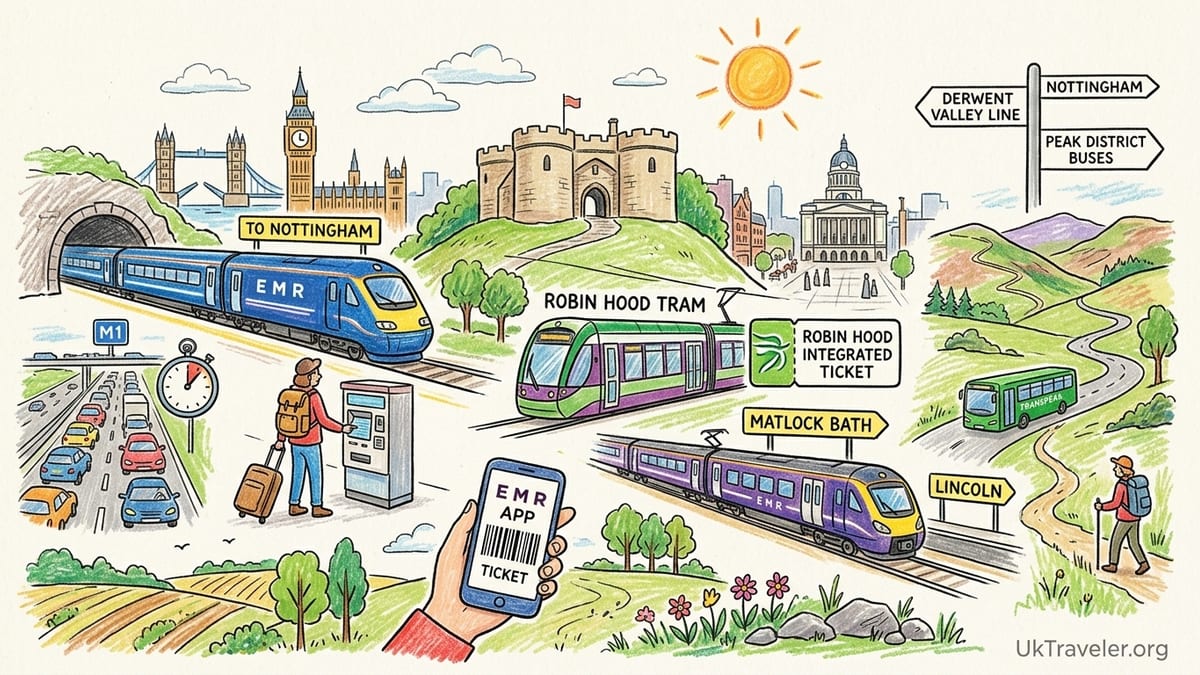
I based myself mainly in Nottingham, which sits in the middle of East Midlands Railway’s regional network. From here, direct trains run to Derby, Matlock, Worksop, Lincoln and Skegness, while frequent intercity services link Nottingham, Derby and Leicester with London. I built an itinerary that tested both: a London to Nottingham intercity leg, day trips on the Matlock–Derby–Nottingham and Nottingham–Lincoln lines, and a foray toward the Peak District using the Derwent Valley Line and local buses.
For long-distance journeys, I used the East Midlands Railway website and app to buy Advance singles. EMR’s current timetables show regular intercity trains from London St Pancras to Nottingham, Derby and Leicester, and regional timetables list routes such as Matlock–Derby–Nottingham, Nottingham–Worksop, Nottingham–Lincoln, Leicester–Nottingham and Nottingham–Skegness. These can be downloaded as PDFs or checked live through the app, which helped when a late-running train threatened a connection.
Within Nottingham, I relied on the Robin Hood integrated ticketing system, which allows travel on most buses, trams and some local trains within the Greater Nottingham area. Nottingham City Transport publishes current fares and, as of mid 2026, the all-day Robin Hood ticket was priced around the mid single digits in pounds, giving unlimited travel on participating buses, trams and local trains in the city boundary. That meant one card tap covered my tram from Nottingham station to the Old Market Square and buses out to suburbs, without worrying about individual operator tickets.
For local buses beyond Nottingham and Derby, I used a mix of operator apps and paying cash onboard. Some rural services, particularly into the Peak District, still feel old fashioned in that sense. In a couple of villages I visited, contactless payment worked but drivers were unfamiliar with passing-day tickets from other operators, so I kept paper receipts and allowed extra time in case there was a discussion at the door.
London to Nottingham and Leicester: When Trains Beat Driving
The best advert for going car free in the East Midlands is the intercity line from London St Pancras. My journey on a mid-morning EMR service to Nottingham took just under two hours, with reserved seating and enough luggage space for a medium suitcase and backpack. Even with a coffee stop at St Pancras, door-to-door time from central London to Nottingham city centre was around three hours.
Driving the same route would have meant navigating the M1, possible congestion near Luton and Leicester, and then parking in Nottingham. Central Nottingham has multi-storey car parks, but day rates add up quickly. By contrast, after stepping off the train I was inside the station concourse and, ten minutes later, rolling my suitcase over the pedestrian bridge to my hotel off Carrington Street. Without a car, there was no detour to a park-and-ride, no search for a space and no parking fees ticking away while I explored.
I tested the intercity network further with a day trip to Leicester. EMR runs frequent trains between Nottingham, East Midlands Parkway, Loughborough and Leicester. My off-peak day return bought on the app took less than a minute to purchase, and I collected it as a barcode on my phone. The train itself was busy but punctual, with a scheduled journey time of around half an hour. Arriving at Leicester station, I walked fifteen minutes along London Road into the city centre and the historic Lanes, which felt very manageable even with a light bag.
By car, that Nottingham to Leicester hop might be slightly quicker in pure travel time, particularly outside peak hours, but it would involve ring roads and one-way systems at both ends. For city to city hops focused on central attractions, the train is often faster in real terms, more predictable and considerably less stressful.
Matlock Bath and the Derwent Valley: Scenic, Simple and Occasionally Slow
One of the most satisfying legs of my trip was along the Derwent Valley Line. I travelled from Nottingham to Matlock Bath via Derby on an East Midlands Railway regional service. Nottingham to Derby took about 22 minutes, with a short wait on the same platform before a single-coach train continued through Belper, Ambergate and Cromford to Matlock Bath and Matlock. Off-peak, EMR runs an hourly service on this line, which matches current published timetables linking Matlock with Derby, Nottingham, Newark Castle and Lincoln.
I boarded with a small suitcase and daypack. Luggage racks on these regional trains are limited, but there was enough space near the doors and overhead for typical city-break baggage. The section north of Derby is especially scenic, with the train hugging the River Derwent and stone-built mills punctuating the view. Even on a cloudy afternoon the valley felt like a moving postcard, and it was easy to see why the Derwent Valley Mills World Heritage Site markets the railway itself as part of the experience.
At Matlock Bath, the practicality of rail travel really showed. The station sits across the road from the base station of the Heights of Abraham cable car. Local visitor information and the attraction’s own guidance confirm that the walk is just a few minutes across a footbridge over the river and into the cable car entrance. That meant my total transfer, with a small queue at the ticket office and a pause to check my map, was under ten minutes from train door to cable car cabin. With a car, I would have needed to navigate Matlock Bath’s one main road, find parking in a very busy valley and then walk from there. In peak season the parking alone can erode any time saved by driving.
The trade-off was frequency and crowding. With trains only once per hour, I built my day around fixed departure times. On the way back, a minor delay out of Matlock Bath meant a tight connection at Derby, which I made with only a couple of minutes to spare. Had that connection failed, I would have faced nearly an hour’s wait. A driver doing the same day trip from Nottingham could simply leave Matlock Bath later, or stop spontaneously in Crich or Belper, and still arrive back at their hotel at a similar time.
Peak District Access: Where Buses Struggle to Replace a Car
The real stress test for a car free trip in the East Midlands comes when you move beyond the river valleys and larger market towns into the heart of the Peak District. The National Park authority highlights the Derwent Valley Line to Matlock as a key rail gateway from Derby, with connecting buses to White Peak villages and to Bakewell. From Derby or Buxton there is the Transpeak bus that runs through the central Peak, calling at Rowsley, Haddon Hall, Bakewell, Ashford in the Water and on toward Buxton.
To experience this, I rode the train from Nottingham to Derby and then walked the five minutes from Derby railway station into the bus station, following signs under the inner ring road. With luggage, that walk felt longer than it looks on the map, due to road crossings and crowds leaving the platforms. Once inside the bus station, I found the stand for the Transpeak and a local service toward Bakewell. On my travel day, the timetable offered roughly hourly departures in the middle of the day, dropping to less frequent services early morning and evening.
Reaching somewhere like Bakewell without a car was perfectly possible. The bus dropped me a short, flat walk from the riverside and town centre, and my small suitcase coped fine on the luggage rack near the driver. The journey was slow, though. Traffic through Matlock Bath and along the A6 meant the bus took significantly longer than a car would, especially when stopping at every village. For hikers aiming for specific trailheads like Monsal Head or more isolated dales, there is usually another bus or a taxi ride on top of that.
This is where the trade-offs become sharp. Staying entirely on the main rail line between Matlock and Derby or in a town like Bakewell, you can do a rewarding weekend of short walks and historic houses without a car. Once you want to reach remoter ridges, start early on a long circular walk or bail out late from a valley far from a main road, public transport becomes constraining. Buses finish early in some areas, Sunday services can be thin, and a missed connection due to weather or navigation can mean expensive taxis or an unplanned extra night.
Comparing a Real Journey: Nottingham to Matlock Bath by Train vs Car
To understand more clearly what a car changes, I compared my actual Nottingham to Matlock Bath rail journey with a realistic estimate of driving the same trip. By train, I left Nottingham mid-morning on an EMR regional service, changed at Derby and arrived at Matlock Bath about an hour after leaving Nottingham. Ticket purchase was quick through the EMR app, and the change at Derby was about ten minutes, involving only a short walk down the platform. My time between stepping off the train at Matlock Bath and joining the cable car queue was under ten minutes.
Had I driven, the route would likely have been via the A52 from Nottingham to Derby, then north on the A6 through Ambergate and Cromford. In free-flowing traffic, that could be done in around an hour or slightly less. That seems competitive with the rail time. However, real-world driving in the Derwent valley is rarely without slow sections. Through Belper, Cromford and Matlock Bath itself, pedestrian crossings and parked cars often slow traffic. I would also have needed to park on or near the main road and pay for a few hours at a machine, then walk to the cable car base.
The other difference is mental load. On the train, I read and watched the scenery, only needing to keep an eye on the time at Derby. With a car, my attention would have been focused on junctions and tight village streets. On the way back, I did feel the constraint of the hourly timetable, cutting short a riverside walk to make sure I did not miss the return train. If I had been driving, I could have left whenever I liked, at the cost of perhaps 20 or 30 minutes of extra travel time in slow traffic and the need to stay alert for parking enforcement.
In the end, for a simple day trip where the attraction sits more or less next to the station, the train was clearly the more relaxing choice. The car wins if you want to string together several small stops along the valley in a single day or stay on into the early evening without worrying about the last train back.
City Transport: Nottingham, Derby and Lincoln Without a Car
For city-based travellers, the East Midlands can work surprisingly well without a car, especially if you are comfortable using different transport modes. In Nottingham, I walked straight from the railway station onto the tram platforms above, where frequent services cross the city from Toton Lane and Beeston through to Hucknall and Clifton. Using a Robin Hood card or contactless payment, trams and buses slot into the same capped-fare system, and tram stops put you within walking distance of key sights like Nottingham Castle, the Lace Market and the Old Market Square.
Derby is less tram oriented but still manageable. From Derby station, the city centre is about a fifteen-minute walk via the footbridge and underpass, or there are regular buses from the station forecourt into the central shopping district and toward Derby Cathedral. For my purposes, walking worked fine, even with a backpack, but with heavier luggage or during bad weather a quick bus hop makes sense. Taxis were lined up outside the station, but I did not need them for central Derby.
Lincoln was one of the more mixed experiences. EMR operates a Nottingham to Lincoln service, with off-peak trains typically once an hour. Upon arrival at Lincoln station, the lower town around the Brayford waterfront is an easy flat walk. However, the main attraction, Lincoln Cathedral and the historic Bailgate, sit at the top of a steep hill. A local bus service runs from near the station up to the cathedral quarter, but frequencies vary through the day. I chose to walk, which took about twenty-five minutes at a steady pace and involved some serious uphill effort. With a car, I could have parked closer to the top, but I would then have had to navigate narrow streets and limited parking availability.
Across these cities, the main advantage of going car free was flexibility in where I stayed. I chose hotels within a short walk of each main station, which reduced the need for taxis or long bus rides with luggage. Once checked in, exploring on foot and using local buses or trams felt natural, and I never had to worry about leaving a car in an overnight car park or negotiating one-way systems.
Solving the Last-Mile Problem: Bases, Taxis and Tours
Where East Midlands public transport does less well is exactly where most national rail networks struggle: the last few miles beyond a mainline station. To handle this, I tested three different strategies. The first was to choose city bases with strong transit, such as Nottingham and Derby, and then rely on day trips out and back. The second was to stay overnight in a smaller town directly served by rail, like Matlock, effectively moving my base closer to walking trails. The third was to use taxis and guided tours selectively when buses did not line up with my plans.
Using Nottingham as a base worked very well for purely urban sightseeing and for rail-accessible towns like Lincoln, Newark, Leicester and Matlock Bath. Trains left often enough that I could adjust my departure by an hour without losing the day. Even when there were delays, the EMR app made it easy to see alternative trains. The Robin Hood card covered cross-city travel at the Nottingham end, so I could step out in the evening without thinking about individual fares.
Staying in Matlock on another night shifted the balance. From Matlock station, the town centre is a few minutes on foot, and local buses fan out toward Bakewell, Chatsworth (via changing at Baslow or Bakewell) and smaller villages. That reduced total travel time into the White Peak, but it increased my reliance on bus schedules that did not always match ideal walking times. One afternoon, an appealing ridge walk would have got me back to the road about twenty minutes after the last convenient bus. With a car, that would have been a non-issue. Without one, I had to either shorten the walk or factor in the cost of a taxi.
I did use taxis twice in rural areas. Both times, the drivers were used to hikers calling from bus stops or pubs when connections fell through. Prices were substantial compared with bus fares, but not unreasonable split between two people. Crucially, they removed the anxiety of being stranded when a bus was cancelled at short notice or when I decided to walk a little farther than planned. Guided day tours from cities like Nottingham and Derby also exist for marquee sights like Chatsworth House, but they tend to run to fixed itineraries and can be infrequent outside summer, so I did not rely on them.
The Takeaway
After a week of real-world journeys, ticket purchases and platform dashes, my verdict on the East Midlands without a car is nuanced. The region is neither a public-transport paradise nor a lost cause. Instead, it rewards travellers who plan around the strengths of the rail network, accept the constraints of rural buses and think carefully about where they base themselves.
If your trip is mainly about cities, the answer is straightforward. Travellers focusing on Nottingham, Derby, Leicester and Lincoln, with perhaps a day trip to Matlock Bath or Newark, can comfortably skip the car. East Midlands Railway’s intercity and regional routes link the main centres efficiently, city centres are walkable, and integrated systems like Nottingham’s Robin Hood card make buses and trams simple to use. You will save money and stress on parking and motorways, and you will not miss the car.
If your priority is the Peak District, especially longer walks in more remote dales or on moorland plateaus, it is harder. You can certainly reach the National Park by a combination of train to Matlock, Derby, Buxton, Sheffield or Chesterfield and then connecting buses such as the Transpeak or routes into Bakewell and surrounding villages. For a carefully chosen base in a town on a main bus corridor, you can enjoy excellent walking without driving at all. But the moment you want flexibility to start at one village and finish at another, catch a sunset on a distant ridge or change your plans around the weather, the hourly or two-hourly buses feel restrictive. In that scenario, a car or a willingness to use taxis becomes close to essential.
For travellers who want to mix cities with countryside, a hybrid approach works best. Start in Nottingham or Derby without a car and make full use of the rail network for city days and easy excursions to places like Matlock Bath and Lincoln. Then, for the Peak District segment, either shift to a village on a strong bus route and accept some timetable discipline, or rent a car just for those days. Alternatively, budget for a couple of key taxi journeys to bridge awkward gaps between railheads and trailheads, which can preserve most of the low-stress benefits of rail travel while giving you the freedom to reach the landscapes that drew you to the East Midlands in the first place.
FAQ
Q1. Is it realistic to visit the East Midlands without hiring a car at all?
It is realistic if your focus is on cities like Nottingham, Derby, Leicester and Lincoln, plus easy rail-linked excursions such as Matlock Bath. Once you start targeting more remote parts of the Peak District, lack of a car becomes more limiting and you will need to plan around train and bus times or use taxis.
Q2. Which East Midlands city makes the best base for car free travel?
Nottingham works particularly well because it sits at the centre of East Midlands Railway’s regional network and has integrated bus and tram ticketing via the Robin Hood system. Derby also makes a good base for the Derwent Valley Line and onward buses into the Peak District.
Q3. How did you buy train tickets for regional journeys?
I mainly used the East Midlands Railway app and website to buy Advance or off-peak tickets, storing them as barcodes on my phone. For simple short hops, it was also easy to buy at station ticket machines, though rural stations sometimes had only basic facilities.
Q4. How far is it to walk from Matlock Bath station to the Heights of Abraham cable car?
The cable car base station is just a few minutes’ walk from Matlock Bath railway station, across a footbridge over the River Derwent. It is close enough that I comfortably did it with a small suitcase and daypack.
Q5. Can I reach the Peak District’s best walks using only public transport?
You can reach many good walks using combinations of trains to Matlock, Derby, Sheffield, Buxton or Chesterfield and buses such as the Transpeak or routes into Bakewell and surrounding villages. However, the very best flexibility for long ridge or moorland walks is harder without a car, because buses can be infrequent and finish early.
Q6. How reliable were the trains and buses during your trip?
Intercity and main regional trains between London, Nottingham, Derby and Leicester were generally punctual. On the Derwent Valley Line and some rural buses, I experienced minor delays and one tight connection, so I learned to allow extra time and avoid last possible departures when making onward links.
Q7. Did you find luggage to be a problem on local transport?
With a medium wheelie suitcase and backpack, I managed comfortably on EMR regional trains and most buses. The main challenge was limited luggage racks on single-coach trains and needing to keep cases close by on busy buses, so travelling light makes car free travel easier.
Q8. Are there guided tours that help with last-mile access?
Yes, there are guided day tours from cities like Nottingham and Derby to major attractions such as Chatsworth House or specific areas of the Peak District. They can be a good solution if you prefer not to navigate rural buses, but they tend to run to fixed schedules and may not operate daily outside peak season.
Q9. When would you still recommend renting a car in the East Midlands?
If your main goal is to hike longer routes in different parts of the Peak District on consecutive days, visit small villages away from main bus corridors or stay out late on the hills, then a rental car for that part of the trip makes sense. It significantly reduces time lost to connections and allows more spontaneous route changes.
Q10. What is the single most important planning tip for car free travel in the region?
The most important tip is to build your itinerary around the fixed hourly or two-hourly patterns of regional trains like the Matlock–Derby–Nottingham and Nottingham–Lincoln lines, then layer buses and walks on top of those. Once you accept the rail backbone as your timetable anchor, it becomes much easier to create a trip that feels smooth rather than constrained.