


South West England is one of Britain’s classic road trip regions: Georgian spa cities, fossil-strewn cliffs, moorland tors and surf beaches all strung along a peninsula that narrows into the Atlantic. It is tempting to cram Bath, the Jurassic Coast, Dartmoor, Devon and Cornwall into a long weekend. In reality, the distances, slow country roads and sheer number of worthwhile stops deserve a more measured 7 to 10 days, with scope to bolt on or trim back sections of Dorset, Somerset, Devon and Cornwall depending on how much time you have.
How Long You Need and Where To Start
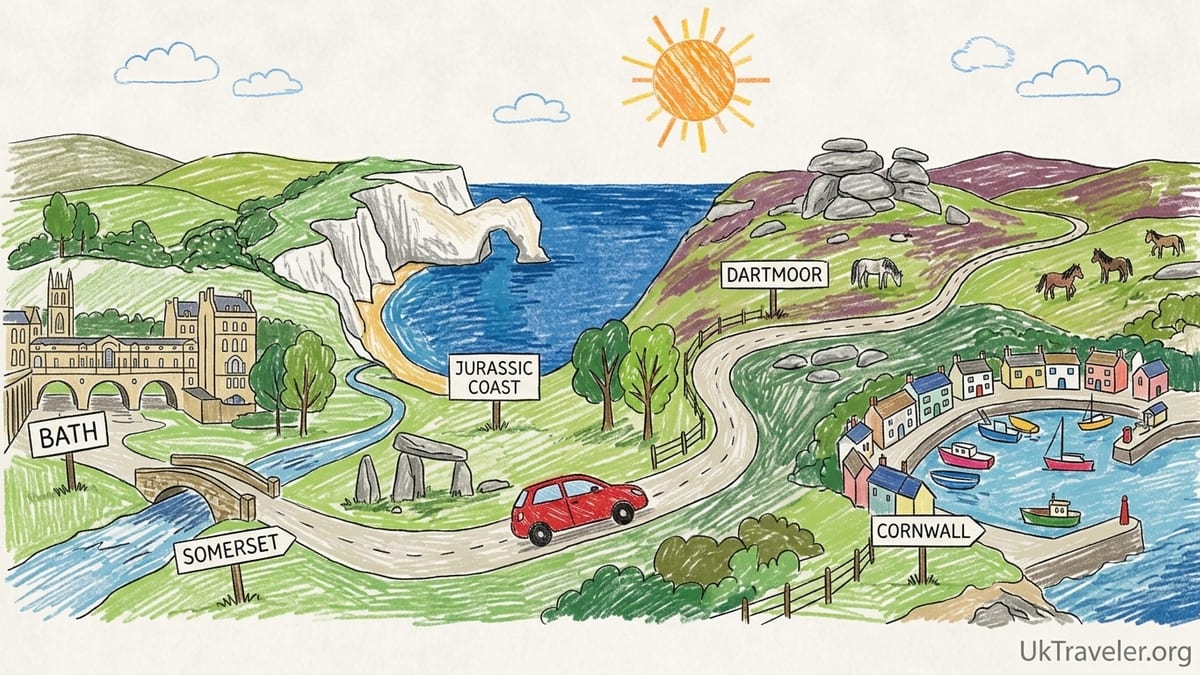
Think of this as a modular road trip, not a single rigid itinerary. A logical flow runs Bath and Somerset to the Jurassic Coast, on to Dartmoor and South Devon, and finally down to Cornwall, with North Devon and Exmoor as a bonus if you have extra days. The core circuit works well in 7 days if you keep Cornwall focused and limit detours. With 10 days, you can add a night or two on the Dorset coast and an extra day in West Cornwall or North Devon.
Most international visitors begin in London or Bristol. From central London, the drive to Bath via the M4 motorway is around 115 miles and typically takes a little over 2 hours in light traffic, though Friday evenings can easily add an hour. Bristol Airport and Bristol city are closer still, about 45 to 60 minutes from Bath, which makes Bristol a practical pick-up point if you can arrange flights and a car rental there. Many global brands have branches in both cities, so you can pick up with Avis or Enterprise in London and return to Bristol if you do not want to drive back.
One-way rentals in the UK carry a surcharge that can range from a modest fee with some nationwide operators to a more noticeable add-on with budget companies. For example, it is common to see one-way charges from London to the South West in the region of tens rather than hundreds of pounds, but the cheapest rates usually require booking well in advance and selecting the same rental brand across locations. Always compare the cost of a round trip to London with a one-way drop in Bristol or Exeter before committing.
However you structure the hire, resist the urge to cover huge daily distances. Even short drives between coastal villages can take longer than expected because of narrow lanes, tractors and summer congestion. As a planning rule, cap your daily driving at three to four hours in total and make peace with the idea that you will not see every cove and castle in a single trip.
Bath and Somerset: A Gentle Start
Beginning in Bath gives you a soft landing before tackling country roads. The city’s honey-coloured terraces, Roman Baths and Royal Crescent are all compact enough to explore on foot. Parking in the historic centre is limited and expensive, so if you are collecting the car in Bath, aim to do so on the day you leave rather than paying to store it while you walk. Central multi-storey car parks typically charge by the hour with daily caps that can rival the cost of a mid-range hotel breakfast.
Many travellers choose a Bath guesthouse that includes on-site or permitted street parking and then leave the car untouched while exploring on foot. A Georgian townhouse B&B on the hills to the north, for instance, might provide a permit for residents’ bays, saving you the hassle of negotiating tight city-centre car parks. When you are ready to depart, it is straightforward to follow the A36 or A4 out of town and join the main roads towards Somerset and Dorset.
If you have 7 days in total, spend 1 or 2 nights in Bath, using the full day between to see the Roman Baths, Bath Abbey, the Assembly Rooms and a slice of the canal or riverside path. With 10 days, you can add a Somerset detour before reaching the coast. Classic stops include Wells, with its Gothic cathedral and moated Bishop’s Palace, or Glastonbury with its Tor and alternative culture. Both towns have small long-stay car parks close to the centre, where you pay on exit or via mobile app, and both are manageable even for drivers unused to tight medieval streets, as long as you take your time.
From Bath or Wells, aim south and slightly east to reach the Dorset coast in 2 to 3 hours, depending on your exact route. The key is to avoid zig-zagging between too many inland attractions on the same day you plan to reach the sea. Choose one inland stop for coffee or lunch, then head for your chosen Jurassic Coast base before late afternoon when coastal parking begins to fill, especially in July and August.
Jurassic Coast: Dorset’s Cliffs and Coves
The Jurassic Coast, a World Heritage coastline between East Devon and Dorset, rewards slow travel. The classic driving stretch for a first visit runs between Swanage and Lyme Regis via Corfe Castle, Lulworth Cove, Durdle Door, Weymouth, Abbotsbury and the long shingle of Chesil Beach. Trying to see all of these in one day results in more time in car parks than on clifftops; plan at least 2 nights in Dorset if your schedule allows, treating this as its own module in a longer South West journey.
A practical base for a short Dorset section might be West Lulworth, Wareham or Dorchester. From London or Bath you could arrive by early afternoon, park at your accommodation, and then either walk or take a short drive to Lulworth Cove. The pay-and-display car park above the cove serves both the village and the walking trail to Durdle Door, with clearly marked paths to viewpoints along the coast. Expect to pay a few pounds for several hours’ parking and factor in a steep walk back up to the car at the end of the day.
Driving along this coast means getting used to B-roads that narrow without warning and occasional single-track sections, particularly if you follow minor lanes between Abbotsbury, coastal viewpoints and inland villages like Cerne Abbas. In peak season, it is common for visitors to queue behind a delivery van or caravan negotiating a tight bend. The best strategy is to set off early for headline sites like Durdle Door, arriving before 9 or 10 in the morning, and to use the middle of the day for slower inland visits or beach time rather than for long cross-country drives.
For those with only a week in total, a single full day on the Dorset coast is usually enough. You might spend the morning walking between Durdle Door and Lulworth Cove, then drive west via Weymouth and Abbotsbury, pausing at the viewpoint over Chesil Beach before continuing to Lyme Regis for an early evening stroll along the harbour. With more time, you could add an extra night in Lyme Regis itself, allowing for fossil hunting at Charmouth and a clifftop walk towards Golden Cap before turning inland to Exeter and Dartmoor.
Dartmoor and South Devon: Moorland and Harbour Towns
From the Jurassic Coast it is an easy half-day drive to Dartmoor National Park, but the character of the roads changes as soon as you leave the main A35 or A30. The moor is laced with narrow lanes, some with grass down the middle and high hedgebanks that limit visibility. The national park authority notes that many roads are single-track with passing places and that some have width and length restrictions which make them unsuitable for large vehicles. In practice, that means driving slowly, anticipating oncoming traffic and being prepared to reverse to the nearest passing bay when required.
A sensible approach is to base yourself in a gateway town like Bovey Tracey, Ashburton or Tavistock, where there are standard-sized supermarkets, car parks and fuel stations, then use the car for day trips onto the moor. Popular spots such as Haytor, Postbridge and Princetown have dedicated car parks, usually pay-and-display, often with public toilets and information boards about walks. Livestock can wander onto unfenced roads, so it is normal to round a bend and find ponies or sheep standing in the carriageway, another reason not to rush or plan tight schedules.
South Devon’s coast pairs naturally with Dartmoor in a 2 to 3 day module. From the moor, you can follow twisting lanes down to estuary towns such as Dartmouth, Salcombe and Kingsbridge, or base yourself in a larger centre like Totnes. Parking in these harbour towns is often in designated long-stay car parks slightly away from the quay, with daily maximums that reflect their popularity. In Salcombe, for example, many visitors leave their car in a park-and-ride style facility on the edge of town in high season and take a shuttle or a 15 to 20 minute walk down to the waterfront.
If you are travelling in July or August, consider leaving the car parked for the day and using local ferries or small passenger boats to explore between villages. A common pattern is to drive in early, secure a long-stay space before midday, and then move around on foot and water until evening. For a 7 day core route, 2 nights split between Dartmoor and South Devon is realistic. With 10 days, spending 3 nights allows a full day on the moor, a day exploring a single estuary in depth, and a travel day into Cornwall that avoids rushing.
Cornwall: Beaches, Bottlenecks and Where To Base Yourself
Cornwall is where many South West road trips start to overreach. The county is long and thin, with busy arterial routes like the A30 and A39 feeding a web of narrow lanes to coves and villages. In summer, official tourism bodies warn that main routes can become heavily congested, especially at weekends and during school holidays. It is not unusual for a drive from Exeter to St Ives that takes 2 hours off-peak to stretch to 3 or more hours on a Saturday in August, even before you start searching for a parking spot.
The key is to limit the number of bases. For a 7 day itinerary, choose one Cornwall base and accept that you will only sample one section of coast. For example, you could stay in Falmouth or nearby Penryn for a mix of beaches, boat trips and gardens, or pick St Ives for art galleries and sandy bays. With 10 days, you might add a second base, such as Padstow or Wadebridge on the north coast paired with Penzance or St Ives in the far west. This cuts down on repeated long drives and gives you a better chance of beating local traffic into town in the mornings.
Parking is one of the main practical challenges in Cornwall. Coastal resorts from Newquay to St Ives operate a mix of council-run car parks, private lots and seasonal park-and-ride schemes. In Newquay, for example, a dedicated park-and-ride service runs into the centre during summer to relieve congestion and pressure on central parking. In St Ives, many visitors leave their vehicle at an out-of-town car park or railway station and ride the train along the coast into town rather than attempting to navigate narrow streets and full seafront bays. Booking private spaces via parking apps can work well in busier towns, though prices rise steeply in July and August.
Expect most sea-view car parks to charge by the hour, with daily maximums that can add up if you come and go repeatedly. Many locals now plan their entire day around a single paid parking session, choosing one beach or town and staying put from late morning to late afternoon. As a visitor, you can copy this pattern: arrive by 9 or 10 in the morning, park once, and treat the car as a base for spare clothes and picnic supplies while you explore on foot. If the forecast is mixed, remember that Cornwall’s weather can switch from sunshine to Atlantic squalls in minutes, so keep waterproofs in the boot even on seemingly perfect days.
North Devon and Exmoor: Optional Extension
If your schedule stretches towards 10 days or more, you can add an extra module in North Devon and Exmoor either on your way into Cornwall or on the return leg towards Bristol. This region offers dramatic cliffs, long surf beaches and quieter roads than the most popular Cornish hotspots, though driving can still be slow thanks to winding A-roads and the occasional caravan holding up a line of traffic. Towns such as Ilfracombe, Woolacombe, Croyde and Lynmouth make good overnight stops, with small clusters of guesthouses and easy access to coastal walks.
One popular pattern is to leave Bath or Dartmoor, spend two nights around Barnstaple or Woolacombe, then drop south-west into Cornwall via Bude and the Atlantic Highway. Alternatively, you can end your Cornwall stay in the far north around Bude, then follow the coast up through Hartland and Westward Ho! before cutting back inland towards the M5 and Bristol. Either way, build in time for detours off the main road; a simple side trip to the Valley of Rocks near Lynton, for example, involves narrow lanes and steep gradients that demand unhurried driving.
Parking and access in these North Devon villages are similar to Cornwall, but with slightly less competition outside school holidays. Beach car parks at Saunton Sands or Woolacombe often run on a flat daily rate in summer, which can be good value if you plan to surf or swim all day. In small Exmoor villages on the high moor, such as Exford or Simonsbath, you will find informal roadside parking and small free car parks, but always leave passing places clear and avoid verges marked to deter parking. Treat this extension as a reward for travellers who can afford a slower pace, rather than an essential building block of the core 7 day route.
When you are ready to return towards Bristol or London, the M5 motorway provides the fastest northbound exit from both North Devon and North Cornwall. Many regular drivers recommend travelling early in the morning or later in the evening to avoid the heaviest holiday traffic on summer Saturdays. Even with careful timing, be prepared for delays caused by accidents or roadworks and keep drinks and snacks in the car in case a 2 hour journey turns into an unexpected 4 hour crawl.
Driving, Parking and Summer Congestion: What To Expect
Driving in South West England is less about high-speed cruising and more about patience and awareness. Motorways like the M4 and M5 bring you swiftly out of London or Birmingham, but once you reach Somerset, Devon and Cornwall, most of your time will be on A-roads and B-roads limited by hedges, villages and topography. In July and August, queues for Cornwall can begin as far back as the Somerset border, turning the southbound M5 into a slow-moving column of cars, campervans and roof boxes. Setting off very early, after dinner or on a weekday rather than peak Saturday helps, but cannot completely eliminate the risk of delays.
Narrow lanes are a fact of life away from main roads. Expect stretches where two cars cannot pass comfortably and you must use designated passing places or farm gateways to let oncoming vehicles through. Local etiquette rewards those who anticipate early, reverse confidently and give a friendly wave of thanks. If you are unused to this kind of driving, consider renting a smaller car rather than a large SUV, even if the larger model is only marginally more expensive on paper. A compact hatchback makes squeezing past tractors, delivery vans and oncoming campervans noticeably less stressful.
Parking requires both budget and planning. Many coastal towns have introduced higher charges and longer enforced periods to manage demand. It is common to pay several pounds for two to three hours in a central car park, with full-day rates rising in the most popular destinations such as St Ives, Padstow and Lyme Regis. Some visitors now use supermarket car parks at the edge of town for shorter visits, combining a grocery shop with the allowed free parking period, before moving on to paid car parks for longer stays. Always read signs carefully; overstaying or misreading tariff boards can trigger automatic number plate recognition fines weeks after your trip.
Consider mixing driving with local public transport where it is practical. In Cornwall and Devon, seasonal bus services and branch line trains link many coastal resorts and villages, letting you park once and explore further without taking the car into every town. For example, you might park at St Erth and ride the scenic branch train into St Ives, or leave the car at a larger town like Truro and use buses to reach nearby villages during peak season. This hybrid approach reduces driving stress and aligns well with the modular structure of a longer touring holiday.
The Takeaway
A successful South West England road trip is less about ticking off names and more about accepting the region’s natural pace. Bath, the Jurassic Coast, Dartmoor, Devon and Cornwall do not fit comfortably into four or five frantic days, but they do reward a 7 to 10 day journey that rolls steadily from spa city to cliffs, moors and Atlantic headlands. Structuring your trip as a series of optional modules means you can trim Dorset or North Devon if time is short, or linger longer in Cornwall if you are blessed with sunshine and empty diaries.
Begin with an arrival that suits your flight pattern and driving confidence, whether that means picking up a car in London and easing west via Bath, or flying into Bristol to skip the capital’s traffic altogether. Choose small, well-located bases with reliable parking rather than trying to sleep in a different town every night. Keep daily driving distances modest, plan around summer congestion, and remember that a day spent exploring one cove thoroughly often brings more lasting memories than racing along the coast road to “see it all.”
With realistic expectations, a carefully chosen hire car and a willingness to adapt, the South West’s combination of Georgian crescents, fossil bays, granite tors and Cornish harbours becomes an inviting, repeatable journey rather than a once-only dash. Leave some corners of the map unexplored this time and you will have the perfect excuse to return, perhaps in a quieter shoulder season when the lanes are emptier and the pace is slower still.
FAQ
Q1. How many days do I realistically need for this South West England road trip?
For the core route linking Bath, the Jurassic Coast, Dartmoor, South Devon and one Cornwall base, plan on 7 to 10 days. Seven days lets you sample each area with one or two nights, while 10 days allows a more relaxed pace and the option to add extra time in Dorset or North Devon.
Q2. Should I start my trip in London or Bristol?
London works well if you want to sightsee there first or have international flights into Heathrow or Gatwick, but picking up a car in central London can be stressful. Bristol is closer to Bath and the West Country, has its own airport and major car rental depots, and can save you an hour or more of driving on day one.
Q3. What kind of car is best for the narrow lanes in Devon and Cornwall?
A small to medium hatchback is usually the best option. Large SUVs and oversized campervans can feel intimidating on single-track lanes with high hedges, while compact cars are easier to manoeuvre in passing places, village streets and tight car parks.
Q4. How bad is summer traffic in Cornwall and Devon?
In July and August, especially on school holiday Saturdays, main routes such as the M5, A30 and A38 can be heavily congested, with journey times sometimes doubling. Leaving early in the morning or later in the evening, avoiding Saturday changeover days where possible and limiting how often you move bases all help reduce time spent in traffic.
Q5. Do I need to book parking in advance?
You cannot usually reserve public council car parks, but in popular towns like St Ives, Falmouth or Padstow it can be worth pre-booking a private driveway or space via parking apps for peace of mind. For day-to-day touring, arriving before mid-morning at beaches and harbour towns gives you a much better chance of finding a space without advance arrangements.
Q6. Is it feasible to do this trip without a car?
You can reach Bath, Exeter, Plymouth and many larger towns by train or coach and then use local buses and tours to explore, but stitching together the full Bath to Cornwall route without a car is slower and more complex. If you prefer not to drive, consider focusing on two or three hubs, such as Bath, Exeter and St Ives, and exploring nearby highlights by public transport and organised excursions.
Q7. When is the best time of year to drive this route?
Late spring (May and early June) and early autumn (September) often offer the best balance of milder weather, longer daylight and lighter traffic. High summer brings the warmest sea temperatures and most lively resort towns but also the heaviest congestion and highest accommodation and parking prices.
Q8. How should I split my nights between regions?
For a 7 day itinerary, a common split is 2 nights in Bath and Somerset, 2 nights between the Jurassic Coast and Dartmoor, and 3 nights in one Cornwall base. With 10 days, you might add an extra night on the Dorset coast and another split between South Devon or North Devon depending on your interests.
Q9. Are one-way car rentals between London and the South West practical?
Yes, many major rental companies allow one-way hires between London, Bristol, Exeter and other regional cities, usually for an additional fee. Compare the one-way charge against the fuel and time cost of returning to London; if you are flying home from Bristol or Exeter, a one-way rental can be convenient and cost-effective.
Q10. What driving skills or habits are most important for this road trip?
Comfort with manual transmission, patience in slow traffic, and confidence reversing in narrow lanes are all useful. Drive defensively, use passing places considerately, avoid blocking junctions or farm gates when parking, and allow generous time buffers so delays from weather, farm vehicles or busy seaside towns do not derail your day.