


On the north Norfolk coast, Blakeney Point has become one of England’s most memorable wildlife experiences, with boatloads of visitors gliding out from Morston Quay to see common and grey seals hauled out on the sands. Unlike classic tourist cruises that run on a fixed timetable, these trips live and die by the tide. If you are planning a September 2026 visit and want to compare operators, prices, wildlife seasons and rules for dogs and children, it pays to understand how Morston’s seal boats really work.
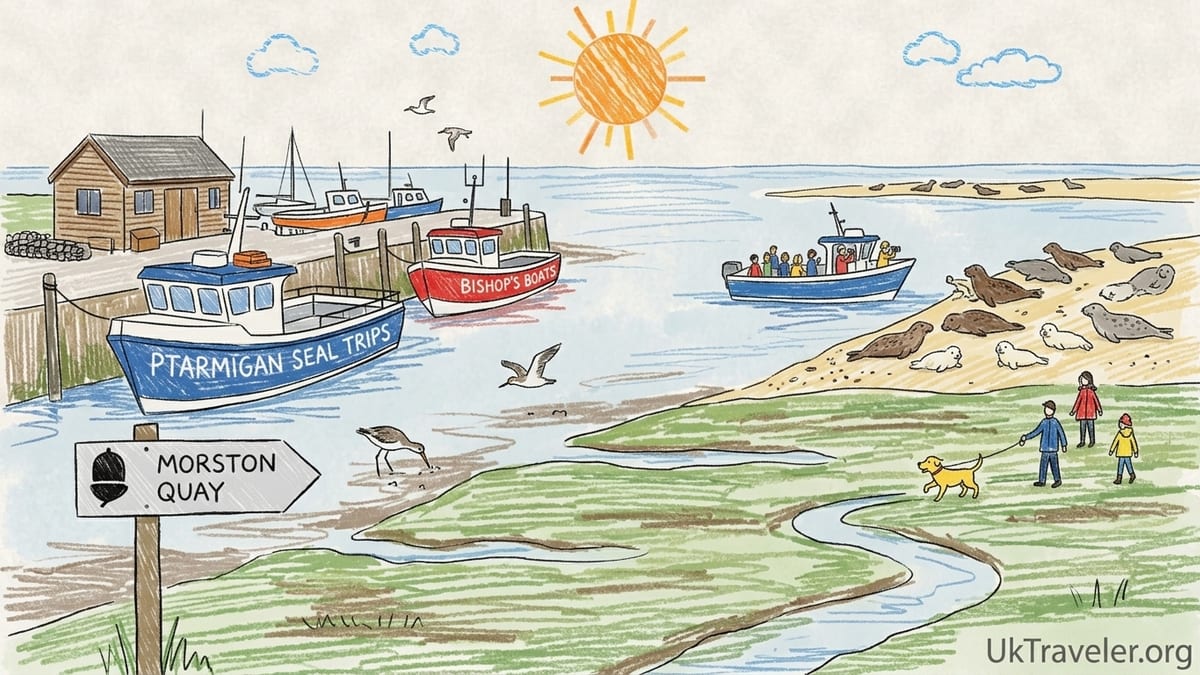
How Morston Quay Seal Trips Work
Morston Quay, a small National Trust harbour a mile west of Blakeney village, is the main departure point for Blakeney Point seal trips. Deep water and relatively sheltered channels make it possible for purpose-built passenger boats to snake out through the saltmarsh and along the shingle spit while staying inside the harbour, rather than heading into open sea. This sheltered route is one of the reasons the trips are popular with families and anyone nervous of rough water.
Every operator at Morston works around the same fundamental constraint: the tide. The channels out to Blakeney Point are too shallow at low water for loaded passenger boats, so sailings are set by the day’s high tides, not by a rigid 10:00, 12:00, 14:00 tourist schedule. In practice, this means you might find departures at 9:45 and 11:00 one day, then 11:30 and 12:45 the next, depending on when the tide is high enough for safe passage.
For visitors this can feel unusual if you are used to fixed daily timetables. You cannot simply assume that “there will be a 2 pm boat every afternoon.” On some neap-tide days there may be only a single late-morning sailing; on stronger spring tides there may be two or even three departures clustered around high water. Checking exact times for your chosen date, and not just your chosen day of the week, is essential.
The National Trust car park at Morston Quay usually opens well before the first trip of the day and has toilets and a small visitor centre. Operators typically ask you to arrive at the quay 20 to 30 minutes before departure to collect tickets and board. Queues build quickly in school holidays and on sunny weekends, even outside peak seal pupping season, so advance planning is strongly advised.
Key Operators: Ptarmigan, Bishop’s Boats and Temple’s
Several long-established local families run boats out to Blakeney Point, but for most visitors comparing options the key names are Ptarmigan, Bishop’s Boats and Temple’s. All depart from or around Morston Quay, follow a similar route through the harbour, and spend time idling just offshore from the sands where seals haul out to rest. The differences lie mainly in booking systems, boat style, and how often they land passengers on the Point itself outside sensitive wildlife seasons.
Ptarmigan operates a broad, purpose-built ferry boat branded “Blakeney Point Seal Trips,” sailing daily from Morston Quay in season. Trip times vary with the tide and the company itself emphasises that departures are set around high water rather than fixed clock times. In September 2026, Ptarmigan is advertising headline fares of approximately £20 per adult and £10 per child, with multiple departures on many dates when tide conditions allow. Booking is strongly advised, especially for weekend and late-afternoon sailings.
Bishop’s Boats, a historic local operator that once sailed from Blakeney harbour but now also uses Morston Quay for its seal tours, lists the same headline pricing for standard September 2026 trips: around £20 per adult and £10 per child. They are clear that advance booking is required for most dates, and they have moved much of their reservations process online so visitors can secure a specific tide slot before travelling. Their typical seal trip is about one hour, staying within the sheltered harbour waters.
Temple’s Seal Trips, another long-running Morston family operator, similarly publishes adult fares around £20 and children’s tickets around £10, with under-twos often travelling free. Their current timetable examples show two departures clustered around the day’s high water, for instance 10:45 and 12:00 one day, then 11:30 and 12:45 another, underlining that there is no fixed daily pattern. As with other operators, they request that passengers collect tickets on the quay about 30 minutes before sailing and recommend ringing ahead to reserve seats during busy periods.
Tide-Dependent Schedules: Planning Around the Water
For travellers unfamiliar with tidal harbours, the most important thing to grasp is that there is no such thing as a standard “morning” or “afternoon” trip at Morston. The timetable slides forward by roughly 40 to 50 minutes each day following the moon, and operators will only run boats when there is enough water in the creek to get loaded vessels out to the Point and back before the channels dry. This can mean early starts or mid-afternoon gaps that catch unprepared visitors out.
A typical week in late summer might see Temple’s publishing sailings at 9:45 and 11:00 on Monday, 10:15 and 11:30 on Tuesday, and 10:45 and 12:00 on Wednesday, with times shifting later as the high tide moves through the day. Ptarmigan and Bishop’s Boats pattern their own departures around the same tidal windows, sometimes offset by 15 to 30 minutes depending on how many trips they can safely fit either side of high water.
Because of this, you cannot simply decide on the day that you will “catch the 11 am boat” unless you have already checked the specific tide timetable for that date. In July and August, popular late-morning and lunchtime departures can sell out days in advance. In shoulder months like September 2026, availability may be better midweek, but operators will still cancel or adjust trips at short notice if strong winds, visibility or swell in the harbour channels make conditions unsafe or likely to disturb wildlife.
The most reliable strategy is to look up the tide-dependent seal trip times for your exact travel dates before you book accommodation, then plan your day around the confirmed slot. Many visitors choose to schedule their seal cruise for the first full day of a Norfolk stay, leaving space later in the week in case weather or tides force a reschedule. This is particularly sensible if you are travelling with young children or elderly relatives and have less flexibility once on the ground.
Trip Duration, Landing Options and Onboard Experience
Most standard Morston seal trips last about one hour from quay to quay. Boats weave slowly through the saltmarsh creeks, often passing wading birds and flocks of terns, before emerging into the wider harbour alongside the tip of Blakeney Point where the seals tend to haul out. Skippers then idle the boat quietly just offshore, turning so that passengers on both sides can see and photograph the animals basking on the sand.
Bishop’s Boats typically describe their seal-watching cruise as a one-hour tour that stays within sheltered waters and does not venture into the open North Sea. Ptarmigan and Temple’s quote a similar overall duration for their standard seal-only sailings. In calm conditions, it can feel much longer due to the sheer volume of wildlife, from curious seals lifting their heads to investigate the boat, to sandwich and common terns diving nearby, and occasional passing waders from the neighbouring Cley Marshes reserve.
Some operators offer combined trips that include a landing on Blakeney Point itself outside sensitive seasons, usually adding 30 to 60 minutes to the overall outing. These allow visitors time to walk a short stretch of the shingle and sand, view the colony from a respectful distance with National Trust guidance, and explore historic features such as the old lifeboat house. Landings are heavily restricted or suspended during key wildlife periods, such as the main grey seal pupping season and peak ground-nesting bird months, so not every September date will necessarily include a landing option.
Onboard facilities are simple: most boats are open or partially covered with bench seating, basic lifejackets and minimal shelter. There are no toilets aboard, so it is essential to make use of facilities at Morston Quay before departure. Conditions can be breezy even on warm days; a light waterproof, hat and camera strap are worth packing. Crew are used to guiding first-time wildlife watchers and will usually offer commentary on seal behaviour, conservation measures and the history of Blakeney Point as a National Nature Reserve.
Prices, Booking Requirements and Practical Costs
For September 2026, headline pricing among the main Morston operators is strikingly consistent. Ptarmigan is currently advertising fares of around £20 per adult and £10 per child for standard seal trips, with multiple tide-dependent departures on many dates. Bishop’s Boats publish the same headline prices for comparable one-hour cruises, while Temple’s Seal Trips list adults at £20, under-14s at £10, and under-twos travelling free, in line with the general market.
Beyond the ticket price, visitors should budget for parking at the National Trust car park at Morston Quay if they are not members. Non-members typically pay a daily charge, while members can scan their card for free parking. There may also be small online booking fees if you reserve through an operator’s digital system, as is currently the case with Bishop’s Boats, who encourage advance purchase for popular tide slots up to the end of the main season.
Booking requirements vary slightly between companies but are tightening over time as demand grows. Bishop’s Boats now strongly recommend, and in practice expect, advance booking for most trips, particularly during school holidays and on weekends from late spring through autumn. Ptarmigan similarly notes that booking is strongly advised during holiday periods and busy weekends. Temple’s traditionally relied heavily on phone reservations and on-the-day sales at Morston, but even they now urge visitors to ring ahead because boats often fill before walk-up customers arrive.
A practical example: a family of four visiting in mid-September 2026 might pay £60 in total for two adults and two children on a standard seal trip, plus parking. If they choose to book Bishop’s Boats online, a small transaction fee may apply. If the weather forecast is unsettled, it would be wise to choose an earlier-in-the-trip-slot in their holiday week so that, if strong winds force a cancellation, the family can rebook for a later tide without missing out entirely.
Dogs, Children and Accessibility Considerations
Children are welcome on all of the main Morston seal trips, and the short one-hour duration, sheltered waters and abundant wildlife make this one of Norfolk’s most popular family outings. Operators typically classify children’s fares up to a specified age, often under 14 for reduced pricing. Under-twos frequently travel free when seated on a parent’s lap, though space for prams on board is limited and pushchairs are usually left on the quay or folded for boarding.
Lifejackets and buoyancy aids are carried for all passengers, and crew are accustomed to helping families with boarding over the quay steps and across gangplanks. However, access is not flat: Bishop’s Boats, for example, advise that you must walk three to four minutes over uneven ground and beach shingle to reach their boarding point from the car park. This can be challenging for those with limited mobility, so it is wise to discuss access needs directly with your chosen operator before booking.
Dogs are a more complex issue, mainly because of strict wildlife protections on Blakeney Point itself. The National Trust currently prohibits dogs anywhere on the Point during ground-nesting bird season from 1 April to 31 August, and again during seal pupping season from 1 November to mid-January. From 2026, the seal-season dog restriction explicitly covers the whole Point, reflecting the growing size and spread of the grey seal colony along the spit. Some operators therefore restrict or completely disallow dogs on landings during these times and may also limit dogs on the boats themselves to reduce stress on wildlife.
If travelling with a dog, you must check the latest policy directly with your chosen operator and be prepared for seasonal bans. Even where dogs are allowed on board during less sensitive months, they must typically be kept on a short lead and under control at all times, and you may be asked to sit in specific parts of the boat. For many visitors, especially between April and mid-January, it is simpler to plan a dog-free trip while someone else in the party enjoys one of the many alternative walking options along the coast, such as the shingle east of the car park at Cley or beaches at Salthouse.
Wildlife Seasons: When to Go for Seals and Birds
Blakeney Point is a wildlife reserve first and a tourist attraction second, and its restrictions and seasons reflect that. Two main seal species use the area. Common seals tend to pup in early summer, typically between June and August, when they can be seen hauled out on the sandbanks with small pups during the warmest months. Grey seals, now forming one of England’s largest colonies at Blakeney, pup later in the year, from roughly late October through mid-January, transforming the distant dunes into a nursery of white-coated pups in midwinter.
For many travellers, September sits between these two peaks. By early September, the bulk of common seal pupping will usually have finished, but good numbers of both common and grey seals still haul out on the sands to rest, and boat trips continue to offer reliable sightings. The main grey seal pupping season has not yet begun in earnest, so there are typically fewer access restrictions than in November and December, though dog bans and limits on landings can evolve as conservation needs change. If your focus is simply to see seals in comfort, a calm September day often offers quieter boats, milder weather and excellent viewing.
Birdlife adds another layer of seasonality. Blakeney Point is a key breeding ground for terns and other ground-nesting birds in spring and summer, which is why access is tightly controlled from 1 April to 31 August. By September, many of these birds have finished breeding and begun to disperse, but waders and migrating species pass through the wider North Norfolk Coast Site of Special Scientific Interest in large numbers, feeding on the mudflats and saline lagoons. Seal trips often double as informal birdwatching cruises, with crew pointing out avocet, oystercatcher, and mixed gull flocks, as well as occasional rarities reported at nearby reserves like Cley Marshes.
Winter, especially November and December, is the most dramatic time to witness grey seal pupping at Blakeney, but it is also the harshest for visitors, with cold winds, short daylight and the strictest access controls. Only certain authorised operators can approach the colony at appropriate distances, and foot access along the Point is heavily restricted. For many travellers, a first visit in late summer or early autumn, such as September 2026, offers a more comfortable introduction to the area, with plenty of seals and birdlife but fewer extremes of weather and regulation.
The Takeaway
Choosing a Blakeney Point seal trip from Morston Quay in September 2026 is less about hunting for a bargain and more about selecting the departure time, operator and wildlife season that best match your plans. Prices are broadly aligned, with Ptarmigan, Bishop’s Boats and Temple’s all advertising adults at around £20 and children at around £10 for standard one-hour, tide-dependent cruises. What will shape your experience is how early you book, how well you understand the moving-tide schedule, and whether you plan around family needs, mobility, dogs and wildlife sensitivity.
If you want the most relaxed experience, secure an advance booking on an earlier tide near the start of your Norfolk stay, arrive 20 to 30 minutes before departure, and allow time to explore the National Trust facilities at Morston Quay. Travel light, dress for wind rather than just sunshine, and prepare for simple open-deck boats rather than luxury yachts. By doing so, you maximise your chances of an unhurried hour in the company of seals and seabirds, with the low shingle of Blakeney Point and the shifting sands of the North Sea as your backdrop.
Above all, remember that this is a living nature reserve. Schedules may shift with the moon, extra restrictions can be introduced in response to bird flu or unexpected wildlife behaviour, and the rules on dogs and landings evolve as the colony grows. A little flexibility and respect for the National Trust guidance go a long way toward ensuring both a memorable trip for you and a safe, undisturbed home for the thousands of animals that make Blakeney Point unique.
FAQ
Q1. How long do Blakeney Point seal trips from Morston Quay usually last?
Most standard seal trips from Morston Quay last around one hour from departure to return, staying in sheltered harbour waters rather than going out into the open sea.
Q2. Why do the boat timetables change every day?
The channels between Morston Quay and Blakeney Point are tidal. Boats can only sail safely when there is enough water, so departure times move with the day’s high tides rather than following a fixed daily timetable.
Q3. How much will a seal trip cost in September 2026?
In September 2026, headline prices for the main operators are around £20 per adult and £10 per child for standard one-hour trips, with similar fares across Ptarmigan, Bishop’s Boats and Temple’s.
Q4. Do I need to book my seal trip in advance?
Yes, advance booking is strongly recommended. Bishop’s Boats in particular requires advance reservations, and Ptarmigan and Temple’s also advise booking ahead, especially for weekends and school holidays.
Q5. Can I take my dog on a Blakeney Point seal trip?
Dog policies vary by operator and are affected by National Trust restrictions on Blakeney Point, where dogs are banned during ground-nesting bird season and seal pupping season. Always check the latest rules with your chosen boat company before travelling.
Q6. Is September a good month to see seals at Blakeney Point?
Yes. September sits between the main common seal summer pupping season and the dramatic grey seal winter pupping, but there are usually plenty of seals hauled out on the sands and the weather is often milder than in midwinter.
Q7. Are the trips suitable for young children and older adults?
Trips are generally suitable for all ages, with calm, sheltered waters and a short duration. However, boarding involves walking over uneven ground and steps, so anyone with limited mobility should check access details with the operator in advance.
Q8. Will I get seasick on a Morston seal trip?
Because the boats operate in sheltered harbour channels rather than the open sea, most visitors find motion gentle. Those prone to seasickness may still wish to take usual precautions, but conditions are typically calmer than on offshore cruises.
Q9. Can I land on Blakeney Point during my trip?
Some operators offer landings outside the most sensitive wildlife seasons, but land access is heavily restricted during ground-nesting bird months and grey seal pupping. Whether you can land will depend on your chosen date and operator.
Q10. What should I wear and bring on board?
Even in warm weather, it can feel cool and breezy on the water. Wear layered clothing, bring a light waterproof and sun protection, and pack a camera or binoculars, remembering there are no toilets on board so you should use facilities at Morston Quay before departure.