


I have been visiting Birmingham, Coventry and the wider West Midlands regularly for more than a decade, in every season and in all kinds of weather. I have queued for curry in the Balti Triangle with an umbrella dripping onto my shoes, watched the Frankfurt Christmas Market lights come on in sleet, and drifted past red-brick warehouses on the Birmingham canals on one of the first warm evenings of spring. What follows is not a perfect-weather fantasy, but a practical, experience-based guide to when to come, what to expect and how the West Midlands’ crowded events calendar, indoor attractions and changeable skies really shape a trip.
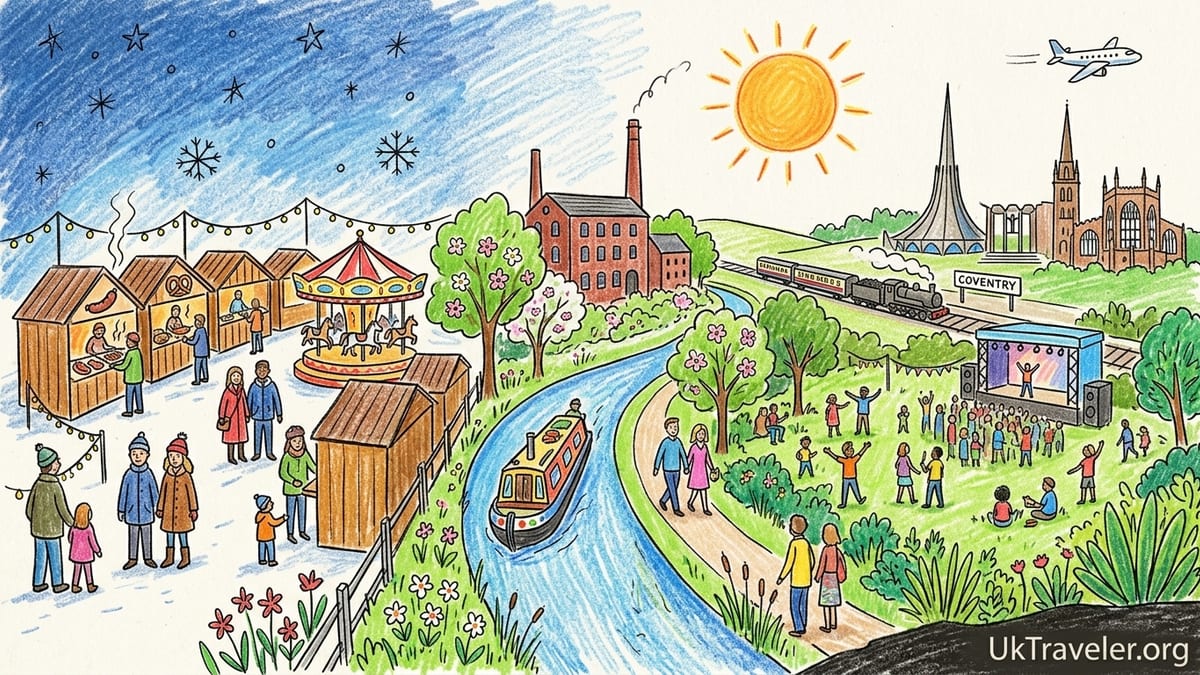
How the West Midlands Really Feels Through the Year
The first thing you notice if you return to the West Midlands often is how much the experience depends on what you want to do, more than what the forecast says. Birmingham in November can feel festive and thrilling, even in steady drizzle, because the city centre is dense with indoor options and winter events. Coventry in July, when the Godiva Festival takes over War Memorial Park, feels like a completely different destination, with traffic diversions, busy trains and late-evening light stretching out the day.
Weather here is rarely extreme by global standards, but it is fickle. Across my trips I have seen heavy showers in August, a surprise warm snap in February that lured half of Birmingham onto the canal towpaths, and a chilly, grey spell in late May that made me grateful for museums. The average visitor’s picture of “English weather” holds true: you are more likely to get cool, damp conditions than deep snow or searing heat, but you can experience several seasons in a single day, especially in shoulder months like April and October.
Because of that unpredictability, the best strategy is to think in terms of what each season does for event schedules, hotel prices, indoor versus outdoor sightseeing and city-centre crowding. Birmingham’s official events calendar is now busy throughout the year, with major listings clustered on Visit Birmingham’s “What’s On” guide, which I always check before booking. Coventry has followed a similar arc, with Visit Coventry and Coventry City Council publishing dense event listings that keep growing, from international exhibitions to local festivals and weekly cultural programmes. The result is that there is no true off-season any more, only different flavours of busy.
My own pattern now is to use winter and very early spring for culture-heavy, mostly indoor trips, and target late spring and early autumn for canal walks and open-air museums like the Black Country Living Museum. High summer, with its big festivals and school holidays, can be wonderful if you like atmosphere and long days, but you need to be more deliberate about where you stay and how you move around.
Winter: Christmas Markets, Low Light and Surprisingly Great City Breaks
Some of my most atmospheric West Midlands trips have been in November and December. Birmingham’s Frankfurt Christmas Market, centred on Victoria Square and spilling down New Street, is now a giant annual draw, regularly welcoming millions of visitors across its run from early November into late December. On an evening visit in mid-November, I remember arriving at New Street Station in a cold, needling rain and assuming the weather would spoil everything. Instead, the combination of warm lights, steam from food stalls and the press of people actually suited the conditions. The rain made the cobbles and paving stones shine, reflecting the carousel lights, and once I had a hot chocolate and a bratwurst in hand the chill faded into the background.
Winter trips do, however, change how you move around. I tend to book hotels within a ten-minute walk of Birmingham New Street or Snow Hill to avoid long wet walks or late-night tram rides. Prices fluctuate, but in the shoulder weeks before and after the peak Christmas market dates I have often found central chain hotels for noticeably less than in high summer, especially midweek, while Fridays and Saturdays when the market is in full swing can be markedly more expensive. If you are price sensitive, watching the market dates announced by Birmingham City Council and then shifting your stay just outside the busiest weekends can save money while still letting you enjoy the atmosphere.
Short daylight hours, usually between roughly 8:00 and 16:00 in December, mean I front-load any outdoor sightseeing. I like to walk a loop from Victoria Square to Centenary Square and along the canals behind Brindleyplace in the late morning, then pivot indoors as soon as fingers and toes start to protest. Thinktank Birmingham Science Museum, the Birmingham Museum and Art Gallery (when galleries are open), Ikon Gallery and the Library of Birmingham all provide long indoor stretches. The same applies in Coventry, where I have happily spent a rainy winter’s afternoon moving between Coventry Cathedral, the Herbert Art Gallery & Museum and indoor shopping centres, barely thinking about the weather outside.
Winter rain matters much less in the West Midlands than in coastal or countryside regions because so many flagship attractions sit under cover. On one particularly wet February weekend in Birmingham, when a steady drizzle made canal walks unappealing, I still managed to fill two days entirely indoors: a morning in the Jewellery Quarter Museum, an afternoon at Thinktank and an evening performance at the Birmingham Hippodrome. The only real trade-off was losing the option of lazy canal-side pub gardens, which I rarely use in winter anyway.
Spring: Unpredictable Skies and Perfect Days for Canals
By March and April, the West Midlands begins to feel different, although the weather can still be erratic. I have packed gloves for Easter trips and not regretted it. On one April visit to Birmingham, a bright morning that tempted me onto the canal towpath from Gas Street Basin towards the Mailbox turned into a cold, wind-driven shower within an hour. What saved the day was the city’s density: I simply ducked into a canal-side café, waited out the worst bursts of rain and then carried on when the sky brightened, repeating that pattern for most of the afternoon. The stop-start nature of the weather mattered far less than it would have in a rural walking region with fewer places to shelter.
Spring is my favourite time for exploring Birmingham’s canal network and the streets around the Jewellery Quarter and Digbeth. When temperatures hover in the low teens Celsius and the air is clear after a shower, the reflections of red-brick factories and arched bridges in the canal are particularly vivid. Crowds on the main city-centre stretches can already be significant on sunny weekends, but they are rarely as intense as during summer holidays. Boat tours feel more relaxed, and you can often find a table outside canal-side bars in the late afternoon without booking.
For the Black Country Living Museum in Dudley, which is mostly outdoors across 29 acres of recreated streets and industrial sites, spring conditions can make or break a visit. The museum’s own information recommends allowing four to five hours on site, which matches my experience. On a blustery March day, even with plenty of indoor nooks such as the sweet shop, schoolroom and workers’ cottages, I remember retreating to the café more often than planned as the wind cut across the open spaces. Return in late April or May in brighter, calmer weather and the entire place feels transformed. You are more inclined to linger by the canal-side scenes, ride the vintage buses and watch costumed demonstrations without constantly checking how cold your hands are.
Hotel prices in spring can be a sweet spot. Outside Easter and big weekend events, I have found better value than in high summer, particularly in Coventry, where midweek stays aimed at business travel can be more affordable for leisure visitors. Events begin to multiply by late spring, though, so I always look at Visit Birmingham and Visit Coventry calendars to see if a big match at Coventry Building Society Arena, a touring exhibition opening or a large conference at the NEC might quietly be driving up both hotel rates and train demand.
Summer: Festivals, Heatwaves and Peak Crowds
Summer in the West Midlands delivers the longest days and the fullest event schedules, but also the thickest crowds and the widest swings in comfort. I have stood in Coventry’s War Memorial Park in early July during Godiva Festival, the city’s flagship three-day music event, and felt the heat build over the course of an afternoon until the grass was dry and dust rose from the paths. On another July visit, grey cloud and breezy conditions meant hoodies rather than sun hats. Planning for both is essential: sun cream, a light waterproof and plenty of water are non-negotiable if you intend to spend hours outdoors at concerts, canal festivals or open-air theatre.
In Birmingham, summer weekends are packed with food festivals, pride events, concerts and sporting fixtures. When a major gig or tournament coincides with school holidays, city-centre hotel prices can climb significantly and availability constricts, particularly around New Street Station and the main shopping district. On a hot Saturday in late August, I once arrived to find the area between the Bullring, New Street and Victoria Square almost uncomfortably crowded, with long queues for chain restaurants and popular independent spots alike. That experience convinced me to stay slightly outside the tightest centre on future peak summer trips, using trams or short train hops from places like Edgbaston or the Jewellery Quarter to avoid the densest foot traffic at night.
Heat itself is a mixed blessing. Upper 20s Celsius on a clear day can make the canals and beer gardens glorious, especially in Digbeth where repurposed industrial spaces host food markets and outdoor seating. The same temperatures can feel sticky and draining in enclosed shopping centres or tightly packed market streets. Many mid-range hotels now have air conditioning, but not all, so I pay close attention to room descriptions when booking summer stays. In Coventry, where the compact pedestrianised centre concentrates people into a relatively small area, I have learned to schedule quieter indoor stops at the Herbert or smaller galleries in the hottest mid-afternoon window and venture back out when the heat eases in the evening.
Summer is also when big-ticket sporting events and concerts make the most noticeable difference to the travel experience. A home match or major concert at Coventry Building Society Arena or a test match at Edgbaston Cricket Ground can fill trains, trams and buses, as well as driving up ride-hailing prices at very specific times of day. I now habitually check fixtures as part of my trip planning if I want a calmer weekend, or lean into the atmosphere if I am happy to be part of a crowd spilling out of the stadium into local pubs.
Autumn: Culture Seasons and Shoulder-Season Sweet Spots
Autumn has become my preferred time to combine city culture, lighter crowds and still-pleasant walking weather. September in particular feels like a second spring for the West Midlands. Universities are gearing up, theatres announce new seasons and yet the school holiday surge has ebbed. I have enjoyed some of my most satisfying canal walks in late September, when the first hints of colour appear in canal-side trees and the air is cool enough for a jacket but not yet cold.
Coventry leans strongly into autumn with its cultural venues. Recent seasons have seen major touring exhibitions and performance runs at the Belgrade Theatre, Warwick Arts Centre and the Herbert Art Gallery & Museum. I remember one October weekend where persistent showers alternated with short dry spells. It might have been frustrating in an outdoor-only destination. In Coventry it simply meant slightly wetter cobbles between indoor stops. I spent two hours with a temporary exhibition at the Herbert, lingered over coffee inside the cathedral’s visitor centre as the rain beat on the glazing, then walked under a clearing sky to an evening performance at the Belgrade. The weather barely dented the experience.
Autumn also suits repeat visits to semi-outdoor attractions like the Black Country Living Museum. The museum frequently extends its opening hours in peak seasons and runs themed evening events, from heritage weekends to Halloween experiences. On an October visit to one of these evenings, the cool air and early dusk actually enhanced the mood; streetlamps and shop windows glowed in the half light, making the reconstructed 19th and early 20th-century streets feel more immersive than they do under bright summer sun. A warm coat and occasional retreat into indoor exhibits was all I needed.
From a cost perspective, I often find better value in September and early October than in high summer or Christmas weeks, especially if there is no huge one-off event on the calendar. Weeknight hotel rates in both Birmingham and Coventry can be notably lower than Fridays and Saturdays, yet the events listings are often richest midweek, with comedy nights, gigs and gallery late openings. If you enjoy culture and are flexible with travel dates, autumn offers one of the best returns on both time and money in the West Midlands.
How Events and Weather Change Birmingham and Coventry on the Ground
Looking back across my trips, what stands out most is how major events physically reshape the cities in ways that matter to visitors. During Birmingham’s Frankfurt Christmas Market, Victoria Square becomes a dense forest of wooden stalls and food stands, and the usual open space in front of the Council House is barely visible. New Street is lined with traders, narrowing pedestrian flows. Simple journey times between New Street Station and Centenary Square lengthen as you navigate crowds, particularly on Friday and Saturday evenings. At peak times the market can attract several million visitors over its run, which shifts the whole feel of the city centre. If you thrive on energy, that buzz is invigorating. If you prefer quieter walks, you will want to route more of your day via canal towpaths or side streets rather than New Street itself.
In Coventry, the Godiva Festival is just one example of events that draw tens of thousands to War Memorial Park and ripple out through transport and accommodation. On a July weekend visit that coincided with Godiva, I noticed local buses running fuller, taxis in higher demand in the evenings and the main streets busier late at night as festival-goers returned to hotels and student accommodation. Even if you never set foot in the festival site, you feel its presence. The same is true for big fixtures at Coventry Building Society Arena, which tempt concert crowds and football fans to pack trains between Birmingham, Coventry and the station by the arena.
Weather overlays this event layer in complex ways. A dry, bright day during Godiva or a similar festival scattered across the city can stretch people into beer gardens and open spaces, diluting the sense of crowding in the very centre. A wet, cool day during the same event can push more people into covered bar areas and city-centre restaurants before and after performances, concentrating crowds. In Birmingham during a rainy festival weekend, I have twice arrived at independent restaurants in the city core without a reservation and been turned away or quoted long waits. On equivalent weekends with clear skies, outdoor seating absorbed some of the overflow and walk-ins were easier.
This interplay is why, for trips that coincide with known big events, I now treat restaurant and attraction bookings as part of my packing list. For a December weekend that overlapped with both the Christmas market and a high-profile concert at Utilita Arena Birmingham, I booked early-evening dinner tables near Brindleyplace and reserved time slots at Thinktank to avoid disappointment. The weather on that trip swung from cold sun to short, sharp showers, but the real determinant of comfort was having a plan that respected how many other people were in town.
Indoor vs Outdoor Sightseeing: When Bad Weather Matters Less
One of the West Midlands’ biggest strengths as a year-round destination is the sheer density of indoor attractions. On my most weather-challenged trips, this has been the difference between frustration and delight. Birmingham alone offers Thinktank, the Library of Birmingham, the Birmingham Museum and Art Gallery (subject to gallery openings), Birmingham Back to Backs, the Jewellery Quarter Museum and a constellation of galleries and performance venues. Coventry counters with the cathedral complex, the Herbert Art Gallery & Museum, Coventry Transport Museum and indoor cultural hubs like the Belgrade Theatre.
On a sodden January weekend, for example, I once arrived in Coventry just as a band of heavy rain settled over the city for most of the day. Outdoor plans for the cathedral ruins and park walks evaporated. Instead, I spent the late morning in the Transport Museum, tracing the evolution of the British car industry, and the afternoon between the Herbert’s permanent collections and a special exhibition. By the time I emerged, it was dark and still raining, but I felt like I had seen the city at its best. In that sense, bad weather mattered surprisingly little. The only experience truly diminished was any desire to linger in squares or on café terraces.
By contrast, outdoor-focused sites like the Black Country Living Museum, Coventry’s parks and canal-side areas in Birmingham benefit hugely from decent weather and long light. On a bright Saturday in May, I wandered from Gas Street Basin all the way towards the University of Birmingham along canals lined with narrowboats and waterside terraces. Families sat on steps by the water, and the sound of outdoor diners drifted from converted warehouses. The same walk in cold drizzle would have been far shorter and much less memorable. Similarly, a breezy but sunny day at the Black Country Living Museum invites slow exploration of back-to-back houses, industrial yards and vintage fairground rides. On my best visit there, a patchwork of sun and cloud meant ever-changing light on brickwork and cobbles, and I barely noticed the hours slipping by.
Understanding this balance helps tailor your plans to the forecast. If I see a mixed weekend coming, I usually earmark one day as my “indoor core” day, loading it with museums and covered attractions, and keep the more flexible, partly outdoor sites ready for whichever day looks brighter when I wake up. Because Birmingham and Coventry are roughly a 20 to 30 minute train ride apart, I also sometimes base myself in one city and hop to the other for a day trip when the weather suits a particular plan.
The Takeaway
After years of repeat visits, my answer to the question “When is the best time to visit the West Midlands?” has become layered. If your priority is atmosphere, festive lights and dense indoor culture, late November and early December around Birmingham’s Frankfurt Christmas Market or February city-break weekends in Birmingham and Coventry can be outstanding, even in near-constant drizzle. If you want to walk along canals, linger in parks and make the most of open-air museums like the Black Country Living Museum, late April to June and again in September often offer the best compromise between mild weather, longish days and manageable crowds.
Summer, with its big festivals, school holidays and occasional heatwaves, can provide unforgettable experiences, from singing along at Godiva Festival in Coventry’s War Memorial Park to enjoying late sunsets over Birmingham’s canals. It also demands the most planning. Hotel prices are higher, city centres are busier and major events at arenas and stadiums send crowd surges through transport networks and restaurants. Autumn and early spring, in contrast, reward those happy to accept some showers in exchange for lower prices and easier access to popular restaurants and attractions.
What makes the West Midlands unusually forgiving is that many of its headline experiences are not weather dependent. On some of my rainiest trips I have come away with the clearest memories, because the region’s museums, galleries, theatres and historic buildings work so well as all-day refuges. When the skies do clear, canals, parks and open-air museums add another layer of enjoyment. Rather than chasing a single perfect season, it is more realistic, and ultimately more rewarding, to embrace the idea that there are many “best” times to visit the West Midlands, each with its own texture shaped by rain, cold snaps, warm evenings and an events calendar that rarely sleeps.
FAQ
Q1. When is the best month to visit Birmingham for first-time visitors?
For a first trip, May, June or September usually balance mild weather, active events calendars and more manageable crowds than peak summer holidays or Christmas market weekends.
Q2. Is winter too wet and dark to enjoy Birmingham and Coventry?
Winter is often wet and daylight is short, but both cities have so many indoor attractions and events that you can easily fill full days without relying on outdoor plans.
Q3. How far in advance should I book hotels during major events?
When trips overlap with events like Birmingham’s Frankfurt Christmas Market, Godiva Festival or big arena concerts, booking accommodation four to eight weeks ahead usually secures better rates and choice.
Q4. Are summer heatwaves a problem in the West Midlands?
Occasional heatwaves can make enclosed spaces feel stuffy and push more people into parks and canals, so look for hotels with air conditioning and plan indoor breaks during the hottest mid-afternoon hours.
Q5. Do I need to rent a car to explore Birmingham, Coventry and the Black Country Living Museum?
Birmingham and Coventry are linked by frequent trains, and local buses and trams reach many attractions, but a car can be convenient for the Black Country Living Museum or combining several out-of-town sites in one day.
Q6. Which season is best for canal walks in Birmingham?
Late spring and early autumn offer the most comfortable conditions for long canal walks, with cooler temperatures than high summer and fewer abrupt downpours than winter.
Q7. How does rain affect visits to the Black Country Living Museum?
Light rain is manageable thanks to indoor exhibits and cafes, but heavy or persistent rain makes moving between outdoor areas less pleasant and can shorten your visit.
Q8. Are city centres very crowded during the Frankfurt Christmas Market and Godiva Festival?
Yes, those events draw large numbers of visitors, so expect crowded streets, longer restaurant waits and busier public transport, especially on weekend evenings.
Q9. When are hotel prices usually lowest in Birmingham and Coventry?
Outside school holidays, major events and Christmas market weeks, midweek stays in late winter, early spring and parts of autumn often offer the lowest central hotel rates.
Q10. How can I check what events are happening during my planned visit?
Before booking, review the official events listings from Visit Birmingham, Visit Coventry and local councils, then cross-check with venue schedules for arenas, stadiums and major museums.