


Southern England is often treated as one big, hazy idea of rolling hills, seaside towns and postcard villages. In reality, it is a patchwork of sharply contrasting landscapes and characters: medieval cathedral cities and edgy coastal resorts, chalk cliffs and fossil-rich coves, manicured villages and wild uplands, all stitched together by fast rail lines and scenic driving routes. This guide focuses on a selective set of destinations that work well together on a trip, explaining not just what to see but how long to linger, and when a place is best treated as a rewarding stop on the road rather than a full-blown base.
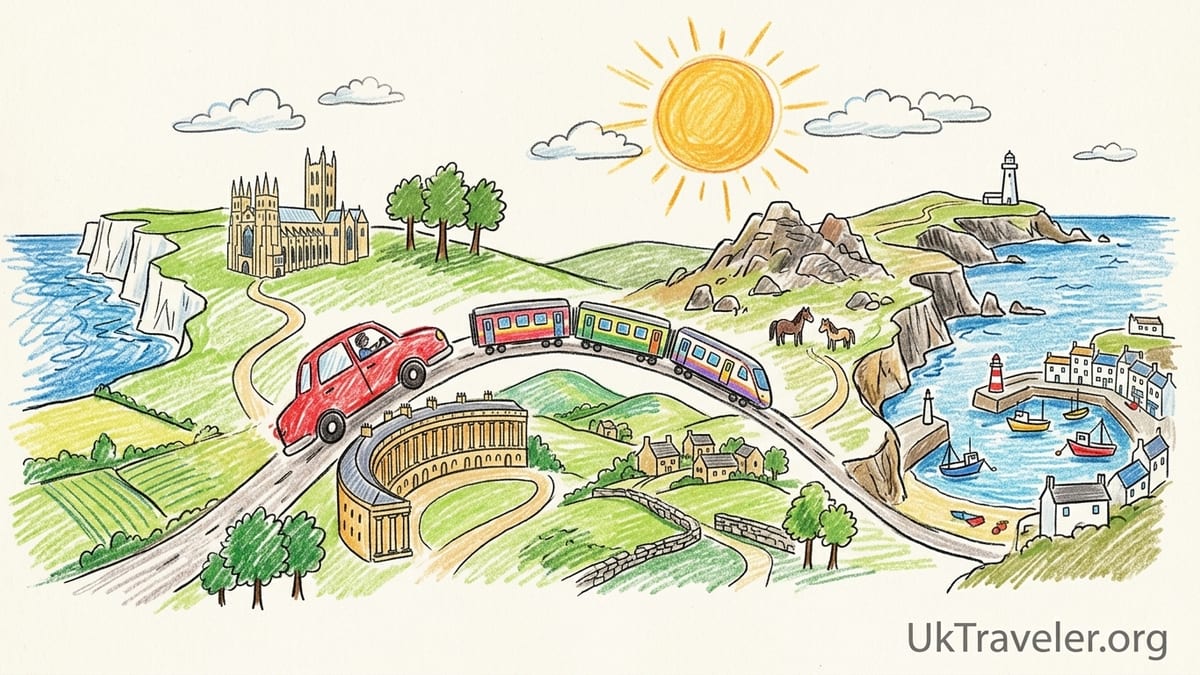
How This Southern England Journey Fits Together
VisitBritain’s regional itineraries increasingly package the south of England as a blend of historic cities, dramatic coastline and rural villages rather than a single homogeneous region. A typical route might pair Bath’s Georgian crescents with the Jurassic Coast’s cliffs, then continue through Devon’s moors to Cornwall’s beaches. Understanding those contrasts makes planning easier: you can decide where to slow down for a two or three night stay and where a few focused hours will do.
For most travellers, southern England breaks naturally into three arcs. The first runs east from London through Kent and Sussex, mixing heritage in Canterbury with chalk cliff walks around the White Cliffs and Seven Sisters. The second swings inland to Bath and the Cotswolds for architecture and classic village scenery. The third heads to the southwest for Jurassic Coast geology, Dartmoor’s wild tors and the far-flung peninsulas of Devon and Cornwall. With ten to fourteen days, you can sample each arc without rushing; with less time, it makes sense to concentrate on one or two and leave the rest for a future trip.
Transport shapes how you experience these places. High-speed trains link London to Canterbury in under an hour and to Bath in around 80 to 90 minutes, so both cities work well as car-free bases. Coastal and rural areas such as the Jurassic Coast, Dartmoor and the Cornish peninsulas are easier with a hire car, though local buses and branch-line trains make it possible to visit key spots like Durdle Door, Lyme Regis or St Ives without driving. When you factor in travel time, some destinations naturally stand out for overnight stays, while others shine as scenic stops along the way.
Kent: Canterbury’s Heritage and the White Cliffs
Kent is often the first taste of England for travellers arriving via continental Europe, and it offers one of the clearest contrasts in the region: the intimate, vertical world of Canterbury’s cathedral quarter versus the open horizons of the White Cliffs of Dover. Canterbury deserves at least one night. Its UNESCO-listed cathedral precinct, medieval streets and compact riverside make it more than a day-trip backdrop. A typical two day visit might include a cathedral tour, a guided walk through the old lanes and a quiet evening in one of the timber-framed pubs near the Westgate Towers.
Canterbury’s costs are broadly in line with other small English cities: mid-range hotels often start around the equivalent of a London three-star, and many visitors find good value in family-run guesthouses just outside the wall line. Being a rail hub, it also works as a base for exploring east Kent without a car. In summer, direct trains link Canterbury with Whitstable for seafood and modest beaches, or with Dover for the cliffs. Booking train tickets in advance through national rail services usually trims the fare compared with buying on the day.
The White Cliffs of Dover and the nearby coastline feel almost like a different destination. Here, a two to four hour stop is usually enough for most itineraries: time to walk along the cliff-top path from the National Trust car park, look down on ferries gliding to France and explore Second World War tunnels or gun batteries if you wish. Strong winds and changeable weather are common, so bring layers even in high summer. Many travellers combine Dover with a night in Canterbury or continue west to Sussex the same day rather than staying in Dover itself, keeping the focus on the landscape rather than the port town.
Sussex: Brighton’s Buzz and the Seven Sisters Coast
If Canterbury is about cloisters and cobbles, Brighton is about pier lights and pebble beaches. Just an hour by train from London, Brighton blends Regency terraces with street art, independent shops and a lively food scene. It rewards at least one overnight stay, especially for travellers interested in nightlife or dining. You can arrive mid-morning, wander the Lanes boutiques and the Royal Pavilion in the afternoon, eat at one of the many modern British or plant-focused restaurants in the evening, then stroll the seafront as the amusement rides wind down.
Brighton also works as a good value base for the Sussex coast if you are willing to commute a little. Regular buses run east to the chalk cliffs of Seven Sisters and Beachy Head near Eastbourne, where clifftop paths give some of the most dramatic sea views in southern England. The bus ride from Brighton to the Seven Sisters Country Park typically takes under an hour, and many visitors plan a full day to hike part of the coastal path, have a café lunch at the visitor hub and return by late afternoon. Because public transport is reliable on this stretch, you can manage without a car, though drivers get a little more flexibility on where to start and end their walks.
In contrast to Brighton’s urban buzz, inland Sussex offers quieter villages and vineyards that pair well with a self-drive itinerary. Places like Alfriston and Lewes are worth short detours for historic high streets, local bakeries and hillside views. They are atmospheric for a lunch stop or a couple of exploratory hours, but for most visitors they do not require an overnight stay unless you are seeking a slow, countryside-based holiday. If your time is limited and you want a clear contrast, combine one or two nights in Brighton with a full hiking day around Seven Sisters before heading west.
New Forest and Bath: Countryside Calm and Architectural Drama
West of Sussex, the New Forest National Park introduces a different kind of landscape: open heath, ancient woodland and grazing ponies rather than cliff drama. Created as a royal hunting ground in the 11th century, it is now a protected mosaic of habitats where free-roaming ponies and cattle share space with walkers and cyclists. Visitor information from the park authority emphasises travelling carefully on the unfenced roads, not feeding animals and sticking to designated paths to protect sensitive heathland and wetlands. Small towns such as Lyndhurst, Brockenhurst and Lymington act as gateways, each with guesthouses, bike hire and traditional pubs.
The New Forest works well as a two night stay for travellers who enjoy easy walking and cycling. You might spend one day following well-marked trails through woodland and across open heath, then another riding quiet lanes or taking a boat trip from Lymington into the Solent. Because the park is compact and relatively flat, it suits families and less experienced hikers. Costs vary by season: in school holidays, room rates in popular villages can approach those in Bath or Brighton, so booking ahead is prudent, especially for July and August. Outside peak times, midweek stays can be noticeably more affordable.
Beneath the New Forest’s open skies and grazing ponies, it is easy to forget that one of England’s most architecturally distinctive cities lies a couple of hours away. Bath, reached by road or by direct train from London, is the set-piece urban stop of this itinerary. Its honey-colored terraces, sweeping Royal Crescent and Roman Baths justify at least two nights, and many visitors happily stay three. A classic first day focuses on the Roman Baths, Bath Abbey and a stroll up to the Circus and Royal Crescent. A second day might feature a walking tour that delves into Georgian social history, plus time for the city’s thermal spa, independent bookshops and galleries.
Overnighting in Bath rather than rushing as a day trip has practical advantages. Traffic and parking in the center can be slow and expensive, so many travellers choose car-free days here, returning hire cars on arrival or collecting them after their city stay. Accommodation spans everything from small guesthouses in converted townhouses to design-led boutique hotels with in-house spas. Prices reflect Bath’s popularity, particularly at weekends and around major events, so if your budget is tight you might choose one of the smaller towns on the rail line and come in by train for sightseeing while still giving the city two full days of your itinerary.
Cotswolds: Villages Worth a Slow Stay
From Bath it is a short hop to the Cotswolds, a region of rolling limestone hills and “honey-stone” villages that has become shorthand for rural England in films and television. Although you can technically tick off a village or two on a rushed day tour, the Cotswolds reward a slower pace. Base yourself for two or three nights in a well-connected village or market town rather than constantly changing hotels. Places such as Chipping Campden, Stow-on-the-Wold or Burford offer enough cafés, pubs and small shops to feel lively without losing their rural character.
Daily costs here can be similar to Bath or Brighton, especially in boutique inns and country-house hotels. However, many visitors keep spending in check by booking self-catering cottages or B&Bs and using local farm shops and bakeries for some meals. The main appeal is not a long checklist of must-see “sights” but everyday experiences: walking along dry-stone walls between fields, pausing at a tearoom for a cream tea, browsing in a small gallery or cheese shop. Public footpaths are well signposted, and local tourism offices often sell simple, inexpensive walking guides for circular routes starting from village centers.
If you are short on time, it is still possible to get a taste of the Cotswolds as a route stop. For example, drivers travelling between Bath and the Midlands sometimes pause for a few hours in Castle Combe or Bibury, both very photogenic. The trade-off is that these villages can feel crowded at midday in summer when coach groups arrive. Early morning or late afternoon visits are quieter. In a broader southern England itinerary focused on contrasts, think of the Cotswolds as your “village and countryside” chapter. Allow at least one night, and ideally two, if you want those quiet walks and evenings in local pubs that define the region’s charm.
Dorset and the Jurassic Coast: Geology on Display
South of Bath and the Cotswolds, the landscape tilts towards the sea again along the UNESCO-listed Jurassic Coast in Dorset and East Devon. This 155 kilometer stretch of shoreline is recognised for its near-continuous sequence of Triassic, Jurassic and Cretaceous rock formations that record around 185 million years of Earth’s history. Even if you are not a geology enthusiast, it is hard not to be struck by the layered cliffs of West Bay, the natural limestone arch at Durdle Door or the fossil-laden beaches near Lyme Regis.
The Jurassic Coast works well as either a two or three night base or a series of focused stops if you are driving through. Many visitors choose a seaside town such as Lyme Regis, Weymouth or Swanage as a hub. A typical pattern is to spend one day walking the coastal path between Lulworth Cove and Durdle Door, another day exploring Lyme Regis and nearby Charmouth’s fossil center, and a half-day discovering Corfe Castle or Studland’s beaches. Seasonal open-top buses and local trains help link some of these spots, but having a car makes it much easier to combine shorter walks with visits to specific coves and villages in a single day.
Safety and planning matter here more than in some inland areas. Cliff erosion is an ongoing reality, and local authorities regularly advise staying well back from the cliff edge and avoiding the base of unstable sections. Tide times are important if you plan to walk along beaches between access points. Visitor centers and heritage coast websites publish up-to-date advice, while local outfitters offer guided fossil-hunting walks that are suitable for families and beginners. Accommodation costs vary widely, from simple B&Bs inland to sea-view hotels and coastal holiday parks. Booking ahead is strongly advised in July and August or during school holiday weeks, when British families flock to the south coast.
Devon and Dartmoor: Wild Uplands and Soft Edges
West of the Jurassic Coast, Devon presents another set of contrasts: soft, green farmland and sheltered estuaries on the one hand; granite uplands and exposed tors on the other. Dartmoor National Park, in particular, offers a sense of space that surprises many first-time visitors. Here, moorland hills rise to rugged rock outcrops, and panoramic views stretch towards the South Devon coast from high points like Haytor. The park authority highlights a variety of short walks from visitor centers for those with limited time, alongside longer routes across open moor for experienced hikers who are comfortable navigating in changeable weather.
Dartmoor rewards at least one or two nights if you are interested in walking or simply want to feel far from cities. Small towns and villages such as Chagford, Widecombe-in-the-Moor and Princetown offer pubs with open fires, local food and small inns. Summer days might begin with a circular walk taking in a tor and an ancient stone circle, followed by a pub lunch and an afternoon visiting a craft workshop or farm shop. In cooler months, mist and low cloud can give the moor a brooding atmosphere; waterproofs and sturdy footwear are essential year-round. Public transport exists but is limited, so a car gives far more flexibility in choosing trails and timing.
Outside Dartmoor itself, coastal Devon offers gentler experiences that fit neatly into a wider southern England journey. The English Riviera around Torquay and Paignton provides beaches, Victorian promenades and family attractions; the South Hams region to the west is known for estuaries, sailing towns like Salcombe and relaxed coastal dining. These can work as overnight stays if your priority is beach time and seafood, or as brief stops for a harbour stroll and meal on a drive between Dorset and Cornwall. When time is tight and you are seeking maximum contrast, many travellers prioritise a Dartmoor stay over additional beach towns, since Cornwall will deliver more coastal drama at the far end of the route.
Cornwall and St Ives: The Far Southwest
At the end of almost every southern England road trip lies Cornwall, the peninsula that reaches towards the Atlantic. Its coastline alone could fill a fortnight, but if you are weaving Cornwall into a broader itinerary, St Ives offers one of the best focal points. This former fishing port turned arts hub curves around a busy harbour, backed by whitewashed cottages and overlooked by a major modern art gallery. Local and national tourism bodies highlight St Ives’ collection of beaches, from family-friendly Porthminster to surf-oriented Porthmeor, all within walking distance of the compact town center.
St Ives justifies an extended stay. Two nights gives you a taste; three to four allows a mix of beach time, coastal walking and day trips. Many visitors plan at least one day simply exploring on foot: coffee near the harbour, a visit to an art gallery or studio, a stroll over the headland and an evening fish dinner watching the light change over the bay. Another day might be devoted to a section of the South West Coast Path, where rugged headlands and hidden coves demonstrate why Cornwall is consistently promoted as one of England’s most scenic coastal regions. St Ives’ station sits on a short branch line that threads along the shoreline, so you can also arrive by train, avoiding the challenge of driving and parking on the town’s steep, narrow streets.
Beyond St Ives, the rest of West Cornwall can be treated as a series of carefully chosen excursions. For many travellers, a day trip towards Land’s End and the wild cliffs around Zennor and Sennen provides enough of the peninsula’s edge-of-the-map feel. Others head to St Michael’s Mount near Marazion or to tin mining heritage sites for a sense of Cornwall’s industrial past. Accommodation prices in and around St Ives reflect high demand in summer and during school holidays, with waterfront hotels and stylish rental cottages at the top end of the scale. Budget-conscious visitors often look to nearby towns and villages on the rail or bus network, commuting in for the day’s activities while still giving Cornwall three or four nights of their overall trip.
Planning Your Route and Overnight Stays
When you look at a map, it can be tempting to cram all these regions into a short itinerary. Distances are relatively modest by global standards, but single carriageway roads and summer traffic mean journeys take longer than the raw kilometers suggest. A sensible ten to fourteen day route might start in London, then spend one night in Canterbury, one or two in Brighton, two in the New Forest or nearby, two in Bath, two in the Cotswolds or on the Jurassic Coast and three or four split between Dartmoor and St Ives. That structure gives you at least one overnight in each of the key “contrast” landscapes: cathedral city, fun-loving seaside resort, wooded national park, Georgian city, stone villages, fossil coast, high moor and Atlantic peninsula.
Shorter trips require more ruthless choices. With seven days, you might decide to focus on the southwest: two nights in Bath, two around the Jurassic Coast, one on Dartmoor and two in St Ives, leaving Kent and Sussex for a future visit. Alternatively, if you enjoy cities and villages more than wild landscapes, you could prioritise Canterbury, Brighton, Bath and the Cotswolds and skip Dartmoor and Cornwall this time. In all cases, it helps to build your timetable around a few anchor nights, such as Bath and St Ives, and treat places like the White Cliffs, Seven Sisters or individual Jurassic Coast coves as flexible day stops.
Costs vary across the region but some patterns are consistent. Peak season, especially school holidays and sunny weekends, sees higher prices and busier roads in coastal areas and national parks. Booking accommodation several months ahead is wise for July and August, while shoulder seasons in late spring and early autumn often provide a sweet spot of milder weather and more moderate prices. Rail cards, where eligible, can reduce train fares, and pre-booked advance tickets between major cities such as London, Canterbury and Bath are usually significantly cheaper than walk-up prices. By combining a few nights in high-demand hotspots with stays in smaller inland towns, you can keep your budget under better control without sacrificing the region’s diversity.
FAQ
Q1. How many days do I need to see the main highlights of southern England?
Most travellers find that ten to fourteen days allows time for Kent or Sussex, Bath, the Cotswolds, the Jurassic Coast, Dartmoor and a corner of Cornwall without rushing. With a week, focus on either the east and central section or the southwest rather than trying to cover everything.
Q2. Do I need a car to visit these places, or can I rely on public transport?
You can reach Canterbury, Brighton, Bath and some Cotswold towns by train and bus, and there are services to parts of the Jurassic Coast and Cornwall. However, a car gives far more flexibility for rural areas like the New Forest, Dartmoor and the more remote sections of the Jurassic Coast and Cornish peninsulas.
Q3. Which places are best for overnight stays versus short stops?
Canterbury, Brighton, the New Forest, Bath, a Cotswold village, a Jurassic Coast base such as Lyme Regis or Weymouth, Dartmoor and St Ives all deserve at least one night. The White Cliffs of Dover, Seven Sisters, individual Jurassic coves and smaller villages work well as half-day or day stops within a longer route.
Q4. When is the best time of year to travel around southern England?
Late spring and early autumn often offer a good balance of milder weather, lighter crowds and moderate prices. July and August bring long daylight and warm sea temperatures but also higher accommodation rates and busier roads, especially in coastal and national park areas.
Q5. How should I budget for accommodation and food on this route?
Prices vary, but cities like Bath and popular spots such as St Ives and parts of the Cotswolds tend to be at the higher end. You can manage costs by mixing guesthouses with a few nights in self-catering cottages, using local bakeries, farm shops and pubs rather than eating every meal in formal restaurants.
Q6. Is it realistic to visit both the Cotswolds and the Jurassic Coast on one trip?
Yes, if you have at least ten days and are comfortable with some driving. Many itineraries link Bath with the Cotswolds for villages and architecture, then drop south to the Jurassic Coast for two or three nights before continuing to Devon and Cornwall.
Q7. Are these destinations suitable for families with children?
They can work very well for families. The New Forest offers easy cycling and pony-spotting, the Jurassic Coast has beaches and guided fossil walks, and Cornwall provides surfing and sheltered coves. City days in Bath or Canterbury are manageable with frequent café breaks and parks.
Q8. How challenging are the walks around the White Cliffs, Seven Sisters and the Jurassic Coast?
There are options for different fitness levels. Short, relatively gentle paths lead to viewpoints near car parks, while longer coastal hikes involve steeper ascents and descents. Good footwear, checking weather forecasts and being aware of cliff edges and tides are important for safety.
Q9. Can I visit Dartmoor and still have time for the coast in Devon and Cornwall?
Yes. A common pattern is to spend one or two nights on Dartmoor for moorland walks, then drive on to a coastal town such as Salcombe in Devon or St Ives in Cornwall for three or four nights by the sea, balancing wild uplands with beaches and harbours.
Q10. How far in advance should I book accommodation in places like St Ives or the Cotswolds?
For peak summer, school holidays and long weekends, booking several months ahead is sensible, especially for sea-view rooms, small boutique hotels or popular village inns. In shoulder seasons, you often have more choice, though it is still wise to reserve at least your key base nights in advance.