


South West England is made for slow journeys: trains that trace estuaries, cliff paths between fishing coves, and B&B windows that open onto moorland or sea. Yet with so many pretty villages and harbour towns, the hardest part of planning can be deciding where to sleep and what to treat as a scenic pause along the way. This selective guide focuses on a classic Somerset, Devon and Cornwall circuit, from Bath and Exmoor to the Jurassic Coast and the far tip of West Cornwall, picking out a handful of genuine bases and a few places that are best enjoyed as evocative stops on the road.
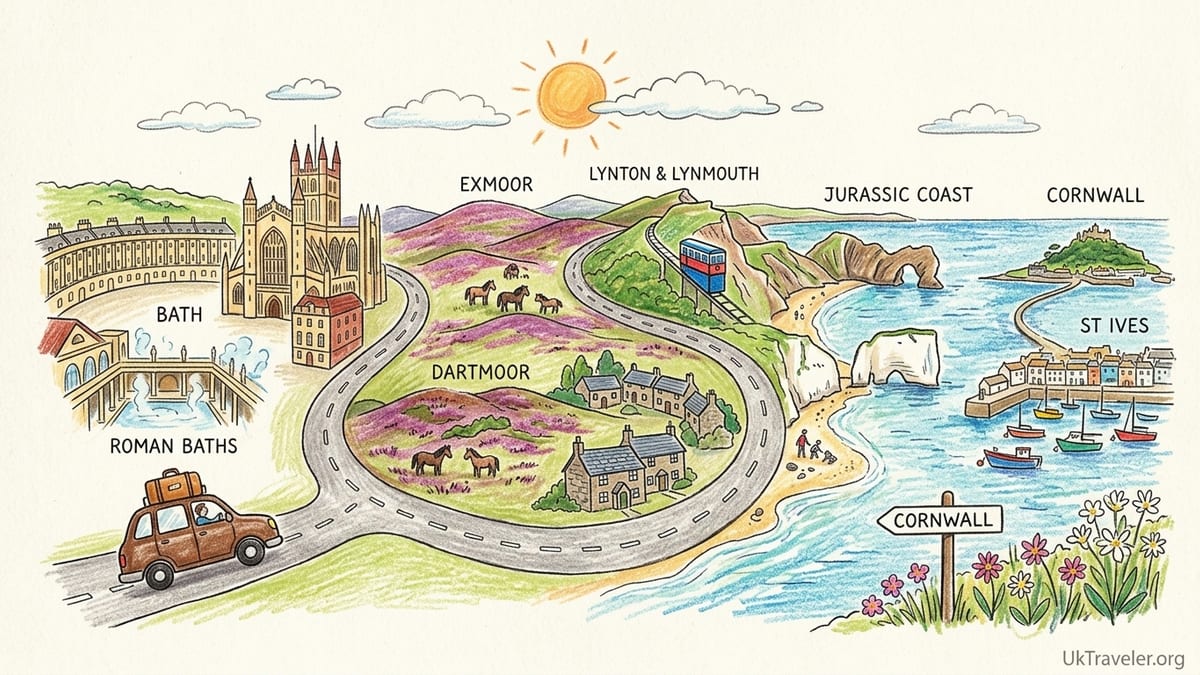
How to Use This Guide to South West England
VisitBritain’s own suggested routes in the south west concentrate on Dorset, Somerset, Devon and Cornwall, including the 95 mile Jurassic Coast between Exmouth and Studland Bay on England’s south shore. That official focus reflects how most international visitors experience the region: as a looping journey from Bath or Bristol, across Exmoor and Dartmoor to the Atlantic, then along the southwest peninsula into Cornwall before turning back east.
This article mirrors that logic but keeps the selection intentionally tight. Rather than listing every resort and village, it highlights a core set of places that work especially well for overnight stays, together with a few smaller harbours and viewpoints that are lovely for lunch, a walk or an hour with the camera, but not ideal as multi night bases. For each, you will find concrete detail on what makes it tick, how long to stay, and what it is realistically like to be there in peak season.
Prices and logistics here are indicative as of late 2026 and may shift, but they should help you picture real world decisions. When you read that a mid range guesthouse in St Ives often runs around 160 to 220 pounds per night in August, or that a guided fossil walk from Lyme Regis might cost roughly 15 to 25 pounds per adult, you can begin to sketch a practical itinerary instead of a purely aspirational one.
The running theme is to pick fewer bases and explore more deeply. Many first timers try to sleep in a different village every night, which quickly turns the romance of the south west into a series of parking battles and rushed check outs. Choosing three or four well connected hubs, then using them for day trips, tends to deliver a far richer experience.
Bath: Refined Gateway to the South West
Bath, set in Somerset’s green bowl of hills, is both a destination in its own right and the most natural urban gateway to the wider region. Its compact centre is stitched together by creamy Georgian terraces, the curve of the Royal Crescent and the more intimate Circus, with the Roman Baths and Bath Abbey anchoring the historic core. You can step out of Bath Spa station and be looking into the steamy waters of the baths within ten minutes on foot, which is ideal after a long international journey.
As a base, Bath works best at the beginning or end of a wider south west loop rather than in the middle. Two or three nights give time for the Roman Baths, the Thermae Bath Spa rooftop pool, the Holburne Museum, and an evening at the Theatre Royal, plus a half day countryside walk along the Kennet and Avon Canal. Hotel prices vary widely: mid range city centre rooms typically fall in the 140 to 220 pound range midweek outside school holidays, with rates climbing on summer weekends and during Christmas markets.
Bath is connected by direct trains to London in around 75 to 90 minutes, and to Bristol in about 15 minutes, making it simple to arrive without a car. From here, travellers often collect a hire car or continue by train and bus toward Exmoor or the Jurassic Coast. If you are short on time, consider Bath as your only city stop and resist the urge to squeeze in Bristol or Exeter; this leaves more margin for moorland and sea air later in the trip.
In terms of itinerary flow, one of the most efficient patterns is to spend your first two nights in Bath to recover from jet lag and adjust to the UK, then head west via the Mendip Hills into Somerset and Exmoor. Alternatively, you can drive south into Dorset and the Jurassic Coast first, circling back through Devon and Cornwall before finishing with a final night in Bath prior to onward travel.
Exmoor: Moorland Villages and the North Devon Coast
Exmoor National Park straddles the Somerset and North Devon border and rewards those who slow down. This is a land of heather moorland, deep wooded combes and a short but spectacular coastline. Walking, scenic driving and low key harbour wandering are the main activities. Many visitors underestimate driving times; moorland roads are often narrow and slow, and a 25 mile journey can easily take an hour once tractors and photo stops are factored in.
For an overnight base, villages such as Dunster and Porlock on the Somerset side or Lynmouth over the border in Devon work particularly well. Dunster, with its medieval yarn market, castle on the hill and over 200 listed buildings, has enough guesthouses and small hotels to support a two or three night stay. From here you can reach Dunster Beach on foot in around 20 minutes, or drive into the high moor for walks on Dunkery Beacon. Porlock and nearby Porlock Weir offer a different feel, closer to the coast and the salt marsh, popular with walkers tackling sections of the South West Coast Path.
As a reality check on costs, expect village B&Bs in Exmoor hotspots to start around 90 to 120 pounds per night for a double room in shoulder season, rising during school holidays. Dinner in a traditional inn might run 16 to 25 pounds for a main course, with local Exmoor ale or West Country cider on tap. In return, you get dark skies, owl calls at night and the sense that the modern world is being held politely at bay.
While Lynmouth and its cliff railway linked twin Lynton draw day trippers, they can feel busy at peak hours. These are fine overnight bases if you enjoy bustle and café culture, but many travellers prefer to sleep somewhere slightly quieter and drive in. Treat coastal viewpoints such as the Valley of Rocks, or tiny harbours like Porlock Weir, more as half day excursions, combining a cliff path walk with tea rooms and a return to your base village in the evening.
Jurassic Coast and Lyme Regis: Cliffs, Fossils and Seaside Charm
The Jurassic Coast, a 95 mile stretch of World Heritage coastline between Exmouth in Devon and Studland Bay in Dorset, is where layered cliffs peel back 185 million years of geological time. This region is where official south west itineraries often pivot from inland scenery back to the sea, with visitors picking two or three nights in one hub and using it to sample nearby coves, fossil beaches and classic viewpoints like Durdle Door and Lulworth Cove.
Lyme Regis, on the Dorset side near the Devon border, makes an especially appealing base for first timers. The town curls around a cobbled harbour wall known as the Cobb and backs onto cliffs rich with fossils. Small hotels and apartment rentals cluster on the hill and seafront roads; in school summer holidays it is wise to book months ahead, as self catering cottages for four can reach 1,200 to 1,800 pounds per week in August. Guided fossil walks, usually two to three hours along the beach, commonly cost in the region of 15 to 25 pounds per adult, with family tickets available.
If you prefer quieter nights, nearby coastal villages such as Charmouth or Seatown can be gentler alternatives. These work better as semi rural bases for travellers with a car, who are happy to drive 15 to 30 minutes to larger towns for restaurants or supermarkets. Without a car, Lyme Regis and larger settlements like Weymouth or Exmouth are more practical because they connect to regional bus and train routes, easing onward travel to Devon and Cornwall.
Some of the Jurassic Coast’s most photogenic locations, such as Durdle Door, Lulworth Cove and Old Harry Rocks near Swanage, lend themselves to half or full day visits rather than overnight stays. Caravan parks and holiday parks line certain stretches, but the immediate villages around these rock formations are small and heavily seasonal. It is usually more comfortable to base in one of the main towns, then time your visit to arrive early morning or late afternoon, when day trip traffic has thinned and the light is softer.
Dartmoor and North Devon: Wild Uplands and Atlantic Beaches
From the Jurassic Coast many travellers head west into Devon, where the granite dome of Dartmoor rises between the county’s two coasts. Dartmoor National Park offers tors, Bronze Age remains and vast grazing commons dotted with ponies. It is a place for walking, cycling and slow road exploration rather than checklist sightseeing. Weather changes quickly on the moor; in practical terms that means packing layers even in July and structuring days with a mix of outdoor and village time.
Good overnight bases on or near Dartmoor include the market town of Tavistock on the western edge and Ashburton or Chagford closer to the heart of the park. These offer a combination of traditional inns, small hotels and self catering cottages. Expect mid range rooms in these towns to cost roughly 110 to 160 pounds per night in summer. Staying in a more central base reduces driving time to circular walks around tors such as Haytor, Hound Tor or Great Mis Tor, and makes it easy to retreat to tearooms when the mist rolls in.
North Devon’s coastline, running from around Bideford and Barnstaple toward Exmoor, appeals for its surf beaches and dramatic headlands. Towns such as Ilfracombe and Woolacombe, and villages like Croyde, are classic seaside bases if you want sea facing guesthouses and surf schools. For example, a group lesson including board and wetsuit hire might run 40 to 60 pounds per person, which can be a worthwhile experience for families or friends new to the Atlantic. With a car, it is straightforward to day trip from North Devon beaches up into Exmoor or south toward Dartmoor.
Some of the prettiest North Devon harbours, including Clovelly with its steep cobbled main street, are best treated as daytime stops. Their historic layouts make access by car challenging, parking limited and luggage hauling uphill unappealing. Spending a few hours wandering these villages, then returning to a larger base with easier access and more restaurant choice, typically strikes a better balance between romantic atmosphere and real world comfort.
Cornwall’s West: St Ives, Falmouth and Penzance as Bases
Once you cross the River Tamar into Cornwall, you enter a longer, narrower peninsula that rewards at least four to seven nights if time allows. A practical way to structure a trip is to choose two main Cornish bases, one on or near the north coast for Atlantic beaches and one on the south or far west for sheltered harbours and big ticket sights such as St Michael’s Mount or the Minack Theatre. St Ives, Falmouth and Penzance emerge repeatedly in current regional advice as strong candidates because they balance atmosphere with transport connections and year round services.
St Ives, on the north coast of West Cornwall, is known for its light, sandy beaches and art scene. Small lanes tumble down to harbourside pubs and the Tate St Ives gallery, and beaches such as Porthmeor and Porthminster are within walking distance of most accommodation. In peak summer, car access into the town centre can be heavily congested, so many visitors either stay within walking distance of the harbour or park at St Erth or Lelant and use the scenic branch line train along the coast. Prices are at a premium: waterfront boutique hotels can easily exceed 250 pounds per night in August, while simpler B&Bs up the hill are more modest.
Falmouth, on the south coast, is a working harbour town rather than a pure resort, with a university, maritime history and a choice of beaches like Gyllyngvase and Swanpool close by. As a base it suits travellers who like a wider range of restaurants, live music and the ability to take ferries to neighbouring spots such as St Mawes, Flushing or the Helford River. Mid range hotels and guesthouses often run around 120 to 180 pounds per night in summer, and it is relatively straightforward to arrive by train via the branch line from Truro, which appeals to those travelling car free.
Penzance, near the far western tip of Cornwall, is an excellent strategic base for exploring West Cornwall and the Land’s End peninsula. It offers rail links to the rest of the UK, regular buses to St Ives, Land’s End and St Just, and easy access to the causeway and boat trips to St Michael’s Mount across Mount’s Bay. Compared to St Ives, Penzance accommodation can be better value, with characterful guesthouses in the historic streets behind the seafront ranging from about 90 to 150 pounds per night for mid range options outside the absolute peak weeks.
In practice, a classic pattern is to spend three or four nights in St Ives or nearby Carbis Bay for the north coast, art galleries and golden sands, then move to Falmouth or Penzance for another three or four nights focused on boat trips, subtropical gardens and exploring West Cornwall’s cliffs. Trying to cover all three as separate bases in a week can feel rushed, turning what should be a leisurely coastal stay into a parade of checkouts and car park searches.
Harbour Towns and Route Stops: Where to Pause, Not to Base
Scattered along the south west coasts are harbour villages that photograph beautifully but are less practical as multi night bases, especially in high season. On the Jurassic Coast you might pause in Beer or Seaton between longer stays, while on the Cornish coasts places such as Mousehole, Mevagissey, Boscastle or Port Isaac are often better suited to a long lunch and cliff walk than to unpacking your suitcase for a week. Narrow streets, limited parking and small stocks of accommodation mean prices can be high and logistics tiring.
Take Mousehole near Penzance as an example. Its enclosed harbour, ringed by stone cottages, is one of the most photographed scenes in Cornwall. Yet driving in during a sunny August afternoon can involve nose to tail traffic along single lane approaches, and parking is scarce. Staying one or two nights in a harbourside cottage can be magical in quieter months such as March or October, if you are prepared for changeable weather and shorter days. In midsummer, many travellers are happier using Penzance as a base and visiting Mousehole by bus or on foot along the coast path, then returning to the larger town’s range of dining and shopping options in the evening.
Similarly, the tiny fishing harbours of the north Cornish coast, such as Boscastle or Port Isaac, are atmospheric but compact. A half day visit allows time to explore the narrow lanes, visit small museums or heritage centres, and walk up to headland viewpoints without needing to factor in supermarket runs or repeated parking charges. Treating them as highlights on a coastal drive keeps the romance while avoiding some of the practical frustrations that locals and longer stay visitors sometimes face in peak weeks.
In Devon, Dartmouth, Salcombe and small estuary villages like Dittisham or Noss Mayo operate on the same principle. They are lovely route stops or short stays if you are prepared to work around ferry timetables and limited road access, but for a first or second visit you may find it simpler to base in slightly larger towns nearby and drop in. When planning, it helps to visualise which places you want to wake up in for several days running, and which you would be satisfied to reach mid morning, wander for a few hours and leave before the day’s parking fills.
The Takeaway
Designing a satisfying journey through South West England is less about collecting as many postcard perfect harbours as possible and more about committing to a handful of well chosen bases. Bath eases you into the region with Roman history and Georgian architecture, Exmoor and North Devon provide moorland drama and quieter coasts, the Jurassic Coast around Lyme Regis brings fossils and classic English seaside charm, Dartmoor offers wild uplands, and Cornwall’s hubs of St Ives, Falmouth and Penzance open the door to some of Britain’s most loved beaches and headlands.
For many travellers, three or four overnight bases over 10 to 14 days is the sweet spot: perhaps Bath, an Exmoor or North Devon village, a Jurassic Coast or Dartmoor stop, and one or two Cornish towns. Smaller harbours and villages can then become memorable pauses along the way rather than logistical headaches. This approach leaves space for weather changes, local recommendations and the small unplanned pleasures that define the best trips, whether that is an impromptu swim on an empty morning beach or a sunset pint in a moorland pub.
The south west rewards repeat visits. Your first trip might follow a relatively classic arc, using the towns and bases in this guide as anchors. A second or third might venture into quieter corners, winter storm watching on the Atlantic or spring bluebell walks in hidden valleys. Either way, letting the landscape, rather than a frantic checklist, set the pace is the surest route to discovering why this corner of England lodges so firmly in many travellers’ memories.
FAQ
Q1. How many days do I need for a South West England loop including Cornwall?
For a loop that includes Bath, Exmoor or North Devon, a taste of the Jurassic Coast, Dartmoor and one or two Cornish bases, 10 to 14 days is a realistic minimum. With only a week, you will need to drop either the Jurassic Coast or Cornwall and focus on fewer regions.
Q2. Is it possible to do this itinerary without a car?
It is possible but requires careful planning. Bath, Exeter, Falmouth, St Ives and Penzance all have rail links, and local buses serve many coastal villages. However, some Exmoor and Dartmoor areas are hard to access by public transport, so car free travellers may want to focus more heavily on the Jurassic Coast and key Cornish hubs connected by train and bus.
Q3. Which towns make the best bases if I am travelling by train?
Bath, Exeter, Falmouth via Truro, St Ives via the St Erth branch line and Penzance are among the most practical. Each has a station, year round accommodation and regular bus or boat connections to nearby sights, meaning you can explore without needing to drive.
Q4. When is the best time of year to visit to avoid crowds but still have decent weather?
Late April to early June and mid September to early October usually offer a good balance of milder weather, fewer families on school holidays and more available accommodation. Sea temperatures are warmer in early autumn than in spring, which can matter if you plan to swim or surf.
Q5. How expensive is accommodation in Cornwall compared with Devon or Dorset?
Cornwall’s most popular towns, especially St Ives and parts of West Cornwall, tend to be more expensive at the height of summer than many Devon or Dorset equivalents. Mid range rooms in peak weeks can cost 160 to 250 pounds per night, while in shoulder seasons you may find similar quality for 110 to 180 pounds in less in demand areas.
Q6. Do I need to book restaurants and activities in advance?
In July and August, and during school holidays, it is wise to book popular restaurants in places like St Ives or Bath a few days ahead, especially at weekends. Guided fossil walks on the Jurassic Coast and boat trips in Cornwall can also sell out in busy periods, so pre booking once you know your dates is sensible.
Q7. What should I pack for a trip that includes both moorland and coast?
Pack layers, including a lightweight waterproof jacket, comfortable walking shoes or boots, and a warm fleece or jumper even in summer, as temperatures on moor tops and exposed headlands can be cooler than in sheltered towns. A small daypack, refillable water bottle and sun protection are also useful, since you may be outside for several hours at a time.
Q8. Is driving difficult in South West England for visitors not used to narrow roads?
Driving can feel challenging at first because of single track lanes with high hedges, steep gradients and tight village streets. Allow extra time between destinations, use passing places considerately and avoid planning long cross country drives late in the day. Many visitors find they grow more comfortable after a few days if they keep daily distances modest.
Q9. Can I swim and surf safely on these coasts?
There are many safe opportunities to swim and surf, especially at lifeguarded beaches in North Devon and Cornwall. Always check local conditions, heed any red flag warnings and, if you are new to the Atlantic, consider booking a lesson with a licensed surf school rather than going out alone in bigger waves.
Q10. How should I divide my nights between the places in this guide?
A balanced first timer split might be two nights in Bath, two or three in an Exmoor or North Devon base, two or three on the Jurassic Coast or near Dartmoor, and four to six nights divided between St Ives and either Falmouth or Penzance. Adjust up or down depending on your interests and total time available.