


Brighton and Oxford sit less than two hours from London, yet offer two very different South East England city breaks. One is a bohemian beach resort below the chalk hills of the South Downs. The other is a honey-stone university city of quads, spires and riverside meadows. If you only have a weekend, which should you choose in 2026? This guide compares Brighton and Oxford on atmosphere, sights, nightlife, food, prices, transport and who each city suits best, so you can pick the city break that matches your style.
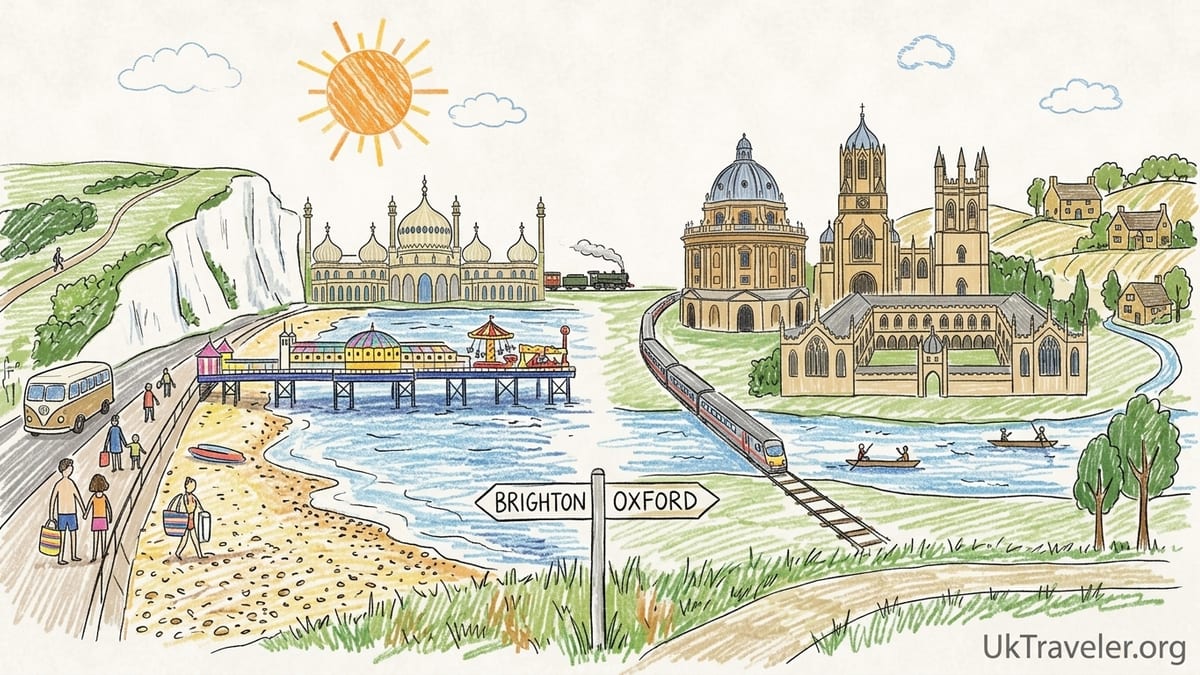
Brighton vs Oxford at a Glance
Think of Brighton as London-on-Sea with salt spray, street art and independent nightlife, and Oxford as a compact historic city where every corner seems to belong on a book cover. In practical terms, both work well for a 2 or 3 night break and both are easy to reach by train from London. The choice really comes down to whether you want to spend your days by the sea and on the South Downs, or among college cloisters, museums and Cotswold stone villages.
Brighton gives you a shingle beach, a classic pier with rides and arcades, a long seafront promenade and quick access into the South Downs National Park. The city’s personality is youthful and creative, with mural-covered lanes, vintage shops and LGBTQ+ venues that stay open late. Oxford is quieter in the evenings but rich in culture, with world-class museums such as the Ashmolean and Pitt Rivers, colleges like Christ Church and Magdalen, and easy onward access to the Cotswolds and the Thames Valley for day trips.
Price-wise, hotel rates in both cities fluctuate heavily by season. Data from major booking platforms in 2025 and 2026 shows mid-range Brighton hotels often cluster around 120 to 180 US dollars per night outside major events, while Oxford’s central hotels are frequently in a similar or slightly higher band, particularly during university term and graduation periods. Exact prices for your dates will depend on demand, but neither city is a serious bargain destination in high season.
For a first-time visitor to southern England, Brighton often appeals more to travelers who value nightlife, independent food and being outdoors, while Oxford is better suited to those who prioritise architecture, history and easy day trips into the countryside. Couples can be happy in either; families may find Brighton’s beach and pier more immediately engaging for children, while Oxford’s museums and park-like college grounds suit older kids and teens who can handle more walking and guided tours.
Getting There and Getting Around
Both Brighton and Oxford are fundamentally train-first destinations from London, which means you will not usually need a car for a short city break. Direct trains from central London to Brighton typically take around one hour on the fastest services from London Victoria, London Bridge or St Pancras, with advance one-way fares commonly starting in the range of 8 to 20 pounds if booked early for off-peak times. Peak-hour walk-up fares can be significantly higher, so flexible timing pays off.
London to Oxford trains run from London Paddington and London Marylebone, with the quickest journeys timetabled at around 45 to 60 minutes and an average of just over an hour. In 2026, advance one-way tickets on slower but cheaper services can appear from around 6 to 7 pounds if you commit to a specific train, while flexible tickets at busy times can be several times that. In practice, many leisure travelers using off-peak trains and a railcard pay roughly 10 to 20 pounds each way.
Once you arrive, neither city demands a car. Brighton’s compact centre runs from the station down to the seafront in about a 10 to 15 minute walk, with local buses covering the marina, Hove and outlying neighbourhoods. The city is on a steep hill, but most key sights such as the Royal Pavilion, Lanes, beach and pier are within a short walk of each other. In Oxford, the historic core is even more walkable, clustering around the High Street, Broad Street and the Bodleian Library. Buses link the station, the city centre, the Headington hospital quarter and Park & Ride sites. In both places, parking in central streets is limited and expensive, making rail the simplest option.
For onward excursions, public transport is workable. From Brighton, buses and occasional trains get you to South Downs villages like Lewes, as well as coastal stops such as Rottingdean. From Oxford, direct buses and trains connect to Cotswold gateways such as Moreton-in-Marsh and to river towns like Henley-on-Thames. If you want to explore smaller villages in depth, a car for a single day hire in Oxford is easier to justify than keeping one for your entire stay.
Atmosphere and Sights: Beach Town vs University City
Brighton’s main stage is its seafront. The wide shingle beach, the Brighton Palace Pier with its fairground rides and arcades, and the arches filled with small galleries and cafes give the city a holiday-town feel in almost any season. The Royal Pavilion, a former royal palace with onion domes and Indian-inspired detailing, adds a surreal note a few minutes inland. Behind the seafront, the North Laine district is dense with street art, independent shops and cafes that spill onto the pavement in good weather.
Oxford’s visual appeal is quieter but more layered. The skyline of spires and domes belongs largely to the colleges and university buildings: the Radcliffe Camera, the Sheldonian Theatre, the Bodleian Library and colleges such as Christ Church, Magdalen, Balliol and New College. Many colleges open their quads and chapels to visitors for a small fee or on limited hours, so a typical day might involve touring one or two colleges in the morning, a museum after lunch and a punting trip on the Cherwell before dinner.
Museums are a major differentiator. Brighton has a small but interesting museum near the Royal Pavilion and a handful of contemporary galleries. Oxford, in contrast, offers heavyweight institutions like the Ashmolean Museum of Art and Archaeology, the Museum of Natural History and the Pitt Rivers Museum, all known for extensive collections and, crucially, free entry. On a rainy weekend, this tilts strongly in Oxford’s favour, especially for travelers who appreciate culture-heavy itineraries without constant extra ticket costs.
If your mental picture of England revolves around beaches and promenades, Brighton matches that well, but with a distinctly alternative, sometimes gritty edge. If your image is of cloisters, ancient libraries and Gothic chapels, Oxford will feel like stepping straight into that postcard. For many travelers, including those visiting from the United States on a broader UK tour, it can make sense to pair Brighton with London for an urban and seaside combination, or pair Oxford with the Cotswolds to build a more classic countryside-and-colleges itinerary.
Nightlife, Food and Coffee
Brighton has the stronger nightlife and independent dining scene. Its reputation as a party town is well earned, especially at weekends and during festivals. The seafront and Kemptown host numerous bars and LGBTQ+ venues, and clubs stay open into the early hours. For example, visitors often string together an evening that starts with sunset drinks on the seafront arches, moves on to small cocktail bars in the Lanes, and ends on the dancefloor in a late-night club. Live music, from small basement venues to mid-sized concert halls, is common on Thursday to Saturday evenings.
Food in Brighton leans heavily towards independent, often plant-focused kitchens. You will find small ramen joints tucked into side streets, vegan cafes around North Laine, seafood spots specialising in grilled mackerel or fish and chips along the seafront, and popular brunch places that fill up on weekend mornings. Prices vary, but you can expect to pay in the region of 12 to 18 pounds for main courses in a casual bistro and more in well-known seafront restaurants. Coffee culture is strong, with multiple speciality roasters and cafes where laptop-toting locals share tables with visitors.
Oxford’s nightlife is more subdued and concentrated in student term time. There are traditional pubs with wooden beams and low ceilings, some claiming centuries of history, and a handful of cocktail bars and small clubs. A typical evening might involve a slow pub crawl between places such as a historic inn off the High Street and a riverside pub near the canal, rather than a high-energy club night. For some travelers, particularly couples seeking quieter evenings, that is a feature rather than a drawback.
On the food front, Oxford’s offer has improved markedly over the past decade, with smarter brasseries, modern British small-plate restaurants and good-value curry houses in Cowley Road. You will also find relaxed cafes around Jericho and the Covered Market. Prices for mid-range dinners sit close to Brighton levels, although central tourist hotspots can be noticeably pricier for similar plates. Coffee is easier to come by than it once was, but the independent cafe density is still higher in Brighton.
Nature: South Downs vs Cotswolds and Thames
If you like to mix city time with proper countryside, both Brighton and Oxford give you appealing but different options. Brighton sits directly beneath the South Downs, a ridge of chalk hills running across southern England. From the city, buses reach viewpoints such as Devil’s Dyke, where walking paths follow the ridge with far-reaching views to the sea, or connect to the trailhead for the Seven Sisters cliffs further east. These walks deliver classic white-cliff and rolling-downland scenery without needing a car, although journey times by bus can run to an hour each way.
Many visitors staying in Brighton for three nights will plan one full day for a South Downs hike, one for the city and seafront, and leave the remaining time flexible for browsing the Lanes or simply sitting on the beach with coffee. Cyclists sometimes base themselves in Brighton to ride sections of the South Downs Way, either with rental bikes or guided tours.
Oxford’s countryside is softer and more inland. From the station, regular trains and buses lead into villages at the eastern edge of the Cotswolds, known for honey-coloured stone cottages, small churches and hedgerow-lined lanes. With careful planning, it is realistic to take a morning train to a town such as Moreton-in-Marsh or Charlbury, walk between villages, and return to Oxford in the evening. Alternatively, you can stay local and rent a punt or rowing boat, drifting along the Cherwell or Thames with views back to college meadows and boathouses.
If your ideal weekend includes standing on windswept cliffs or hilltops looking down on the sea, Brighton and the South Downs have the edge. If you picture yourself on a quiet river or meandering through villages with stone cottages and pub lunches, Oxford’s Cotswolds and Thames connections are the better fit. In both cases, weather in southern England can change quickly, so flexible plans and layers of clothing are useful in any season.
Costs, Hotels and When You Need a Car
Accommodation patterns in 2025 and 2026 show that Brighton and Oxford are similarly priced overall, with significant swings by date. In Brighton, recent booking data from major travel sites suggests that mid-range hotels often sit in the equivalent of roughly 120 to 180 US dollars per night for a double room on ordinary weekends, with budget rooms occasionally dipping below 100 dollars midweek in quieter months like January or February. Prices rise sharply for big weekends such as Brighton Pride or bank holidays, when sea-view rooms can climb well above 250 dollars per night.
Oxford’s hotel stock is smaller and constrained by university terms. In high-demand periods such as graduation weeks, college events and big conference dates, central hotel rates can climb steeply and availability tightens. On typical spring or autumn weekends without major events, you can expect central three-star and four-star hotels to be broadly in the same mid-range band as Brighton, often with better deals if you are willing to stay slightly further from the ancient core and walk 10 to 15 minutes in. College rooms sometimes open to the public outside term, offering basic but atmospheric stays in real student accommodation at competitive prices.
Neither Brighton nor Oxford requires a car for city sightseeing, and in fact a car can be an expensive inconvenience. Parking in central Brighton can easily run into tens of pounds per day, and streets are narrow and busy. Oxford is famously hostile to cars in the centre, with restricted zones and high parking charges. For most visitors, the best strategy is to arrive by train, explore on foot and bus, and only consider a one-day rental from an out-of-centre office if you are planning a specific countryside loop that is awkward by public transport.
Overall daily budgets will vary by travel style, but a realistic mid-range planning figure for 2026 might be around 180 to 250 pounds per couple per day in either city, covering a mid-range hotel, casual meals, coffee and drinks, and local transport, but excluding shopping. Backpackers using hostels and self-catering can come in substantially below this, while high-end travelers staying in boutique hotels and dining in top restaurants will naturally spend more. Because both cities rely heavily on weekend visitors, booking rail and accommodation early for Friday and Saturday nights is wise in any season.
Brighton vs Oxford for Couples and Families
For couples, the decision often hinges on preferred pace and atmosphere. Brighton is ideal if you enjoy late dinners, bar-hopping, live music and brisk walks along a windy promenade. A typical romantic weekend might include a sunset stroll on the pier, cocktails in a hidden bar in the Lanes, brunch in North Laine, then a day hike on the South Downs followed by a seafood dinner on the seafront. The city’s creative, slightly scruffy charm appeals to many younger couples and to those who prioritise nightlife.
Oxford suits couples who are happier with quieter nights and long daytime walks. A classic itinerary would involve touring a couple of colleges, sharing an audio guide through the Bodleian Library, then punting along the river before settling into an old pub for a slow dinner. If you are interested in literature and history, there is particular pleasure in seeing places associated with authors such as J.R.R. Tolkien, C.S. Lewis and many others, then reading in a cafe under the same spires.
Families with younger children may find Brighton easier in the short term, simply because the pier, beach, aquarium and seafront playgrounds offer instant entertainment without lengthy explanations. Children can run on the beach, play on the arcades, ride small attractions and eat ice cream along the promenade. That said, the seafront can be noisy and crowded in peak season, and parents will need to keep a close eye near the water and roads.
For older children and teens, Oxford’s museums and colleges can be surprisingly engaging. Skeletons and stuffed animals in the Natural History Museum, the dense cabinets of the Pitt Rivers Museum and the chance to climb a tower for views over the city all tend to land well with curious teenagers. A family day punting or cycling on quiet lanes out towards villages also provides a change of pace. Overall, if your children need obvious and immediate fun, Brighton has an edge; if they are curious and patient, Oxford might be the more rewarding choice.
Ideal Stay Length and When to Visit
Both Brighton and Oxford can work as day trips from London, but most travelers find that at least one overnight stay makes the experience more relaxed. For Brighton, two nights is often the sweet spot: arrive on Friday evening, enjoy dinner and drinks, spend Saturday exploring the city and seafront, then devote Sunday to a South Downs walk or a slower beach day before heading back. With three nights, you can add a second countryside excursion or simply lean into long lunches and late starts.
Oxford can be seen in outline in a single long day, but two nights give you enough time to explore several colleges, at least one major museum, and enjoy a punting or walking excursion without rushing. With three nights, you can realistically add a Cotswolds or Thames Valley day trip while still returning to your same hotel. Travelers on tight itineraries sometimes choose to spend one night in Oxford between London and a Cotswold stay, using the city as an elegant stepping stone between urban and rural legs of a longer journey.
Seasonally, Brighton is at its buzziest from late spring through early autumn, with May to September bringing the best odds of beach-friendly weather. Sea breezes mean it can feel cool even on sunny days, so a light jacket is useful. Winter sees fewer crowds, lower room rates and stormier seas, which can be atmospheric but less appealing if you dislike wind and rain. Oxford is a genuine year-round destination. Spring and early autumn are particularly pleasant, with green college lawns and moderate temperatures. Summer can feel busy with tour groups, while winter brings quieter streets and early nightfall but plenty of indoor cultural distractions.
Whichever you choose, booking timed entries where required, checking college opening schedules and reserving popular restaurants on Friday and Saturday nights will keep frustrations low. Rail maintenance works occasionally disrupt weekend services, so checking train plans a week or two before travel is a sensible habit for both cities.
The Takeaway
If you want a South East England city break filled with beach walks, independent cafes, nightlife and easy access to hilltop views over the sea, Brighton is likely your better choice. You will trade some architectural grandeur and museum depth for a more casual, bohemian atmosphere and the immediate presence of the coast and South Downs. For many visitors, especially those pairing London with a quick seaside escape, that is exactly what they are looking for.
If you are drawn to historic buildings, libraries, museums and riverbanks edged with meadows, Oxford should sit higher on your list. It is a compact, walkable city where you can spend hours amid centuries-old colleges, then be among Cotswold stone villages or on the Thames in under an hour. Evenings are quieter, but the city rewards unhurried wandering by day and lingering in characterful pubs at night.
On practical matters such as rail access from London, daily budgets for mid-range travelers and the need for a car, Brighton and Oxford are more alike than different. Both can be comfortably explored without driving, both support two to three night stays without running out of things to see, and both reward advance booking in busy seasons. The decisive factor is less cost or logistics and more whether you picture yourself with sand in your shoes and gulls overhead, or under stone spires with the sound of chapel bells.
For many travelers, the best answer is not Brighton or Oxford but choosing them at different moments in your travel life. Take Brighton when you want noise, nightlife and sea air; choose Oxford when you are in the mood for quiet streets, college courtyards and days that move at walking pace.
FAQ
Q1. Which is easier to reach from London, Brighton or Oxford?
Both are straightforward by train. Brighton is usually around one hour from London Victoria, London Bridge or St Pancras on direct services, while Oxford is roughly 45 to 60 minutes from London Paddington or Marylebone on the fastest trains, with many services taking just over an hour. For most visitors, the difference in journey time is not significant.
Q2. Do I need a car to visit Brighton or Oxford?
No. Both cities work very well without a car. Their centres are compact and walkable, public transport covers most outlying areas, and parking can be expensive and limited. A short car rental only makes sense if you plan specific countryside day trips that are difficult by bus or train, especially from Oxford into smaller Cotswold villages.
Q3. Which city is cheaper for hotels, Brighton or Oxford?
Average mid-range hotel prices are broadly similar, though both fluctuate widely by date. Brighton often sees sharp price rises on big event weekends and in peak summer, especially for sea-view properties. Oxford can be more expensive during university terms and graduation periods. Checking several dates and booking early usually matters more than which city you choose.
Q4. Is Brighton or Oxford better for nightlife?
Brighton has a livelier and more varied nightlife scene, with many bars, clubs, live music venues and LGBTQ+ spaces that stay open late, especially on weekends. Oxford’s evenings focus more on traditional pubs, a smaller selection of bars and modest student nightlife during term time, making it calmer overall.
Q5. Which city has better museums?
Oxford has the stronger museum offering, with major institutions such as the Ashmolean, the Museum of Natural History and the Pitt Rivers Museum, many with free admission. Brighton has smaller museums and galleries, including the Royal Pavilion and its attached museum, but it is not primarily a museum destination.
Q6. Is Brighton suitable for families with children?
Yes. Brighton’s beach, pier, seafront playgrounds and aquarium make it particularly appealing for families with younger children who enjoy outdoor play and simple seaside attractions. Parents should be prepared for crowds in peak season and supervise closely near the water and roads, but the variety of low-structure activities is a strong plus.
Q7. Is Oxford suitable for a family trip?
Oxford works well for families with older children and teens who enjoy museums, history and walking. Highlights include the Natural History and Pitt Rivers museums, climbing towers for city views and punting on the river. Very young children may tire of walking and structured visits more quickly than they would on a beach-focused break.
Q8. How long should I stay in Brighton or Oxford?
Two nights is a comfortable minimum for both cities. In Brighton, that allows one full day on the seafront and in the Lanes and another for a South Downs walk. In Oxford, it gives you time for several colleges, at least one major museum and a punting or short countryside excursion without rushing. A third night lets you add a longer day trip in either destination.
Q9. Which city is better as a base for the countryside, Brighton or Oxford?
Oxford is generally a better base for classic English countryside, with easy rail and bus links into the Cotswolds and along the Thames Valley. Brighton excels for access to the South Downs and coastal walks, including cliff scenery. Your choice depends on whether you prefer inland villages and rivers or coastal hills and sea views.
Q10. If I can only visit one, should I choose Brighton or Oxford?
Choose Brighton if you prioritise the beach, nightlife, independent food and quick access to the South Downs. Choose Oxford if you value historic architecture, colleges, museums and day trips into the Cotswolds or along the Thames. From a practical standpoint both are similarly easy from London and comparable in cost, so your personal interests should drive the decision.