


The Seven Sisters cliffs, Beachy Head and the chalk coastline of the South Downs are no longer just a backdrop for postcards. By 2026 they have become a fully fledged day-trip destination, with dedicated coach tours from London, guided minibus excursions from Brighton and a growing ecosystem of independent train, bus and hiking options. This guide compares those choices side by side so you can decide whether to sit back and sightsee or lace up for a full coastal hike.
Why the Seven Sisters Make a Perfect Day Trip
Seven Sisters, Beachy Head, Birling Gap and Cuckmere Haven sit on a compact stretch of South Downs coastline between Brighton and Eastbourne, roughly 90 minutes from central London by fast train. That proximity is what has turned this into a stand-alone excursion market in 2026, with operators selling full-day trips that focus solely on this landscape rather than tagging it onto broader South Coast itineraries. You can realistically leave London after breakfast, walk the cliffs, linger for photos and be back in the city by evening.
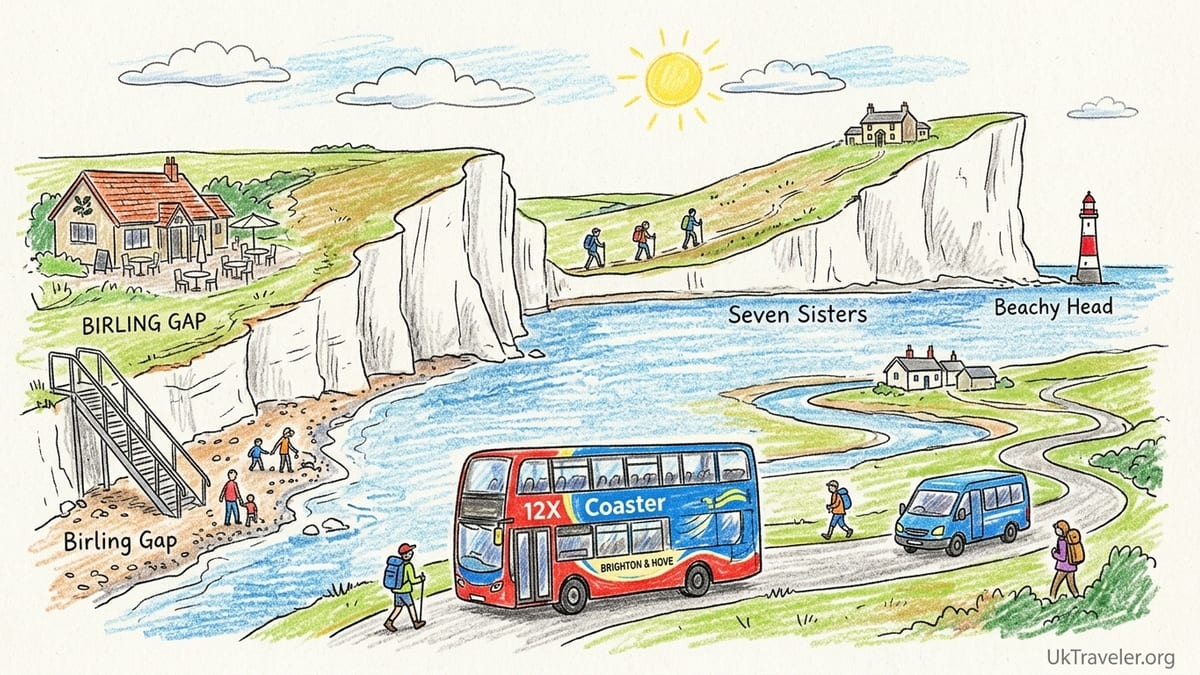
The appeal lies in the variety of viewpoints within a small area. Beachy Head is the towering chalk headland above Eastbourne, crowned by a clifftop pub and sweeping views. A little west, Birling Gap offers safe access down steps to the shingle beach and rock pools, plus a National Trust café and facilities. Beyond that, the skyline undulates across the Seven Sisters themselves toward Cuckmere Haven, where the meandering river and coastguard cottages create one of Britain’s classic sea vistas. Each touring style emphasises a different combination of these stops.
Weather adds a strong seasonal character to any visit. On clear summer days, coach groups spill out at the main viewpoints for short walks and photographs. In shoulder seasons and winter, guided Brighton minibus tours and independent hikers tend to dominate, targeting days with crisp visibility when the white cliffs contrast sharply with a steel-blue Channel. Because this coast is exposed and can be windy even in August, your choice between sightseeing and hiking format should factor in how happy you are walking long distances in changeable conditions.
By 2026, the local tourism infrastructure has caught up. Seven Sisters Country Park at Exceat has a visitor centre and café, Brighton & Hove Buses run frequent Coaster services along the coast road between Brighton, Seaford, Exceat and Eastbourne, and seasonal route 13X links Birling Gap and Beachy Head directly. Together with a cluster of guided tour providers, this makes it easier than ever to combine scenic viewpoints into one carefully planned day.
Coach and Minibus Tours from London
London-based day tours to the Seven Sisters have shifted from generic “South Downs & seaside” branding to explicitly marketing Brighton and the cliffs as the main draw. Typical itineraries depart from central London locations such as Victoria or London Bridge between 7:30 and 8:30 in the morning, travel by coach or small bus to the South Downs and return between 7:00 and 9:00 in the evening. Journey time each way is usually in the region of two to two and a half hours, depending on traffic leaving London and around Brighton.
A common full-day format combines several short walks with traditional sightseeing stops. For example, a small-group tour might start with a Downs viewpoint such as Devil’s Dyke, then continue east via the villages of Alfriston or East Dean before reaching the main coastal highlights. Guests are typically given 45 to 60 minutes at Birling Gap to walk along the cliff path or take the metal steps down to the beach, followed by shorter photo stops at Beachy Head and one of the classic viewpoints over the Seven Sisters and Cuckmere Haven. The emphasis is on variety and commentary rather than a single long hike.
Coach-based excursions often appeal to first-time visitors who want logistics handled in one booking. Prices in 2026 commonly sit in the mid-range bracket for UK day tours, with small-group minibus options usually costing more than large coaches but offering hotel pick-ups at selected London addresses and more time for questions. The trade-off is flexibility: departure times are fixed, and you share your day with a group whose walking pace and appetite for detours may not match your own.
For travellers comparing tour styles, the key questions are how active you want your day to be and how important it is to visit specific viewpoints. Many London tours promise “Seven Sisters and Beachy Head” but may prioritise easily accessed panoramas over longer cliff-top sections. If your goal is to walk a substantial part of the coastal ridge, consider whether an independent train and bus route or a specialist hiking-focused tour might suit you better than a general sightseeing circuit.
Guided Seven Sisters Trips from Brighton
Brighton has become a natural springboard for the Seven Sisters. As of 2026, several operators run half-day and full-day small-group minibus tours from Brighton city centre to Beachy Head, Birling Gap, Seven Sisters Country Park and surrounding villages. These tours typically carry 8 to 16 passengers, start mid-morning and last between five and nine hours, making them manageable even if you are staying in London and catching an early train to Brighton.
A representative full-day minibus tour will pick up outside Brighton railway station or near the seafront, then head inland to viewpoints on the South Downs before looping to the coast. Expect multiple stops: a vantage point above Cuckmere Haven, a walking section along the cliffs between Birling Gap and one of the Seven Sisters summits, and a photo stop at Beachy Head looking toward its red-and-white lighthouse. Guides often weave in geology and local history, explaining how the chalk downland formed and why coastal erosion is steadily reshaping the cliffs and the beach access at Birling Gap.
Compared with London-based tours, Brighton departures spend less time on the motorway and more time out of the vehicle. Even on a nominally “sightseeing” itinerary, you may cover three to six kilometres on foot over the course of the day, broken into short walks. Some companies advertise specialist hiking departures that tackle longer sections of the South Downs Way between the cliffs and inland ridges, suitable for moderately fit walkers who want to experience the undulating chalk landscape without navigating solo.
For independent travellers, a Brighton-based tour can be a convenient compromise: you travel from London to Brighton under your own steam, meet the guide by late morning and let them handle the local busier sections, car parks and tide times. This arrangement also insulates you from some weather-related stress. In poor conditions, a local guide can adjust the route, opting for more sheltered inland walks or extra café stops instead of an exposed clifftop stretch that feels unsafe in high winds.
Independent Train, Bus and Hike Options
For many visitors, the best way to experience the Seven Sisters is as an independent walk linked together with trains and local buses. From central London, the two usual gateways are Brighton and Eastbourne, both around 70 to 90 minutes away by rail, with frequent departures from Victoria, London Bridge and occasionally London Blackfriars. These mainline trains connect directly with the coastal bus network that serves Seven Sisters Country Park, Cuckmere Haven, Birling Gap and Beachy Head.
The most popular independent route in 2026 remains the Seaford to Eastbourne or Seaford to Exceat coastal hike, which traverses all seven of the major chalk undulations. A typical day sees you take a train from London to Seaford, walk through Seaford to the cliffs at Seaford Head, continue past the estuary at Cuckmere Haven and along the Seven Sisters towards Birling Gap, then either finish at the visitor centre at Exceat for a bus back or continue on to Eastbourne along the cliffs past Belle Tout and Beachy Head. Strong walkers usually allow six to seven hours of walking plus time for breaks, photographs and the necessary bus connections.
If that sounds too strenuous, there are shorter loop and point-to-point options. One classic moderate option is to travel by train and bus to Seven Sisters Country Park at Exceat, then follow the clifftop path to Birling Gap and either return inland through Westdean and Friston Forest or hop on a bus back to Seaford or Eastbourne. Another is to use the seasonal 13X bus, which stops at both Beachy Head and Birling Gap, to link shorter walks: you might stroll for an hour along the cliffs from Beachy Head to Birling Gap, enjoy the café and beach, then ride the bus back to your starting point.
Going independent gives you the greatest flexibility but puts the onus on you to interpret maps, bus timetables and the weather forecast. Recent guides produced by local organisations explain how to transfer between the Coaster 12 and 12X buses on the coast road and the 13X on the clifftop road, and how to use the train line between Seaford and Eastbourne to shorten or lengthen your walk. Many hikers now rely on GPS-based walking apps with offline maps to keep track of their position on the cliffs and judge whether they have time to catch their intended return train to London.
Beachy Head, Birling Gap and Cuckmere Haven Compared
Although they sit close together, Beachy Head, Birling Gap and Cuckmere Haven each offer a different style of experience. Beachy Head, towering to the east of the Seven Sisters, is primarily a viewpoint. From the roadside car park and nearby paths you can look down on the red-and-white striped lighthouse at the base of the cliffs and follow the ridge toward Eastbourne. There is a pub with panoramic windows and several short, relatively easy paths that contour along the clifftop. Most coach tours and Brighton minibus excursions include at least a photo stop here, even on days when the wind cuts the visit short.
Birling Gap, about 15 minutes’ drive west of Beachy Head, is the practical hub for many visitors. A National Trust complex houses a café, toilets, a small shop and seasonal exhibitions. Crucially, metal steps lead from the clifftop down to the wave-cut platform and shingle beach below, one of the few safe access points between Eastbourne and Cuckmere Haven. At low tide, visitors wander among rock pools and chalk boulders, always conscious that the tide and the loose chalk above mean access is limited and closures are possible. For hikers, Birling Gap is a useful halfway marker and bus stop on longer walks.
Further west again, Cuckmere Haven provides the postcard view. Here the River Cuckmere snakes toward the sea in a series of gentle meanders, framed by the white cliffs of the eastern Seven Sisters and the row of coastguard cottages on the bluff. Unlike Beachy Head and Birling Gap, you reach the dramatic viewpoint by following paths from Seven Sisters Country Park or Seaford. Many tours do not have time to walk all the way to this spot with groups, which is one reason independent hikers and Brighton-based minibus trips that prioritise walking emphasize it in their marketing.
When planning your day, think about which of these three you most want to emphasise. Coach tours from London often deliver a snapshot of each: half an hour atop Beachy Head, an hour at Birling Gap and glimpses of Cuckmere Haven from a distance. Guided Brighton trips sometimes sacrifice a stop at the Beachy Head pub in favour of a longer walk to the Cuckmere viewpoint. Independent hikers usually weave all three into a continuous coastal journey, but at the cost of more physical effort and less structured commentary.
Hiking Days versus Sightseeing Formats
In practical terms, a “hiking day” on the Seven Sisters usually means at least 10 to 12 kilometres of undulating walking, with steep descents and climbs between each of the chalk ridges. The full Seaford to Eastbourne route approaches 22 kilometres and includes repeated ascents that can feel relentless, especially in wind or strong sun. Fit walkers treat this as a satisfying full-day challenge, rewarding themselves with a meal in Eastbourne or a swim at Seaford. Hiking-focused tours and independent walkers aim for this level of immersion, planning for sturdy footwear, layered clothing, a packed lunch and the psychological acceptance that the path will rise and fall far more than a simple distance figure suggests.
Sightseeing formats, by contrast, break the coastline into manageable fragments. A London coach tour might let guests walk a short section of the path from Birling Gap along one or two of the chalk undulations before circling back, totalling perhaps two to four kilometres across the whole day. A Brighton small-group tour might combine one moderate cliff-top segment with easier village walks, viewpoints accessible from car parks and time at cafés. This approach suits visitors who want the iconic photos and the sensation of walking on the white cliffs without committing to a strenuous trek.
Choosing between the two formats depends on your priorities and group composition. Families with younger children or older relatives often find the sightseeing pattern more enjoyable, as it builds in rest stops and reduces the risk of being caught mid-route by sudden weather changes. Solo travellers and experienced hikers generally gravitate toward independent or walking-focused options, accepting that if conditions deteriorate they may need to use a bus stop several kilometres earlier than planned.
One hybrid strategy gaining popularity in 2026 is to use local buses to “edit” the walk. For example, instead of hiking the entire Seaford to Eastbourne stretch, you might bus from Seaford to Exceat to bypass the river meanders, then walk just the heart of the Seven Sisters ridge to Birling Gap before busing onward. This retains the most dramatic cliff sections without turning the day into an endurance test.
Pickup, Duration and Weather: What Really Matters
When comparing tours, pay close attention to their departure and return details. London-based excursions often advertise central meeting points near major stations rather than hotel pickups, although higher-end small-group operators sometimes include limited hotel collection within specific zones. Brighton tours, by contrast, usually focus on one or two central pickup spots such as Brighton railway station or the seafront, which suits visitors arriving by train from London. Independent travellers should factor in the time it takes to get from their accommodation to the early departure trains, especially on weekends with engineering works.
Total duration is another key factor. A guided day trip from London that claims “9 to 11 hours” typically includes four to five hours of driving, leaving around five to six hours on the ground spread across stops. Brighton minibus tours tend to run shorter, often in the five to eight hour range, which can feel more relaxed. Independent itineraries are the most elastic: you can spend anything from a gentle three-hour loop at Seven Sisters Country Park to a full 12-hour day that starts with the first train from London and ends with a late return after a long coastal hike.
Weather is the wild card on this coast and should shape both your planning and your on-the-day decisions. Wind funnels along the cliffs, making exposed sections feel much colder than inland forecasts suggest. Mist can roll in off the Channel and briefly obscure views that looked clear in Brighton an hour earlier. In summer, unshaded sections of chalk path can feel punishingly bright and hot. Sensible tour operators openly acknowledge this, sometimes swapping the order of stops or shortening cliff-top walks on the windiest days. Independent hikers should adopt the same flexibility and avoid walking too close to the edge, particularly after heavy rain when the chalk can be slippery.
For safety, build in margins around transport. If you are relying on an evening train back to London after an independent hike, aim to be at your chosen station earlier than strictly necessary so that a missed bus or a slower-than-expected pace does not cascade into last-minute stress. Guided tours mitigate this by building buffers into their timetables, but delays leaving London or congestion near Brighton can still compress time at the coastal stops, something to bear in mind if you have your heart set on a particular viewpoint.
The Takeaway
By 2026, the Seven Sisters, Beachy Head, Birling Gap and Cuckmere Haven have matured into a dedicated day-trip destination with options to match almost every travel style. London-based coach and minibus tours offer a structured, low-effort way to see the highlights, Brighton departures add more walking and local nuance, and independent train-plus-bus itineraries let confident travellers stitch together long hikes along the most dramatic sections of coastline.
If your priority is convenience and commentary, a guided tour from London or Brighton that includes both Beachy Head and Birling Gap is likely to satisfy you, even if your time actually walking on the cliffs is limited. If, instead, you dream of cresting every chalk ridge from Seaford to Eastbourne, you may be happier arranging your own transport and treating the tour market as a safety net rather than a necessity.
Whichever route you choose, success on the Seven Sisters comes down to three fundamentals: understanding the difference between hiking and sightseeing formats, checking how your chosen tour or DIY route handles key stops like Birling Gap and Cuckmere Haven, and staying realistic about the weather. Do that, and you will step off the train or coach at the end of the day with chalk dust on your boots, sea salt in your hair and the memory of one of southern England’s finest coastal landscapes etched firmly in your mind.
FAQ
Q1. Can I visit the Seven Sisters on a day trip from London without a tour?
Yes. Take a train from London to either Brighton, Seaford or Eastbourne, then use local Coaster buses to reach Seven Sisters Country Park, Cuckmere Haven, Birling Gap and Beachy Head. Many visitors hike independently using waymarked paths and offline maps.
Q2. What is the difference between tours from London and tours from Brighton?
London tours usually involve longer coach journeys and more structured sightseeing with shorter walks. Brighton tours spend less time in transit, often use smaller minibuses and typically include more walking on the cliffs and Downs within the same overall day length.
Q3. How long does a typical Seven Sisters day tour last?
Most London-based day trips run for nine to eleven hours door to door, including four to five hours of driving. Brighton departures commonly last five to eight hours. Independent hikers can shape their own days anywhere from a short three-hour loop to a full twelve-hour outing.
Q4. Do tours include Beachy Head, Birling Gap and Cuckmere Haven?
Many do, but not all to the same extent. London coach tours often guarantee Beachy Head and Birling Gap and may only see Cuckmere Haven from a distance. Brighton minibus and hiking-focused trips are more likely to walk to the classic Cuckmere Haven viewpoint overlooking the river and coastguard cottages.
Q5. Is the full Seaford to Eastbourne hike suitable for beginners?
The full Seaford to Eastbourne route is long and quite demanding, with repeated steep climbs and descents, so it is better for reasonably fit walkers with some hiking experience. Beginners often prefer shorter segments, such as Exceat to Birling Gap and back, or a one-way walk combined with a bus.
Q6. What should I wear for a Seven Sisters day trip?
Wear sturdy closed shoes with good grip, as chalk paths can be slippery, and bring layers, including a windproof jacket, even in summer. The cliffs are exposed, so sun protection, water and a warm layer are all important. Avoid walking close to the cliff edge, especially after rain or in strong winds.
Q7. Are there places to eat at the cliffs?
Yes. Seven Sisters Country Park has a café, Birling Gap has a National Trust café and seasonal kiosks, and Beachy Head has a pub and other refreshment options nearby. Many visitors still bring their own picnic so they can eat at viewpoints along the trail without relying on opening hours.
Q8. Can children and older travellers enjoy the Seven Sisters?
Yes, provided you choose the right format. Sightseeing-oriented coach or Brighton minibus tours with short walks suit mixed-age groups, while long independent hikes can be tiring. Families often enjoy exploring the beach at Birling Gap or the riverside trails around Cuckmere Haven rather than tackling the full cliff route.
Q9. What happens if the weather is bad on the day of my tour?
Most tours run in light rain and wind but may adjust routes to avoid the most exposed clifftop sections. In cases of very severe weather or official warnings, tours can be rescheduled or cancelled according to the operator’s policy. Independent visitors should always check local forecasts and be prepared to shorten walks or switch to lower-level paths.
Q10. Is it safe to walk along the cliff edge at the Seven Sisters?
Safety on the cliffs relies on keeping back from the edge, staying behind warning signs and following local advice. Chalk cliffs are subject to erosion and occasional sudden collapses, so it is wise to maintain a sensible distance, supervise children closely and avoid leaning over or sitting on the very edge, even in fine weather.