


South West England has long been the classic British family holiday destination, and in 2026 its holiday-park scene is more competitive than ever. A live regional database now indexes around 69 parks across Cornwall, Devon and Dorset alone, while specialist family-travel sites maintain fresh shortlists of the best parks with pools, kids’ clubs and beach access. For parents, the variety is a blessing, but it can also make choosing where to stay feel overwhelming. This guide breaks down how the main types of accommodation and facilities compare in the South West, with concrete examples and realistic price expectations for school-holiday stays.
Why the South West Dominates the UK Family Holiday Park Scene
From Newquay’s surf beaches to Dorset’s Jurassic Coast, Cornwall, Devon and Dorset combine sea, scenery and easy days out in a way few other UK regions can match. That is why so many of the country’s most family-focused park operators cluster here, from big names such as Haven, Parkdean Resorts and Park Holidays UK to independent parks and luxury lodge resorts. A 2026 regional index of touring and holiday parks lists close to 70 family-suitable parks across the South West, underlining just how strong the market is in this corner of England.
For families, that density of parks translates into choice. Within a short drive of Newquay alone you can compare large, full-on resorts with indoor waterparks and kids’ entertainment to smaller rural parks with just a modest pool and playground. In Devon, Dawlish Warren, Woolacombe and Paignton offer several beach-adjacent parks, while in Dorset the arc between Weymouth, Poole and Swanage is lined with coastal sites, many with direct or very short walks to the sand. This competition has pushed standards up, particularly around accommodation quality and family facilities.
Recent round-ups from family-focused sites in 2026 highlight that parents are now looking for more than a basic caravan and a small pool. Demand has shifted toward parks with proper indoor leisure complexes, splash zones, adventure play areas and structured kids’ clubs, alongside decent on-site dining so families are not forced to drive out every evening. In response, operators have steadily upgraded many of their South West parks, closing older units, refurbishing pools and adding lodge-style accommodation to meet expectations.
The result is that you can now fine-tune your choice according to what matters most: all-out entertainment, quieter nature, or a balance of both. To help, the sections below compare caravans and lodges, wet- and dry-weather facilities, beach access and real-world pricing, weaving in specific examples from Cornwall, Devon and Dorset.
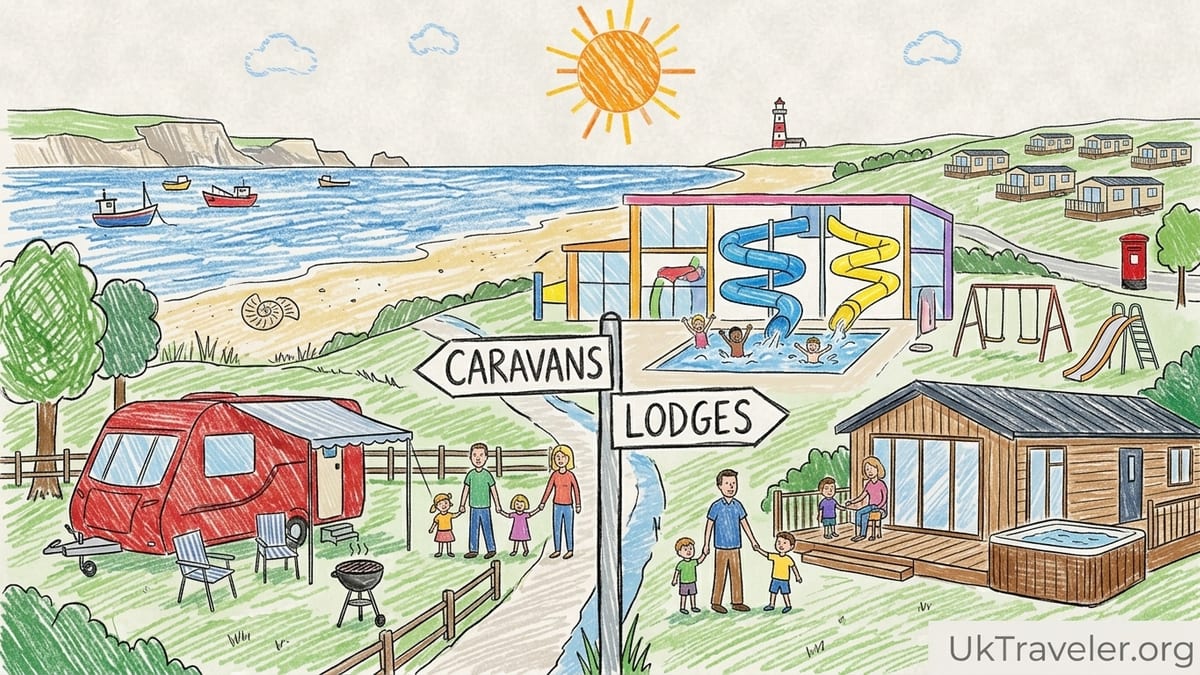
Caravans Versus Lodges: What Families Really Get
Traditional caravans remain the workhorse of South West holiday parks, especially in Cornwall where coastal land is at a premium. Typical family units sleep four to eight, with compact bedrooms, a small living area and a galley kitchen. Parks such as White Acres Holiday Park near Newquay and St Minver Holiday Park near Rock offer multiple caravan grades, from older “standard” models to newer “platinum” vans with double glazing and decking. For many families, these upgraded caravans hit the sweet spot: more comfort than the cheapest options without the price leap into full lodge territory.
Lodges, by contrast, are pitched as the South West’s more spacious and luxurious option. Cornwall’s Sandymouth Holiday Resort, north of Bude, combines modern lodges with an indoor pool and large pirate-ship playground, while The Park, Cornwall near Mawgan Porth has a mix of eco-lodges and cottages with access to indoor and outdoor pools and family-friendly facilities such as free loan of travel cots and high chairs. In Devon, Dawlish-area sites and some East Devon parks have steadily expanded their lodge stock, and Dorset’s higher-end parks near Poole and Swanage now showcase timber-clad lodges with hot tubs and wraparound decking.
Inside, lodges tend to feel closer to small holiday homes than caravans. Expect wider living spaces, better insulation, often two bathrooms, and proper dining tables, which matter when you are dealing with rainy days and mealtime chaos. For example, family-focused reviews of North Devon’s lodge parks around Woolacombe describe being able to comfortably seat a family of five inside on wet evenings, something that can be more of a squeeze in standard caravans.
The trade-off is price. In late July or August, a mid-range two or three bedroom caravan at a popular Cornish or Devon park might run to several hundred pounds for a long weekend and noticeably more for a full week, with prices climbing sharply in the school summer holidays. Lodge units on the same park commonly cost a significant premium, especially if they add hot tubs or sea views. For budget-conscious families, the smarter move is often to choose a higher-grade caravan on a park with strong facilities, rather than stretch to a lodge and then struggle with activity and dining costs once on site.
Pools, Splash Zones and Rainy-Day Cover
Given the South West’s famously unpredictable weather, indoor pools are one of the main things differentiating holiday parks. Many of Cornwall’s larger family parks, such as White Acres near Newquay and Hendra Holiday Park on the edge of the town, feature large indoor complexes with flumes, toddler areas and session-based swim times that spread demand. Newperran Holiday Resort, also near Perranporth, is promoted by regional operators as a strong option for families who want a heated indoor pool with shallow zones and relaxed swim sessions suited to younger children rather than high-adrenaline slides.
In Devon, a recent 2026 guide to seaside holiday parks highlighted that parks around Woolacombe and Dawlish Warren almost all include at least one indoor pool, with some adding an outdoor pool for sunny days. Dawlish-area parks, including long-established family resorts in the town itself, lean heavily on all-weather water play as a selling point, which can make a major difference on a week when the rain sets in. Around Paignton and Torbay, several parks combine indoor pools with small splash zones or water playgrounds for under-10s.
Dorset’s family parks tend to be slightly more mixed, with some sites near Weymouth and Poole offering proper indoor pools and others focusing purely on outdoor pool areas. Sandford Holiday Park near Wareham, for example, has been singled out in a 2026 parent review for its combination of indoor and outdoor pools plus a full schedule of kids’ activities, which helped to fill an entire week for a family with a three-year-old. At the quieter end of the market, rural Dorset parks such as South Lytchett Manor major on clean facilities and play areas but may not offer large pool complexes.
For families planning a South West park stay, the practical takeaway is to always check whether there is an indoor pool and what the configuration looks like. A single small indoor pool without a toddler section will feel crowded fast in peak season. Look for mentions of specific features such as toddler pools, shallow “beach-entry” ends, or segregated flume zones. Parks that publicise structured swim sessions, from family fun hours to quieter adult swims, often manage crowds better and can make swimming with younger children less stressful.
Kids’ Clubs, Entertainment and Quiet-time Balance
Kids’ clubs and evening entertainment are another area where South West parks diverge. At the bigger end of the scale, Cornish parks close to Newquay and Perranporth, and Devon’s large coastal sites like Devon Cliffs near Exmouth, run full daily schedules with mascot-led clubs, sports coaching, craft sessions and nightly showtime in on-site venues. Families choosing these parks can effectively spend most of their week on site, moving from pool to playground to kids’ club to early-evening entertainment without ever starting the car.
Independent parks or those positioned as quieter alternatives often take a lighter-touch approach. At The Park, Cornwall, the emphasis is on natural play, smaller organised sessions and family time rather than booming cabaret every evening. Similar thinking can be seen at a number of family-run Devon parks along the Jurassic Coast and around Sidmouth and Seaton, where daytime activity programmes might include bug hunts, storytelling or modest craft sessions but evenings are more subdued, sometimes limited to a small bar or restaurant with a children’s corner.
Parents’ reviews across 2025 and 2026 suggest that the right choice depends heavily on children’s ages and temperaments. Families with primary-school-age children who like structure and socialising tend to value full kids’ clubs and busy entertainment, even if the noise and crowds are higher. By contrast, parents of easily overwhelmed toddlers or neurodivergent children often prefer smaller parks or those where activities are optional rather than constantly on loudspeakers. A Devon-focused parenting blog in early 2026, for instance, praises smaller parks near Dawlish Warren for feeling calmer than the biggest branded sites while still offering enough to do on rainy days.
It is also worth checking whether kids’ clubs are included in the stay or come with per-session fees. Many South West parks bundle basic children’s activities into the overall tariff, but some specialist experiences, such as high-rope courses, archery or surf lessons, come at extra cost. Over a week, especially at peak summer prices, these add-ons can quietly increase your spend, so factor them into the overall budget when comparing parks and accommodation types.
Beach Access, Coast Paths and Off-site Adventures
One of the South West’s biggest attractions is how quickly you can shift from caravan or lodge to beach, and this is where location matters as much as on-site facilities. In Cornwall, the area around Perranporth and Newquay is particularly rich in parks with short drives or direct walking access to sandy beaches. Some parks sit on clifftops with sea views and stepped paths down, while others, slightly inland, trade immediate access for quieter surroundings but remain within a ten to fifteen minute drive of major beaches and surf schools. Widemouth Bay Caravan Park near Bude, for example, occupies a hilltop position overlooking the bay and markets itself on easy access to surf and sand, combined with an indoor pool and kids’ club back on site.
Devon presents a similar picture, with clusters of parks near Woolacombe, Ilfracombe and Croyde in the north, and Dawlish Warren, Teignmouth and Torbay in the south. A 2026 feature on “holiday parks by the sea” for Devon parents highlighted how some of Woolacombe’s parks are set just inland, relying on a short drive or bus ride to the beach, while others sit immediately behind the dunes. Families who want to nip back to their caravan for naps or forgotten toys tend to value a short, traffic-light-free walk more than an extra slide in the pool complex.
Dorset’s Jurassic Coast gives its parks a different feel. Here, several sites sit within walking distance of fossil-hunting beaches such as Charmouth or near the sheltered waters of Weymouth Bay. Sandford Holiday Park, a few miles inland, trades direct beach access for a central location between multiple coastal options and countryside, which recent guests have cited as a plus when planning day trips. Families can spend one day on the sand near Poole or Bournemouth, another exploring Corfe Castle or Swanage Railway, then retreat to the relative calm of the park in the evening.
Whichever county you choose, it pays to look beyond the headline “near the beach” language and examine distances in minutes rather than vague phrases. A five to ten minute stroll down a gentle lane is a very different prospect from a twenty minute drive through summer traffic. Check also how the coastal setting interacts with wind and weather; exposed clifftop parks can be spectacular on a fine day but breezy and cool in shoulder seasons, while valley-set parks a little inland often feel warmer and more sheltered for small children.
On-site Dining, Self-catering and Local Food
Most South West holiday parks are designed around self-catering, which keeps costs down for families and suits picky eaters. Even basic caravans come with small kitchens and fridges, and larger lodges often provide full-size ovens and dishwashers. But on-site dining has improved markedly in the region, reflecting a wider shift in UK holiday expectations. For instance, Tregoad Holiday Park in south-east Cornwall, winner of a 2025 industry award, has invested in its Stargazy Bar & Grill, promoted for its family-friendly menu built around local produce and classic pub favourites.
Cornish and Devon parks increasingly emphasise local ingredients, from Cornish fish and chips to Devon ice cream and farm-shop style breakfasts. Many parks now run one main restaurant or bar plus a takeaway window, which can be a lifesaver after a long day on the beach. In Dorset, family reviews of parks around Weymouth and Poole frequently mention the convenience of on-site pizza, burger or carvery options, especially for multi-generational groups where not everyone wants to head into town each evening.
That said, park food remains, on average, more expensive than supermarket self-catering, and menus in many mid-market parks are still fairly predictable. Families on tighter budgets often plan a pattern of one or two on-site meals per week, supplemented with simple cooked dinners at the caravan or lodge and occasional outings to local pubs or fish-and-chip shops. Towns such as Bude, Newquay, Dawlish, Paignton and Weymouth all have dense clusters of casual family-friendly restaurants and takeaways, giving you plenty of choice if you are willing to drive or walk a little further.
A small but important detail for parents of young children is how parks handle dietary needs and children’s options. Larger South West parks increasingly highlight vegetarian, vegan and gluten-free dishes on their menus, and many now provide microwaves or bottle-warming facilities in public areas of their main complexes. High chairs are widely available in on-site restaurants, but at busier parks it can be worth arriving early in the evening to avoid queues and the loudest peak times.
School-holiday Pricing and How to Stretch Your Budget
Across Cornwall, Devon and Dorset, school-holiday pricing is the single biggest shock for many parents comparing parks. Guides and forums in early 2026 consistently note that the same caravan that might be offered at a moderate rate in May or late September can cost several times more during the late July to August peak. Parks near top beaches or with the most extensive facilities tend to sit at the upper end of the range, and lodge units attract a further premium. As one parent on a UK forum put it in spring 2026, if you have school-age children and want a South West holiday park in August, “do not expect to have much money left” after paying for the basics.
There are, however, ways to tilt the value equation back in your favour. First, consider the shoulder seasons. For families with pre-schoolers or flexible term dates, June, early July and early September can offer significantly lower accommodation prices and quieter facilities while still delivering warm-enough weather for beaches and outdoor pools. A three or four night short break in this window at a mid-range park in Devon or Dorset can sometimes cost what a single weekend might in peak August at a headline Cornish site.
Second, think carefully about where you place your money: into accommodation or into experiences. Choosing a good-value caravan on a park with an indoor pool and basic entertainment, then allocating spare budget to boat trips, surf lessons or visits to nearby attractions such as theme parks and aquariums, can be more satisfying than stretching to a top-tier lodge but then cutting back on everything else. This balance is particularly relevant in Cornwall, where parks often sit within easy reach of well-known attractions, so you are not reliant solely on on-site activities.
Finally, make use of the fact that the South West has a dense cluster of competing parks. Comparison sites and local tourism boards track dozens of parks across Cornwall, Devon and Dorset, with filters for indoor pools, kids’ clubs, distance to beach and pet-friendly options. Because there are around 69 indexed parks in the region, you can often find a park one notch inland or a few miles along the coast that offers very similar facilities to a famous name at a noticeably lower price, especially if you are prepared to compromise slightly on immediate sea views.
The Takeaway
Cornwall, Devon and Dorset sit at the heart of the UK’s family holiday-park scene, and in 2026 the choice has never been broader. Whether you are picturing a classic caravan beside a surf beach, a lodge in quiet countryside with a pool complex, or something in between, there is almost certainly a South West park that fits. The key is to focus on the practical trade-offs: caravan versus lodge comfort, the presence of a proper indoor pool, the style and intensity of kids’ clubs, realistic access to the beach, and how much you plan to spend once you are there.
For families who value all-out facilities and on-site entertainment, larger branded parks near Newquay, Perranporth, Woolacombe and Dawlish Warren remain strong bets, provided you budget for peak pricing. Those seeking calmer surroundings might look to independent parks near Mawgan Porth, Sidmouth, Seaton or inland Dorset, where the pace is slower but pools and play areas still keep children happy. Across the region, recent upgrades mean that even mid-market parks now offer far more comfort and weatherproofing than their equivalents a decade ago.
Ultimately, the “best” family holiday park in South West England is the one that matches your children’s ages, your tolerance for noise and crowds, and your budget. By comparing real-world details such as pool layouts, kids’ club schedules, distance to the nearest beach and school-holiday pricing, you can use the region’s rich choice to your advantage and build a stay that feels both memorable and manageable. With a little planning, the South West’s caravan and lodge parks can still deliver that timeless combination of sand between toes, tired but happy children and evenings that end with the sound of waves and distant entertainment drifting across the site.
FAQ
Q1. Which South West county is best for a first family holiday park trip? Cornwall is often the first choice for its famous beaches and dense cluster of parks, but Devon and Dorset can be better value and slightly less crowded in peak season, so the best option depends on your budget and how far you are happy to drive.
Q2. Are lodges in Cornwall, Devon and Dorset worth the extra cost over caravans? Lodges usually offer more space, better insulation and sometimes extras such as hot tubs, which can be worth the premium for larger families or off-season stays, but a higher-grade caravan on a park with strong facilities is often the better-value choice in the school summer holidays.
Q3. How important is having an indoor pool at a South West holiday park? Given the region’s changeable weather, an indoor pool is a major advantage, especially with younger children, as it provides a guaranteed activity on rainy days and helps avoid the frustration of being stuck in a small caravan when the weather turns.
Q4. Do all family holiday parks in the South West have kids’ clubs? Most larger parks in Cornwall, Devon and Dorset run some form of kids’ club and evening entertainment, but smaller or more rural sites may offer only informal activities or playgrounds, so always check the programme if structured clubs are important to your children.
Q5. How close to the beach are typical South West holiday parks? Some parks sit directly behind dunes or on clifftops with paths to the sand, while others are a short drive inland, so you should look for specific walking or driving times in minutes rather than relying on vague “near the beach” descriptions.
Q6. When is the cheapest time to visit Cornwall, Devon or Dorset holiday parks with kids? Prices are generally lower outside the main school holidays, so late spring and early autumn can offer much better value, while midweek short breaks in June or September often cost significantly less than equivalent stays in late July or August.
Q7. Can I manage without a car at a South West holiday park? It is possible at a few parks close to towns or with good public transport links, but many sites are rural and designed around car access, so having a car gives you far more flexibility for beach trips, supermarket runs and days out.
Q8. How far in advance should I book a South West family holiday park for school holidays? For popular weeks in late July and August, especially at headline parks near Newquay, Woolacombe or Weymouth, it is sensible to book several months in advance, while off-peak stays usually allow more flexibility and occasional last-minute deals.
Q9. Are South West holiday parks suitable for families with babies or toddlers? Many parks cater well to very young children with toddler pools, play areas, high chairs and the option to hire cots, but it is still worth checking details such as stair gates in lodges and the availability of quiet accommodation areas away from late-night venues.
Q10. What should I budget for extras once I have paid for accommodation? Beyond your caravan or lodge, plan for food, fuel, attraction tickets, occasional paid activities such as water sports or high ropes, and perhaps laundry and takeaway meals, with the exact amount varying widely depending on how often you eat out or book on-site experiences.