


I thought a rental car would unlock North West England. Over ten days I drove between Manchester, Liverpool, rural Cheshire, Lancashire, the Forest of Bowland and the Lake District, chasing coastal sunsets and fell walks. What I actually discovered was a region where driving can be joyous and freeing on one day, then slow, stressful and expensive the next. This is the story of the roads I genuinely drove, what it cost, when the car transformed the trip, and where I now wish I had simply taken the train or hopped on a bus.
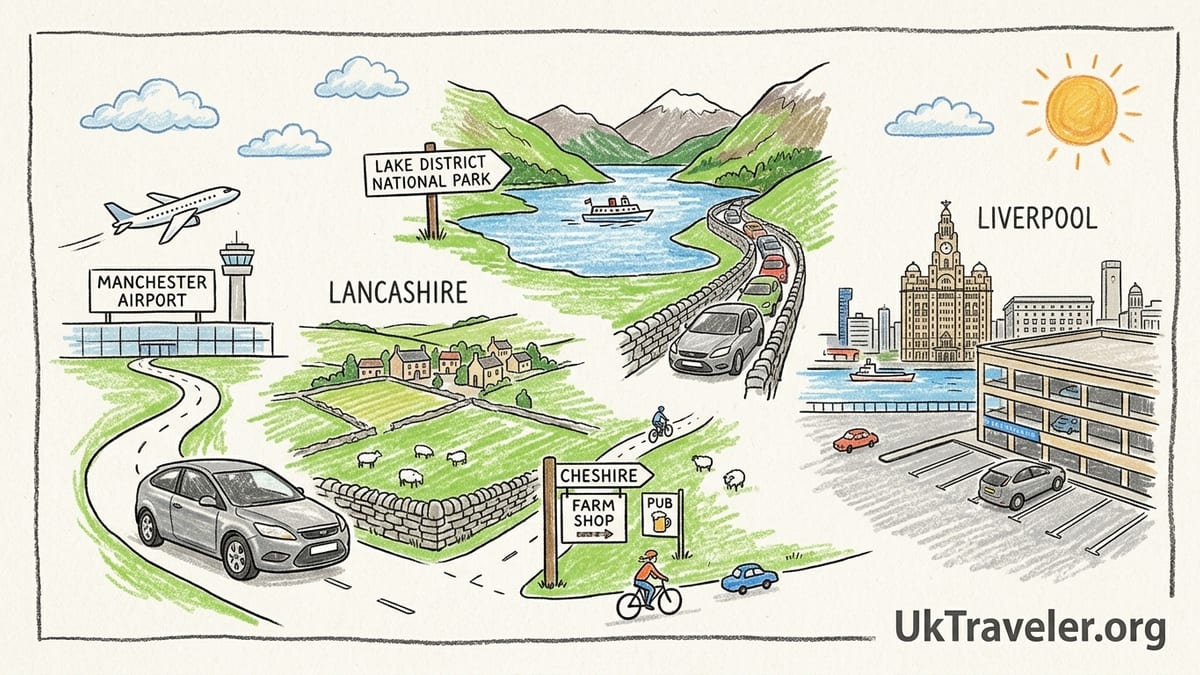
Picking Up The Car In Manchester: Costs, Categories And First Lessons
My trip began at Manchester Airport, because that is where the widest choice of rental cars and longer opening hours tend to be. A week-long compact car with basic insurance at the airport in autumn 2026 was advertised from about £14 per day for advance bookings, with more recognisable brands charging closer to £30 to £40 per day once you add a sensible fuel policy and basic excess cover. I chose a compact hatchback similar to a Ford Focus rather than a tiny city car. That decision mattered later on the motorway when overtaking lorries in heavy rain felt controlled rather than hair-raising.
I declined the expensive “zero excess” insurance from the rental desk and instead relied on a separate excess insurance policy bought in advance in my home country, which cost significantly less per day for the same week. At the counter, the agent reminded me that any damage on narrow Lake District lanes would still be charged to my credit card, then reclaimed from the insurer, a subtle preview of the driving to come. I also added an extra driver so my partner could share the longer motorway stretches across Lancashire.
Leaving Manchester Airport, I immediately joined the M56, then the M60 ring road skirting the city. The first lesson came quickly: even before reaching countryside, traffic around Manchester in the late afternoon can turn a theoretical 45 minute hop into more than an hour of patient queueing. The sat-nav constantly suggested shaving minutes by diving off at unfamiliar junctions into urban shortcuts, but I stuck to the main motorway. This would become a theme of the trip: ignoring clever-looking alternatives in favour of the more predictable A roads and motorways.
Fuel costs added up more quickly than expected. On this trip, petrol on the motorway services hovered around £1.60 to £1.70 per litre, compared with a few pence less in supermarkets on the edge of towns. Over ten days and roughly 600 to 700 miles of mixed motorway and rural driving, I spent a little over £120 on fuel. That felt reasonable for the ground covered, but it was also a reminder that every scenic detour had a real, measurable cost.
Rural Cheshire And The Joy Of Quiet A Roads
From Manchester I headed south into rural Cheshire, broadly following the A556 and then smaller A roads toward Knutsford and the countryside around Tatton Park. Here, having a car genuinely transformed the trip. Public transport does exist, but reaching smaller villages and farms without a vehicle would have required multiple bus changes and limited the ability to stop at viewpoints or farm shops along the way.
The roads through Cheshire were wide by British rural standards, usually with clear markings, hedges set back from the carriageway and frequent lay-bys. This was some of the least stressful driving of the entire trip. Passing places were rarely needed because most of these roads allow two vehicles to pass comfortably, unlike later in the Lake District. We stopped easily at a country pub with a small car park and at a farm shop selling local cheese, neither of which would have been practical without the car.
Parking costs in rural Cheshire were modest. Tatton Park charged a car park fee that felt proportionate for a full day’s visit, and several villages offered either free on-street parking or inexpensive council-operated car parks. Because we slept outside the biggest cities for this first stretch, the car was in constant use during the day and parked for free at a guesthouse overnight, which made the rental feel like good value.
This early phase set an expectation that North West England would be relaxed to drive. The main challenge was remembering to stay patient behind tractors and cyclists rather than attempting risky overtakes. The real shock only arrived when we aimed the car north toward Liverpool and then the Lake District, where density, tourists and older road layouts changed the equation.
Liverpool And Manchester: Paying To Park A Car We Barely Used
From Cheshire we drove into Liverpool on the M56 and M62, crossing the Thelwall Viaduct and then easing into the web of city dual carriageways. The traffic was busy but predictable, and sat-nav directions to a city-centre hotel near the waterfront were straightforward. The mistake was assuming we would want the car in the city at all. Once parked in an underground hotel garage, at about £20 per night, the car did not move for nearly 36 hours.
In Liverpool, we walked almost everywhere. The Albert Dock, the central museums and the Georgian Quarter all sat comfortably within a 20 to 25 minute stroll from the hotel. For the one journey further out toward Anfield, a bus and short walk would have been more than adequate. Instead, we paid city-centre parking fees while the car sat idle, a pure sunk cost on top of the rental rate. The money would have covered train tickets from Manchester and a city-only stay, picking up a rental later.
The same pattern almost repeated in Manchester. On our return leg we chose a hotel close to the Northern Quarter and paid for a multi-storey car park, again around £20 for overnight parking. The car remained in its bay while we explored on foot, dipping only briefly into it to move to a cheaper lot when the first one reached its maximum daily rate. In both cities, rail connections from elsewhere in the region are strong, and I finished the trip wishing we had done at least Liverpool without a car, collecting the vehicle only when it was time to head into rural Lancashire.
Driving inside the cities taught a second lesson: while the motorway network around Manchester and Liverpool is efficient, inner-city one-way systems, bus lanes and complex junctions demand more attention than they are worth for a short visit. For future trips I would time car collection and drop-off for the edges of these cities, or stick strictly to rail for urban sightseeing days, leaving driving for the countryside legs.
Across Lancashire To The Coast: Good Roads, Long Days
Leaving Liverpool, we joined the M58 and then the M6 northbound, with the plan to see a slice of the Lancashire coast and then cut inland. The motorway driving itself was straightforward. The car’s adaptive cruise control took much of the strain between Warrington and Lancaster, and even with service-station queues we covered the distance in around 1.5 hours. Motorway service parking is free for short stays, but the food and fuel premiums are noticeable, so we limited stops to quick coffee breaks and toilets.
Things became more nuanced once we left the M6 around junctions near Lancaster to explore the lower-key coast. Smaller A and B roads toward places such as Glasson Dock and the saltmarsh edges of Morecambe Bay gave some of the best views of the entire trip. These roads were mostly two-way but narrower, sometimes with no centre line and soft verges leading directly to drainage ditches. In several places our sat-nav suggested shaving time by taking unsigned lanes that did not feel like sensible through routes for a standard hire car.
The day we attempted to connect Liverpool, a Lancashire coastal wander and an evening arrival in the Lake District became the most exhausting of the entire journey. On paper, the total driving distance looked manageable. In practice, pulling off the M6 for slow meanders through small coastal villages, then rejoining for only short hops before leaving again, turned it into more than five hours behind the wheel once traffic, photo stops and a supermarket visit were counted.
By the time we rolled into a supermarket car park near Lancaster for fuel and supplies, we had already been in and out of the car repeatedly. Although parking at the coast itself was often free or limited to a few pounds in small council-operated lots, the real cost was fatigue. It became clear that trying to combine Liverpool, the Lancashire coast and an arrival into the Lakes all in one day was too much. Next time, I would choose between a coastal day or a dedicated city-to-Lakes transfer, not both.
Forest Of Bowland: Where Driving Truly Made The Trip
After Lancaster we dipped into the Forest of Bowland, an officially designated National Landscape of moorland, fells and deep valleys in north-east Lancashire. Here, the car was not just convenient; it was essential to the experience. Public transport into the interior is sparse, with buses mainly serving the edges and market towns, while the scenery that defines Bowland stretches along narrow high passes and remote lanes.
We followed A roads to Clitheroe and then smaller roads toward Dunsop Bridge and the Trough of Bowland. The Trough road is steep in places, single track with passing places and tight bends framed by dry-stone walls. It is also one of the most atmospheric drives in the region, with views that unfold suddenly after each crest. Speeds were low, often under 30 miles per hour, but unlike in the busier central Lakes, traffic here was light enough that pulling into passing places felt unhurried.
This was where sat-nav almost caused a genuine problem. Eager to save a few minutes, the device suggested leaving the more established road to cut across on what turned out to be a minor lane that narrowed to grass in the middle and blind summits with no room for error. After one nerve-wracking kilometre we stopped at the first gate entrance, turned around carefully and rejoined the main road. It cost us ten minutes but probably saved a scratched car and a difficult reverse down an invisible farm track.
Driving in the Forest of Bowland came without steep parking costs. Villages such as Dunsop Bridge and Slaidburn offered small paid car parks or on-street parking by donation, and several viewpoints simply had lay-bys where one could stop briefly. In this landscape, the car felt proportional to the road network, and journeys took roughly the time the map suggested. For anyone comfortable with rural UK driving, this is where a rental car really earns its keep, unlocking quiet valleys, dark-sky viewpoints and circular walks unreachable by bus.
Into The Lake District: Narrow Lanes, Parking Stress And Regrets
From Bowland we rejoined the M6 near Lancaster and continued north toward Kendal, then into the Lake District National Park. The motorway stretch from around Lancaster services to Kendal typically takes around 30 to 40 minutes, and from there the A591 carried us toward Windermere and Ambleside. The Lake District National Park Authority actively encourages visitors to arrive by train and then explore using buses, boats and bikes, partly because many of its roads are narrow and car parks at popular spots can fill early on busy days.
The contrast with Bowland was immediate. The A591 itself is a solid trunk route, but as soon as we turned off toward smaller valleys and lakes, such as Langdale and Borrowdale, the roads squeezed into historic country lanes. Often they were only just wide enough for two smaller cars to pass at slow speed, with stone walls, hedges and occasional sharp drainage gullies leaving no forgiveness for drifting too far left. Passing places were more frequent than in Bowland, but the volume of traffic was significantly higher.
Our biggest driving mistake came when trying to squeeze too much into one day. We left Ambleside mid-morning for a walk near Buttermere, optimistically trusting a sat-nav prediction of around 1 hour 15 minutes via Keswick. Traffic through the heart of the park, roadworks near road constrictions and slower vehicles on the passes stretched that to almost 2 hours. By the time we arrived, the main car park was full. We circled to a smaller pay-and-display a little further away, which also filled just after we grabbed one of the last remaining spaces. The parking fee itself was not exorbitant, but arriving late meant a truncated hike and a long, sleepy drive back.
The journey illustrated how deceptive Lake District distances can be. It may take around 1.5 hours to drive from Manchester to the southern Lakes along modern motorways and A roads, yet going from somewhere like Kendal to a remote valley such as Wasdale can also take around 1.5 hours of slow progress along narrow, twisting roads. Map distance alone is meaningless when much of the route winds along lanes where 25 miles per hour is fast. Several times the sat-nav invited us onto smaller “shortcuts” between valleys that locals avoid in favour of slightly longer but more reliable A and B roads.
Lakeside Parking, Internal Transport And When I Wished For A Bus
Parking around the central Lakes quickly became the single biggest recurring cost after accommodation. In places such as Ambleside, Grasmere and Keswick, council and private pay-and-display car parks often charged by the hour, with full-day tickets for cars typically in the high single digits or low double digits in pounds. That might be fair for a long day walk, but on shorter stops to pick up groceries or wander around a village, we paid several pounds each time to avoid fines. Over four days in the Lakes we spent roughly £60 on parking alone.
On our second day we decided to park the car at our accommodation near Windermere and use buses and boats instead. We walked down to the lake, took a boat across to a landing point near Wray Castle and then connected with a local bus to Hawkshead. The experience was calmer than wrestling with traffic and hunting for village parking, and it allowed us to enjoy one-way walks without worrying about returning to the car. The National Park and local tourism bodies highlight these linked boat and bus services as a key way to reduce congestion, and after one stress-free day we understood why.
The day after, however, impatience set in. Keen to reach a trailhead early, we reverted to the car. A queue into a popular lakeside car park near Grasmere, then a near miss squeezing past a large van on a lane barely wider than the two vehicles, left us wishing we had simply taken the Stagecoach 555 or another local bus and started walking a little further from the car park. The time saved was negligible, the stress greater, and we paid both for parking and for the privilege of worrying about returning before the ticket expired.
There were even moments when I envied travellers without cars. They could step off a bus in the centre of Keswick or Ambleside, walk straight into their accommodation and then make day trips entirely on foot, by bus or by boat. By contrast, we circled blocks hunting for suitable spaces, lugged luggage from multi-storey car parks and factored parking charges into every decision to stop for a coffee or an unscheduled stroll.
Drive Times, Sat-Nav Pitfalls And The Myth Of The Perfect Loop
Looking back at the route as a whole, what stands out is not a neat circular “perfect loop” but a slightly messy zigzag shaped around actual roads and realistic drive times. Manchester Airport to rural Cheshire was around an hour on A roads. Cheshire to Liverpool took another hour or so, largely on motorways. Liverpool to Lancaster and the Lancashire coast, with our scenic detours, stretched past five hours behind the wheel even though the crow-flies distance looked much shorter. Lancaster to Bowland was under an hour, yet we comfortably spent another half day in the car exploring internal valleys. Bowland to Windermere took perhaps 90 minutes along the M6 and then A591, but internal trips within the Lakes were frequently as long as the city-to-park transfer.
Sat-nav had both benefits and traps. On motorways and major A roads it was invaluable for warning about congestion and lane changes. In rural areas it often fixated on mathematically short routes using single-track lanes and unclassified roads. After our experience in the Forest of Bowland, we adopted a new rule: on unfamiliar ground, if a lane looks narrower than the wing mirrors are comfortable with, ignore the device and stay with the thicker lines on the paper map or the more prominent A and B roads on the digital display. This slowed us down slightly but paid dividends in reduced stress.
I also learned to factor in realistic average speeds when planning each day. On motorways such as the M6 you can expect to cover ground quickly when traffic flows, but in the Lakes and some Bowland valleys, 25 to 30 miles per hour often feels fast. A supposed 30 mile hop can easily take 70 to 90 minutes once you account for slow vehicles, photo stops, sheep on the road and giving way in passing places. Starting early helped avoid the worst of the congestion into popular car parks, but we still misjudged at least twice, arriving after lots had filled.
The psychological impact of these miscalculations was tangible. Aiming to see “one more valley” or “one more coastal village” in a day routinely pushed actual arrival times into early evening, compressing time for walks and forcing us to choose between a hurried meal and collapsing in the room. I finished the trip less interested in crafting a tidy loop on the map and more committed to anchoring future itineraries around fewer overnight bases, with larger sections done by rail and bus to allow the car-free days to breathe.
The Route I Would Drive Next Time, And Where I Would Switch To Rail
If I repeated this North West England journey, I would start very differently. First, I would arrive in Manchester by train or air as before, but I would not pick up a rental car immediately. Instead, I would take the train from Manchester Airport or Manchester Piccadilly to Liverpool for two nights, enjoying the city entirely on foot and by bus, leaving my budget for museums, food and perhaps a ferry rather than hotel parking.
From Liverpool I would travel back to Manchester by rail, spend another night without a car exploring the Northern Quarter and museums, then collect a rental from a city-edge or railway-station location on the morning I planned to leave for rural Cheshire and Lancashire. This would remove two days of paid parking and city driving from the equation, while still giving me a car for the countryside segments where it genuinely adds value.
With the car collected, my countryside route would look familiar but slower and more deliberate. I would revisit rural Cheshire, then drive north to stay one or two nights on the fringes of the Forest of Bowland, using the car for scenic loops along established A and B roads and resisting the lure of single-track shortcuts. Rather than trying to dip to the coast and into the Lakes on the same day, I would choose a dedicated coastal overnight stay near Lancashire’s quieter shore or spend the entire day in Bowland before driving directly to the southern Lakes the following morning.
In the Lake District, I would still bring the car to reach less accessible valleys, but I would limit driving days to specific objectives: perhaps one for a quieter valley like Eskdale or the western lakes, where public transport is thinner, and another for a transfer day between bases. For central hubs such as Windermere, Ambleside or Keswick, I would aim to park the car at the accommodation and commit to using buses, boats and my feet for at least half of my days, in line with the National Park’s encouragement to let public transport carry some of the load.
The Takeaway
This road trip through North West England revealed two truths at once. A rental car can absolutely unlock the quieter countryside of Cheshire, Lancashire, the Forest of Bowland and some of the lesser-known Lake District valleys and coastal corners. It gave us dawn access to remote trailheads, freedom to stop in small villages, and memorable drives over high passes that would have been awkward or impossible on public transport alone.
Yet the same car also drained money and energy inside the cities and busiest parts of the Lakes. We paid for multi-storey parking in Liverpool and Manchester while walking everywhere. We fed pay-and-display machines around Windermere and Keswick on days when the car could have stayed at the guesthouse while we used buses and boats. We allowed sat-nav to nudge us onto uncomfortable lanes and tried to link too many destinations into single days, underestimating how long short-looking routes really take in this landscape.
If you are planning a similar journey, my strongest recommendation is to separate the city and countryside halves of your trip in your mind. Think of Liverpool and Manchester as rail-and-bus destinations, where a car is at best a burden. Treat rural Cheshire, Lancashire’s coast and the Forest of Bowland as places where a modest, well-insured rental really shines, but where patience and respect for narrow roads are as important as horsepower. In the Lake District itself, consider arriving by train, hiring a car only for specific days, and otherwise embracing the network of buses and boats that the National Park is keen for visitors to use.
Most of all, resist the urge to design a perfect loop on your map. Instead, build in short driving days, accept that a direct-looking 30 miles in the Lakes can equal a full city-to-park transfer, and leave space for the kind of slow, serendipitous moments that turn a simple drive between North West England’s cities, fells and coasts into a journey you will remember for years.
FAQ
Q1. Do I really need a car for a North West England trip that includes the Lake District?
Not for the entire trip. A car is very useful in rural Cheshire, Lancashire countryside, the Forest of Bowland and some quieter Lake District valleys, but in Liverpool, Manchester and the central Lake District hubs you can comfortably rely on trains, buses, boats and walking. Splitting the trip into car-free city days and focused driving days works best.
Q2. What type of rental car is best for these roads?
A compact hatchback similar to a Ford Focus is a good balance. It has enough power for motorways and hills but is still small enough to thread through narrow country lanes and tight village streets. Very large SUVs can feel cumbersome on single-track roads, while very small city cars may feel underpowered and less stable on busy motorways.
Q3. How much should I budget for fuel, tolls and parking?
On a ten-day itinerary with roughly 600 to 700 miles of mixed driving, expect to spend around £100 to £150 on petrol at current prices, depending on your route and car. There are no tolls on the main motorways you are likely to use in this region, but parking in cities and popular Lake District villages can easily add another £10 to £20 per day if you move the car frequently.
Q4. Is driving in the Lake District really that difficult?
Driving in the Lake District is not technically difficult for experienced drivers, but it can be stressful because many internal routes use narrow country lanes with stone walls, sharp bends and frequent passing places. Traffic is heavier than in other rural areas, and popular car parks fill early, so patience and early starts are more important here than advanced driving skills.
Q5. Can I rely on sat-nav in rural Lancashire, Bowland and the Lakes?
You can use sat-nav for broad guidance, especially on motorways and major A roads, but in rural areas it often prefers mathematically shorter routes that use single-track lanes and unclassified roads. It is wiser to cross-check with a paper map or a zoomed-out digital map and stick to clearer A and B roads unless you are very confident on tight, enclosed lanes.
Q6. When did you most regret having a car on this trip?
The biggest regrets were in Liverpool and central Manchester, where we paid for expensive hotel and multi-storey parking but then walked everywhere, and on a day in the central Lakes when we drove into congested villages, queued for car parks and paid repeated short-stay fees when buses and boats would have been easier and cheaper overall.
Q7. When did having a car genuinely improve the experience?
The car made the most positive difference in rural Cheshire, on the quiet lanes and high passes of the Forest of Bowland, when exploring parts of the Lancashire coast, and on specific days in the Lake District when reaching more remote valleys and trailheads that are poorly served by public transport.
Q8. How long do key drives actually take compared with what the map suggests?
Motorway sections such as Manchester to the southern Lakes can be around 1.5 hours in normal conditions, but internal routes like Kendal to Wasdale can also take around 1.5 hours because of narrow, twisting roads and lower average speeds. Short-looking hops of 25 to 30 miles inside the National Park can easily take 70 to 90 minutes.
Q9. How can I avoid parking problems in the Lake District?
Arrive early for popular spots, consider basing yourself in a village and walking or using buses from there, and plan a couple of fully car-free days where you leave the vehicle at your accommodation and rely on the bus and boat network. Buying longer-stay or all-day tickets rather than paying for repeated short stops also helps to control costs.
Q10. What route would you recommend for a first-time visitor combining cities and countryside?
Arrive in Manchester, visit Liverpool and central Manchester without a car, then collect a compact rental for a loop through rural Cheshire, the Forest of Bowland and one or two areas of the Lake District. Drop the car before your final nights in a city. This split approach gives you the freedom of the road where it matters, while avoiding the cost and stress of driving and parking in the busiest urban and lakeside areas.