


Southern England has become one of Europe’s most polished regions for multi-day walking holidays. From chalk downland ridges to wave-battered cliffs and soft pastoral Cotswold scenery, almost every major trail now comes with turn-key holiday packages, reliable luggage transfer and a deep pool of guesthouses and inns. For travellers, that maturity brings choice: not just which path to walk, but whether to go guided or self-guided, carry a full pack or a day bag, and how much comfort to build into the budget.
Southern England’s Big Five Walking Routes at a Glance
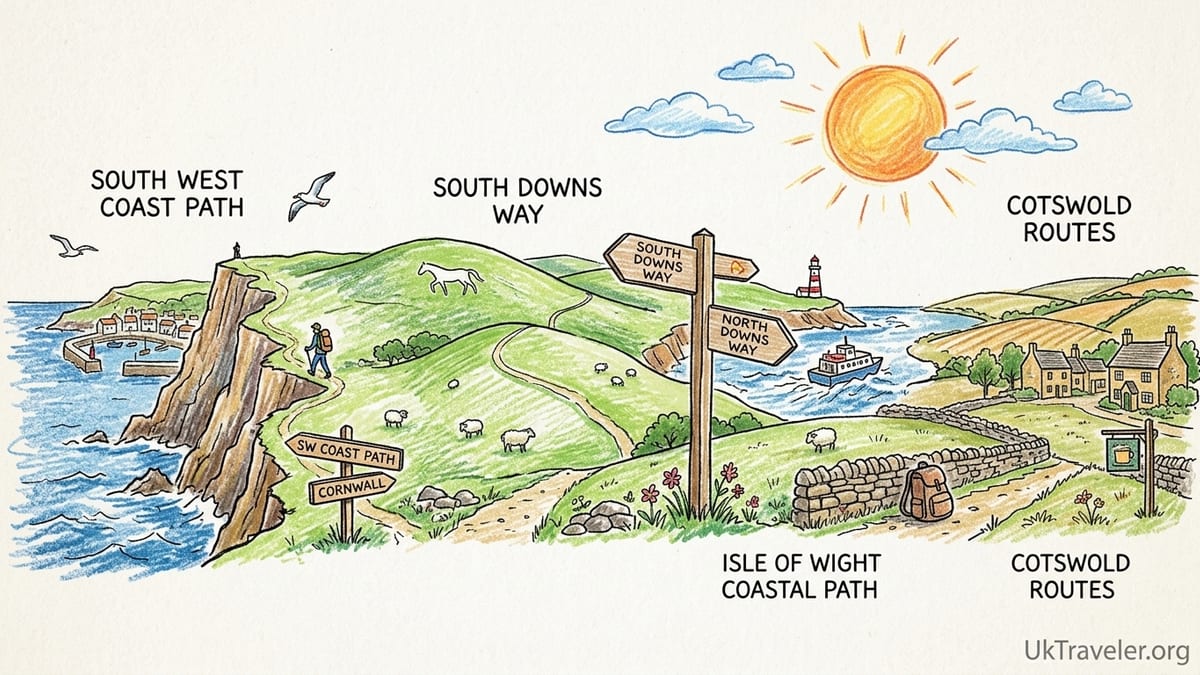
Most first-time walkers in Southern England focus on five headline options. The South West Coast Path delivers rugged Atlantic and Channel views along Cornwall, Devon and Dorset. The South Downs Way and North Downs Way offer high chalk ridge walking within easy reach of London. Offshore, the Isle of Wight Coastal Path circles a compact island with regular ferries. Inland, classic Cotswold routes link honey-stone villages and country inns.
In practical terms these routes vary significantly in length and character. The South West Coast Path is Britain’s longest National Trail at about 630 miles, far beyond a typical first holiday, so most travellers book a curated section such as St Ives to Penzance or Plymouth to Exmouth for 4 to 10 nights. The South Downs Way runs for roughly 100 miles between Winchester and Eastbourne, while the North Downs Way covers about 153 miles between Farnham and Dover. The Isle of Wight circuit is a more manageable 65 to 70 miles, and popular Cotswold itineraries often span 40 to 100 miles depending on whether you follow a short Cotswold taster or a longer Cotswold Way section.
All five now support a mature ecosystem of walking operators. Companies such as Contours Walking Holidays, Macs Adventure, Encounter Walking Holidays, Big Trail Adventures and various regional specialists bundle accommodation, daily luggage transfer and route notes into self-guided packages. On the South West Coast Path and the Downs, baggage-transfer firms like Luggage Transfers work independently of tour operators, moving bags between thousands of hotels, B&Bs and campsites across the region, so walkers can also plan their own itineraries and simply bolt on bag transport from around £20 to £25 per day.
Price points reflect this maturity. Short South Downs Way packages of 3 to 5 nights frequently start around £460 to £760 per person for self-guided trips in standard B&Bs, rising beyond £1,000 for full-route itineraries with 9 to 10 nights or for higher-grade hotel stays. Comparable Isle of Wight breaks over a long weekend can cost less, while full coastal or Cotswold journeys with upgraded rooms, transfers and add-on sightseeing days can move well above £1,200 per person in peak season.
Duration & Itinerary Styles: From Long Weekends to Fortnight Adventures
When you compare routes, duration is one of the clearest differentiators. The Isle of Wight Coastal Path is perhaps the most flexible for travellers constrained by time. Operators commonly offer 3-night breaks focusing on a scenic quarter of the island, such as the stretch between Yarmouth, Freshwater Bay and Ventnor, alongside 6 or 7-night packages that complete the full circuit with daily distances of 10 to 13 miles. With fast ferries from Southampton and Portsmouth, it is genuinely feasible as a long-weekend escape from London or the Midlands.
The South Downs Way sits in a middle bracket. Many self-guided specialists suggest 7 to 9 nights to walk the full 100 miles between Winchester and Eastbourne at a comfortable pace, averaging 11 to 15 miles per day. Some sell condensed 6-night itineraries for fitter walkers. Shorter breaks usually cover a highlight section, such as three or four nights between Amberley, Devil’s Dyke and the Seven Sisters chalk cliffs, ideal for first-time long-distance walkers who want a taste without committing to the full route.
The South West Coast Path and selected Cornwall routes lean toward longer trips, though you can still find 3 or 4-night “taster” sections. In Cornwall, for example, a common format is a 5 to 7-night journey between Padstow and St Ives or between St Ives and Penzance, linking fishing harbours, sandy bays and cliff-top headlands. Companies such as Encounter Walking Holidays package individual segments of about 50 to 70 miles, while others allow you to join multiple sections for 10 to 14-day itineraries. A full end-to-end journey typically requires 6 to 8 weeks, so it is rarely sold as a single package.
The North Downs Way and Cotswold routes occupy a similar space to the South Downs in terms of duration. Full North Downs itineraries via Canterbury or Folkestone often run to 10 to 13 days, but you will also see 5 or 6-night “Surrey Hills” or “Kent Downs” sections marketed as standalone products. In the Cotswolds, operators carve the landscape into multiple products: a 6-night “Cotswold Highlights” route might link Chipping Campden, Broadway and Bourton-on-the-Water, while a complete Cotswold Way journey from Chipping Campden to Bath usually runs to 10 or 11 nights.
Trail Difficulty: Cliffs, Chalk Ridges and Gentle Cotswold Valleys
Difficulty is where differences become most apparent and where a commercial comparison is most useful. Broadly, the South West Coast Path is the most demanding in terms of daily ascent and descent. Even on seemingly benign map sections, the route repeatedly drops to sea level at coves and river mouths before climbing back to the cliffs. Travellers used to flat walking often find that a “moderate” 12-mile coastal day feels as hard as a 15 to 18-mile day on the Downs. Operators tend to label much of the Cornish and North Devon coast as moderate to strenuous, and they warn first-time clients to allow more time than they expect.
The South Downs Way and North Downs Way are easier underfoot but still involve rolling ascents. The paths follow chalk escarpments and open downland, so climbs are longer but generally less abrupt than cliff paths. The South Downs Way, at roughly 100 miles, is often described by operators as “moderate” rather than strenuous for reasonably fit walkers. Many stages involve between 300 and 600 metres of ascent spread across the day, and the open ridgeline means good, fast walking on firm surfaces in dry weather.
The Isle of Wight Coastal Path is something of a hybrid. Sections around Freshwater Bay, the Needles and Ventnor can feel quite steep and rugged, while parts of the north and east coast follow promenades, seawalls and easy country paths. Most commercial itineraries keep daily distances conservative, recognising that not every visitor is a seasoned hiker. That makes the island particularly attractive to mixed-ability groups, where some travellers want a challenge and others prefer shorter or easier days, and where occasional use of local buses can trim down tougher stages.
Selected Cotswold routes, finally, are the most forgiving for newcomers. The Cotswold escarpment has its climbs, especially around Broadway Tower and Leckhampton Hill, but many popular itineraries meander through valleys and rolling farmland rather than chasing the highest ground. Operators commonly rate Cotswold routes as easy to moderate, highlighting relatively modest daily ascent combined with excellent waymarking and well-trodden paths. If you are unsure whether you can manage the coastal undulations or Downs ridges, a Cotswold-based holiday is a gentle entry point.
Accommodation & Local Character: Pubs, Inns and Seaside B&Bs
Across all five areas, accommodation choice is a major strength and a key selling point for holiday companies. On the South West Coast Path, especially in Cornwall, walkers typically overnight in seaside B&Bs, small hotels or pub rooms in villages such as St Ives, Porthleven and Mevagissey. In more remote stretches, such as the North Devon coast between Hartland and Bude, options can be thinner, so operators may use farm B&Bs or country inns a short taxi ride off the path. This variety is part of the appeal, but it does require careful booking in high season.
The South Downs Way and North Downs Way run through well-settled countryside close to London and the south coast, so you will find a dense network of inns in places like Amberley, Bramber, Alfriston and Wye. Many walking packages highlight nights in historic coaching inns and traditional pubs with rooms, which add atmosphere and reduce reliance on taxis off the trail. The flipside is that single-night stays can be in high demand on summer weekends, which is why many walkers are happy to let an operator negotiate allocations and minimum-stay requirements on their behalf.
The Isle of Wight Coastal Path has its own flavour, mixing Victorian seaside hotels in Ryde and Shanklin with guesthouses in Ventnor and small inns in Yarmouth or Brighstone. Because the island is a popular family beach destination, coastal resorts can feel busy in school holidays, but this also means a wide price spectrum, from budget guesthouses to boutique seafront hotels. Multi-base holidays, where you stay in one or two coastal towns and use local buses to reach trailheads, are increasingly common and can be cost-effective for couples or families.
Cotswold walking routes lean heavily into village charm, with stone-built guesthouses, farmhouse B&Bs and smart country inns. Places such as Broadway, Winchcombe and Painswick cater to a mixed market of walkers and leisure tourists, so standards are generally high. Several higher-end operators offer “comfort” or “luxury” grading on Cotswold itineraries, swapping simple B&Bs for four-star inns and manor houses, which can easily push a week’s walking holiday beyond £1,200 per person in peak months.
Luggage Transfer, Dog-Friendliness and On-the-Ground Logistics
Daily luggage transfer is now standard on commercial self-guided itineraries across Southern England, and it is a major reason many walkers are happy to spend extra on a package. On the South West Coast Path, dedicated baggage firms cover the entire route and many inland spurs, typically charging from the low twenties per bag per day within weight limits around 20 kilograms. The same companies often also cover the South Downs Way, North Downs Way and selected Cotswold and Devon routes, which means you can switch operators or design a bespoke itinerary while relying on a single luggage contractor.
Dog-friendliness varies more by accommodation than by trail. The Isle of Wight Coastal Path and the Downs are both popular with UK dog walkers, and many pubs and small hotels take dogs in at least a subset of rooms, sometimes with an extra cleaning fee per night. South West Coast Path sections that pass through seaside resorts and surfer towns often have dog-friendly B&Bs and holiday lets, though local beach restrictions in high summer can complicate sea-swimming plans. In the Cotswolds, pet policies range from warmly welcoming to strictly no-dogs, so checking in advance is essential if you are travelling with a companion animal.
Logistics for reaching the trails are straightforward but differ by route. The South Downs Way and North Downs Way are exceptionally well-connected by rail and bus, with trailheads at Winchester, Farnham, Eastbourne and Dover all on mainline routes. The Isle of Wight requires a short ferry transfer from Portsmouth, Southampton or Lymington, but crossings are frequent and many holiday companies offer add-on transfers from mainland train stations. South West Coast Path segments can feel more remote; while towns like Plymouth, Penzance and Exmouth have direct trains, smaller ports may require a change of bus or a pre-booked taxi, which is often arranged by the operator in packaged holidays.
For independent walkers, several regional websites and local tourism bodies maintain up-to-date information about bus links and seasonal ferry services that connect points on the South West Coast Path and around the Isle of Wight. In practice, many travellers blend self-organisation with commercial services: they plan their own stages using guidebooks, then book luggage transfer and perhaps one or two tricky taxi legs to avoid backtracking on busy roads or tackling unsafe river crossings.
Guided vs Self-Guided: How the Holiday Products Differ
Commercially, Southern England walking holidays fall into two broad categories: guided group tours and self-guided packages. Self-guided products dominate the market on the South West Coast Path, South Downs Way, North Downs Way, Isle of Wight and Cotswolds. Companies such as Contours, Macs Adventure and Big Trail Adventures typically include pre-booked accommodation, daily luggage transfer, route notes or GPS tracks, and an emergency helpline, leaving you to walk at your own pace. These trips start in the range of a few hundred pounds per person for short breaks, scaling with length, season and accommodation grade.
Guided holidays are often sold by slightly different operators, including larger walking clubs and specialist adventure brands. On the South Downs and in the Cotswolds you will find centre-based guided weeks where groups stay in a single country house or hotel and join daily walks led by leaders, returning to the same bed each night. Prices can be similar to or higher than self-guided packages once guiding, evening meals and social elements are factored in. On the South West Coast Path, fully guided inn-to-inn trips exist, but they tend to be more niche and operate on limited dates, often charging a premium over comparable self-guided weeks.
The choice between guided and self-guided is often less about fitness than about confidence and preference. For many first-time visitors, a self-guided South Downs or Cotswolds holiday feels comfortable: waymarking is clear, mobile reception is generally good, and daily distances are manageable. On more physically demanding or exposed sections of the South West Coast Path, travellers who are anxious about navigation or walking alone might prefer a guided group, particularly outside the main summer season when path traffic thins out and daylight hours are shorter.
In a mature market, the lines can blur. Some operators now offer semi-guided arrangements, such as a hosted inn on the Downs where a local guide accompanies the group on two days while the remaining walks are self-guided using provided notes. Others provide optional add-on guiding for a single challenging stage, like the cliffy stretch around Hartland or the Seven Sisters chalk cliffs, for guests who otherwise walk independently.
Cost Comparison: What You Get for Your Money
With Southern England’s walking holiday sector now well established, pricing has become relatively transparent. For shorter South Downs Way products of three to five nights, entry-level self-guided packages often cluster between about £460 and £760 per person, based on two people sharing en-suite rooms on a bed and breakfast basis in shoulder season. Extending to a full 9 or 10-night South Downs itinerary, or requesting higher-end hotel upgrades, reliably pushes costs into four figures per person, particularly if you are travelling in late spring or high summer.
On the Isle of Wight, 3-night packages focused on a portion of the coastal path are typically priced below comparable South Downs breaks, making the island attractive for budget-conscious walkers who still want a packaged experience. A week-long Isle of Wight circuit with luggage transfer and mid-range guesthouses usually costs broadly similar to a medium-length South Downs or Cotswold itinerary, though exact prices vary widely with ferry-inclusive deals, room standards and season.
South West Coast Path sections in Cornwall and Devon show more variation. Highly scenic, well-known stretches such as Padstow to St Ives or St Ives to Penzance command a premium in peak months, both because accommodation in these tourist towns is expensive and because single-night bookings are hard to secure. For a 6 or 7-night self-guided package with luggage transfer, it is reasonable to expect pricing at or above the level of South Downs and Cotswolds standards, especially if you are staying in sea-view rooms or boutique guesthouses. Less famous sections, such as parts of North Devon or south Cornwall away from resort hubs, can be marginally cheaper.
Cotswold routes present perhaps the widest spread. Basic-grade Cotswold highlights itineraries can undercut Downland trips, particularly outside school holidays. However, if you opt for “comfort” or “luxury” versions staying in manor houses, spa hotels and destination restaurants, the same week of walking can rival or exceed the cost of a South West Coast Path holiday. Independent travellers with time to plan can often reduce costs by booking accommodation directly and using third-party luggage transfer, but that saving comes at the price of more research and less flexibility if plans change mid-trip.
The Takeaway
Choosing between Southern England’s marquee walking routes is not a matter of finding a single “best” trail but of matching your expectations, budget and appetite for challenge. The South West Coast Path offers the most dramatic scenery and the greatest physical test, ideal for confident walkers who want big views and do not mind punchy climbs. The South Downs Way and North Downs Way offer classic ridge-top walking with easy transport links and plenty of inns, making them natural first choices for visitors arriving via London.
The Isle of Wight Coastal Path brings sea views in a compact package that works well for long weekends and mixed-ability groups, while Cotswold routes prioritise village charm and gentler terrain. Across all of them, the market has matured to the point where you can buy everything from a three-night sampler with luggage transfer included to a ten or twelve-night end-to-end itinerary, guided or self-guided, dog-friendly or not.
If you value simplicity and support, a self-guided package on the South Downs, Cotswolds or Isle of Wight is a robust starting point, with transparent pricing and well-honed logistics. If you crave wilder edges and do not mind steeper days, targeted South West Coast Path sections deliver exceptional reward. Whatever you choose, Southern England now offers a walking holiday product to match almost every level of ambition, all within a few hours of London’s main airports and rail hubs.
FAQ
Q1. Which Southern England trail is best for a first-time walking holiday?
For most first-timers, the South Downs Way, North Downs Way or a Cotswold highlights route works best, thanks to moderate terrain, clear waymarking and dense accommodation options.
Q2. How many days should I allow for the South Downs Way?
A comfortable full-route South Downs Way holiday typically takes 7 to 9 walking days, with some operators offering 6-day versions for fitter walkers and shorter 3 to 4-night highlight sections.
Q3. Is the South West Coast Path too hard for casual walkers?
Much of the South West Coast Path is steep and demanding, but shorter, carefully chosen sections with conservative daily distances can suit casual walkers who are prepared for regular climbs.
Q4. Can I bring my dog on these walking holidays?
Yes, many accommodations on the South West Coast Path, South Downs, North Downs, Isle of Wight and Cotswolds accept dogs, though availability is limited and you should confirm pet-friendly rooms when booking.
Q5. Do I need a guided group, or is self-guided enough?
On most Southern England trails, self-guided holidays are sufficient for reasonably confident walkers; guided groups mainly appeal to solo travellers, those who enjoy social walking, or visitors nervous about navigation.
Q6. How much should I budget for a one-week walking holiday?
For a 6 or 7-night self-guided trip with mid-range B&Bs and luggage transfer, many travellers budget roughly the mid to high hundreds of pounds per person, with costs rising for longer routes or upgraded hotels.
Q7. Is luggage transfer worth paying for?
For most people it is, especially on the South West Coast Path and longer Downs routes, as walking with only a daypack significantly reduces fatigue and makes back-to-back walking days more enjoyable.
Q8. Which trail is easiest to reach by public transport?
The South Downs Way and North Downs Way are the easiest, with trailheads in Winchester, Farnham, Eastbourne and Dover all served by frequent mainline trains from London and other major cities.
Q9. Can I complete the Isle of Wight Coastal Path in a long weekend?
Completing the full circuit in a single long weekend is ambitious; most visitors either tackle a particularly scenic quarter in 3 nights or allow 5 to 7 nights to walk the whole island at an easier pace.
Q10. When is the best time of year to walk these routes?
Late spring and early autumn are often ideal, offering long daylight, generally good weather and fewer crowds, though summer brings the liveliest atmosphere in coastal resorts and Cotswold villages.