


Booking a self guided walking holiday on the South West Coast Path can feel overwhelming. At 630 miles from Minehead in Somerset to Poole in Dorset, the choice of sections, daily mileage, B&B quality and luggage transfer options quickly multiplies. The good news is that there are now mature, well tested holiday packages with luggage transfer on every stretch of the trail, so you can focus on choosing the right region, budget and walking intensity rather than worrying whether your bags will arrive.
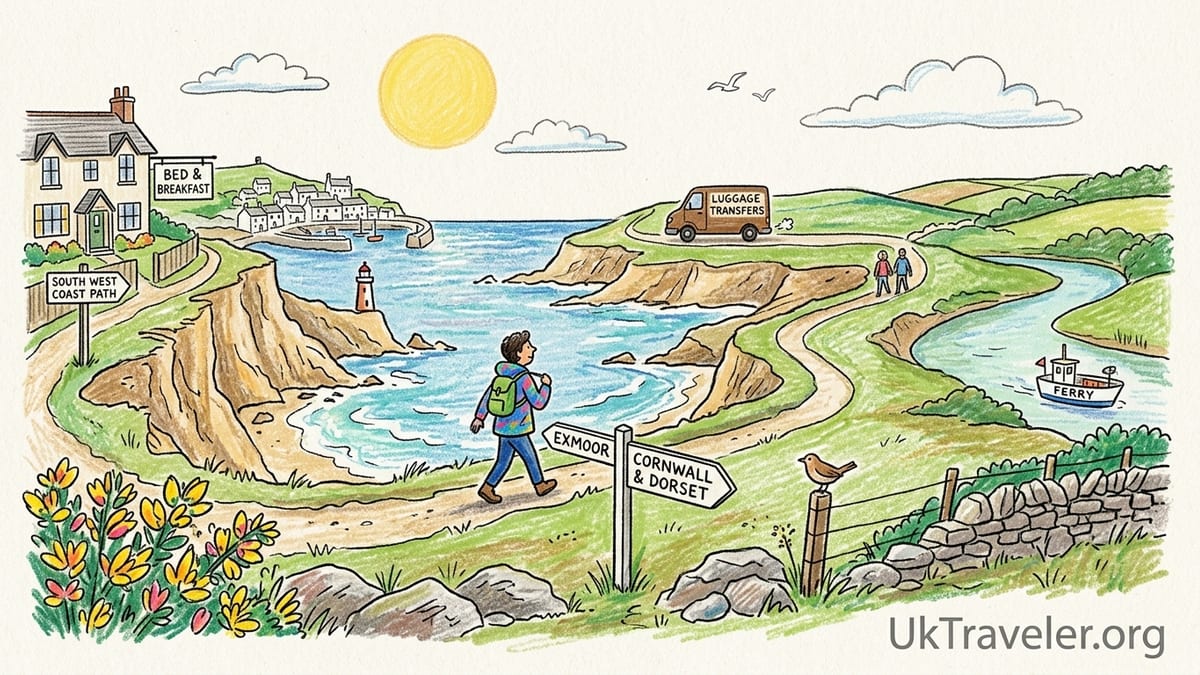
How self guided Coast Path packages work
Most South West Coast Path walking holidays sold today follow a similar template. You walk independently with detailed route notes and GPX files, stay in pre booked B&Bs or small hotels, and use a dedicated luggage transfer service so that your main bag travels between overnights while you carry only a day pack. Companies such as Encounter Walking Holidays and Absolute Escapes package popular sections like Minehead to Westward Ho or St Ives to Penzance into fixed itineraries, while the baggage specialists Luggage Transfers and Hassle Free Hiking move bags for both tour operators and DIY planners.
Pricing currently clusters in a fairly narrow band. The official trail organization highlights an 8 night Minehead to Westward Ho section at around £160 per person per night including accommodation, breakfast, baggage transfer and route materials, and a 7 night Cornwall coast itinerary around £1,060 per person based on two sharing. Long established baggage companies advertise transfers from roughly the high teens to low twenties per bag per day when booked direct, with typical weight limits around 18 to 20 kilograms per item. On top of that, expect to pay out of pocket for lunches, dinners, drinks and any optional taxis.
Within that broad framework, the key differences between holiday packages lie in average daily mileage, the steepness of the terrain, whether you prefer small harbours and fishing villages or remote cliffs, and how easy it is to get to your starting point without a car. Breaking the decision down into the main geographic sections North Devon and Exmoor, North Cornwall, West Cornwall, South Cornwall, South Devon and Dorset makes it much easier to match a package to your fitness and travel style.
North Devon & Exmoor: Minehead to Westward Ho
The classic way to begin the South West Coast Path is with an 8 or 9 night self guided holiday between Minehead and Westward Ho, usually covering around 85 to 90 miles. Commercial packages on this stretch commonly work out at roughly 10 to 12 miles per day, but the raw numbers hide the difficulty. This is some of the most rugged terrain on the whole trail, especially the Exmoor cliffs between Porlock and Combe Martin and the big ascents around Great Hangman. Operators often describe this as a “strenuous” or “challenging” section even at modest daily distances, and it suits reasonably fit walkers who are already comfortable with repeated steep ups and downs.
Accommodation standards are generally high in North Devon and Exmoor, with a strong B&B culture in towns like Minehead, Porlock, Lynmouth, Ilfracombe and the villages around Hartland. Self guided packages tend to use well reviewed guesthouses, pubs with rooms and small hotels within walking distance of the trail, many of which are used to Coast Path walkers and offer drying rooms, early breakfasts and packed lunches. Because the area has a long tourism history, there is usually a choice of mid range and slightly more upmarket options if you specify a higher budget when booking.
Luggage logistics on this stretch are straightforward. Luggage Transfers and similar companies cover the route continuously and work behind the scenes for most of the holiday operators. Transfers are usually limited to one bag per person, and many commercial holidays include the baggage costs in the nightly rate rather than itemising them. For example, an 8 night Minehead to Westward Ho package at around £160 per person per night will typically bundle in all bag movements between properties as well as taxi transfers where the trail and accommodation are slightly offset.
Public transport is better here than many visitors expect. Minehead connects to Taunton by frequent buses, giving easy rail access from London and the Midlands. At the far end, Westward Ho is close to Barnstaple and Bideford, with buses onward to Exeter and national rail links. Some packages include or can add private transfers back to your car or to the nearest station, but if you are comfortable with buses you can usually keep extra transport costs modest.
North Cornwall: Westward Ho to Padstow and Newquay
North Cornwall, often sold in itineraries from Westward Ho or Bude through to Padstow, Newquay or St Agnes, offers the archetypal wild cliff walking many people picture when they think of the South West Coast Path. Daily distances in commercial packages here need careful attention. Because the terrain around places like Hartland Quay, Crackington Haven, Boscastle and Tintagel features constant short, steep climbs, many self guided holidays aim for 10 to 13 miles a day for fit walkers and 7 to 10 miles for those who prefer a steadier pace. If you are used to 15 to 20 mile days on gentler trails, it is wise to scale back on this coast.
Accommodation choice on the North Cornwall stretch is a mix of small seaside hotels, traditional inns and walker friendly B&Bs in resorts such as Bude, Port Isaac and Padstow. Quality is generally good but there are fewer alternatives than in Devon, and in high season the best located properties often fill months ahead. Many North Cornwall packages therefore build in at least one two night stay to reduce pressure on bag transfers and secure stronger accommodation at key points. Rest days in Padstow or Newquay are popular, giving time for boat trips or a long lunch in a harbour restaurant before continuing.
Luggage transfer is very well established in this region. Major baggage operators serve hundreds of accommodations along the route every season, and most B&Bs are set up with clear instructions for bag labels and pick up times. Expect baggage costs, whether included in your package or paid direct, to be similar to other sections, typically in the low to mid twenties per bag per day for ad hoc bookings and a little less when bundled via a holiday company. Because some overnight stops are in small hamlets, certain itineraries incorporate short taxi links from the path to inland guesthouses, which will be pre arranged and included in the package price.
Transport to and from North Cornwall is marginally more complex than North Devon but still workable without a car. Bude, Tintagel and Boscastle are served by regional buses from Exeter, Plymouth or Bodmin Parkway rail stations. Padstow and Newquay both connect to the rail network through nearby stations on the Newquay and St Columb Road branches. Many holiday companies provide planning notes that explain exactly which train and bus combinations to use on arrival and departure days, which can be a deciding factor if you value a frictionless start and finish.
West Cornwall: St Ives, Land’s End and the far west
West Cornwall covers the spectacular arc between St Ives and Penzance, often extended eastward towards Falmouth or north towards Newquay. This area is one of the most popular for shorter self guided walking holidays because it combines dramatic scenery with compact stages and excellent public transport. A typical 7 night package might cover St Ives to Penzance at 7 to 10 miles per day, possibly with a rest or sightseeing day around Land’s End or St Michael’s Mount, and is often priced in the same ballpark as the Cornwall itinerary highlighted by the trail association at a little over £1,000 per person.
The walking here is still undulating but generally slightly less punishing than the steepest North Cornwall or Exmoor sections. The stretch between St Ives and Zennor is rugged and slow going underfoot, but east of Land’s End the gradients ease somewhat, allowing relaxed half days through fishing villages like Mousehole and Newlyn. That makes this section a strong candidate for travellers who want the coastal drama but also time to linger over cream teas, galleries and gardens rather than chasing big mileages.
West Cornwall has some of the most characterful accommodation on the entire path. Packages frequently feature whitewashed harbourside inns, boutique guesthouses in St Ives and Penzance and small hotels with sea views. Walker focused extras such as flexible breakfast times, early check in and drying rooms are common, and many properties will refresh water bottles or provide picnic ingredients. Because this is prime holiday territory, prices at the nicer end reflect demand, and coastal view rooms can attract a notable supplement, but they also lift the trip from simple trek to coastal holiday.
Luggage transfer in West Cornwall is seamless. The main baggage companies originated here and now move tens of thousands of bags each season across hundreds of properties. With the rail line running directly into St Ives and Penzance, and frequent mainline trains to London and Bristol, arrival and departure logistics are among the simplest on the trail. That combination of easy access, atmospheric accommodation and manageably short walking days explains why West Cornwall regularly tops lists of the best introductory sections for international visitors.
South Cornwall: Roseland, Falmouth and the soft south coast
South Cornwall, particularly the Roseland Peninsula, Falmouth Bay and the coast towards Plymouth, offers a softer, greener alternative to the exposed north. Self guided packages here often run from around Falmouth or St Mawes towards Fowey or Looe across 6 to 8 nights, with average daily distances of 9 to 12 miles. The walking features more woodland, creeks and estuaries and fewer relentless cliff staircases, so it is generally graded as moderate rather than strenuous, although there are still regular short climbs.
One distinctive feature of South Cornwall is the number of mandatory ferry crossings on the South West Coast Path, such as the short hops across the Fal and Helford rivers. Holiday companies factor these into your route notes and often provide current timetables, but you will normally pay the small fares locally. Ferries can slightly complicate daily planning in low season when frequencies reduce, so spring to early autumn packages are more common here.
Accommodation in South Cornwall is a mix of waterfront B&Bs, traditional village inns and a growing number of contemporary small hotels in places like Falmouth. Many providers along this stretch participate in the South West Coast Path Association’s “Way Maker” scheme, which simply indicates businesses located close to the trail rather than an official star grading. In practice, the standard of mid range properties is good, with many owners used to single night stays and early breakfasts for walkers catching ferries.
Baggage transfer coverage is strong across South Cornwall, with regional companies that specialise in Devon and Cornwall working alongside full trail operators. If you prefer a linear holiday that avoids any motorised transfers during walking days, it is worth checking the small print. In some estuary areas, paths and accommodation do not line up perfectly, so a handful of packages include very short taxi journeys from the ferry to inland guesthouses. Arrival and departure are straightforward, with rail access to Falmouth, Truro, Liskeard and Plymouth and regular buses to smaller coastal settlements.
South Devon: estuaries, coves and rolling countryside
South Devon picks up where South Cornwall leaves off, with routes typically threading between Plymouth, Salcombe, Dartmouth, Brixham and Exmouth. This section is famous for beautiful coves, sandy beaches and estuaries that force the Coast Path inland or onto seasonal ferries. Self guided packages here usually assume 8 to 12 miles per day, but the combination of short steep climbs and tidal crossings makes the walking more complex than the distances alone suggest. It is often classed as moderate to strenuous depending on the exact itinerary.
The quality of small scale accommodation along the South Devon coast is a major selling point. Villages such as Noss Mayo, Hope Cove and Bigbury-on-Sea offer classic seaside inns and contemporary B&Bs, while towns like Salcombe and Dartmouth provide higher end guesthouses that appeal to travellers combining walking with a more traditional coastal holiday. Because the visitor season is long, these properties are used to Coast Path walkers and commonly offer luggage storage corners, boot trays and detailed local advice.
Luggage transfer is well catered for by regional specialists based in South Devon who advertise direct baggage services on the Coast Path, Dartmoor and connecting trails. They charge similar rates to the Cornwall and North Devon operators and often work in partnership with self guided holiday companies to cover awkward inland detours or stretches where public transport is thin. Rest days are easy to build into itineraries here because there is so much to do in the coastal towns, from boat trips on the River Dart to beach days near Thurlestone or Blackpool Sands.
Transport connections are usually via Plymouth, Totnes, Paignton and Exeter, all of which sit on mainline rail routes. From there, local buses and occasional boats link to smaller trailheads. For example, many walkers arrive by train in Totnes, transfer by bus to Dartmouth, then start a holiday that finishes days later near Exmouth or Sidmouth with a return rail journey. When comparing packages, check whether the operator includes detailed arrival and departure notes or offers optional private transfers to simplify these links.
Dorset & the Jurassic Coast: Lyme Regis to Poole
The Dorset section of the South West Coast Path, forming part of the Jurassic Coast World Heritage Site, runs from the Devon border near Lyme Regis through West Bay, Weymouth and Lulworth Cove to Poole Harbour. Self guided packages on this stretch are popular with walkers who want dramatic geology, chalk cliffs and famous viewpoints such as Durdle Door without committing to the full 630 miles. A typical 6 to 8 night holiday might cover Lyme Regis to Swanage at 10 to 13 miles per day, with gradients classed as moderate to occasionally strenuous on the big headlands.
Compared with Cornwall, the terrain here mixes easier promenades near resorts with stiff climbs around places like Golden Cap, Portland and the Purbeck cliffs. Many travellers report that this variation suits mixed ability groups, as shorter days can be planned around the toughest bits. Holiday companies often suggest one or two two night stops to allow for rest days in Weymouth or Swanage, where non walkers in the party can enjoy beach time or boat trips while others tackle optional extra miles.
Accommodation along the Dorset coast includes a wide range of seafront B&Bs, pubs with rooms and small hotels. As with other sections, many are independent, family run businesses that increasingly market directly to Coast Path walkers, offering early breakfasts, secure bag storage and advice on local buses and ferries. Because this area has excellent road and rail access, weekend and short break demand can be strong, so self guided packages that guarantee specific partner properties can be reassuring if you want a certain standard of room.
Luggage transfer is very well established in Dorset, with the larger South West Coast Path baggage firms running services all the way to Poole and beyond, often at the same per day bag rates as in Cornwall and Devon. Public transport is another strong point. Axminster, Weymouth and Poole all sit on main rail lines, and a network of branded coastal bus services operates in season along much of the Jurassic Coast. When you compare Dorset based packages, pay attention to how arrival and departure are organised, as some start or finish in places with direct rail access while others rely on bus links from inland stations.
Comparing difficulty, mileage and value
Viewed across the whole 630 miles, the pattern is relatively clear. Exmoor and North Cornwall are the toughest in terms of constant steep climbs and descents, and they reward strong walkers with remote, wild scenery. West Cornwall remains hilly but couples that with shorter stages and more frequent villages. South Cornwall and South Devon soften the gradients slightly while adding estuaries and ferries, and Dorset offers the most varied mix of promenades, chalk downs and showcase coastal features.
If you are looking at an 8 night Minehead to Westward Ho package at roughly £160 per person per night versus a 7 night West Cornwall or wider Cornwall itinerary around £1,060 per person, the difference in nightly cost is modest. Value therefore hinges less on the sticker price and more on whether the daily mileage and difficulty match your expectations. For first time long distance walkers, a week in West or South Cornwall or in Dorset with daily targets under 12 miles and at least one rest day is often a more forgiving introduction than launching straight into Exmoor’s climbs.
B&B and small hotel quality is fairly consistent across the route, with local variations in style rather than in basic comfort. Devon and Cornwall in particular have dense networks of coastal guesthouses that have grown up around the holiday trade. The biggest difference is availability. In high summer, North Cornwall and West Cornwall can book out early, so packages that include confirmed rooms and manage luggage for you become attractive even if they cost slightly more than booking everything yourself. Shoulder seasons in May, June and September often deliver a better balance of price, quieter paths and reliable baggage services.
When you are comparing specific operators, look beyond headline price. Check the average daily mileage, how many days are rated as strenuous, whether baggage transfers are included or extra, how many rest or sightseeing days are built in, and how clearly arrival and departure by public transport are explained. For some travellers, a slightly higher per night rate that includes meticulous travel notes, pre booked taxis and responsive local support represents better value than the cheapest possible bed and bag option.
The Takeaway
Choosing a self guided South West Coast Path walking holiday with luggage transfer is less about finding a single “best” package and more about matching the right stretch of coast to your experience, fitness and travel logistics. North Devon and Exmoor, together with North Cornwall, offer wild, demanding cliff walking that suits fit hikers looking for a physical challenge. West Cornwall brings iconic scenery on slightly shorter stages and easy rail access, while South Cornwall and South Devon blend estuaries, creeks and sandy coves with moderate days. Dorset’s Jurassic Coast adds a final flourish of textbook English seaside and unusual rock formations with broadly manageable gradients.
Across all these regions, commercial packages now share the same core ingredients: well located B&Bs or small hotels, reliable bag transfers from established regional providers and route information tailored to international visitors. Current pricing for week long holidays with luggage transfer typically sits close to the £150 to £170 per person per night band, with mid range Cornwall itineraries around £1,000 per person based on two sharing a twin or double room. Within that range, subtle differences in pacing, accommodation style and rest days will matter more to your enjoyment than saving or spending a small amount per night.
If you are unsure where to start, consider a 6 to 8 night West Cornwall, South Cornwall or Dorset itinerary with daily distances of 8 to 11 miles and at least one built in non walking day. That will give you an authentic taste of the South West Coast Path and its inn to inn rhythm while leaving room to relax into the pace of coastal life. Once you have walked one section with full luggage support and friendly B&B hosts waiting at the end of each day, the rest of the 630 mile trail often starts to look like an inviting long term project rather than an intimidating line on the map.
FAQ
Q1. How many miles a day do most South West Coast Path packages include?
Most self guided holidays plan on 8 to 13 miles per day, with Exmoor and North Cornwall often at the lower end because of steep climbs and Dorset or South Cornwall sometimes at the higher end where the gradients are friendlier.
Q2. How much should I budget per person for a week with luggage transfer?
Mid range packages that include B&B accommodation, breakfasts, bag transfer and route notes typically work out around £150 to £170 per person per night, so roughly £1,000 to £1,200 per person for a 7 night trip, plus lunches, dinners and travel to and from the trail.
Q3. Is the Exmoor and North Devon section too hard for a first long distance walk?
The Minehead to Westward Ho stretch is one of the most physically demanding parts of the trail because of constant ascents and descents, so many first timers prefer to start with West Cornwall, South Cornwall or Dorset where daily distances and gradients are a little more forgiving.
Q4. Do I need to book luggage transfer separately from my holiday package?
Most commercial self guided holidays include luggage transfer in the price, using specialist baggage companies behind the scenes. If you are organising everything yourself, you can book bag movers directly and coordinate pick up and drop off times with each B&B.
Q5. What kind of accommodation is typical on South West Coast Path holidays?
You will usually stay in small, independently run B&Bs, guesthouses, pubs with rooms or modest seaside hotels, almost all of which are familiar with Coast Path walkers and offer early breakfasts, drying facilities and help with local transport and ferries.
Q6. Can I walk the trail using only public transport and no car?
Yes. Key trailheads such as Minehead, Barnstaple, St Ives, Penzance, Falmouth, Plymouth, Exeter, Weymouth and Poole all link to the national rail network, and regional buses connect most smaller coastal towns and villages, especially in spring and summer.
Q7. Are rest days recommended on a one week itinerary?
Including at least one non walking day on a 7 to 8 night trip is sensible, particularly on tougher sections like North Cornwall. Many packages schedule an extra night in places such as Padstow, St Ives, Penzance, Falmouth or Weymouth to allow for recovery and sightseeing.
Q8. When is the best time of year to book a South West Coast Path package?
May, June and September are often ideal, with long daylight hours, generally mild weather and fewer crowds than peak school holiday weeks. Baggage services and ferries also operate reliably throughout this period.
Q9. How heavy can my luggage be for transfer services?
Most baggage operators set a per bag weight limit in the region of 18 to 20 kilograms and charge a per day fee for each item moved. If you tend to overpack, consider taking one shared larger bag between two people plus a small personal day pack each.
Q10. Which section offers the best mix of scenery and easy logistics for first time visitors from overseas?
West Cornwall between St Ives and Penzance, or the Dorset coast between Lyme Regis and Swanage, are often recommended because they combine striking scenery, good public transport, plenty of characterful B&Bs and well established luggage transfer services.