


South West England has quietly become one of Europe’s most accessible surf-camp destinations, with Newquay and wider Cornwall on one side of the Bristol Channel and Croyde and North Devon on the other. For 2026 and 2027 there is now a genuine market for packaged surf holidays, with 3 to 6 day products typically running from around 330 to 730 US dollars or more, including lessons, equipment and often accommodation. This guide focuses on how those real-world camps work in practice, what you get for your money, and how to choose between beginner weekends, progressive coaching, surf and yoga retreats, accommodation-inclusive stays and family-focused options.
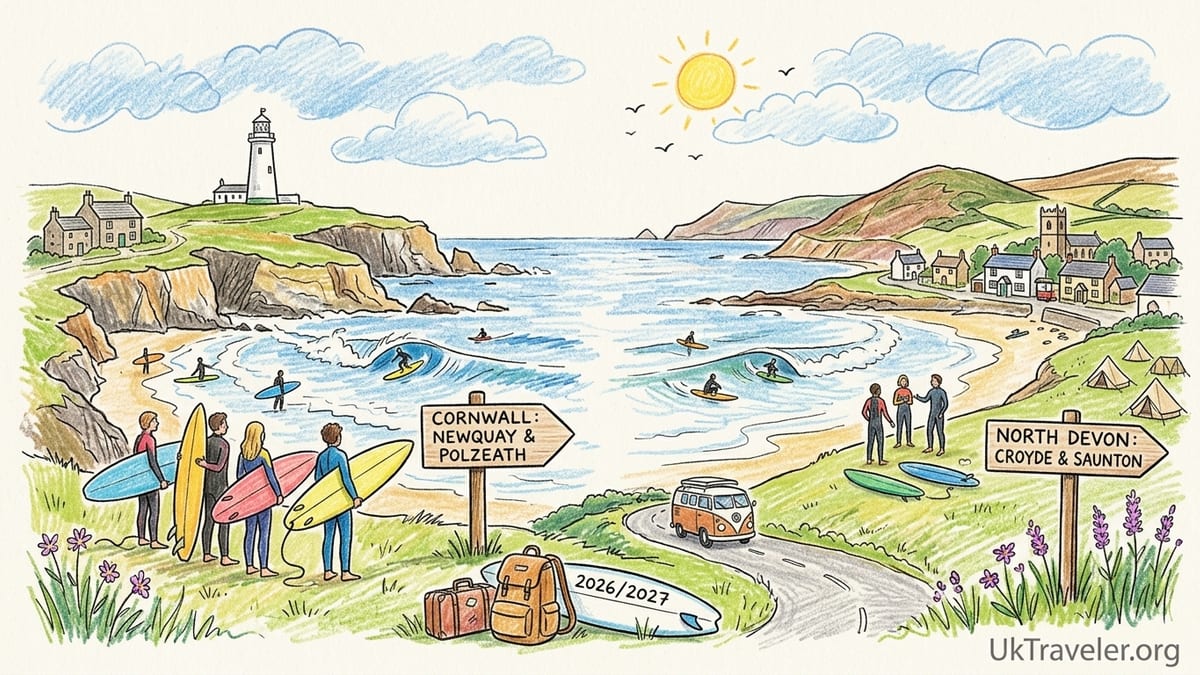
Why Newquay, Cornwall and North Devon Work So Well for Surf Camps
Newquay has long been considered the surf capital of England, with Fistral, Towan and Lusty Glaze beaches all offering consistent beach breaks, plenty of surf schools and a full tourist infrastructure. That combination makes it easy for operators to package multi-day surf products without guests needing a car or local knowledge. In practical terms this means you can arrive by train or coach, walk to your accommodation, and be in a wetsuit within an hour of check-in.
Further along the Cornish coast, spots such as Polzeath, Watergate Bay and the beaches around St Ives have also attracted small-scale surf and yoga retreats and higher-end lodges that bundle surf coaching with stylish accommodation and healthy food. These coastal villages are quieter than central Newquay, which appeals to travellers who want progression-focused tuition by day and early nights rather than nightlife.
Across the county border, Croyde, Saunton and Woolacombe in North Devon offer a slightly different feel. Croyde is a compact village with a renowned beach break and several campsites and holiday parks within walking distance of the sand. Saunton Sands, a longer, mellower beach just to the south, tends to suit beginner and longboard-friendly coaching, while Woolacombe offers yet more options within a short drive. This concentration of beaches has allowed several providers to build weekend surf camp products that bundle coaching with glamping or campsite stays.
For 2026 and 2027, the overall trend in both Cornwall and North Devon is toward more structured packages rather than just ad-hoc lessons. Providers are marketing 3 to 6 day camps targeted at distinct audiences: total beginners wanting a first taste, intermediates looking for video analysis, solo travellers who want a social group, and families seeking child-friendly tuition. Prices in the 330 to 730 US dollar range typically reflect two to five coaching sessions, board and wetsuit hire, and either simple shared accommodation or connections with nearby lodgings.
Beginner Weekend Camps: Fast-Track Foundations
Beginner weekend camps are the entry point for many travellers. In Croyde, for example, weekend surf camps commonly offer four group sessions of about two and a half hours each spread over two days, with all equipment supplied and small groups so that new surfers get plenty of feedback. Guests are usually encouraged to book nearby accommodation at partner guesthouses or campsites, which keeps the package cost focused on coaching and equipment rather than luxury add-ons.
In Newquay, several surf schools base their beginner camps on a similar model: two to three days with two longer water sessions, often timed around the most suitable tides. A typical 3 day beginner package in 2026 might cost the equivalent of roughly 330 to 450 US dollars per person and include three or four lessons, wetsuit and soft-top board hire, and use of changing and storage facilities close to the beach. Travellers then either add their own hostel or guesthouse booking or upgrade to a bundled bed-and-breakfast partner.
The advantage of these structured weekends compared with booking single lessons is continuity. Instructors can see how you progress from the first pop-up attempts to trimming along whitewater and, when conditions cooperate, catching green waves. Because the same coaches work with you across multiple sessions, they can fix small mistakes such as foot placement or stance that would otherwise go unnoticed. Beginners also benefit from going out in the same small group each time, which helps with confidence and makes the weekend feel like a mini surf holiday rather than a one-off activity.
For travellers flying into the United Kingdom, beginner weekends in Cornwall or North Devon are often used as part of a longer stay. You might spend a week road-tripping through the region but ring-fence three days in Newquay or Croyde for dedicated surf progression. That pattern is reflected in the way many schools now market their camps: as plug-in modules that slot neatly into broader UK itineraries.
Progressive Coaching and Video-Based Camps
Once you can stand and ride whitewater consistently, progressive coaching camps become more relevant than broad beginner weekends. In Cornwall and North Devon these are typically sold as three to six day programmes aimed at intermediates who want to read line-ups, paddle into unbroken waves and execute basic turns. Prices for 4 or 5 day progression camps often sit toward the upper end of the 500 to 730 US dollar band, reflecting higher coach-to-student ratios and extras such as video analysis.
Video coaching has become a distinctive feature of several South West England surf camps. Coaches film a subset of each session from the beach or water, then run through clips on a tablet or laptop later that day. Rather than relying on memory, you can see your stance, arm position and timing on screen, making corrections far more tangible. On a 5 day progression camp you might expect at least two video review sessions built into the schedule, especially when conditions are clean.
North Devon’s long, peeling waves at Saunton and, in the right conditions, Croyde lend themselves to this style of tuition, since longer rides give more material for analysis. In Cornwall, intermediate coaching often takes place at Fistral or Watergate Bay, both of which offer multiple peaks and options for different wind directions. Surf schools now commonly advertise that progression camps are capped at small numbers per coach, sometimes as low as six students or fewer, which directly affects the per-person price but significantly improves the quality of feedback.
For travellers weighing up whether to pay for a progression camp or simply book daily group lessons, the key difference is structure. Multi-day coaching will normally follow a curriculum, starting with paddling technique and take-off positioning on day one, moving to trimming, speed generation and basic cutbacks later in the week. Everything from choice of board to timing your paddle for set waves is treated as a skill to be refined rather than left to chance. That level of detail is especially valuable for people who already surf occasionally at home but rarely get such intensive coaching.
Surf and Yoga Retreats: Cornish Calm With Waves Attached
Surf and yoga retreats have grown quickly around Cornwall, particularly near Newquay and Polzeath, as operators realise that many guests value recovery and community as much as pure wave count. These retreats often run for 3 to 5 nights and sit toward the upper end of the price spectrum, typically around 600 to 730 US dollars or more, but include far more than simple lessons. A long weekend might include two surf sessions, three or four yoga classes, guided cold-water dips and communal meals in a shared lodge or boutique guesthouse.
In practice, a Cornish surf and yoga retreat schedule might start with sunrise mobility and breathwork, followed by a mid-morning surf lesson at a nearby beach chosen for conditions, then afternoon restorative yoga or sauna time back at the accommodation. Some retreats in 2026 advertise use of wood-fired saunas and hot tubs so that guests can warm up after long sessions in cold Atlantic water. Others emphasise mindfulness sessions, coastal walks or journalling circles alongside surfing, positioning themselves as wellness weekends with surfing as the central outdoor activity.
Newquay-based operators sometimes run surf and yoga retreats from private woodland camps with bell tents or cabins, where guests share simple accommodations and eat together around a communal table. On the north Cornwall coast, between Polzeath and Bude, retreats may instead be based in renovated farmhouses or cliff-top lodges with ocean views, catering more directly to couples or small groups of friends seeking comfort and quiet. In both cases, pricing reflects not just water time but catered meals, yoga teachers and additional staff.
Compared with beginner or progression-only camps, the key benefit of a surf and yoga retreat is the balance between intensity and restoration. Many participants are working professionals or solo travellers who want an immersive but not exhausting experience. Two hours of surfing followed by a slow yoga flow or guided stretching means you can surf back-to-back days without the soreness that would come from pushing too hard. For some guests, the social element of shared meals and yoga circles is as important as their first green wave.
Accommodation-Inclusive Camps and Where to Stay
In both Newquay and Croyde, travellers can now choose between surf schools that focus on coaching only and those that package lodging directly into the price. Accommodation-inclusive camps usually sit above the 500 US dollar mark for a 3 or 4 night stay, but that figure tends to include breakfasts, a set number of dinners and non-surf activities such as coastal walks or firepit evenings. These products appeal most to people who do not want to juggle separate room bookings, lesson times and transport.
In Croyde, accommodation-inclusive surf weekends are commonly tied to holiday parks, glamping pods or camping fields a short walk from the beach. Guests might stay in pre-pitched safari tents, shepherd’s huts or static caravans with simple kitchens, then walk to the surf school meeting point each morning. Some packages are built in partnership with local campsites, where the park provides beds and facilities while the surf school runs coaching and equipment rental. This approach keeps prices more manageable while still delivering the feeling of an organised camp.
Newquay offers a broader spectrum of accommodation styles, from bunk-style surf lodges and hostels to self-catered apartments and boutique hotels. Some schools operate their own surf lodges a few minutes’ walk from Towan or Fistral beaches and can therefore offer fully in-house packages where coaching, board storage, breakfast and social evenings all happen under one roof. Others prefer to collaborate with independent hotels and guesthouses, leaving travellers free to pick between budget shared dorms and private, ensuite rooms before adding a multi-day surf package.
For those on tighter budgets, it is perfectly viable to book accommodation separately and focus spending on coaching. Hostels and simple guesthouses off central Newquay’s main streets often undercut the cost of boutique surf lodges, while campsites or basic holiday parks outside Croyde or Saunton can significantly reduce nightly rates in North Devon. In these cases, check whether your chosen surf school offers discounts on lesson blocks or board hire for guests staying more than a couple of days, as that can close much of the gap to a fully packaged camp.
Family-Friendly Lessons and Multi-Day Courses
Families are a major part of the surf-camp market in South West England, especially during school holidays. In Newquay, dedicated family surf lessons allow parents and children to share an instructor and have equipment sized appropriately, which is vital when kids are swapping bodyboards for real surfboards. A family session typically lasts 2 to 3 hours, and some providers offer discounted rates when several relatives share one coach, making it cost-effective when compared with booking individual places on group lessons.
Multi-day family courses in Cornwall commonly span 3 to 5 days, with one coached session each morning or afternoon and the option to rent boards for free-surfing between lessons. That structure allows children to build confidence gradually, with instructors repeating safety messages about rips, flags and etiquette each day so that young surfers absorb the information. For parents who already surf, family courses are an opportunity to fine-tune their own technique while their kids benefit from professional instruction in the same environment.
North Devon’s long, gently sloping sands at Saunton and Woolacombe are particularly well suited to younger or more cautious surfers, and several schools there offer family packages that prioritise easy whitewater waves and shallower banks. In Croyde, where the beach can be more powerful at higher tides, family lessons are often carefully timed to coincide with friendly conditions and are backed by strict ratios of instructors to participants to keep things safe and fun.
Prices for family courses vary widely depending on group size and whether equipment hire is included outside formal lessons. As a rough guide, families booking three or more shared sessions during a week in 2026 can often negotiate package-style pricing, with the per-person cost comparing favourably to standard adult group lessons. It is also common for surf schools to combine surf sessions with coasteering or beach games to keep younger children engaged when they tire of paddling.
Equipment, Wetsuits and What Is Typically Included
One practical advantage of choosing a surf camp in South West England is that high-quality cold-water equipment is nearly always included. Standard packages in Newquay and Croyde typically provide full-length wetsuits, often 4/3 mm or 5/3 mm thickness depending on season, along with neoprene boots in the colder months and sometimes gloves and hoods during early spring or late autumn. Soft-top learner boards are used for most beginner sessions, while intermediate camps may offer a wider quiver including hard boards for those ready to progress.
Most providers include all necessary equipment during scheduled lessons and often allow guests to keep their board and wetsuit between sessions, especially on 3 to 6 day packages. This is an important detail when comparing offers around the 330 to 730 US dollar mark. An apparently cheaper camp that charges extra for rentals outside formal coaching hours can end up costing more than a slightly pricier package where free-surf time is built in. Travellers who know they will want extra practice should confirm how many hours of board use are included each day.
In Newquay, surf bases close to the sand usually offer hot showers, changing rooms and secure storage, allowing guests to arrive in regular clothes and leave valuables safely stowed while they are in the water. Some schools in North Devon operate from beachside huts or car parks with more basic facilities but compensate with shuttle services from partner campsites or lodges. If you plan to visit in shoulder seasons such as April, May, September or October, prioritising providers with warm changing areas and hot drinks after sessions can make a significant difference to comfort.
For travellers bringing their own wetsuit or board, many camps will discount the package price slightly, but this is not universal. Given the quality and suitability of rental gear in both Cornwall and North Devon, most visitors find it easier to travel light and rely on the camp’s equipment. This is especially true for those flying from abroad, where airline baggage fees on longboards or heavy winter wetsuits can be substantial.
Meals, Transfers and Practical Logistics
Meal and transfer inclusions vary more than coaching or equipment, so it is worth reading package descriptions closely. In North Devon, some weekend surf camps based at or near campsites include simple lunches from an on-site cafe, leaving breakfasts and dinners up to guests. In Cornwall, surf and yoga retreats are more likely to include all breakfasts and several communal dinners, with lunches taken either at beach cafes or prepared in-house between sessions. Self-catered surf lodges in Newquay often provide continental breakfast but leave other meals flexible so that guests can explore local restaurants.
Transfers are rarely included in UK surf camp prices, which is an important consideration for international visitors. Newquay has the advantage of a small airport, a railway station and coach connections, and once you arrive many packages are designed to be car-free. In North Devon, by contrast, Croyde and Saunton are reached most easily by car from Exeter or Bristol, though some camps run limited shuttle services from nearby towns or railway stations on changeover days. When budgeting, factor in the cost of a hire car or shared taxi if you plan to stay in a more remote lodge or glamping site.
Within resorts, walking is usually the main mode of transport. Newquay’s town beaches, surf shops and many lodgings are within a short stroll of each other, and Fistral is reachable by a coastal path or short taxi ride from the centre. Croyde’s compact layout means you can move between campsite, cafe and surf school on foot in a matter of minutes. For guests at Saunton or Woolacombe, some surf camps cluster their accommodation close enough to the beach that boards can be carried rather than roof-racked, which simplifies logistics considerably.
Travel seasons also matter. July and August bring the warmest water and busiest line-ups, with family-focused camps often selling out months ahead. Late spring and early autumn can deliver better surf quality with fewer crowds but require warmer wetsuits and a tolerance for changeable weather. Many operators now run structured packages from around April through to early November, adjusting pricing slightly for peak and shoulder dates while keeping the core inclusions consistent.
The Takeaway
Choosing the best surf camp in South West England in 2026 or 2027 comes down to matching your goals and budget with the right style of product. Newquay and surrounding Cornish beaches offer the widest choice of surf schools, hostels, retreats and lodges, while Croyde and North Devon provide a slightly quieter, village-focused experience with excellent waves and a strong weekend-camp culture. Across both regions, you can now find structured 3 to 6 day packages at prices broadly ranging from around 330 to more than 730 US dollars, reflecting differences in coaching intensity, accommodation style and added extras such as yoga or catered meals.
Beginners who simply want to stand up and experience a first wave will be well served by two or three day camps that concentrate on fundamentals and supply all equipment. Intermediates looking for real progression should seek out smaller-group coaching with video analysis and a clear curriculum over four or five days. Travellers wanting a more holistic break may prefer surf and yoga retreats, where saunas, hot tubs and restorative classes are given equal weight alongside time in the Atlantic.
Families, meanwhile, will find dedicated multi-day courses in both Cornwall and North Devon that emphasise safety, fun and age-appropriate boards and wetsuits, turning a UK seaside holiday into a shared learning experience. Whether you stay in a simple campsite, a social surf lodge or a boutique retreat, the core appeal remains the same: consistent waves, professional coaching and the satisfaction of visible progress in just a few days.
With careful comparison of inclusions around equipment, meals and potential transfers, South West England’s surf camps can offer excellent value for money and a memorable introduction to cold-water surfing. For many travellers, a long weekend at a Newquay surf lodge or a glamping-based camp in Croyde becomes the highlight of a wider UK trip, and often the beginning of a longer relationship with surfing itself.
FAQ
Q1: How much should I budget for a surf camp in Newquay or North Devon in 2026/27?
For a 3 to 6 day camp including lessons and equipment, expect roughly 330 to 730 US dollars per person, with higher prices reflecting accommodation, meals and extras like yoga or video coaching.
Q2: Is Newquay or Croyde better for absolute beginners?
Both work well, but Newquay offers more surf schools, sheltered town beaches and car-free access, while Croyde guests often use nearby Saunton’s gentler waves when conditions at Croyde are more powerful.
Q3: Do I need my own wetsuit and board for these camps?
No. Most packages in Cornwall and North Devon include full wetsuit, boots when needed and a suitable learner or intermediate board, often available between lessons for extra practice.
Q4: What time of year is best for a surf camp in South West England?
June to September brings warmer water and more reliable small waves for beginners, while late spring and early autumn can offer better-quality surf for intermediates with fewer crowds but cooler conditions.
Q5: Are surf and yoga retreats suitable for complete beginners?
Yes. Many Cornish surf and yoga retreats cater specifically to first-timers, combining gentle beginner lessons with restorative yoga so that newcomers can handle multiple days in the water.
Q6: Can families with young children join the same lessons?
Most schools offer family lessons where parents and children share an instructor, but very young kids may have shorter sessions or use bodyboards first. Check minimum age policies before booking.
Q7: Will my camp include meals and airport or train transfers?
Surf and yoga retreats and some lodge-based camps include breakfasts and a few dinners, but transfers are rarely bundled. Budget options usually focus on coaching and equipment only.
Q8: How important is video coaching for improving my surfing?
Video analysis is especially helpful at the intermediate level, making it easier to correct stance, timing and positioning. If your budget allows, a camp that includes it can accelerate progress noticeably.
Q9: Is it possible to join a camp as a solo traveller?
Yes. Many Newquay and North Devon camps actively welcome solo guests, using group sizes and social evenings to help people meet, making them popular with single travellers in their twenties to forties.
Q10: What should I pack besides normal holiday clothing?
Bring multiple swimsuits, quick-drying towels, warm layers, a waterproof jacket, sturdy sandals for wet car parks, and high-factor, water-resistant sunscreen suitable for use with wetsuits.