


If you are dreaming of a classic English seaside break, the choice between Norfolk and Suffolk can feel surprisingly high stakes. These neighbouring East of England counties share big skies, open landscapes and handsome coastal towns, but the experience on the ground is quite different. Norfolk brings bigger sandy beaches, the watery maze of the Broads and the cultural pull of Norwich, while Suffolk leans into shingle shores, heritage-rich villages and a quietly luxurious feel along its boutique coastline. This guide compares the two across beaches, cottages, boating, history, food and practicalities so you can decide which county suits your next holiday.
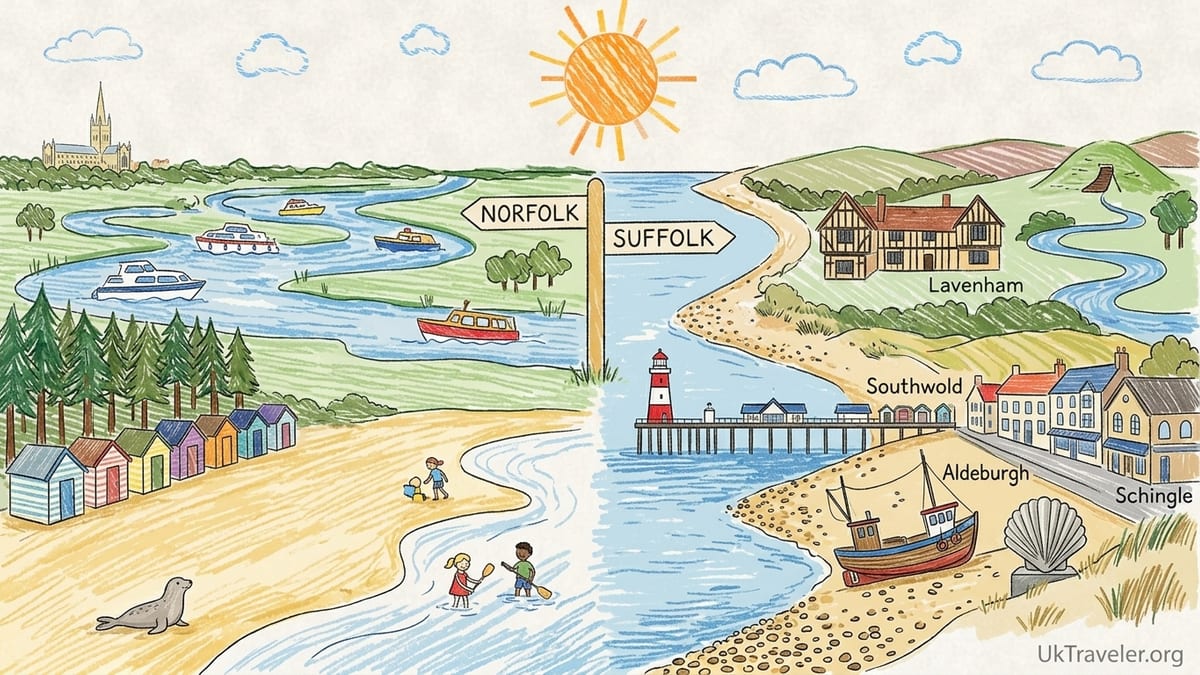
Norfolk vs Suffolk at a Glance
Norfolk is the extrovert of the pair. Its north and east coasts are lined with broad, sandy beaches from Hunstanton and Wells-next-the-Sea to Sea Palling and Winterton. Behind the shoreline lie the Broads, a network of navigable rivers and shallow lakes stretching across Norfolk and a corner of Suffolk, officially designated a national park. The county’s main city, Norwich, adds a dash of culture with its cathedral, independent shops and year-round events, making Norfolk feel like a complete holiday ecosystem in its own right.
Suffolk is quieter and more low-key, with a coastline defined by shingle and dunes rather than huge sand expanses. Characterful resorts such as Southwold and Aldeburgh, the Anglo-Saxon royal burial site at Sutton Hoo near Woodbridge, and the wool towns of Lavenham and Long Melford give the county a distinctly historic and gently upmarket air. Inland, the soft countryside of “Constable Country” along the River Stour appeals to walkers and those who want a slower pace.
In very broad terms, Norfolk suits families and activity-seekers who want long beach days, boat trips and plenty of choice in cottages and holiday parks. Suffolk better fits couples and groups looking for smart small hotels, good restaurants, art and history, and a boutique coastal feel where nightlife is understated and pubs, delis and galleries take centre stage.
Both counties work without a strict budget in mind, but it is often slightly easier to find value in Norfolk simply because there is more stock: more caravan parks, more traditional seaside guesthouses and a wider spread of self-catering options close to the beach or Broads.
Beaches: Big Norfolk Sands vs Boutique Suffolk Shores
For pure, sandy space, Norfolk is hard to beat. The north coast around Holkham and Wells-next-the-Sea is famous for its wide, golden strand backed by pinewoods and photogenic beach huts. On the east coast, beaches such as Sea Palling and Waxham offer sweeping sands with relatively few amusements. These are the sorts of places where you can walk for half an hour along the tideline in August and still feel you have room to breathe, especially at lower tide.
Norfolk’s coast is also a strong bet for families who like traditional seaside fun. Cromer and Sheringham mix respectable stretches of sand with promenades, fish and chip shops, small arcades and seasonal events such as crab and lobster festivals. At Hunstanton, you can expect colourful cliffs, rock pooling and the classic combination of ice cream kiosks and donkey rides in high summer. Many of these resorts sit within a short drive of the Broads, allowing a beach-and-boating holiday without changing base.
Suffolk, by contrast, excels in atmosphere more than scale. Southwold combines a sandy and shingle beach with a handsome pier, pastel beach huts and an attractive town centre anchored by the Adnams brewery and a run of independent shops. Aldeburgh’s beach is mostly shingle but its fishing boats, Maggi Hambling’s Scallop sculpture and cluster of galleries and concert links to nearby Snape Maltings lend it strong character. Further down the coast, Walberswick and Dunwich feel more like grown-up coastal hideaways than classic resorts, with dunes, marshes and birdlife rather than slot machines.
If you are travelling with young children who want to dig, paddle and run, the scale and softness of Norfolk’s sands give it the edge. If your idea of a perfect day is a bracing coastal walk followed by oysters and a glass of wine, Suffolk’s more intimate beaches and foodie villages are likely to appeal more.
Cottages and Places to Stay
Norfolk’s holiday accommodation market is broad and busy. Around the Broads there are numerous boatyards in hubs such as Wroxham and Potter Heigham offering cruisers and day boats, often alongside riverside cottages or apartments. On the coast, you can choose from seafront apartments in Cromer, traditional cottages in North Norfolk villages like Blakeney and Burnham Market, and large holiday parks around Great Yarmouth and Hemsby that bundle pools, kids’ clubs and entertainment into a single package. This diversity means you can find everything from a simple static caravan around 400 to 600 pounds per week outside peak season to larger houses commanding significantly more in school holidays.
Suffolk has fewer large parks and generally feels more curated. Along the so-called Suffolk Heritage Coast, properties tend to be smaller-scale: smart terraces and fishermen’s cottages in Aldeburgh, pastel villas and townhouses in Southwold, and converted barns or farmhouses tucked back from the shore. Many are marketed through specialist regional agencies and can carry price tags that reflect demand, especially in August and during key cultural events such as the Aldeburgh Festival. For couples or small groups seeking style over size, this can be a positive, with a good choice of design-conscious boltholes and small hotels.
For bigger families and groups needing four bedrooms or more, Norfolk usually offers more choice and often better value, particularly if you are happy to stay a short drive inland from the coast or near the Broads rather than directly on the seafront. Suffolk certainly has larger properties but they book early, especially in Southwold and Aldeburgh, where stock is tighter and the streets are physically smaller.
If you do not intend to drive, consider that some Norfolk resorts and Broads villages have more options within walking distance of shops and pubs, whereas parts of rural Suffolk can feel more spread out. Southwold and Aldeburgh are walkable and self-contained, but many inland Suffolk cottages are firmly car-focused.
Boating, Wildlife and the Broads
The Norfolk Broads are the county’s trump card. This network of rivers and shallow lakes, spreading across both Norfolk and a slice of northern Suffolk, is one of Britain’s classic boating destinations. Visitors can hire a cruiser for several nights from bases around Wroxham or Stalham, or opt for a simple electric day boat to explore for a few hours. The waters are largely calm and sheltered, there are plenty of riverside pubs, and navigation is straightforward for first-timers, which makes the Broads particularly attractive for multi-generational trips and groups of friends.
Wildlife is another strong suit. The Broads’ reedbeds and marshes shelter herons, marsh harriers, otters and a variety of waders and wildfowl. Around Horsey Mere and Hickling Broad, you can combine a gentle boat trip with a walk to Horsey Gap or Winterton to see the seal colonies that haul out along this stretch of Norfolk coast. In winter, grey seals give birth on the sands, drawing visitors for carefully managed viewing from the dunes; at other times of year you may spot them bobbing in the surf or lazing on quieter beaches.
Suffolk has its share of waterways but they are less central to the holiday experience. The southern Broads touch into Suffolk around Oulton Broad, where you will find day boats and watersports, and the River Orwell near Ipswich and the River Deben near Woodbridge provide attractive backdrops for walks and sailing. However, the feel is more of riverside rambles and estuary views than a fully boat-based holiday. Sailors and serious boaters will find marinas and yacht moorings, especially around the Shotley Peninsula and Levington, but casual visitors are less likely to plan an entire trip around them.
If messing about in boats is central to your decision, Norfolk is the clear winner. The ability to split your time between a Broads cruiser and a cottage stay, or to take simple day boats out from Wroxham or Horning between beach trips, is something Suffolk cannot quite match on the same scale.
History, Culture and Character
Both counties are steeped in history, but they showcase it in slightly different ways. Norfolk’s headline cultural draw is Norwich, a compact medieval city with a Norman cathedral, castle museum and an array of independent shops, pubs and cafes. It makes a useful rainy-day base if you are staying on the coast or the Broads, and its arts scene, from the Theatre Royal to smaller venues and festivals, adds depth to a Norfolk trip. Elsewhere in the county, you will find stately homes such as Holkham Hall, Blickling and Sandringham within an easy drive of the coast.
Suffolk presents its history in a more concentrated, sometimes quieter way. Sutton Hoo, near Woodbridge, is one of England’s most important Anglo-Saxon burial sites, with a visitor centre, reconstructed burial chamber and walking trails overlooking the River Deben. Inland, the medieval wool towns of Lavenham, Long Melford and Clare preserve timber-framed streets and churches that tell the story of Suffolk’s prosperous past. Along the coast, the link between Aldeburgh and composer Benjamin Britten, plus the concert halls and galleries at Snape Maltings, give the area a distinctive cultural flavour.
If your ideal day combines a heritage site with tea rooms and antique shops, Suffolk may be more your style. It is easy to base yourself, for instance, around Woodbridge or the Stour Valley and spend several lazy days exploring churches, half-timbered market squares and riverside paths. Norfolk certainly offers historic interest but the experience is broader: a mixture of seaside promenades, Broads villages, big country houses and the urban buzz of Norwich.
In terms of overall character, Norfolk generally feels a little busier and more varied, in part because it has more sizable resorts and a larger city. Suffolk feels more self-consciously quiet and curated, particularly along its Heritage Coast where conservation and low-rise development keep things firmly on the charming rather than brash side.
Food, Drink and Dining
Seafood, local beer and farm-to-table cooking are common threads across both counties, but the way you encounter them differs. In Norfolk, coastal towns such as Cromer and Sheringham are known for their crabs and shellfish, often sold from simple stalls, cafes or pubs near the seafront. Around the Broads you will find a string of riverside inns and pubs serving hearty classics alongside local ales, ideal for mooring up at lunchtime. Norwich adds another layer with a growing number of independent restaurants, cafes and street food traders, meaning you can switch from very casual to more ambitious dining without leaving the county.
Suffolk’s coastal towns lean further into an upscale but understated food scene. Southwold and Aldeburgh both support well-regarded fish and chip shops, delis, bakeries and wine shops, while the wider county is dotted with country pubs that prioritise local ingredients and seasonal menus. The influence of producers such as the Adnams brewery in Southwold and small-scale farmers and cheesemakers means that food and drink can feel central to the Suffolk experience, even if you are simply grazing from shops and markets rather than booking big-name restaurants.
In practice, families in Norfolk may appreciate the sheer number of casual options near the beach and Broads, from beachside kiosks to large pubs with gardens. Couples and small groups in Suffolk might find it easier to build their stay around longer lunches, wine bars and thoughtful cooking in compact town centres where everything is within a few streets.
Vegetarians, vegans and diners with dietary needs will find growing choice in both counties, but Norwich, Southwold and Aldeburgh stand out as particularly good bases thanks to their concentration of modern cafes and bistros.
Best for Families vs Best for Couples
Norfolk and Suffolk both work for a wide range of travellers, but there are some natural fits. For families with primary-age children and teenagers, Norfolk’s bigger sandy beaches, amusement-filled resorts and easy access to the Broads are persuasive advantages. It is simple to plan days that mix adrenaline and downtime: a morning building sandcastles at Sea Palling or Hunstanton, an afternoon on a seal boat trip from Blakeney or Morston, or a lazy cruise along the River Bure stopping at waterside play areas and pubs.
Suffolk can still be very family-friendly, especially around Southwold, Walberswick and Thorpeness where boating lakes, crabbing spots and beaches provide classic holiday fun. However, the overall feel is a little more sedate and best suited to children who enjoy walking, cycling and pottering in pretty towns rather than endless amusements. Older teenagers who appreciate art, history and food might enjoy Suffolk’s mix of heritage sites, music events and estuary walks more than younger kids seeking arcades and rides.
For couples, Suffolk’s quieter coastal villages and historic market towns are hard to beat. A few days in Aldeburgh, for example, can include shingle-beach walks, gallery-hopping, a concert at Snape Maltings and dinners in small, candlelit restaurants. Inland, staying in a converted barn near Lavenham or Kersey gives you access to footpaths, old pubs and scenery that inspired John Constable’s paintings along the Stour Valley.
Couples in Norfolk have different strengths to draw on. You can base yourselves in a Georgian inn in Burnham Market, dine on seafood along the north coast, then take a day trip into Norwich for culture and shopping or into the Broads for a leisurely boat hire. The county suits those who want a slightly livelier, more varied holiday where quiet moments on the marshes sit alongside busy promenades and city streets.
Walking, Exploring and Do You Need a Car?
Both Norfolk and Suffolk reward walkers, but in different settings. Norfolk offers a strong coastal walking experience, especially along the North Norfolk Coast Path where saltmarshes, dunes and beaches connect villages like Wells-next-the-Sea, Blakeney and Cley. The flat landscapes around the Broads are ideal for easy rambles along riverbanks and reedbeds, with plenty of pubs and bird hides as motivation. Inland, you can explore quiet lanes, heathland and woodland without much climbing.
Suffolk’s walking tends to weave together coast, estuary and farmland. The Suffolk Coast Path and routes around Orford, Dunwich and Walberswick link shingle beaches, marshes and small harbours. Further inland, the Stour Valley, Dedham Vale and villages like Flatford and East Bergholt form the heart of “Constable Country,” a landscape of meadows, hedgerows and church towers familiar from the painter’s works. For those who enjoy combining walking with heritage, circuits around Sutton Hoo or between wool towns and their churches can be particularly satisfying.
In terms of transport, a car gives you more freedom in both counties, but Norfolk’s larger resorts and the Broads’ boating network mean you can manage without one more easily. Train services run to Norwich, Great Yarmouth, Cromer and Lowestoft, and from Norwich it is simple to connect by bus or taxi to Broads hubs. Once you are on a boat, day-to-day movement becomes part of the experience rather than a chore, and many riverside pubs and attractions are geared to visitors arriving by water.
Suffolk’s coastal towns of Southwold and Aldeburgh are reachable by public transport with a change or two, but services can be less frequent and many rural spots are not well linked. If you want to explore the full range of Suffolk’s charms, from Constable Country to the Heritage Coast and wool towns, a car is highly advisable. This is one reason Suffolk holidays often feel more self-contained: people tend to base themselves in one or two places and explore locally, rather than roving widely each day.
The Takeaway
If you picture long, soft, sandy beaches, kids racing to the water, seal trips, and lazy days drifting along reed-lined rivers, Norfolk is likely the better choice. It offers a bigger, more varied holiday inventory, from budget-friendly caravan parks to smart coastal inns, plus the cultural backup of Norwich and the unique appeal of the Broads for boating and wildlife.
If, instead, you dream of wandering cobbled high streets, browsing independent boutiques, tracing Anglo-Saxon and medieval history and lingering over good food and wine in low-key coastal towns, Suffolk will probably suit you more. Its Southwold and Aldeburgh axis, nearby Sutton Hoo and the wool towns and valleys of the interior create a concentrated, quietly sophisticated holiday atmosphere.
In reality, you cannot go far wrong with either. Families and activity seekers may find Norfolk the more obvious fit, especially for a first East of England trip. Couples, culture-lovers and those seeking a boutique coast with fewer arcades and more galleries often lean to Suffolk. If you have the time, combining a few days on the Norfolk Broads with a later stay on the Suffolk coast delivers the best of both worlds and shows just how complementary these neighbouring counties can be.
FAQ
Q1. Which county is better for traditional sandy beach holidays, Norfolk or Suffolk?
Norfolk is generally better for classic sandy beach holidays, with expansive sands at places like Holkham, Wells-next-the-Sea, Sea Palling and Hunstanton that suit families and long beach days.
Q2. Is Suffolk really quieter than Norfolk in peak summer?
Suffolk’s coastal towns can still be busy in school holidays, but overall the county feels quieter and more low-key than Norfolk, with fewer large resorts and amusement-heavy frontages.
Q3. Where should I stay if I want to explore the Norfolk Broads easily?
For first-time visitors, bases around Wroxham, Horning or Stalham work well, with plenty of boat hire yards, riverside cottages and pubs geared towards Broads holidays.
Q4. Are there good options in Suffolk for a short, car-free break?
Yes. Southwold and Aldeburgh both work for car-free breaks if you are happy to stay mostly in town, as they offer beaches, shops, restaurants and coastal walks within easy reach on foot.
Q5. Which county is better for history lovers?
Both are rewarding, but Suffolk has an edge for concentrated heritage, thanks to Sutton Hoo, the medieval wool towns and the Constable Country villages that preserve much of their historic fabric.
Q6. Is Norfolk or Suffolk better value for larger holiday cottages?
Norfolk tends to offer more choice and sometimes better value for larger properties, especially if you are willing to stay a short drive from the coast or near the Broads instead of directly seafront.
Q7. Where is best if we want seal watching as part of our trip?
Norfolk is the stronger choice for seals, with seasonal colonies and boat trips around Blakeney Point and regular sightings on east coast beaches near Horsey and Winterton.
Q8. Which county suits food-focused travellers more?
Food-focused travellers will find plenty to like in both, but Suffolk’s compact, boutique towns such as Southwold and Aldeburgh make it easy to build a trip around restaurants, delis and local producers.
Q9. Do I need a car to enjoy the Norfolk Broads?
You can visit the Broads without a car by taking the train to hubs like Wroxham or Norwich and arranging boat hire or local taxis, though having a car offers more flexibility for exploring.
Q10. If I only have a long weekend, should I choose Norfolk or Suffolk?
For an activity-packed weekend with beaches and boating, pick Norfolk. For a slower, more boutique-feeling escape focused on coastal towns, art and history, choose Suffolk.