


Few countries reward slow, scenic driving quite like England. Within a day’s drive of London you can roll through honey-stone Cotswold villages, hug Cornwall’s Atlantic cliffs, cross the high passes of the Lake District and wind through the quiet dales and castles of Yorkshire and Northumberland. This guide sets out practical, real-world advice to help you design a multi-day self-drive circuit, understand how car rental, fuel, parking and roads actually work on the ground, and choose the right routes for a memorable road trip rather than a stressful slog between hotel car parks.
Planning your England road trip: when, how long and where to start
For most visitors, a classic England road trip starts and ends in London or at a major airport such as Heathrow. From central London, it typically takes around two hours to reach the eastern Cotswolds around Burford via the M40 and A40, a similar time to reach the South Downs near Winchester, and around four to five hours to reach Cornwall’s north coast depending on traffic. Treat those timings as minimums: on summer Saturdays, routes like the M5 toward the South West or the A30 into Cornwall can slow to a crawl, so build generous buffers into your plans.
If you want to combine southern England, Cornwall and at least one northern region such as the Lake District or Yorkshire, allow a minimum of 10 to 14 days. A realistic, comfortable circuit might be: London to the Cotswolds (2–3 nights), down to southern England’s coast such as the Jurassic Coast or New Forest (2 nights), across to Cornwall (3–4 nights), then a longer drive up to the Lake District (3 nights) before looping across Yorkshire or Northumberland (3 nights) and dropping back south via York or the Midlands. Anything shorter risks spending most of your time on motorways rather than scenic roads.
Season makes a big difference. Late April to June and September to early October usually offer the best compromise between lighter traffic, milder weather and long daylight hours. July and August bring lively village festivals and sea-swimmable water in Cornwall, but also congested main routes, busier car parks and higher accommodation prices. Winter driving can be magical in the Cotswolds or the Lake District, yet high passes such as Honister or Kirkstone may be icy or temporarily closed; if your itinerary depends on those roads, have low-level alternatives planned.
Fly-drive visitors often choose a rental car pick-up at Heathrow, Gatwick or central London and then return the car at the same point to avoid one-way drop fees. Another workable pattern is to take the train from London to Bath, Oxford or Bristol, spend a night car-free, then collect a rental at a city depot to avoid the capital’s heavier traffic and congestion charges before heading into the countryside.
Rental cars, driving rules and fuel: what to expect in practice
Most major international brands operate in England, alongside local firms in regional towns and cities. Compact hatchbacks such as the Ford Focus, VW Golf or similar are usually the best choice for Cotswold lanes, Cornish fishing villages and Lake District passes. They are easier to squeeze into tight car parks and to reverse on single-track roads when you meet oncoming traffic. Automatics are now widely available but are often pricier and can sell out in peak season; if you need one, book well ahead and check your booking confirmation specifies “automatic” rather than “or similar manual.”
Drivers sit on the right side of the car and drive on the left side of the road. If you are new to this, it can help to start with a motorway segment where lanes are wide and consistent before tackling village centres like St Ives in Cornwall or Bourton-on-the-Water in the Cotswolds. Roundabouts are everywhere, including on main routes; traffic flows clockwise and you give way to vehicles coming from the right. Navigation apps work well but can send you down farm tracks or very narrow cut-throughs, especially around Cotswold and Devon villages, so it is sensible to sanity-check your route against a paper map or zoomed-out view and prefer B-roads over tiny lanes wherever you can.
Fuel is sold in litres and prices fluctuate, but compared with North America it is generally high. You will find the most expensive fuel at motorway service areas and the best value at supermarkets such as Tesco, Sainsbury’s or Morrisons on the edges of towns. In rural areas like Northumberland’s coast, parts of the Yorkshire Dales or Cornish peninsulas, 24-hour fuel can be sparse, so keep the tank at least half full before heading onto moorland or into remote valleys. Most stations accept credit cards with chip and PIN or contactless payments, but if you are using a foreign card, notify your bank in advance and carry a backup card in case of fraud checks.
City centres like London, Bristol and Bath operate various clean-air zones and, in London, a daily congestion charge within the central zone. These can add a noticeable cost if you plan to drive into the heart of a city for sightseeing. A practical approach is to base yourself just outside those zones and use park-and-ride schemes or local trains. In Bath, for example, many visitors leave their car in one of the signed park-and-ride car parks on the outskirts and take a shuttle bus into the historic centre rather than wrestling with narrow Georgian streets and limited spaces.
Cotswolds and southern England: gentle hills, New Forest ponies and chalk cliffs
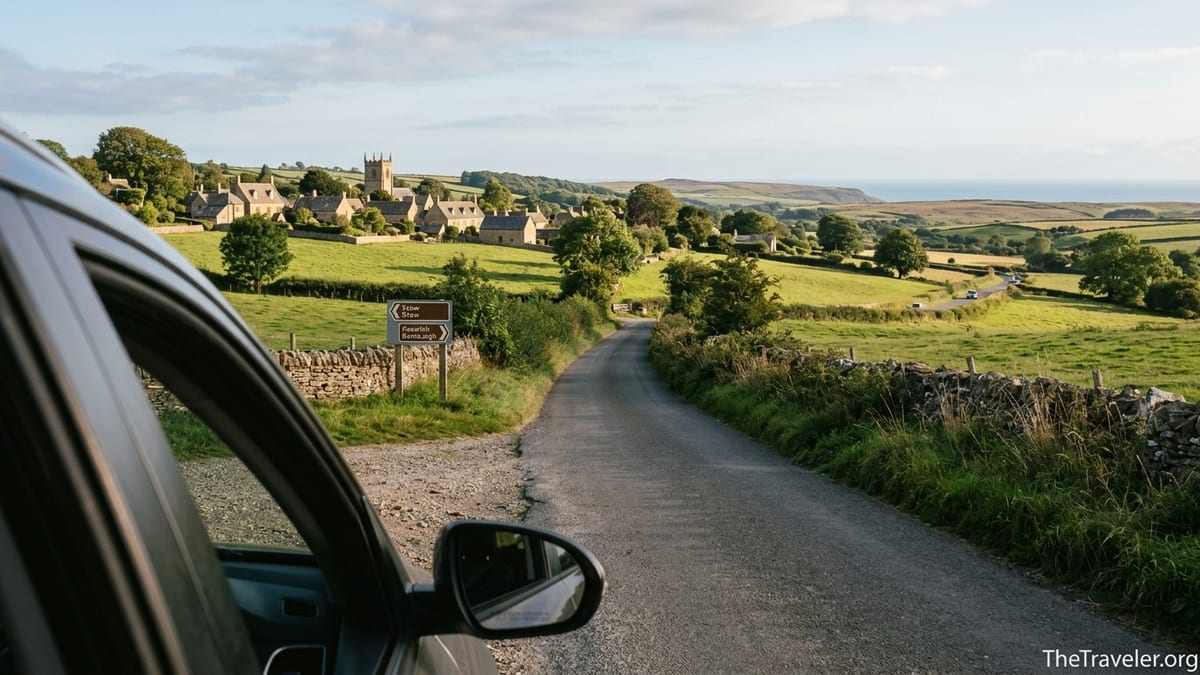
The Cotswolds is one of England’s most accessible rural road trip regions, covering almost 800 square miles of rolling hills, stone villages and small market towns. Burford, often called the “Gateway to the Cotswolds,” makes a natural first stop driving in from London or Oxford, with a long sloping high street and pay-and-display parking near the top and around the church at the bottom that allows you to avoid climbing back up at the end of the day. From here, you can create a satisfying loop via Bibury, Bourton-on-the-Water, Stow-on-the-Wold and Broadway, weaving together riverside lanes and hilltop views.
Car parks across the region are mainly run by local councils. In towns such as Cirencester or Stow-on-the-Wold, you’ll typically use pay-and-display machines between morning and early evening. Many now offer app-based payment via services like PayByPhone alongside coins or cards. Free on-street parking is rare in village centres and verges are often signed with double yellow lines, so plan to use official lots rather than improvising on lanes or field gates. Some car parks, particularly around the Cotswold Water Park and honey-pot villages, now include EV charging bays, although it is wise to check their locations ahead of time if you are driving electric.
South of the Cotswolds, the New Forest National Park and the South Downs add variety to a southern England road trip. The New Forest, between Southampton and Bournemouth, is threaded with unfenced roads where ponies, donkeys and cattle wander across without warning, so speeds are low and you must be ready to stop. Short, scenic drives link villages like Lyndhurst, Brockenhurst and Beaulieu, with informal gravel car parks opening onto heathland and woodland walks. Seasonal open-top bus routes now criss-cross the area in summer, a useful way to give the driver a break and reduce pressure on small car parks.
Further east, the South Downs form a line of chalk hills stretching from Winchester to Eastbourne. While the South Downs Way is a walking and cycling trail rather than a driving route, parallel country roads let you hop between highlights such as the hilltop viewpoints near Devil’s Dyke or the coastal cliffs of Beachy Head and the Seven Sisters. Inland, towns like Arundel offer castle views and riverside walks, with signed pay-and-display lots near the centre and extra overflow parking on busy days. By combining the Cotswolds, New Forest and South Downs in a three to five day loop from London, you can create a gentle introduction to English rural driving before tackling longer hauls.
Cornwall: Atlantic cliffs, fishing harbours and parking challenges
Cornwall rewards patience behind the wheel. Its main approach roads, the A30 from Exeter and the A38 via Plymouth, are modern and fast in parts, but once you turn off toward the coast, roads quickly narrow, lose their centre lines and sprout high hedgebanks that hide oncoming traffic until the last second. This is especially true around fishing villages such as Port Isaac, Mousehole and Mevagissey. In many of these places, driving into the old core is strongly discouraged or outright restricted, and visitors are directed to car parks on the edge of the village, often on steep slopes with tight turns.
For a classic Cornish driving day, many visitors follow sections of the A39 between Barnstaple, Bude and Wadebridge, often called the Atlantic Highway. From this road you can detour to beaches such as Widemouth Bay, where seafront car parks sit right above the sand, or north to the clifftops at Hartland. Further west, the loop around the Land’s End peninsula, via St Ives, Zennor, Sennen Cove and Porthcurno, mixes postcard villages with raw Atlantic scenery. Car parks in St Ives and at popular beaches are busiest from late morning to mid-afternoon in summer; arriving before 10am or after 4pm greatly improves your chances of finding a space without circling for half an hour.
Parking in Cornwall is mostly pay-and-display, with prices varying by proximity to the coast. Machines often allow payments by card and contactless, but a handful still require coins. Private fields converted into summer-only parking are common around beaches like Porthcothan or Kynance Cove; these can fill or close early if ground becomes muddy. It is important not to improvise parking on narrow access roads or in front of gateways, as locals rely on these routes for farm work and emergency vehicles. In recent years there has been more active enforcement of double yellow lines around hotspots such as Newquay, Padstow and St Ives.
To reduce time spent in queues, many travellers now base themselves in one or two hubs, such as Falmouth or Wadebridge, and then plan loop drives that radiate out on less obvious roads. For example, a day from Wadebridge might take you via the Camel Estuary to Padstow early in the morning, then out to Trevose Head for clifftop views, before returning inland via quiet B-roads rather than repeating the same coastal bottlenecks. If you are travelling in a larger vehicle, such as a campervan, it is often worth using village park-and-ride style lots, where you can leave the van and board local buses into especially constricted towns.
The Lake District: high passes, lakeside roads and weather awareness
The Lake District in Cumbria is one of England’s great road trip landscapes, but it demands respect from drivers. Valleys are linked by high mountain passes such as Honister, Kirkstone and Wrynose/Hardknott. These roads are narrow, steep and occasionally hairpinned, with gradients that can challenge heavily loaded rental cars, and they are best tackled in clear weather and daylight. Many visitors sensibly limit themselves to one or two high passes in a trip and otherwise use lower valley roads and lakeside routes.
A popular driving circuit starts in Keswick, loops around Derwentwater, heads south through Borrowdale to Seatoller, then climbs Honister Pass toward Buttermere and Crummock Water. Car parks at key points, including National Trust lots, are pay-and-display and can fill quickly on sunny weekends. Another classic drive runs from Windermere up to Ambleside and over Kirkstone Pass, with a small car park and an old inn near the summit that walkers use as a base. These passes can become slick in rain and are not recommended in snow or ice for inexperienced drivers; in those conditions, keep to main valley roads and use local buses and boats for sightseeing.
Lakeside car parks in Ambleside, Bowness and Keswick are used heavily by day-trippers. Expect to pay for half-day or all-day stays, and budget time to walk from parking to lake shores or piers. Many of the national park’s smaller car parks serve specific walking routes up fells and are tucked into lay-bys or small gravel lots; they tend to be unsigned until you are nearly upon them, so watch your navigation and avoid sudden braking for a space when someone is close behind you on a narrow road.
Weather in the Lake District changes fast. A sunny morning can turn into low cloud and heavy rain by lunchtime, which affects both visibility and your appetite for a twisting high pass. It is wise to check local mountain forecasts before committing to routes like Honister or Wrynose and to carry waterproofs and warm layers in the car even in midsummer. If visibility deteriorates, slow down and use passing places courteously. Locals are used to the roads; there is no shame in pulling over to let a queue behind you go ahead so that you can continue at your own pace.
Yorkshire and Northumberland: dales, moors and castle-dotted coasts
North of the Lake District, or reachable directly from southern England via the M1 and A1, Yorkshire and Northumberland offer some of England’s most rewarding but least crowded driving. In the Yorkshire Dales, roads contour around limestone hills and drop into steep-sided valleys, linking villages such as Hawes, Kettlewell and Reeth. The Buttertubs Pass between Hawes and Swaledale is widely regarded as one of England’s most spectacular roads, with sweeping bends and huge views. It is also narrow with limited parking at viewpoints, so plan to use village car parks and then walk short stretches rather than stopping in precarious spots on the roadside.
Across on the North York Moors, drives from Pickering toward Whitby or from Helmsley toward Rosedale take you over big open plateaus and down into wooded valleys. Roadside parking is limited on fast moorland stretches; you will typically find formal car parks at trailheads, visitor centres and villages, and it is safer to start walks from those rather than leaving the car on soft verges of 60 mph roads. In both Dales and Moors, weather can be harsher than in the lowlands, with fog and winter snow, so in colder months favour lower-level routes and check road reports before setting off at dawn.
Northumberland’s coast, from Amble up past Alnwick and Bamburgh to Holy Island, is superb road trip country. A common route starts inland at Alnwick, where town car parks are currently free, then heads out to coastal villages like Alnmouth and Craster before continuing to Bamburgh. The village has a main car park at Links Road opposite the castle, plus overspill areas in peak season; from here it is a short walk across the dunes to the vast sandy beach. Further north, access to Holy Island of Lindisfarne involves crossing a tidal causeway, so your driving plan must follow the official safe tide times published locally and displayed on roadside signs. Drivers occasionally get stranded by ignoring the timetable, and rescue is both embarrassing and expensive.
In this northern stretch of England, distances between fuel stations, supermarkets and late-opening services can be larger than in the south. It is a good idea to refuel in market towns such as Alnwick or Hexham, carry snacks and water, and keep an eye on your range before heading onto minor coastal or upland roads. Mobile coverage is patchy in some parts of the Dales, Moors and Northumberland interior, so download offline maps to your phone or carry a paper road atlas as a backup in case your navigation app loses signal.
Suggested multi-day driving circuits linking England’s scenic regions
To make sense of England’s many scenic pockets, think in terms of multi-day circuits rather than a single huge loop. One popular southern circuit starts and ends in London over about seven days. Day one and two cover the Cotswolds, perhaps with a base near Stow-on-the-Wold or Chipping Campden, using local loops to visit Bourton-on-the-Water, Snowshill and Broadway Tower. Days three and four swing south to the New Forest, with slow drives between Lyndhurst, Beaulieu and the coast, plus side trips into the South Downs or to the Jurassic Coast for views of the chalk cliffs and coastal walks. Days five to seven can be spent pushing further west into Dorset and Devon, using Exeter or Sidmouth as bases before returning to London via Stonehenge or Salisbury.
A longer two-week circuit could focus on both south and north. Starting in London, you might drive to the Cotswolds for two or three nights, then continue down to Cornwall via Bath or Exeter for three or four nights split between the north coast (for rugged cliffs) and south coast (for slightly calmer seas and gardens). From Cornwall, a full day’s drive takes you up to the Lake District, where you can base in Keswick or Windermere and plan day drives over one or two high passes plus quieter valley lanes. To finish, cross east into Yorkshire or Northumberland for three nights, focusing on a combination of Dales, Moors and coast before returning south via York and the A1 or M1.
Travellers with less time might prefer a northern-only loop starting in Manchester, Leeds or Newcastle. For example, a week-long circuit could begin at Manchester Airport, head straight to the Lake District for three nights, then cut across to the Yorkshire Dales and Moors for three nights, ending with a night on Northumberland’s coast before flying out of Newcastle. This approach cuts the long drives from southern England and lets you spend more of your time on scenic A and B roads rather than motorways.
Whichever pattern you choose, try to build in occasional car-free days. In the Cotswolds, this might mean parking in a market town like Cirencester or Tetbury and exploring on foot or by local bus. In the Lake District, boats on Windermere or Derwentwater offer a way to see the scenery without having to park at every viewpoint. On the Northumberland coast, you might leave the car in Seahouses for a day and take boat trips to the Farne Islands or walk sections of the coastal path between villages. Giving the driver breaks keeps energy and concentration levels high for the more challenging scenic segments.
Practical tips for parking, costs and staying safe on England’s roads
Parking is one of the most frequent pain points for road trippers in England’s popular regions. In many villages and beauty spots, especially in the Cotswolds, Cornwall and the Lake District, public car parks are small relative to demand. Arriving early usually pays off; pulling into a village car park at 9am in summer can feel relaxed, whereas by midday you may be queueing for a space or circling nearby streets. Where signed, park-and-display machines will ask you to pre-pay for a fixed duration, so it helps to have a rough idea of how long you plan to stay. If you are unsure, err on the side of a little extra time rather than risking an overstay penalty.
For budgeting, assume that scenic-region parking will form a noticeable line in your daily costs alongside fuel and lunches. A day of exploring might involve paying for a town centre car park in the morning, a second fee at a national park lot for a walk or beach visit, and perhaps a third fee at an evening viewpoint or coastal village. While many car parks now accept contactless cards and app payments, it remains sensible to carry a stash of pound coins in case machines are older or connectivity is poor.
On rural roads, the most important safety rule is to take your time. Many of the most beautiful lanes in the Cotswolds, Cornwall and the Dales are technically signed at 50 or 60 mph, but local drivers and experienced visitors typically travel far slower. Expect blind bends, hidden driveways, horse riders and cyclists. When you meet oncoming traffic on a single-track road, use designated passing places rather than verges, and if you are closest to a passing place it is usually courteous for you to reverse back into it. At night, wildlife on the road is common in forested areas and on moorland, so lean on your dipped headlights and keep speeds well down.
If you are new to driving in England, it is helpful to read up on key rules before you pick up your rental. Speed limits are generally 30 mph in built-up areas, 60 mph on single-carriageway rural roads and 70 mph on dual carriageways and motorways, unless signs state otherwise. Fixed speed cameras are widespread and some rural villages use mobile enforcement vans. Seat belts are compulsory for all occupants and using a handheld phone while driving carries substantial penalties. In practical terms, this means using your passenger or pulling into a safe lay-by if you need to adjust navigation rather than juggling the phone while steering through narrow bends.
FAQ
Q1. Do I really need a car to explore the Cotswolds, Cornwall and the Lake District?
While you can reach gateway towns by train or coach, a car offers far more flexibility for small villages, viewpoints and remote walks. In areas like rural Cornwall, the Northumberland coast and many Lake District valleys, public transport is limited or infrequent outside peak seasons, so a self-drive trip is usually the most practical option.
Q2. What kind of rental car is best for narrow English country roads?
A compact hatchback such as a Ford Focus, VW Golf or similar is usually ideal. These cars are small enough for tight Cornish lanes and village car parks but comfortable enough for motorway stretches. Unless you are travelling with a large family or lots of luggage, avoid SUVs and large vans, which can be stressful to manoeuvre and park in older villages.
Q3. How hard is it to adjust to driving on the left?
Most visitors adapt within a day or two. Start with simple motorway or A-road segments, avoid city centres at first, and pay special attention at roundabouts and junctions where muscle memory from right-side driving can kick in. Having a confident navigator and using clear sat-nav instructions helps, as does taking breaks when you feel tired.
Q4. Are England’s scenic passes like Buttertubs or Honister suitable for nervous drivers?
These roads are spectacular but can be intimidating. If you are nervous, choose a clear, dry day, travel outside rush hours, and be prepared to drive slowly and let others pass. Alternatively, you can enjoy similar scenery from lower valley roads or by joining guided tours and local buses that traverse some of the higher passes.
Q5. How expensive is fuel on an England road trip?
Fuel in England is relatively expensive compared with many countries. Exact prices change frequently, but motorway service stations are typically the priciest, with better value found at supermarket forecourts in towns. To control costs, refuel in larger towns when possible and drive smoothly rather than accelerating hard between bends and junctions.
Q6. What should I know about parking in villages and national parks?
Expect most official car parks to be pay-and-display, with charges during the day and sometimes free evenings. Many now accept cards and phone payments, but carrying coins is still wise. Avoid parking on verges, in front of farm gates or in narrow village lanes, where enforcement is increasing and local access can be blocked.
Q7. Can I do this kind of road trip with an electric vehicle?
Driving an EV through southern England and the Cotswolds is increasingly straightforward, with growing numbers of chargers at supermarkets, town car parks and some tourist sites. In more remote western Cornwall, parts of the Lake District, the Dales and Northumberland, charger density is lower, so you will need to plan your route and overnight stops carefully around reliable charging points.
Q8. How many days should I allow for a combined south and north England circuit?
A comfortable pace for a loop that includes the Cotswolds, parts of southern England, Cornwall, the Lake District and Yorkshire or Northumberland is around 10 to 14 days. This allows for two to three nights in each main region, plus travel days, without turning the trip into a continuous long-distance drive.
Q9. Is it safe to drive on English rural roads at night?
It is generally safe, but more demanding than daytime driving. Many lanes lack street lighting, have sharp bends and may see wildlife on the carriageway. If possible, schedule the most challenging scenic sections for daylight hours and reserve night driving for short hops between dinner and your accommodation on familiar routes.
Q10. How can I reduce stress on an England road trip as the only driver?
Build in regular rest days where you park the car and explore on foot or by public transport, avoid over-ambitious daily distances, and book lodgings with on-site or guaranteed parking. Starting drives early, using clear navigation and stopping for coffee or viewpoints when you feel tense also make a significant difference to how enjoyable the journey feels.