


Ask a Brit where to go for a quintessential countryside escape and two names come up again and again: the Cotswolds and the Lake District. Both offer stone cottages, cosy pubs and green hills, yet they deliver very different kinds of trips. One is all honeyed villages and gentle rambles, the other is big mountains, wild lakes and serious hiking. This guide compares them side by side so you can decide which countryside break fits your style, budget and time frame.
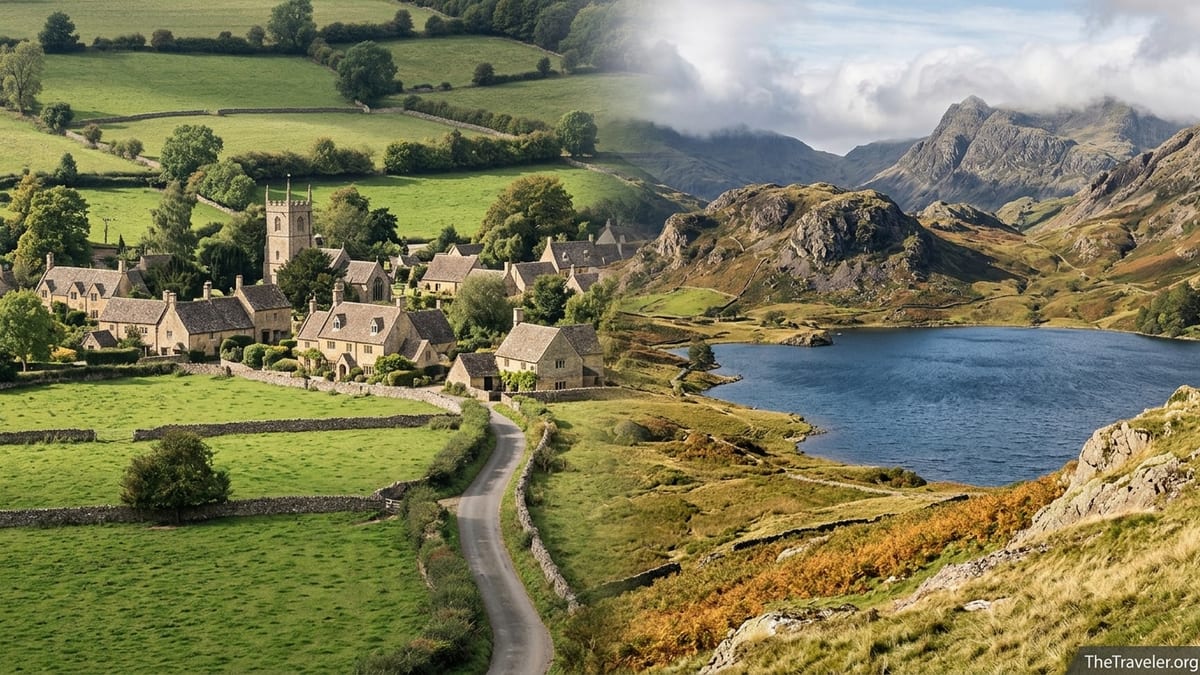
Overall vibe: soft-focus charm vs wild drama
If you picture low golden cottages, church spires and antique shops lining village squares, you are thinking of the Cotswolds. Spreading across several counties between Bath and Stratford-upon-Avon, it is made up of dozens of small market towns and villages such as Bourton-on-the-Water, Stow-on-the-Wold, Bibury and Broadway. The pace is slow, the hills are rolling rather than steep, and the focus is on pretty streets, cream teas, farm shops and short countryside walks rather than big, all-day hikes.
The Lake District in northwest England feels more rugged from the moment you arrive. Craggy peaks rise above deep lakes like Windermere, Derwentwater and Ullswater. Bases such as Keswick, Ambleside and Bowness-on-Windermere sit right on the water, with boat piers, gear shops and trailheads starting almost from the high street. You are never far from a serious fell walk, a rainstorm sweeping in, or a dramatic shaft of light on the fells. Cafes and pubs are still plentiful, but the Lakes are first and foremost about the landscape.
In practical terms, this means the Cotswolds suit travellers who want a gentle, picturesque break with lots of villages to browse and easy half-day walks. The Lake District suits those who actively want outdoor adventure, long hikes or time on the water, and who do not mind unpredictable weather to get it.
Villages and bases: where you will actually stay
In the Cotswolds, your choice of base shapes the trip more than in the Lakes, because public transport between villages is patchy and driving between them takes time. Stow-on-the-Wold is a classic first-timer base, with a good spread of inns and B&Bs, several pubs and restaurants, and fast road links to nearby highlights such as Bourton-on-the-Water and the twin villages of Upper and Lower Slaughter. Broadway is another popular base, especially if you like boutique hotels and want to walk sections of the Cotswold Way long-distance path.
If you favour quieter villages, people increasingly look to spots like Painswick, Winchcombe or Kingham rather than the most photographed places. From a practical point of view, Kingham and Moreton-in-Marsh are notable because they both have mainline rail stations, which makes them useful if you are arriving without a car and then relying on taxis or limited buses to reach your accommodation.
In the Lake District, the key decision is usually between Windermere and its neighbour Bowness (livelier, more restaurants and boat trips), Ambleside (central, with easy bus links north and south) and Keswick (on Derwentwater, brilliant for walking and with a more traditional town feel). Someone wanting an easy first visit might base in Bowness or Ambleside, where you have a dense cluster of hotels and guesthouses and car-free boat trips across Windermere. More walking-focused visitors often lean towards Keswick or smaller valleys like Borrowdale or Langdale, where you can walk straight from your door without driving.
Both regions also offer rural farm stays and cottages down single-track lanes. In the Cotswolds, that might mean a converted barn outside Chipping Campden reached via hedgerow-lined lanes. In the Lakes, it might be a stone cottage above Grasmere with a steep drive and a view straight onto the fells. These can be idyllic, but they do make a car almost essential and winter driving conditions something to consider.
Scenery and hiking: gentle strolls vs serious fells
The Cotswolds are officially designated an Area of Outstanding Natural Beauty, and the scenery reflects that status. Expect patchwork fields bounded by dry-stone walls, hilltop market towns and low wooded valleys. Walking here is more about meandering between villages than conquering summits. Sections of the 102-mile Cotswold Way, for example, link places like Chipping Campden, Broadway and Winchcombe with well waymarked paths and relatively modest climbs. Many visitors are content with 1–3 hour circuits, such as a circular walk from Bourton-on-the-Water via Lower Slaughter before looping back along the River Windrush.
The Lake District is England’s premier mountain playground. It contains the country’s highest peaks and dozens of classic fell walks, from a half-day up Catbells above Derwentwater to long days tackling Helvellyn or Scafell Pike. Even low-level walks feel more dramatic: a flat loop around Buttermere involves waterfalls, tunnels cut into the rock and sheer slopes rising straight out of the water. For those who prefer something easier, lakeside paths around Windermere or Derwentwater offer gentler options with constant views and regular cafes and jetties.
If you are new to hiking or travelling with children, the Cotswolds can be more forgiving. You can walk in trainers in dry weather on well-trodden tracks and always be close to a village tea room. In the Lakes, conditions change more quickly, and even simple walks often involve rocky, uneven paths. Proper footwear, waterproofs and a willingness to turn back if the weather closes in are essential, especially outside summer.
On the other hand, if you are a keen hiker, runner or wild swimmer, the Lake District offers far more depth. Guided walks, scrambling courses and ghyll scrambling (a kind of canyoning in mountain streams) are widely available, and outdoor shops in Keswick and Ambleside can kit you out with everything from walking poles to detailed Ordnance Survey maps.
Accommodation and costs: where your budget goes further
Both regions command a premium compared with much of rural England, especially in school holidays and summer. Broadly, mid-range hotel rooms in popular Cotswold villages often start around the high double digits or low triple digits in pounds per night if you book well ahead, with smarter boutique hotels and coaching inns running significantly higher. Bed and breakfasts above local pubs or in village houses can be better value and often include a cooked breakfast. Self-catering cottages range from compact one-bedroom conversions on a farm to full-blown country houses sleeping eight or more, priced accordingly.
In the Lake District, prices are just as variable and very sensitive to location and view. A simple guesthouse in Ambleside or Keswick can still be competitive outside peak dates, while lakeshore hotels around Windermere or Derwentwater command obvious premiums. Data from hotel comparison platforms in 2026 suggests that average nightly rates in Ambleside and Windermere often sit around the low to mid hundreds of dollars in high season, with Keswick sometimes a little lower on average. That aligns with what you see on the ground: chic design hotels with lake views and spas on one end, and wallet-friendlier B&Bs on side streets on the other.
If you are on a tighter budget, the Cotswolds can actually be more challenging, because there are fewer classic budget hotels and hostels than in the Lake District. The Lakes benefit from a strong tradition of youth hostels, bunkhouses and camping. For example, you can still find multi-bed rooms and simple private rooms run by hostel networks near Windermere, Keswick and Borrowdale, along with well-serviced campsites. That means backpackers, students and hikers can access the Lakes without spending heavily, especially if they self-cater.
For a comfortable but not extravagant stay, expect to budget similar headline amounts for both regions in peak season, but remember that in the Cotswolds your money often buys a picture-perfect village setting, while in the Lakes you are paying for immediate access to the fells and water.
Getting there and getting around: driving vs public transport
From London and the southeast of England, the Cotswolds are significantly closer. Mainline trains from London Paddington to gateways such as Moreton-in-Marsh or Kemble typically take around 1 hour 30 to just over 2 hours, after which you can continue by taxi, pre-booked transfer or local bus to your final village. Regional tourism and transport guides note that the Cotswolds are also well connected to the motorway network, with the M4, M5 and M40 giving fast access by car from London, Birmingham and Bristol. For many travellers, this makes the Cotswolds an easy 2 or 3-night add-on to a city stay.
Once you are in the Cotswolds, however, you feel the limits of rural public transport quickly. There are local buses and some integrated tickets that allow travel by train and bus, but services are often infrequent, especially in the evening, and many of the prettiest villages are not on direct routes. In practice, self-drive or small-group tours are often the most efficient way to hop between villages in a short trip. If you are uncomfortable driving on narrow lanes, it can be worth basing in a larger town like Cheltenham or Cirencester and joining day tours into the smaller villages.
Reaching the Lake District from London takes longer but is still straightforward. Direct trains from London Euston to Oxenholme, the main gateway station for the national park, typically take around 2 hours 40 to 3 hours, with onward connections to Windermere and bus links into Ambleside and Keswick. For those coming from Scotland or northern English cities, the Lakes are even more convenient, with Penrith and Oxenholme both on main north–south lines.
Within the Lake District, public transport is surprisingly practical in the central and northern valleys. There are regular bus services along the main routes, including frequent services around Windermere, Ambleside, Grasmere and Keswick, and boats criss-crossing major lakes. Regional tourism boards actively promote car-free itineraries that combine trains, buses and boats, making it possible to visit for several days without hiring a car, particularly if you focus on the central belt of the park. For visitors who dislike driving on rural roads, this is a significant advantage over the Cotswolds.
Best for couples, families and different trip lengths
Couples looking for a romantic, slow-paced escape often gravitate to the Cotswolds. A typical long weekend might involve checking into a coaching inn in Broadway, spending a morning browsing antique shops in Stow-on-the-Wold, walking down to Lower Slaughter for lunch by the river, and booking a table at a country gastropub in the evening. Spa hotels, afternoon tea rooms and stylish barn conversions are plentiful. The walking is scenic but not strenuous, which suits those more interested in conversation than peak-bagging.
The Lake District can be just as romantic, but in a more outdoorsy way. Think lakeside hotels with log fires in Bowness-on-Windermere or Grasmere, paired with boat trips, waterfall walks and perhaps a guided hike to a viewpoint. Active couples might schedule a mix of fell walks, paddleboarding or kayaking sessions and pub dinners in Keswick or Ambleside. The choice comes down to whether your ideal shared time is wandering stone lanes and gardens, or strapping on boots for a day on the hills.
For families, the Cotswolds work very well with younger children or grandparents, thanks to short drives between sights and a long list of straightforward attractions. In a single weekend you might visit a wildlife park, tour a stately home, and stroll through villages that look like film sets. Many pubs and tearooms are family-friendly, and day-to-day logistics are simple as long as you have a car.
The Lake District is exceptional for families with older children or teens who enjoy being active. Hiring rowing boats on Derwentwater, taking a lake cruise from Bowness, following easy ridge paths above Grasmere or trying a beginner-friendly scrambling session are all realistic day activities. However, wet weather days require more planning; it can be wise to book attractions such as indoor climbing walls or heritage railways in advance in high season to avoid disappointment.
In terms of trip length, the Cotswolds are arguably perfect for a 2 or 3-night break, particularly as an add-on to London, Bath or Oxford. You can see a satisfying number of villages and viewpoints in that time without feeling rushed. The Lake District rewards a longer stay of 3 to 5 nights or more, because the weather is changeable and walking routes are more varied; having extra days gives you flexibility to swap big hikes for valley walks or museum visits when conditions dictate.
Driving, seasonality and practical drawbacks
Both destinations have a few downsides that are worth weighing before you book. In the Cotswolds, driving can be stressful at peak times. Narrow lanes, high hedges and limited passing places are common, and villages like Bourton-on-the-Water can feel crowded with day-trippers in summer and on sunny weekends. Parking in the most popular spots is controlled and can be expensive for all-day stays, and moving your car between villages multiple times a day quickly adds to costs and frustration.
The Lake District suffers its own form of congestion. Car parks around Windermere, Ambleside and Keswick fill early on sunny days and during school holidays, and the main A-roads through the central lakes can crawl in midafternoon. The weather is also more volatile than in the Cotswolds. It rains often, including in summer, and low cloud can hide the peaks you came to see. Packing solid waterproof jackets, quick-drying layers and spare socks is not optional if you plan to walk.
Seasonality plays a big role in both. Spring and early autumn are often ideal times to visit either destination, with fewer crowds and milder weather. In the Cotswolds, late April and May bring blossom and lambs to the fields, while September highlights golden light on stone cottages and ripening hedgerows. In the Lake District, autumn colours in October can be spectacular on wooded slopes, though nights draw in quickly. Winter in the Cotswolds can feel cosy, with roaring pub fires and Christmas markets, whereas in the Lakes it can be magical but severe, with snow on high fells and ice on minor roads.
Another practical factor is accessibility. Those with limited mobility may find the Cotswolds easier for gentle exploration, as many village centres are relatively flat, and you can enjoy much of the scenery from the car or short walks. In the Lakes, many of the best viewpoints still require uneven paths or slopes, though there are accessible lakeside paths and some adapted boat trips for wheelchair users and those with reduced mobility.
The Takeaway: which countryside trip is better for you?
If your ideal English countryside trip means postcard-perfect villages, leisurely pub lunches and gentle walks between stone cottages, the Cotswolds are likely your best fit. They work especially well if you have limited time, want to tack a rural escape onto a city itinerary, or are travelling with mixed-ability groups who prefer easy walking and lots of cafes and shops.
If you crave big landscapes, proper hiking, and a sense of being out in wild country, the Lake District has a clear edge. It is the better choice for longer trips, active couples and families with older children, and anyone who is happy to plan around the weather for the reward of world-class scenery. The public transport infrastructure in the central Lakes also makes car-free travel more realistic than in the Cotswolds.
Ultimately, there is no single winner. Many repeat visitors to England happily return to both: a long weekend in the Cotswolds for slow charm and heritage, and a week in the Lake District when they want to lace up their boots and head for the fells. If this is your first trip and you must choose, let your answer to one question guide you: do you want to spend more time wandering villages or walking hills? Choose the Cotswolds for the former, the Lake District for the latter, and you are unlikely to be disappointed.
FAQ
Q1. Is the Cotswolds or the Lake District better for a first-time visit to England?
The Cotswolds are often easier for a first-time visitor because they are closer to London, gentler to explore and pair well with city itineraries. The Lake District is better if you already know you want a hiking-focused trip and are comfortable with longer travel times and variable weather.
Q2. Can I visit the Cotswolds or the Lake District as a day trip from London?
A Cotswolds day trip from London is realistic by train and organised tour or by car, although you will only sample a few villages. A Lake District day trip from London is technically possible by very early train and late return but is not practical; the journey time means you will spend more of the day travelling than exploring.
Q3. Which destination is better without a car?
The central Lake District works better without a car. Trains connect London and major cities to Oxenholme and Penrith, with buses and boats linking hubs like Windermere, Ambleside and Keswick. In the Cotswolds, rail gets you to a few edge towns, but buses are limited and many villages are hard to reach without taxis or tours.
Q4. Where should couples stay in the Cotswolds vs the Lake District?
Couples in the Cotswolds often choose romantic bases such as Broadway, Stow-on-the-Wold or a rural inn near Chipping Campden, focusing on cosy pubs and short walks. In the Lake District, popular couples’ bases include Bowness-on-Windermere, Grasmere or Keswick, where you can mix lakeside strolls, boat trips and scenic hikes.
Q5. Which is more suitable for young children and older relatives?
The Cotswolds usually suit mixed-age groups better, thanks to shorter walks, gentle terrain and easy access to villages, gardens and family attractions. The Lake District is excellent for families who enjoy outdoor activity, but steeper paths and more changeable weather can be challenging for very young children or those with limited mobility.
Q6. How many days do I need in the Cotswolds vs the Lake District?
Two or three nights in the Cotswolds is enough for a satisfying introduction covering several villages and a country walk or two. The Lake District rewards longer stays of three to five nights or more so you can explore different valleys, fit in both high and low-level walks and work around the weather.
Q7. Which trip is more expensive?
Headline accommodation prices in both regions can be similar in peak season, especially in popular villages and lakeshore locations. The Lake District, however, offers more true budget options such as hostels and campsites, while the Cotswolds lean more toward boutique hotels, inns and self-catering cottages, which can make shoestring trips harder there.
Q8. What is the best time of year to visit each destination?
Late spring and early autumn are ideal for both, with fewer crowds and generally pleasant weather. The Cotswolds are particularly charming in spring with blossom and lambs, and in December for festive markets. The Lake District is stunning in autumn for leaf colour and reflections on the lakes but requires more robust clothing at almost any time of year.
Q9. Are there good food and drink options in both places?
Yes. The Cotswolds have an especially strong pub and tearoom scene, along with farm shops and high-end country restaurants in villages and market towns. The Lake District offers excellent pub food, cafes geared to walkers, and a growing number of destination restaurants, particularly around Windermere and Cartmel, though you may find options more spread out in remote valleys.
Q10. If I love both villages and hiking, should I choose the Cotswolds or the Lake District?
If you value serious hiking and do not mind that villages feel more like bases than the main attraction, choose the Lake District. If you prefer having multiple pretty villages on your doorstep and are happy with shorter, gentler walks, choose the Cotswolds. Many travellers ultimately plan separate trips so they can experience both styles fully.