


The English Midlands reward slow, thoughtful travel: historic cities close together, green countryside between, and motorways that can be both a blessing and a headache. This guide shows how to link Birmingham, Warwick, Stratford-upon-Avon, the Peak District, Nottingham and Shropshire in several manageable circuits, so you can enjoy the region by car without spending your holiday in traffic jams or multi-storey car parks.
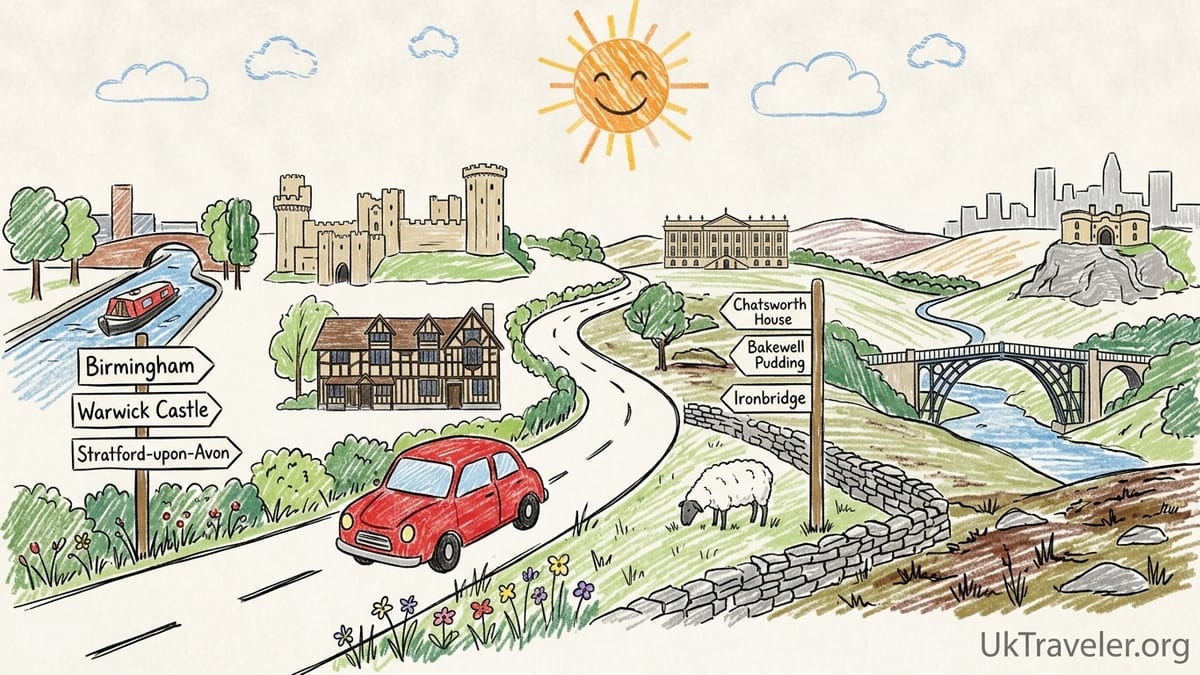
How to Structure a Realistic Midlands Road Trip
The temptation in the Midlands is to try to do everything in one sweeping loop: Birmingham, Warwick and Stratford, up to the Peak District, across to Nottingham, then west to Shropshire and back again. On a map the distances look short. In reality, congestion around Birmingham and the M6, queues near popular beauty spots in the Peak District and slow rural A-roads can easily double your driving times at busy periods. A more satisfying approach is to break the region into two or three compact circuits and accept that you will not see everything on a single trip.
Most visitors arriving from overseas will fly into Birmingham Airport or London. For a first visit, consider a two-part structure. Spend two or three nights in Birmingham without a car, using trains to reach Warwick and Stratford-upon-Avon. Then rent a car for four to six days to explore one or two countryside circuits: either a Peak District and Nottingham loop, a Shropshire and Ironbridge loop, or a shorter Worcestershire and Cotswolds-style loop south of Birmingham. That way you are not paying to park an idle car in Birmingham city centre, where day rates in central multi-storeys typically run to several pounds per hour, and you avoid the most stressful urban driving.
Driving distances in the Midlands are modest but rarely “motorway fast.” Birmingham to Warwick is roughly 25 miles and usually 35 to 45 minutes via the A45 and A46 outside peak rush hours. Birmingham to Stratford-upon-Avon is similar, around 25 miles and 45 minutes in light traffic, but Friday evenings or summer Saturdays can stretch that well beyond an hour. In the Peak District, short distances such as Bakewell to Castleton can take 40 minutes or more because you are on winding single-carriageway A-roads with tractors, walkers and touring coaches.
In practice, a comfortable Midlands road trip covers two or three overnight bases over a week to ten days. For example, you might spend three nights in Birmingham for museums and canals, three nights based in Bakewell or Buxton for the Peak District, and two or three nights in Shrewsbury or Ludlow for Shropshire and Ironbridge. Nottingham can be added as a night or two between the Peaks and Birmingham or visited as a day trip by train from a Peak District-edge base such as Derby.
Birmingham, Warwick and Stratford: City Break Plus Castles
Birmingham works best as your big-city anchor. The compact core around New Street and the canals is walkable and well served by trains and trams. Central driving is slow, traffic-calmed and increasingly constrained by one-way systems and clean-air measures. Parking is available in council and private multi-storey car parks, but it is not cheap at central locations. Day visitors often spend the equivalent of a modest restaurant lunch simply to leave the car for eight hours, especially near the Bullring, Brindleyplace or the business district. For a two or three night stay, it usually makes more sense to choose a hotel with included parking on the fringe of the centre, or to skip the car entirely until you head into the countryside.
From Birmingham, Warwick and Stratford-upon-Avon are straightforward train trips. Direct trains from Birmingham Moor Street or Snow Hill reach Warwick in about 30 minutes and Stratford in around 45 to 50 minutes, avoiding the need to navigate the M40 or A46. This makes a “city plus castles” mini-circuit easy without a car: base yourself in Birmingham, spend one day in Warwick touring Warwick Castle and the compact medieval town centre, and another in Stratford exploring Shakespeare-related sights along the River Avon. You simply step off the train and walk; Warwick station is about a 15-minute walk from the castle, Stratford’s station is 10 to 15 minutes from the riverside.
If you do choose to drive this circuit, allow extra time around commuter peaks. Birmingham to Warwick by car is frequently 45 minutes to an hour with congestion approaching the A46 junctions, and parking by Warwick Castle and in the town centre fills quickly on school-holiday and weekend days. In Stratford, riverside and town-centre car parks can be extremely busy on summer Saturdays and theatre nights, so arriving before 10:00 in the morning is wise. Expect to pay several pounds for a few hours of parking near the centre, slightly less in peripheral long-stay car parks that are a 10-minute walk from the historic core.
An efficient pattern for this mini-circuit is three nights in Birmingham, one night in Warwick or Stratford if you prefer evenings in a smaller town, and then back to Birmingham or onwards to your countryside base. With this structure, you can still be car-free in Birmingham and perhaps pick up a rental car from a city or airport office on the morning you leave for the Peak District or Shropshire.
Peak District and Nottingham: Hills, Market Towns and City Culture
The Peak District feels far from Birmingham but is only about 60 to 90 minutes’ drive from the city depending on your destination. Heading via the M6 and A50 to Ashbourne or via Derby to Matlock and Bakewell, you quickly move from motorways to rural A-roads that thread through limestone dales and gritstone edges. Driving is scenic but requires concentration: there are tight bends, dry-stone walls, sheep close to the roadside and frequent speed limit changes as you enter villages. At popular spots such as Chatsworth House, Bakewell and Castleton, day-visitor car parks are often full by late morning on bank holiday weekends and in the school summer holidays.
A practical route is to treat the Peak District and Nottingham as a five-night loop with two bases. One option is to drive from Birmingham to a southern Peak District base such as Matlock or Bakewell, stay two or three nights, then continue east via the A6 and A38 to Nottingham for a final one or two nights before returning to Birmingham. Distances are short: Birmingham to Matlock is roughly 70 miles and around 90 minutes outside peak periods; Matlock to Nottingham is around 30 miles and an hour or less via main roads. However, on sunny weekends, traffic around Matlock Bath and along the Derwent valley can slow to a crawl, so avoid planning tight arrival times.
Bakewell and Buxton make excellent countryside bases. Bakewell sits on the A6, with frequent buses to Chatsworth and onward connections towards Sheffield and Derby, so you can even mix driving days with public transport days to rest from the wheel. Buxton gives quicker access to the high moorland of the Dark Peak, Winnats Pass above Castleton and reservoirs around Ladybower. Travellers report that even short hops such as Bakewell to Castleton or Buxton to Castleton can take around 30 to 40 minutes, and that some of the most scenic roads are also among the slowest because of walkers, cyclists and tour buses.
From a Peak District base, Nottingham fits neatly as the “urban bookend” on the eastern side. The city is well signed from the A52 and A610, but rush-hour queues on approaches and around major junctions are common. Parking is straightforward in multi-storey car parks and signed surface lots, with fares broadly similar to other large English cities. A Nottingham stay of one or two nights allows time for the castle area, caves attractions and city centre. If you would rather avoid city driving altogether, you could instead base in Derby at the southern edge of the Peak District, visiting Nottingham by half-hourly trains that take around 30 minutes, leaving your car at a hotel or station car park.
Shropshire, Ironbridge and Worcestershire: Slow Roads and Classic Countryside
West of Birmingham lies quieter countryside: Shropshire’s rolling hills, the Ironbridge Gorge and the border landscapes edging into Wales. Compared with the Peak District, roads are generally less crowded, but they are also more lightly engineered, with narrow B-roads, hedgerows and blind summits that reward unhurried driving. The M54 gives fast access from the M6 towards Telford, but once you drop into Ironbridge Gorge you are on steep, twisting lanes where 20 to 30 miles can easily take an hour.
A popular circuit is Birmingham to Ironbridge and Coalbrookdale, then on to Shrewsbury or Ludlow for a base of two or three nights, adding a day exploring the hills of Church Stretton or the Severn Valley. From Birmingham, allow around an hour to reach Ironbridge by car outside rush hour, a little more if joining from the M6 or city centre. Car parks serving the various museums and riverside areas are pay-and-display and can be busy in fine weather, though they are usually less pressured than Peak District hotspots. From Ironbridge, Shrewsbury is about 30 to 40 minutes’ drive, Ludlow just over an hour via the A49.
Shrewsbury and Ludlow are excellent overnight bases. Both are historic market towns with compact centres, a range of independent hotels and guesthouses, and pay-and-display car parks just outside their medieval cores. Shrewsbury is on a loop of the River Severn and can be confusing to drive into on the first attempt, with one-way streets and tight corners, so it is sensible to park at the edge of town and explore on foot. Ludlow’s castle, local food scene and hilly streets are best appreciated without worrying about where you have left the car; choose accommodation with on-site or nearby parking if possible.
To complete a loop via Worcestershire, you might return towards Birmingham along the A456 and M5, detouring for a night in Bewdley on the Severn or the Malvern area on the Herefordshire border. These sections combine A-roads and local lanes; driving is not difficult, but progress can be slow behind agricultural vehicles or on narrow stretches where passing places are limited. Worcestershire villages like Great Malvern, Tenbury Wells or the Teme Valley hamlets are largely car-dependent: public transport exists but tends to be infrequent. Here a car is genuinely useful for pub lunches in out-of-the-way inns, visits to cider orchards or countryside walks starting from small parish parking areas.
Driving Conditions, Congestion and Parking Realities
Midlands motorways and trunk roads carry heavy traffic year round. The M6 around Birmingham is one of the busiest stretches of motorway in Britain, and incidents or roadworks can cause long delays. The M42, M5 and M40 corridors also slow significantly on Friday afternoons, holiday getaway weekends and around major events in Birmingham, Nottingham or Derby. Even non-motorway links, such as the A50 towards Stoke and Derby or the A38 around Derbyshire, can be stop-start at peak hours and around large retail parks.
Within cities, expect slow progress and tight parking. In central Birmingham and Nottingham, multi-storey car parks typically charge by the hour, with capped daily rates that quickly add up if you are staying more than a night or two. It is common to pay the equivalent of a modest museum admission simply to park for three or four daytime hours. On busy days, drivers report queues just to enter or exit some central car parks, especially when a major concert or football match finishes. Many locals prefer to park outside the central ring roads, sometimes for free on residential streets where it is permitted, then walk or use buses and trams into the core.
In historic towns like Warwick, Stratford, Shrewsbury and Ludlow, most central parking is pay-and-display in council-run or privately operated car parks. Machines usually accept coins and cards, and increasingly mobile payment apps, though phone signal can be patchy in deep valleys such as parts of the Peak District or Ironbridge Gorge. Maximum stays can be as little as two or three hours in prime spots, so check signs carefully if you plan a long castle visit plus lunch. For overnight stays, look for car parks that permit 24-hour tickets, or book accommodation that provides a space in a private yard or small on-site car park.
The Peak District has its own parking patterns. National Park and council car parks serve popular walking starts such as Mam Tor, Dovedale and Stanage Edge, and they are often full by mid-morning in good weather. Many charge all day rather than hourly, which can represent good value if you plan a long walk but feels steep if you only stay briefly. Lay-bys and roadside verges may seem tempting alternatives, but enforcement against unsafe or inconsiderate parking has become stricter in recent years, and locals are vocal about blocked lanes and access points. Arriving early, sharing a car among several travellers and being prepared to walk 10 or 15 minutes from a less popular parking area can all reduce frustration.
When a Car Is Essential and When It Is Not
One of the biggest decisions for a Midlands trip is whether to rent a car for the entire journey or only for the rural segments. In broad terms, you do not need a car in Birmingham or Nottingham, and you arguably do not want one in their centres. Frequent local trains and buses link Birmingham with Warwick, Stratford, Wolverhampton and Coventry, while Nottingham has an efficient tram and bus network. For a visitor staying mostly within these cities and doing the occasional rail day trip, taxis and ride-hailing services can fill any gaps at lower cost and stress than renting and feeding a car in a multi-storey.
A car becomes genuinely useful once you step into rural Derbyshire, Shropshire and Worcestershire. Many Peak District villages have bus links, especially along main routes like the A6 between Matlock, Bakewell and Buxton, or between Sheffield and Castleton. However, services can run only every hour or two, and evening departures thin out early. Trailheads for quieter walks, remote stone circles and out-of-the-way farm shops may be virtually inaccessible without your own wheels. Similarly, in Shropshire and the borderlands, picturesque villages and hill walks around Carding Mill Valley, the Stiperstones or Wenlock Edge are easiest reached by car, with parking in small pay-and-display lots or lay-bys.
A hybrid strategy suits many travellers. Arrive in Birmingham by train or plane, enjoy two or three days car-free in the city, then collect a rental car from a depot on the edge of the centre or at the airport on the morning you depart for the countryside. Use it for a Peak District and Shropshire loop of five to seven days, then either drop it back in Birmingham before a final night in the city, or continue south by car into the Cotswolds or Wales. This approach concentrates your driving in the areas where it adds the most value and saves both money and nerves in the big-city sections.
For those uncomfortable with driving on the left or on narrow lanes, it is still possible to experience much of the countryside without driving, but it requires more planning and acceptance of limited reach. You might base yourself in a transport hub like Derby, Sheffield or Chesterfield, using regional trains to reach Matlock, Buxton or Edale and then local buses or taxis to specific sights. In Shropshire, Shrewsbury works in a similar way, with rail links and some bus routes into the hills. Even in these scenarios, a day or two of local car hire from a small-town rental office can open up otherwise hard-to-reach corners.
Choosing Overnight Bases and Trip Length
Because the Midlands is compact, it is possible to over-base: to change hotels too often for small gains. A better approach is to choose two or three overnight bases that balance urban interest and rural access. For a week-long trip, one pattern is three nights in Birmingham, three nights in the Peak District and one night in Shropshire. For ten days, you might extend each of those stays or add a night or two in Nottingham between the Peaks and Birmingham, or in Warwick or Stratford to enjoy evenings by the river once day-trippers have gone.
In cities, look for centrally located hotels or apartments within walking distance of major sights and restaurants, but confirm parking arrangements before you book if you will have a car. Some properties include spaces in nearby multi-storeys or private courtyards for a nightly fee, while others point guests to public car parks that may not guarantee availability. In smaller towns like Bakewell, Buxton, Shrewsbury or Ludlow, independent inns and guesthouses often include at least limited off-street parking. Booking early for summer weekends, bank holidays and festival periods is sensible, as capacity can be tight and prices rise when local events take place.
For Peak District stays, think about the type of walking or scenery you prefer. Bakewell and surrounding villages such as Ashford in the Water or Baslow suit those who enjoy river meadows, stately homes and moderate dales walking. Buxton, Castleton and Hathersage give quicker access to higher, rougher ground and tors. In Shropshire, Ludlow is ideal if you care about food and markets, while Church Stretton and Craven Arms place you closer to upland walks. Worcestershire’s Malvern area combines Victorian spa-town architecture with long ridge walks and reasonably frequent trains towards Birmingham, which can reduce driving if you want a day back in the city.
Overall trip length depends on how many circuits you attempt. To include all the elements in this guide at a comfortable pace, ten to twelve nights is ideal, allowing separate time for Birmingham and Warwick/Stratford, five or six nights split between the Peak District and Nottingham, and three or four nights in Shropshire and Worcestershire. With a week, prioritise: either Birmingham, Warwick/Stratford and the Peak District, or Birmingham and a combined Shropshire/Worcestershire loop, leaving Nottingham for a future visit.
The Takeaway
The Midlands sits at the heart of England but is often bypassed by travellers rushing between London and the north. Those who slow down discover a region where distances may be short but experiences vary widely: industrial canals and cutting-edge galleries in Birmingham, medieval timber-framed streets in Stratford and Ludlow, limestone dales and high moorland in the Peak District, iron bridges and Victorian factories along the Severn.
Making that variety work as a road trip means resisting the urge to tick off every dot on the map. Break the area into logical circuits, use trains for the straightforward hops between Birmingham, Warwick and Stratford, and reserve your car rental for the sections where rural roads unlock hill walks, hidden villages and riverside pubs. Plan for congestion on motorways and around honeypot towns, budget realistically for parking, and be kind to yourself by limiting each day’s driving to a couple of hours at most.
With that mindset, a Midlands road trip becomes not a forced march but a series of linked mini-breaks: a gallery afternoon followed by canalside dinner in Birmingham, a Shakespeare matinee in Stratford, a misty morning walk above Castleton or Dovedale, a slow lunch in a Shropshire market town. The region rewards repeat visits, but even on a first circuit, thoughtful routing and sensible use of the car will let you see both its cities and its countryside without turning your holiday into one long queue.
FAQ
Q1. Do I need a car for the whole Midlands trip or just the countryside parts?
For most travellers it is better to be car-free in Birmingham and Nottingham, then rent a car only for the Peak District, Shropshire and Worcestershire sections where public transport is limited and a car genuinely expands what you can see.
Q2. How bad is motorway congestion around Birmingham and when should I avoid driving?
Motorways such as the M6, M5, M40 and M42 around Birmingham are heavily trafficked, with frequent slowdowns on weekday rush hours, Friday afternoons and holiday getaway periods, so it is wise to plan longer non-city transfers for mid-morning or early afternoon on weekdays where possible.
Q3. Is driving in the Peak District difficult for someone not used to UK roads?
The Peak District has many narrow, winding A-roads with steep gradients and stone walls close to the edge, which can feel challenging at first, but if you keep speeds modest, avoid night driving on unfamiliar lanes and choose main routes between larger towns, most careful drivers adapt within a day or two.
Q4. Where should I base myself in the Peak District for a first visit?
Bakewell and Buxton are popular first-time bases, as both offer a good choice of accommodation, restaurants and shops, plus relatively frequent bus links to nearby highlights such as Chatsworth, Castleton and various walking areas, reducing your need to drive for every outing.
Q5. Is parking in Birmingham and Nottingham very expensive?
Central multi-storey car parks in Birmingham and Nottingham typically charge several pounds per hour with higher daily caps, so costs mount quickly if you leave a car all day, which is why many visitors prefer either hotels with included parking on the edge of the centre or a largely car-free city stay.
Q6. Can I visit Warwick and Stratford-upon-Avon easily by train from Birmingham?
Yes, direct trains from Birmingham Moor Street and Snow Hill reach Warwick in roughly half an hour and Stratford-upon-Avon in around 45 to 50 minutes, making both very practical day trips without needing to drive or worry about castle or riverside parking.
Q7. How many days do I need for a Midlands road trip that includes cities and countryside?
To combine Birmingham, Warwick or Stratford, the Peak District, Nottingham and a Shropshire loop at a relaxed pace, ten to twelve days is ideal, while a week is enough for Birmingham, Warwick or Stratford and either the Peak District or Shropshire but not all areas comfortably.
Q8. Are rural roads in Shropshire and Worcestershire well signposted?
Main A-roads are clearly signposted, but many minor lanes use small, sometimes weathered signs, so it helps to rely on a sat-nav or offline map while still paying close attention to road markings and using lay-bys to pull over and check directions safely.
Q9. Is it easy to refuel and find services in the countryside?
Fuel stations are common on main roads and near larger towns, but can be sparse in deeper rural zones of the Peak District and Shropshire, so it is sensible not to let your tank fall too far below half when planning longer runs across hills or moors.
Q10. When is the best time of year to drive this Midlands route?
Late spring and early autumn often provide the best balance of quieter roads, reasonable weather and longer daylight, whereas school summer holidays, bank holiday weekends and midwinter dark evenings tend to bring heavier traffic, busier car parks and more challenging driving conditions.