


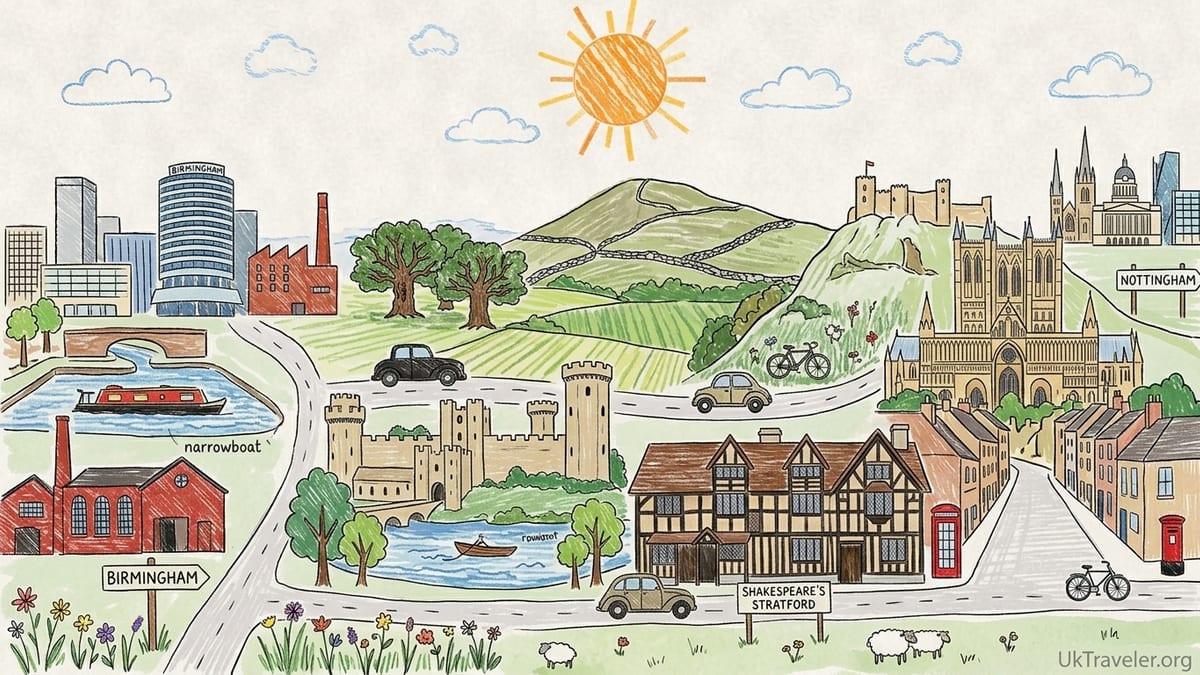
For many first-time visitors to England, the Midlands is a grey area on the map: not quite the romantic Cotswolds, not quite the northern dales, and certainly not London. Yet this broad band of central England holds some of the country’s most compelling contrasts, from the canals and curry houses of Birmingham to the limestone dales of the Peak District, Robin Hood country in Nottinghamshire and the half-timbered streets of Shakespeare’s Stratford-upon-Avon. This guide explains what “the Midlands” actually means, how the East Midlands and West Midlands fit together, and how to plan realistic trips built around the region’s most useful visitor zones.
Understanding the Midlands, East Midlands and West Midlands
The Midlands is simply the central belt of England, sitting between the North and the South, east of Wales and west of the North Sea. For visitors, it usually means the broad area around Birmingham, the Peak District, Nottingham, Leicester, Derby, Lincoln, Coventry, Warwick, and their surrounding countryside. You will often also see the broader term “Central England,” especially on tourism sites describing routes that run from the Cotswolds through Warwickshire to the Peak District and Lincolnshire. In practice, all these labels refer to overlapping parts of the same inland heartland.
Administratively, the UK government divides England into nine official regions, including the West Midlands region and the East Midlands region. The West Midlands region includes the metropolitan county around Birmingham plus largely rural counties such as Warwickshire, Shropshire, Staffordshire, Herefordshire and Worcestershire. The East Midlands region covers Derbyshire, Nottinghamshire, Leicestershire, Lincolnshire, Northamptonshire and Rutland. These boundaries matter for politics and statistics, but as a traveler you will find it more helpful to think in terms of logical visitor zones that naturally cluster together around cities, landscapes and transport lines.
Because of these overlapping definitions, you will see attractions marketed in several ways. Stratford-upon-Avon, for example, is in Warwickshire within the West Midlands region but is often promoted as part of “Shakespeare’s England” or “Shakespeare’s Country,” which stretches into neighboring Worcestershire and the northern Cotswolds. The Peak District spans several counties including Derbyshire and Staffordshire but is usually described as a single national park destination. When planning your trip, treat terms like “Midlands,” “Central England” and “Shakespeare Country” as broad, experience-based labels rather than strict borders.
A practical way to approach the Midlands is to group the region into zones that are easy to explore from a single base. This guide uses seven: Birmingham and the Black Country; Shakespeare’s Warwickshire; the Peak District and Derbyshire; Nottinghamshire; Leicestershire; Lincolnshire; and Staffordshire and Shropshire. Each of these areas can be the focus of a dedicated trip of two to four days, or combined if you have a week or more and are comfortable with some driving or longer rail journeys.
Birmingham and the Black Country: Urban Heart of the Midlands
Birmingham is England’s second-largest city and an obvious anchor for a first Midlands trip. Its compact city centre revolves around New Street and Moor Street stations, making it a convenient base even if you are visiting by train. From here you can walk to the canals around Brindleyplace and Gas Street Basin, the Jewellery Quarter with its preserved workshops, and the major galleries and museums clustered around Centenary Square. The city has a strong food reputation, with everything from Michelin-starred restaurants to the famous “Balti Triangle,” where a simple curry for two might cost the equivalent of a modest London pub meal but with far more character.
West of Birmingham lies the Black Country, a dense cluster of historic industrial towns such as Dudley, Walsall and West Bromwich. For visitors, the standout attraction is the open-air Black Country Living Museum in Dudley, where historic houses, shops and tramlines recreate everyday life in an industrial Midlands town. Families typically spend half a day to a full day here, riding vintage trams, visiting a Victorian schoolroom and trying traditional fish and chips. The site has been undergoing major redevelopment in recent years, so it is worth checking opening hours and current exhibits when you plan your dates.
Birmingham works well as a transport hub. Direct trains usually connect it to London in under 90 minutes and to Manchester in around 90 minutes to two hours. Regional rail links put Stratford-upon-Avon at roughly an hour away, while Shrewsbury, Wolverhampton and Stoke-on-Trent can often be reached in under an hour. If you are renting a car, the city sits at the junction of several motorways, but driving and parking in the core can be stressful. Many visitors choose to stay centrally without a car and rent one only when heading out into the countryside.
For a first visit focused on Birmingham and the Black Country, two or three nights is usually enough to experience the main urban sights and make one or two short side trips, perhaps to Coventry’s striking cathedral or to the canalside village of Bournville, long associated with chocolate-making. If you want to combine Birmingham with Stratford-upon-Avon or Warwick Castle, allow four nights so you are not rushing between city museums, theatre performances and major historical sites.
Shakespeare’s Warwickshire: Stratford-upon-Avon and Surroundings
South of Birmingham, Warwickshire offers one of the most recognisable slices of English culture. Stratford-upon-Avon, on the River Avon, is the birthplace and burial place of William Shakespeare and is one of the country’s major tourist towns. Here you can visit the timbered house on Henley Street where Shakespeare was born, his later home site at New Place, and other family properties, alongside the riverside theatres of the Royal Shakespeare Company. Performances run through most of the year, and it is wise to book tickets in advance if you are visiting during school holidays or at weekends.
Just up the road, Warwick is dominated by Warwick Castle, a large, family-oriented attraction that mixes real medieval history with modern storytelling, seasonal shows and sometimes overnight “knights’ village” stays. Visitors with children often allocate a full day to the castle, since ticketed experiences can include castle ramparts, bird of prey displays and interactive dungeons. Expect prices broadly similar to other major British castles and theme-style attractions, especially if you purchase tickets at the gate rather than in advance.
The wider Warwickshire countryside balances gentle farmland with pockets of ancient woodland and low hills. Driving 15 to 30 minutes from Stratford or Warwick brings you to small market towns such as Alcester and Henley-in-Arden, or to villages on the northern edge of the Cotswolds where honey-coloured stone cottages line narrow lanes. Country house hotels and converted barns sit among this landscape, offering a quieter base than the busy centre of Stratford. Walking routes like Shakespeare’s Avon Way link river meadows and historic churches, providing an easy-going contrast to theatre nights and castle crowds.
For most first-time visitors, two to three nights in Stratford or Warwick is a comfortable amount of time, particularly if you are adding the area onto a Birmingham stay. With that you can see key Shakespeare sites, watch one performance, visit Warwick Castle and still enjoy some relaxed strolling by the river or a short drive into the countryside. Without a car, trains and buses connect Stratford with Birmingham and Warwick, but services can be less frequent late in the evening, so factor that into theatre plans.
Peak District and Derbyshire: England’s Uplands in the Midlands
The Peak District, most of it in Derbyshire, is England’s original national park and one of the most scenic areas within easy reach of the Midlands’ cities. It lies roughly midway between Manchester and Sheffield, with the southern reaches accessible by road from Derby and Stoke-on-Trent. Landscapes range from soft green dales, where rivers wind between dry-stone walls and sheep pastures, to higher gritstone edges with sweeping views that appeal to walkers, climbers and photographers.
Derbyshire towns such as Bakewell and Matlock Bath serve as classic visitor bases, with small hotels, traditional pubs, tea rooms and riverside walks. Near Bakewell, Chatsworth House is one of England’s grandest stately homes, set in a wide estate with gardens, fountains and walking trails. Tickets typically include timed entry to the house interior as well as access to the grounds, and many visitors plan half a day or more here, especially if they want to combine formal rooms, farmyard attractions for children and lunch in one of the on-site restaurants.
Further north, the village of Castleton sits in a limestone valley overlooked by Mam Tor and the ruins of Peveril Castle. It makes a strong base for outdoor-oriented travelers, with easy access to show caves, shorter hill walks and scenic drives over passes like Winnats Pass. The Peak District National Park Authority maintains visitor information in Castleton, and seasonal campaigns encourage visitors to treat the landscapes gently by sticking to paths, taking litter home and supporting local businesses when possible. For families, straightforward circular walks along former railway lines such as the Monsal Trail provide traffic-free cycling and walking options.
Without a car, the best access points into the Peak District are often rail-connected towns on the edges, such as Sheffield, Derby or Buxton, from where local buses fan into the hills. With a car, you can create loops linking Bakewell, Castleton and the Derwent Valley, home to historic mills that tell the story of the Industrial Revolution. A focused Peak District and Derbyshire trip works well as a three- or four-night break, but even two nights give you a flavour if you are adding it onto a wider Midlands itinerary.
Nottinghamshire and Robin Hood Country
East of Derbyshire, Nottinghamshire blends a lively university city with layers of medieval legend and woodland. Nottingham city itself sits on a sandstone outcrop honeycombed with historic caves. The central castle site today combines a museum, galleries and access to some of these tunnels, while nearby you will find pubs that trade on claims of being among the oldest in England, such as cave bars cut directly into the rock. Street-level, the Lace Market district mixes Victorian warehouses and contemporary shops, and the city’s role as a centre for literature and sport gives it a creative, energetic feel.
Beyond the city, Nottinghamshire’s countryside is inseparable from the stories of Robin Hood. Sherwood Forest, now a managed country park and nature reserve, protects ancient oak woodland including the famous Major Oak. Trails wind among the trees with information boards about both the ecology and the legends. Seasonal Robin Hood-themed events and festivals often run in late summer, attracting families for archery demonstrations, storytelling and costumed performances. The nearby village of Edwinstowe features a church that folklore links with Robin Hood and Maid Marian, and it has basic visitor services such as cafes and small shops.
For many visitors, a day trip from Nottingham to Sherwood Forest is enough to satisfy the legend. Buses and tours can connect the city with the forest, but a rental car offers more flexibility, allowing you to combine the forest with other stops such as Clumber Park or the romantic ruined abbey at Newstead, once home to the poet Lord Byron. Travel times are not long in distance terms, but rural bus services can run only every hour or two, which is important when planning with children or in poor weather.
A short Nottinghamshire break of two or three nights lets you pair city and countryside. One realistic pattern would be to spend one day focused on Nottingham: castle site, cave attraction, a walk through the Lace Market and perhaps an evening at a local theatre or football stadium. The next day, devote to Sherwood Forest and one or two extra stops. If you are visiting during August or school holidays, expect the forest car parks and family activities to be busy and arrive earlier in the morning to secure parking spaces close to the main visitor centre.
Leicestershire and the Underrated Centre
Leicestershire sits at the very centre of England and is often bypassed by overseas visitors despite offering a straightforward, less crowded Midlands experience. Leicester city itself mixes Roman archaeology, a large market, and multicultural neighbourhoods with strong South Asian food scenes. The rediscovery and reburial of King Richard III in Leicester brought international attention, and the city’s visitor centre dedicated to his story is now a key attraction, explaining both the medieval politics and the modern archaeological detective work that uncovered his grave beneath a car park.
Outside the city, the county is mostly gently rolling countryside punctuated by villages and market towns such as Market Harborough and Loughborough. Heritage railways, canals and reservoirs offer low-key days out. Families often gravitate toward attractions just beyond the county borders that are still convenient from Leicester, such as the National Space Centre near the city or theme parks in neighbouring counties. This underscores how fluid “Midlands” boundaries are for practical travel: you can base in Leicester and still spend much of your time enjoying experiences branded under nearby regions.
Leicestershire makes sense either as a quieter base for exploring multiple Midlands zones or as a one- or two-night stopover between London and northern England. Rail links connect Leicester with London in around an hour and with Nottingham and Derby in under an hour in many cases, so you can treat it as a hub for day trips if you prefer to stay outside the busiest tourist centres. Accommodation prices can be lower than in better-known destinations, especially midweek when business travel is lighter.
If your main interests are castles and dramatic landscapes, Leicestershire may feel more like a supporting act than a headline destination. However, for travelers who enjoy everyday English city life, good value food and the sense of being in a real working region rather than a curated tourist bubble, it adds welcome depth and variety to a Midlands itinerary. One or two nights are generally sufficient for first-time visitors unless you have personal or family ties pulling you to stay longer.
Lincolnshire, Staffordshire and Shropshire: Edges of the Midlands
On the eastern flank of the Midlands, Lincolnshire stretches from flat inland farmland to a modest coastline, with the historic city of Lincoln at its heart. Lincoln Cathedral and the hilltop castle dominate the skyline, and the steep streets linking the lower town with the historic quarter give the city a strong sense of place. Compared with more famous cathedral cities in southern England, Lincoln is often quieter and less commercial, yet it offers similar ingredients: medieval architecture, independent shops and views over a wide countryside of fields and villages.
Reaching Lincoln usually requires a change of train from major hubs such as Nottingham, Newark or Sheffield, though direct services exist from some cities. For drivers, the approach roads are mostly standard A-roads passing through villages rather than fast motorways, so journey times can be longer than the map might suggest. Lincolnshire’s coastline, including traditional seaside resorts, is mostly of domestic interest for British families, but if you are exploring deeper into Central England it is possible to combine cathedral, market town and a glimpse of the North Sea within a three-night stay.
To the west of Birmingham, Staffordshire and Shropshire frame the region against the Welsh border and the Cheshire Plain. Staffordshire mixes pottery heritage in Stoke-on-Trent with large modern theme parks and historic houses. The county is also home to sections of the Peak District within its northern boundaries, meaning that bases like Leek or Ashbourne can serve both Peak District walks and day trips south toward Birmingham or east toward Derby. Shropshire, centred on Shrewsbury, offers half-timbered streets, riverside walks and Ironbridge Gorge, a World Heritage Site that marks a birthplace of the Industrial Revolution with its preserved iron bridge and museum sites.
Together, Staffordshire and Shropshire present a slower-paced, more rural Midlands where hedgerows line narrow lanes and market towns host weekly livestock or produce markets. Public transport can be limited in the deepest countryside, so this is where a rental car becomes particularly useful. A three- or four-night loop from Birmingham might take in Ironbridge, Shrewsbury and a slice of north Staffordshire, or combine these with a couple of days in the southern Peak District, blurring administrative boundaries in favour of coherent travel experiences.
Transport, Trip Planning and Where to Base Yourself
Planning a Midlands trip starts with understanding just how central and connected the region is. From London, fast trains reach Birmingham, Nottingham and Leicester typically in around one to two hours, and onward regional trains or buses connect to towns such as Stratford-upon-Avon, Warwick, Derby and Shrewsbury. Within the region, rail lines often radiate from Birmingham and from East Midlands cities, which makes hub-and-spoke trips easier than point-to-point linear routes. For a visit of a week, it is realistic to choose two main bases and explore outward rather than changing hotels every single night.
One common strategy is to use a major city as your first base, then move to a rural or small-town base. For example, you might spend three nights in Birmingham without a car, focusing on museums, canals and a day trip to Stratford, then pick up a rental car and spend four nights split between the Peak District and Nottinghamshire. Alternatively, you could base in Nottingham to combine city life and Robin Hood country, then move to Derbyshire or Staffordshire for countryside and stately homes. Each shift usually involves under two hours of travel if you plan sensibly, which keeps travel days manageable.
Public transport is strong between the major nodes but less so in remote countryside. In the Peak District or rural Shropshire, bus services can be infrequent, particularly on Sundays. If you plan to rely on trains and buses, choose bases with central stations or strong bus interchanges, like Derby, Nottingham or Shrewsbury, and focus day trips on well-served destinations such as Bakewell, Castleton or Warwick. Taxis can cover gaps but may need to be booked ahead, and costs add up quickly for long distances, often outstripping the per-day price of a small rental car.
The number of separate trips the Midlands warrants depends on your interests. A single ten- to fourteen-day journey could comfortably combine Birmingham and the Black Country, Shakespeare’s Warwickshire, the Peak District, Nottinghamshire and perhaps a taste of Lincoln or Shrewsbury. Many travelers instead split the region into at least two shorter trips: a long weekend built around Birmingham, Warwick and Stratford, followed by another built around the Peak District and Nottinghamshire. If you are also trying to cover London, the Cotswolds and perhaps York or the Lake District, treating the Midlands as its own focused chapter rather than a rushed through-corridor will reward you with a stronger sense of place.
The Takeaway
The Midlands is not a single postcard image but a patchwork of cities, uplands, forests and cathedral towns that together form England’s heartland. Understanding that “the Midlands,” “East Midlands,” “West Midlands” and “Central England” are fluid, overlapping labels rather than rigid boxes helps you plan a trip that follows your interests instead of administrative maps. Think in terms of real travel zones: the urban confidence of Birmingham and the Black Country, the literary and castle heritage of Warwickshire, the rugged beauty of the Peak District, the legends of Nottinghamshire, and the quieter depth of Leicestershire, Lincolnshire, Staffordshire and Shropshire.
For your first visit, start by choosing one city base and one countryside base and allowing at least a week between them. Use trains to reach your first hub, and consider renting a car only when you move into more rural zones. Accept that you will not see everything in one go. The Midlands lends itself to repeat visits, each focused on a different cluster: Shakespeare country one year, hill walks and stately homes the next, Robin Hood forests and canal-side industrial heritage another time.
Above all, treat the Midlands as a destination in its own right, not just the scenery between London and the North. Whether you are sharing fish and chips on a canal basin in Birmingham, looking out from a Peak District ridge, or walking under the oaks of Sherwood Forest, you will find a region that tells England’s story in an unvarnished, engaging way.
FAQ
Q1. How many days do I need for a first trip to the Midlands?
For a meaningful first visit, plan at least seven days. That allows three nights in a city such as Birmingham or Nottingham and four nights in one or two countryside zones like the Peak District or Shakespeare’s Warwickshire.
Q2. Should I rent a car to explore the Midlands?
You can explore the main cities and some major attractions by train and bus, but a car is very useful for the Peak District, rural Shropshire, parts of Lincolnshire and more remote castles or stately homes.
Q3. What is the best base for first-time visitors?
Birmingham works well as an initial base thanks to its rail connections and central location. Nottingham, Derby and Leicester are also strong options if you are focusing on the East Midlands.
Q4. Can I visit the Peak District as a day trip from a city?
Yes, it is realistic as a day trip from Sheffield, Manchester or Derby by train and bus, or by car from Birmingham and Nottingham, but staying two or three nights in Derbyshire gives you a much better experience.
Q5. Is Stratford-upon-Avon worth an overnight stay?
If you want to see Shakespeare sites and attend an evening performance at the Royal Shakespeare Company, staying at least one night is ideal. A rushed day trip can feel tight, especially in peak season.
Q6. How do East Midlands and West Midlands differ for travelers?
The West Midlands centres on Birmingham, Coventry and Warwickshire’s castles and Shakespeare heritage. The East Midlands offers the Peak District, Nottingham and Sherwood Forest, Leicester and Lincoln, with generally more rural landscapes.
Q7. When is the best time of year to visit the Midlands?
Late spring through early autumn, roughly May to September, usually offers the most reliable weather for walking and outdoor attractions. Winter visits can be atmospheric in cities but bring short days and colder, wetter conditions.
Q8. Are Midlands attractions expensive compared with London?
Major castles, theme parks and stately homes can be similarly priced to London attractions, but everyday costs such as mid-range hotels, pub meals and local transport are often noticeably lower in Midlands cities and towns.
Q9. Can I combine the Midlands with the Cotswolds or North of England?
Yes, the Midlands sits naturally between these areas. Many itineraries link London, the Cotswolds and Warwickshire, then continue north via Birmingham, the Peak District and on to York or Manchester.
Q10. Is the Midlands suitable for family travel?
Very much so. Families can mix hands-on industrial museums, Warwick Castle, the Black Country Living Museum, Sherwood Forest, theme parks in Staffordshire and easy Peak District walks, all within relatively short travel distances.