


The East of England rewards travelers who look beyond county borders and think in landscapes instead. From the colleges and cobbles of Cambridge to the wind-rippled reed beds of the Norfolk Broads and the shingle beaches of the Suffolk coast, this is a region built for slow journeys, long horizons and atmospheric historic towns. Current tourism promotion increasingly highlights hero destinations such as Cambridge, Norwich, North Norfolk, the Broads, the Suffolk coast and emerging corners of Essex rather than ticking off every county in turn. This guide follows that lead, picking the standout places that merit your time and helping you decide which deserve an overnight stay and which work best as easy day trips.
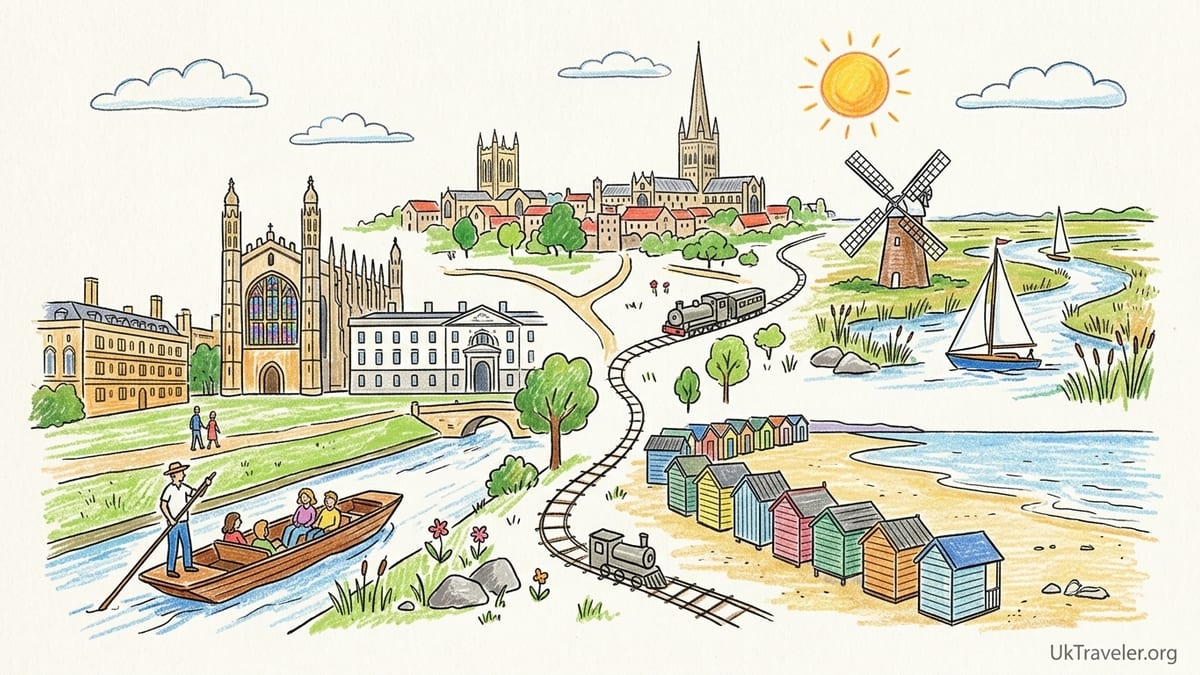
How to Structure a Trip to the East of England
For most visitors, the East of England fits naturally into two or three bases rather than a sprint across every county. Cambridge and Norwich anchor the urban side of a trip, with the Norfolk Broads and North Norfolk coast forming one obvious cluster, and the Suffolk coast plus historic inland towns and Essex highlights forming another. With good rail links from London and between Cambridge and Norwich, you can travel mostly by train and bus, topping up with taxis or local tours where needed.
A realistic one-week itinerary might spend two nights in Cambridge, three nights split between the Norfolk Broads and North Norfolk, and two nights on the Suffolk coast or in Bury St Edmunds. With ten to twelve days you might add a night in Norwich itself and allow time for a day trip or stopover in Colchester or the Hertfordshire and Bedfordshire countryside. Shorter breaks from London can work as focused two-night stays: for example a long weekend in Southwold and Aldeburgh, or a Friday to Sunday sampling Norwich and the Broads.
Costs are in line with other popular English regions. In high summer you should expect mid-range coastal hotels to start around the equivalent of a modest city boutique in London, with Southwold and Aldeburgh at the higher end. Punting tours in Cambridge often start at roughly the price of a sit-down lunch for two at a mid-range restaurant, and a half-day self-drive boat hire on the Broads typically costs about what you might pay for a good bistro dinner for four. Book coastal and Broads accommodation well ahead for school holidays, when demand is highest and minimum-stay rules are common.
Public transport connects the main hubs but becomes patchy away from rail lines, especially in the evening. Cambridge, Norwich, Bury St Edmunds and Colchester all work without a car. For the Norfolk Broads, North Norfolk and some Suffolk coast villages, a car or pre-booked taxis give you far more flexibility. If you are planning mostly town-based stays with one or two organised excursions, you can rely on trains and local buses, but if your heart is set on remote beaches, windmills and marsh walks, factor in the cost and logistics of a rental car.
Cambridge: Rivers, Colleges and a Classic Short Stay
Cambridge is one of the East of England’s flagship destinations and easily justifies an overnight stay, ideally two nights if you can spare them. The historic centre is compact but dense with sights, from the courtyards and chapels of the colleges to the River Cam and the green sweep of the Backs. Staying overnight allows you to experience the city after the day-trippers have left, when the lanes around King’s Parade and Trinity Street feel calmer and college silhouettes glow above the river.
Most visitors start with a punting trip on the River Cam, either on a guided shared punt where a professional does the hard work or in a self-hire boat if you are confident balancing a pole. Guided tours typically last around 45 minutes and pass under the Bridge of Sighs and the Mathematical Bridge, giving you a relaxed overview of college architecture that is difficult to see from the streets alone. Combine this with a walking tour that includes entry to at least one chapel, such as the fan-vaulted interior of King’s College Chapel, for a rounded sense of the city’s history and scholarship.
Beyond the classic postcard views, Cambridge has a surprisingly rich cultural scene. The Fitzwilliam Museum offers free entry and houses everything from Egyptian antiquities to Impressionist paintings, making it an excellent bad-weather option and a good anchor for a slower day in the city. Smaller museums focus on archaeology, polar exploration and the story of computing. In the evening, the city’s pubs and bistros along King Street, Mill Road and around the market square provide plenty of choices, from traditional fish and chips to modern small plates and craft beer bars.
If you stay two nights, you can use the second day for side trips or exploration on foot or by bike. The flat surroundings make cycling easy, and mapped routes lead to nearby villages and green spaces. Alternatively, a fast train connects Cambridge to London in under an hour, and there are direct services to Ely with its imposing cathedral, or to Bury St Edmunds and Norwich. For most travellers, Cambridge is much more than a day trip: treat it as a base or a mini-break in its own right.
Norwich and the Norfolk Broads: City Break Meets Waterscape
Norwich is now heavily promoted as a cultural and shopping hub for East Anglia, and it functions best as a one or two night stay rather than a quick day dash. The historic centre compresses a thousand years of history into an easily walked area: Norwich Cathedral’s Romanesque nave, the Norman castle on its hill, and a large outdoor market in the city’s heart. Independent shops cluster in the Norwich Lanes, where narrow streets are filled with cafes, record shops, bookshops and bars that stay lively well into the evening.
A single full day is enough for headline sights, but an overnight stay lets you enjoy the evening atmosphere and make a relaxed side visit the next morning. The city mixes big-name high street stores with longstanding local institutions in and around the market, which local tourism authorities highlight as one of the largest permanent markets in the country. On Saturdays and in the run-up to Christmas the atmosphere can feel as busy as a small festival, with food stalls, buskers and pop-up events concentrated around the Forum and the surrounding streets.
The Norfolk Broads lie just east of Norwich and are marketed in their own right as a national-park-style wetland landscape, officially recognised as Britain’s largest protected wetland and a major inland waterway. Boat hire companies cluster around hubs like Wroxham, Potter Heigham and Horning. Many visitors take week-long boating holidays, sleeping onboard and spending each day exploring reed-lined channels, riverside pubs and small villages. For shorter stays, day boats are widely available and can be an excellent way to sample the Broads in four to six hours.
If your time is limited, the Broads work well as a day trip from Norwich using either a guided tour or a combination of train and short taxi ride to a boatyard. However, if you are drawn to nature, birdwatching or slow travel, consider at least one night in a Broads village or on a moored houseboat. Waking to early-morning mist over the water or watching the sunset from a riverside pub garden is a very different experience to a quick daytime outing. In itinerary terms, many travelers choose two nights in Norwich followed by two or three nights in the Broads, or vice versa, creating a balanced city-and-water combination.
North Norfolk and the Coast: Wells-next-the-Sea, Holkham and Cromer
North Norfolk’s coast has become a star of regional marketing, promoted for its huge skies, wide beaches and wildlife-rich salt marshes. It is most rewarding as a multi-night stay, ideally two to four nights, based in or around Wells-next-the-Sea, Blakeney or one of the smaller villages. Unlike a compact city, the attractions here are spread along the coast, and limited public transport and tidal timetables mean that a slower pace leads to a better trip.
Wells-next-the-Sea and nearby Holkham together make a standout base. Wells combines a bustle of fish and chip shops, independent boutiques and a small working harbour with a long sandy beach backed by pine woods. Holkham, a short walk or drive away, is known for its sweeping beach, dunes and the landscaped park around Holkham Hall, a grand country house with walking and cycling trails. In summer the beaches can be busy but rarely feel cramped because of their sheer size, and at low tide the sand stretches far into the distance with dog walkers, kite flyers and families spreading out across the flats.
Cromer sits further east and offers a more traditional resort feel, with a Victorian pier, cliff-top promenades and a compact town centre. It is accessible by rail from Norwich, which makes it an easy day trip if you prefer to base yourself in the city. A typical day might combine a stroll along the pier, a crab sandwich from a seafront cafe and a walk along the coastal path over the cliffs to nearby Overstrand, returning by bus or on foot depending on your energy levels. The town’s family-friendly feel and mix of simple guesthouses and small hotels also make it a good two-night base for beach-focused short breaks.
For itineraries that include both the Broads and the coast, many visitors spend three to five nights across two bases, for example two nights in Wroxham or Horning and two or three nights in Wells-next-the-Sea or Cromer. While it is possible to visit Wells or Holkham as a long day trip by car from Norwich, the travel time and dependence on parking and tides mean you will enjoy these landscapes more if you linger. Plan for wind and changeable weather, even in high summer, and pack layers and a waterproof so you can still enjoy the vast beaches and nature reserves if clouds roll in.
The Suffolk Coast: Southwold, Aldeburgh and Sutton Hoo
The Suffolk coast is actively promoted through dedicated regional campaigns as a National Landscape of estuaries, beaches and heathland, and it deserves serious consideration for an extended stay. Southwold and Aldeburgh form the classic pairing, each with a distinct personality. Southwold offers a sandy beach, a pier with amusements, a working lighthouse and often colourful beach huts lined up along the promenade. Its town centre hosts independent shops, cafes and pubs, and a famous brewery that anchors the local food and drink scene. Accommodation in Southwold ranges from small seafront hotels to self-catering cottages, many of which require two or three night minimum stays in peak season.
Aldeburgh, a little further south, sits on a shingle beach and feels slightly more low-key and literary in character, with pastel-coloured seafront houses, fish shacks on the beach and links to classical music through the nearby concert hall complex at Snape Maltings. Visitors often split three or four nights between the two towns or choose one as a base and day trip to the other, since the drive between them is modest. The surrounding coast includes quieter spots such as Thorpeness and nature reserves like RSPB Minsmere, which appeal to walkers and birdwatchers and can easily fill extra days.
Inland but closely tied to the coastal story is Sutton Hoo, an Anglo-Saxon royal burial site near Woodbridge, promoted as one of Britain’s most important archaeological discoveries. Managed as a visitor site with a small museum, viewing tower and trails through the burial mounds, it works perfectly as a half-day or day trip from a Suffolk coast base or even from Ipswich. Families might combine a visit here with a picnic by the River Deben or a wander through Woodbridge’s independent shops and cafes. Because the site is compact and mostly outdoors, visits generally last two to four hours, including time in the exhibition centre.
For most travellers, the Suffolk coast repays at least two nights and ideally four to five if you want to blend beach time, walking, local food and heritage sites. Public transport is limited, so a car is useful, especially for reaching Sutton Hoo and scattered villages. However, if you base yourself in one town you can spend a car-free day simply walking the seafront, exploring nearby marsh paths and browsing local galleries and delis. In high season and over bank holidays, book restaurants and popular fish-and-chip shops early in the evening or plan to eat slightly off-peak to avoid queues.
Historic Towns and Emerging Essex: Bury St Edmunds, Colchester and Beyond
Away from the coast, Bury St Edmunds in Suffolk and Colchester in Essex provide strong inland counterpoints and are increasingly woven into wider regional itineraries. Both can function as rewarding overnight stays or as day trips from larger bases such as Cambridge, Ipswich or London. Rail connections are good, and both towns have compact centres that are easy to explore on foot.
Bury St Edmunds brings together a handsome market town layout with the atmospheric ruins of its medieval abbey, extensive abbey gardens and a cathedral that has seen major restoration in recent decades. Visitors often spend a relaxed day here visiting the cathedral, strolling through the gardens, browsing independent shops and sampling the local food and drink scene, which includes long-standing breweries and modern cafes alike. An overnight stay allows you to enjoy the town’s restaurants and theatres without rushing for a train and makes it a comfortable base for exploring surrounding villages and countryside.
Colchester promotes itself as Britain’s oldest recorded town, with a Roman history that underpins many of its headline attractions. The castle museum, set in a Norman keep built on the foundations of a Roman temple, offers family-friendly exhibitions and hands-on activities. The town centre mixes chain stores with local shops and a regular market, and there is a well-regarded zoo on the outskirts which families often earmark for a full day. From London, Colchester works well as a straightforward day trip, with journey times short enough to allow for breakfast at home and dinner back in the capital, but it can also justify a night if you want to pace your sightseeing and fit in the zoo without rushing.
Beyond these, tourism campaigns are beginning to highlight selected attractions in Hertfordshire and Bedfordshire as extensions of East of England trips rather than as separate county tours. St Albans in Hertfordshire, for example, with its cathedral and Roman remains at Verulamium, is frequently combined with Cambridge or Bury St Edmunds in history-focused itineraries. The path follows the Roman story from one town to the other in under an hour by train. Similarly, Woburn Abbey and its safari park in Bedfordshire attract families looking to add a countryside estate experience to a broader regional holiday. Both St Albans and Woburn work well as day trips or overnight pauses, depending on your interest level and travel pace.
Day Trips vs Overnight Stays: Making the Most of Limited Time
When planning a route through the East of England, think of destinations in two groups: those that reward lingering and those that work well as focused excursions. Cambridge, Norwich, the Norfolk Broads, North Norfolk and the Suffolk coast all justify at least one night and often two or three. Their appeal lies as much in the evening light on old stone or water, quiet early-morning walks and unhurried meals as in headline sights. Trying to see them only in the middle of the day risks missing much of their character.
By contrast, Sutton Hoo, Bury St Edmunds, Colchester and many Hertfordshire and Bedfordshire attractions function comfortably as day trips from these larger bases. Sutton Hoo can be combined with time in Woodbridge or Snape Maltings in a single day. Bury St Edmunds fits between breakfast in Cambridge and an evening back in the city, with several trains per day and a town centre that is a short walk from the station. Colchester can anchor a day focused on Roman history or family-friendly attractions, then you can return to London, Cambridge or the Suffolk countryside by evening.
Think about your preferred travel rhythm when choosing bases. If you enjoy unpacking once and making day trips, you might choose Cambridge and Southwold or Norwich and Aldeburgh as two hubs, each with several satellite options. If moving every couple of days does not bother you, a chain of one- or two-night stays could run Cambridge, Norwich, Wroxham in the Broads, Wells-next-the-Sea and Southwold, with a final night in Colchester before returning to London. In either case, check last train times and local bus schedules in advance, as rural services can finish early and taxi availability varies outside major towns.
Season also makes a difference to whether places feel best as day trips or stays. In winter and early spring, shorter daylight hours mean that smaller towns and village resorts may feel quiet after dark, which can suit travellers seeking calm but may disappoint those looking for nightlife. In summer, extended evenings and outdoor events make overnight stays more rewarding, especially in coastal areas where sunsets over marsh and sea are part of the experience.
The Takeaway
Tourism bodies across the East of England now put their weight behind a cluster of standout destinations rather than simply listing counties, and travellers benefit from planning the same way. Cambridge and Norwich headline the urban offering, the Norfolk Broads and North Norfolk supply wild skies and waterways, while the Suffolk coast and parts of Essex add shingle beaches, historic towns and evolving food scenes. Together, they make a region that invites slow exploration.
For most visitors, the strongest trips mix two or three bases with a handful of carefully chosen day trips. Stay overnight in at least one city and one coastal or waterside area so you see the region in different lights and moods, from early mist on the Broads to late sun on Southwold’s beach huts or the stones of Cambridge colleges. Then use day excursions to add depth at places like Sutton Hoo, Bury St Edmunds, Colchester and selected Hertfordshire and Bedfordshire attractions without constantly packing and unpacking.
However you structure your time, keep logistics and weather in mind, book key accommodation and boat hire ahead in high season, and leave room in your schedule for unplanned detours. Some of the East of England’s best moments arrive when you pause on a harbour wall with fish and chips, linger in a market square cafe or follow a marsh path simply because the light looks interesting. Plan the framework of bases and day trips, then allow the region’s landscapes and historic streets to fill in the details.
FAQ
Q1. How many days do I need to see the main highlights of the East of England?
Four to seven days is enough to sample Cambridge, a taste of the Norfolk Broads or North Norfolk, and either the Suffolk coast or an inland historic town such as Bury St Edmunds.
Q2. Which places in this guide really deserve overnight stays rather than day trips?
Cambridge, Norwich, the Norfolk Broads, North Norfolk around Wells-next-the-Sea or Cromer, and the Suffolk coast near Southwold or Aldeburgh all reward at least one or two nights.
Q3. Can I visit the Norfolk Broads without hiring a boat for a full week?
Yes. Many boatyards offer day boats or short hire periods, and you can also explore on foot or by bicycle from villages such as Wroxham, Horning or Potter Heigham.
Q4. Is it realistic to visit North Norfolk as a day trip from Norwich by public transport?
It is possible, especially to Cromer or Sheringham by train, but reaching Wells-next-the-Sea or Holkham usually involves longer bus journeys, so an overnight stay provides a more relaxed experience.
Q5. Should I choose Southwold or Aldeburgh if I only have time for one Suffolk coast town?
Southwold offers a classic pier-and-promenade feel with a sandy beach, while Aldeburgh feels a little quieter and more low-key on a shingle shore. Both are excellent bases; your choice depends on personal preference.
Q6. Is Sutton Hoo suitable for children and families?
Yes. The visitor centre uses models and interactive displays to explain the burial ship and Anglo-Saxon history, and the mounds and woodland trails give children space to explore outdoors.
Q7. Do I need a car to enjoy this region properly?
You can see Cambridge, Norwich, Bury St Edmunds and Colchester easily by train and on foot, but a car helps significantly for the Norfolk Broads, North Norfolk and smaller Suffolk coast villages.
Q8. When is the best time of year to visit the East of England?
Late spring through early autumn offers the most reliable weather for coastal and Broads trips, while winter and early spring can be quieter and atmospheric but require warmer clothing and flexible plans.
Q9. Are these destinations expensive compared with other parts of England?
Prices vary, but popular coastal spots such as Southwold and Aldeburgh can feel similar to well-known resorts elsewhere, while inland towns like Bury St Edmunds or Colchester often offer better value on accommodation and dining.
Q10. Can I combine this region with a London city break without feeling rushed?
Yes. Many travellers spend two or three nights in London, then add four to five nights split between Cambridge, Norwich, the Broads or the Suffolk coast, using direct rail links to move between the capital and regional hubs.