


Choosing where to base yourself in the East of England is not a minor detail. Norfolk alone has thousands of listed places to stay and Cambridge has hundreds, so the decision about which town to pick can shape your entire trip. This guide compares the main bases that work in real life: Cambridge for a university city break, Norwich for history with easy access to wider Norfolk, Wroxham and Horning for the Norfolk Broads, Wells, Blakeney and Holt for North Norfolk, Southwold and Aldeburgh for the Suffolk coast, Bury St Edmunds for inland Suffolk, and selected Essex and Hertfordshire bases for London-adjacent trips.
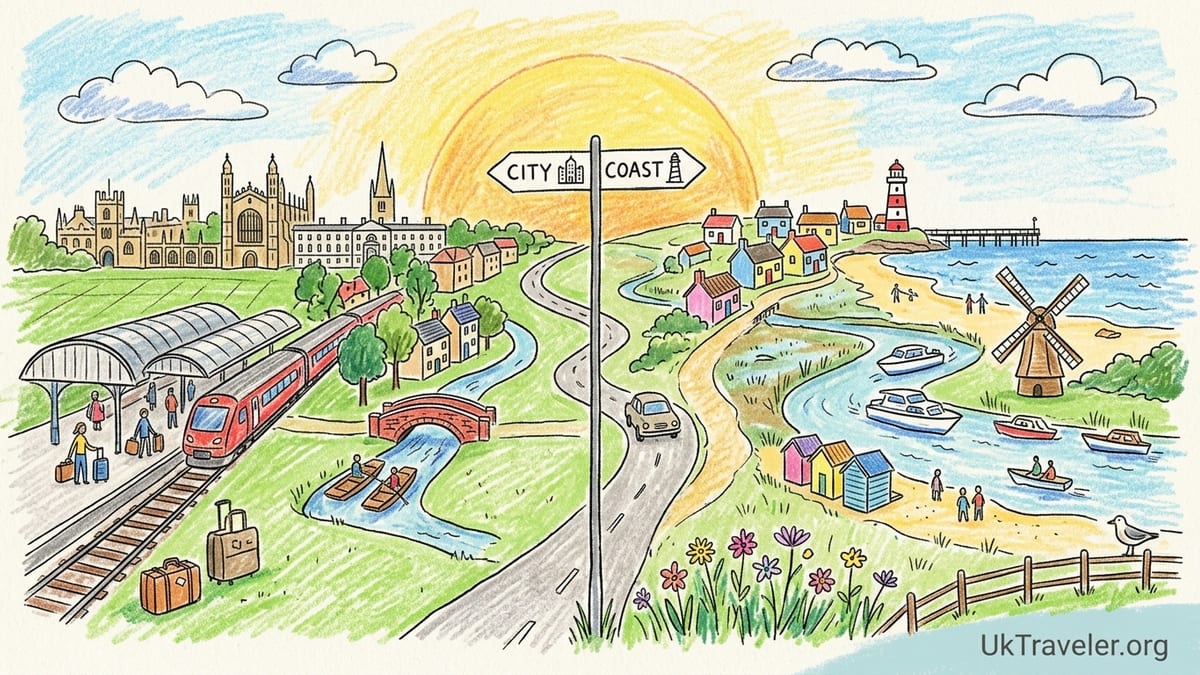
How to Choose the Right Base in the East of England
Before you look at individual towns, it helps to think about how you want to travel. Distances in the East of England can look short on the map, but many roads are single carriageway and scenic rather than fast. A drive from Cambridge to Southwold can easily take two hours or more once you factor in traffic and village speed limits. Trains run on a spoke system into London and regional hubs such as Cambridge and Norwich, which makes some bases brilliant if you want to stay put and explore by rail, and others far more practical if you have a car.
As a rule of thumb, Cambridge and Norwich work best as self-contained city breaks or rail hubs, while Wroxham, Horning, Wells-next-the-Sea, Blakeney, Holt, Southwold and Aldeburgh are better for coastal and countryside stays where you are happy to rely on a car, local buses, walking and in some cases boats. Bury St Edmunds is an excellent inland base for Suffolk and parts of Norfolk if you want classic market-town character with straightforward parking. If London is on your itinerary, several towns in Essex and Hertfordshire offer fast commuter trains into the capital while still feeling like small, walkable centres once you step off the platform.
The key planning question is how many times you want to change hotels. For a week that combines a university city, the Broads and the coast, most visitors find that two or three bases is the sweet spot. For example, three nights in Cambridge followed by four nights split between Wroxham and either Wells-next-the-Sea or Southwold allows you to experience very different landscapes without spending half your holiday packing and unpacking.
Price is another factor. Nightly rates in Cambridge and the most sought-after coastal towns such as Southwold and Aldeburgh can be significantly higher in peak season than inland Norfolk or smaller Suffolk villages. In practice that often means choosing a slightly less famous base a few miles away if you want more space or on-site parking without paying top rates. Holt instead of Wells, Reydon instead of central Southwold and nearby villages around Cambridge or Norwich are three examples that can work well in high summer.
Cambridge: Compact University City With Strong Rail Links
Cambridge is the obvious base if you want a university-city atmosphere with museums, historic colleges and the River Cam all within walking distance. The historic centre around King’s Parade and the Market Square is compact enough that you can explore most major sights in two days without using public transport. Staying in central hotels, such as those clustered around Parker’s Piece and Regent Street, puts you within a ten to fifteen minute walk of the colleges, the Fitzwilliam Museum and the main restaurant areas on Bene’t Street and Mill Road.
Parking, however, is the main constraint. Many period hotels and guesthouses in the core do not have on-site parking and rely on multi-storey car parks where daily fees add up, especially in peak season. Travellers who want to arrive by car but avoid central charges often look at accommodation in the Station District about a mile south of the centre. Here several chain hotels and apartments sit within a few minutes’ walk of Cambridge station and offer at least some on-site or nearby paid parking, while still being an easy bus or taxi ride from the colleges.
If you are relying on trains, Cambridge is one of the best-connected hubs in the region. Direct services link the city with London King’s Cross and London Liverpool Street in around 50 to 80 minutes depending on the service, and there are regular trains to Ely, Norwich, Ipswich and Stansted Airport. That makes it possible to stay in Cambridge for four or five nights and take day trips by rail to Bury St Edmunds, Ely’s cathedral, or even down to London without changing hotels. In practice, this suits visitors who prefer to unpack once and use the city as a platform rather than touring by car every day.
Dining is a strong point, particularly if you want variety without travelling far. Around the centre and along Mill Road you will find everything from casual pasta and ramen spots to higher-end modern British restaurants suitable for a celebratory meal. Because many streets are pedestrianised or one-way, evenings tend to feel relatively calm compared with larger cities, and you can comfortably walk back to your hotel after dinner without needing a taxi, as long as you choose a base within the inner ring roads.
Norwich: Historic City With Easy Access to Norfolk
Norwich works well if you want a city break that can stretch into wider Norfolk without changing hotels. The medieval cathedral, Norman castle and network of lanes between the river and Gentleman’s Walk give the compact centre a strong sense of place even if you are only staying two nights. Boutique hotels around the Cathedral Quarter and independent properties close to Tombland and the Norwich Lanes put you in easy walking distance of major sights, the covered market and many of the city’s most characterful restaurants and pubs.
Parking is generally easier than in Cambridge, although many central streets are still tight and one-way. Several hotels have small private car parks, and the city is ringed with multi-storey car parks that serve the shopping districts. If you plan to drive out to the coast or the Broads each day, it can be worth paying a little more for a hotel with guaranteed on-site parking so that you do not have to move the car once you return in the evening. Visitors using mobility aids should also note that much of the central area is relatively flat, with slopes mainly up toward the castle.
From Norwich you can realistically cover a large swathe of Norfolk without switching bases. To the north, Cromer and Sheringham are reached by an approximately 40 to 50 minute drive, and the smaller resort of Sea Palling is around 40 minutes away. To the east, Wroxham, which is often called the capital of the Broads, lies a little over 10 miles from the city, which makes easy day trips for boat hire or riverside walks. Southbound, you can drive to the market towns of Wymondham or Diss in under an hour. With planning, you can combine a city-based long weekend with one or two coastal or Broads day trips without feeling rushed.
For travellers relying on public transport, Norwich station is a key node on the Greater Anglia network, with direct trains to London Liverpool Street, Cambridge and regional towns. Local trains connect to coastal points such as Great Yarmouth and Lowestoft, and a frequent service runs to Wroxham’s Hoveton & Wroxham station for Broads access. This makes Norwich a good choice if you want to avoid hiring a car altogether, especially outside the school holidays when trains and buses can be less crowded.
Wroxham and Horning: Classic Bases for the Norfolk Broads
If your trip is built around the Norfolk Broads, Wroxham and Horning are the two most popular bases. Wroxham often calls itself the capital of the Broads, with marinas, day-boat hire yards and riverside holiday cottages concentrated along the River Bure. Many visitors either rent a cruiser for several nights or choose a self-catering apartment above a boatyard so that they can be on the water within minutes of stepping outside. Because the village is compact, you can walk from your accommodation to supermarkets, fish and chip shops, riverside pubs and the train station without needing the car each day.
Horning, a few miles downstream, offers a slightly quieter but very scenic alternative. The main street runs along the river with a string of pubs, tea rooms, moorings and a small green, and a number of cottages and small hotels sit directly on the water. Families are drawn by the combination of riverside views and nearby attractions such as the BeWILDerwood outdoor adventure park, which is only a short drive or cycle ride away. Many holiday homes and small guesthouses here provide on-site parking, which matters in high season when the village’s few public spaces fill quickly with day-trippers.
Both Wroxham and Horning are strong choices if you want to base yourself in one spot for three to five nights and explore the Broads slowly, rather than racing between different towns. With a hired day boat from one of the Wroxham boatyards you can cruise to Salhouse Broad, Horning and as far as Ranworth and back within a day, mooring up for lunch at waterside pubs or nature reserves. Because many riverside properties also come with their own moorings, you can mix days on the water with days on foot or bicycle, following riverside footpaths or quiet country lanes.
In public transport terms, Wroxham has the advantage of a mainline station on the Bittern Line towards Cromer and Sheringham, which makes it possible, though slower, to arrive without a car. From Norwich the train ride takes around 15 minutes, and from Hoveton & Wroxham station it is a short walk over the bridge into the main part of the village. Horning is more dependent on car access, with bus routes subject to seasonal variation, so it suits visitors comfortable driving and parking in small villages. In both places, evenings are low key, centred around pub dinners, simple restaurants and self-catering rather than late-night bars.
Wells-next-the-Sea, Blakeney and Holt: North Norfolk Without Moving Hotel
The North Norfolk coast between Wells-next-the-Sea and Blakeney is one of England’s most distinctive coastal landscapes, with tidal harbours, salt marshes and wide sandy beaches backed by pines. Wells itself is a popular base thanks to its working quay, small-town high street and a long sandy beach about a mile from the harbour reached on foot or by small seasonal train. Parking at the beach car park is convenient for families carrying gear, but many visitors prefer to stay in the town centre so they can walk to shops and restaurants in the evenings and drive or stroll out to the beach by day.
Blakeney, a short drive east, has a smaller, slightly more upmarket feel, with a cluster of inns and hotels around the quay and along the high street. It is a classic base for seal trips to Blakeney Point and for walking the coastal path along the marshes. Parking can be tight in peak summer and at high tide, but there is a National Trust car park at the harbour and several inns offer limited guest parking. Here, you are ten to fifteen minutes’ drive from both Cley-next-the-Sea and Morston, which keeps day trips compact and manageable even if you are travelling with children.
Holt lies a few miles inland from the coast, on higher, wooded ground. It is often chosen by visitors who want easy access to the coast but prefer to stay in a slightly larger town with more year-round services. The Georgian high street has food shops, galleries and cafes that serve not only tourists but also locals from surrounding villages, and there is usually more choice of parking than in the tight streets of Wells or Blakeney. From Holt you can drive to Sheringham or Cromer in around 20 minutes, and to Wells or Blakeney in a similar time, which makes it realistic to see a wide stretch of coast without changing hotels.
In terms of trip style, a four or five night stay in either Wells, Blakeney or Holt allows you to explore much of the North Norfolk coast in a slow, layered way. For example, you might spend one day on the beach at Holkham, another walking from Blakeney to Cley and back, and a third driving further east to Sheringham Park or Cromer Pier. Public transport is limited mainly to coastal bus services and heritage railways, so a car is strongly recommended. Many visitors also find that self-catering cottages with dedicated parking are more practical here than in smaller seaside resorts, particularly during school holidays.
Southwold and Aldeburgh: Walkable Suffolk Coast Villages
Southwold and Aldeburgh are the two headline names on the Suffolk coast, and both make excellent bases if you prefer to park the car and explore on foot for most of your stay. Southwold combines a sandy beach, pier, lighthouse and compact high street, all close enough together that many visitors barely move their car once they have checked into a central cottage or hotel. Long-stay car parks on the edge of town and on-street options around the common take the strain off the small core, and some properties in the town centre include a reserved parking space, which is valuable during peak summer weekends.
Aldeburgh, a little further south, has a different feel: the beach is shingle rather than sand, and the long high street runs just behind it with a string of galleries, fish and chip shops, delis and cafes. Many holiday rentals and small hotels sit either on the seafront or a block inland, allowing you to wake up and be on the beach in minutes. Parking is a mix of roadside spaces on the seafront and pay and display car parks at either end of the town, so a base with off-street parking can be worth the search if you are staying more than a night or two, particularly during bank holidays and school breaks.
From either Southwold or Aldeburgh you can explore a good portion of the Suffolk coast on day trips without changing hotels. Southwold is well placed for Walberswick, accessed by a short drive or foot ferry across the River Blyth in season, and for Kessingland and Benacre’s wildlife-rich beaches a little further south. Aldeburgh, by contrast, is within a short drive of Snape Maltings concert hall, Thorpeness with its ornamental lake, and the RSPB Minsmere nature reserve. Many visitors spend five or six nights in a single coastal cottage and simply vary their walking routes and day trips along the coast.
Public transport to these towns is more limited. Trains run only as far as Saxmundham or Halesworth, from which you would need a bus or taxi to reach the coast. That means most travellers arrive by car and appreciate bases where they can walk to restaurants, pubs and grocery shops without driving each evening. Both towns have a mix of higher-end restaurants, casual bistros and traditional pubs, so you can eat well without needing to dress formally or book weeks in advance, except perhaps in peak August or on major festival weekends.
Bury St Edmunds: Inland Suffolk With Market-Town Character
Bury St Edmunds is an attractive inland base for exploring much of Suffolk and parts of West Norfolk. The focal points are the Abbey Gardens, cathedral and compact medieval grid of streets lined with independent shops and cafes. If you stay in or just off the town centre, you can walk to most attractions, including the theatre, cinema and a wide range of restaurants that range from casual chains in the modern shopping arcade to long-established local brasseries and pubs around the older core.
Compared with coastal towns, parking in Bury St Edmunds is generally straightforward and relatively good value. Several long-stay car parks ring the centre, and drivers arriving early in the day often find spaces in multistorey facilities such as those near the main shopping areas. Some hotels, including chain options and independent guesthouses, have limited on-site parking or discounted arrangements with nearby car parks. Because the centre is small, once you have parked you are rarely more than a ten minute walk from most dining and shopping streets.
In terms of reach, Bury St Edmunds sits roughly between Cambridge, Ipswich and Norwich, which makes it practical for road-based day trips across a wide area. You might, for example, spend one day exploring the wool towns of Lavenham and Long Melford, another driving to the coast around Aldeburgh or Southwold, and a third heading north to Thetford Forest or even into Norfolk towards Swaffham. Trains connect Bury with Cambridge and Ipswich, though frequencies are lower than on the intercity routes, so a car substantially increases your flexibility if you are using the town as a multi-day base.
Trip style here tends to be slower and more town-focused than on the coast. Visitors often book two or three nights, using afternoons for short driving excursions and returning to the town for evenings in its pubs, restaurants and wine bars. Because Bury is not as seasonal as seaside resorts, you will find a good choice of places to stay and eat year-round, and rates can be noticeably lower than in high-demand coastal locations at the height of summer.
Selected Essex and Hertfordshire Bases for London-Adjacent Trips
For travellers who want to include London in an East of England itinerary without staying in the capital itself, several towns in Essex and Hertfordshire act as practical bases. The key is to choose somewhere with fast, frequent trains into central London combined with a walkable centre and reasonable parking. Market towns such as Bishop’s Stortford in Hertfordshire or Chelmsford and Colchester in Essex offer this balance: they sit on mainline routes into London Liverpool Street, with journey times that are short enough for day trips yet still feel distinctly separate once you are back in town.
Bishop’s Stortford lies on the line between Cambridge and London, close to Stansted Airport. The town centre around North Street and South Street has a mix of chain and independent restaurants, and many hotels are within walking distance of the station. Limited on-site parking at central hotels means you may need to use public car parks, but for visitors arriving by rail or air, this is a manageable trade-off for quick access to both London and Cambridge. In practice, you could stay here four nights and fit in a full day in London, a day exploring Cambridge, and another day in the Hertfordshire or Essex countryside without moving base.
Chelmsford and Colchester are further east, well placed if you also want to see the Blackwater estuary, Dedham Vale or the Essex coast. Both have large station car parks, multi-storey parking in the town centres and a good spread of chain hotels and serviced apartments. Direct trains into London typically run at least twice an hour at peak times. Once back in town, you can walk to restaurants along the main high streets or by the river without needing a taxi. These bases suit travellers who prefer a modern, straightforward environment over chocolate-box scenery and who value reliable transport above all.
When using London-adjacent towns in this way, it is realistic to stick to a single base for four to five nights and make repeated day trips into London and the surrounding countryside. However, it makes less sense to combine them with distant parts of Norfolk or the Suffolk coast in one continuous stay, because you would be backtracking large distances. A more efficient pattern is to cluster your itinerary, for example three nights in Cambridge or Norwich, followed by four nights on the Suffolk or Norfolk coast, and then, if needed, a separate one or two-night stay near London before your flight or onward train.
The Takeaway
Base selection in the East of England is a genuine planning challenge, but thinking in terms of trip style and realistic travel times makes the picture clearer. Cambridge and Norwich suit visitors who want a walkable city base with strong train connections and are content to explore a radius of about an hour without moving hotels. Wroxham and Horning are the natural choices for a Broads-focused stay, particularly if hiring a boat is central to your plans. Wells-next-the-Sea, Blakeney and Holt cluster neatly for a North Norfolk coastal holiday, while Southwold and Aldeburgh reward travellers who enjoy parking the car and living on foot between beach, high street and pub.
Bury St Edmunds adds an inland market-town option with easy parking and good reach across Suffolk, and selected bases in Essex and Hertfordshire can connect your East of England journey to London without the cost and complexity of staying in the capital. With so many thousands of places to stay across Norfolk and hundreds more in Cambridge alone, the most effective strategy is to limit yourself to two or three well-chosen bases for a week-long trip, rather than trying to sample the entire region in a single sweep.
Above all, be realistic about how much you can see in a day without turning your holiday into a series of long drives. A thoughtful choice of base, aligned with how you prefer to travel, will let you experience the best of the East of England at a humane pace, with more time spent on rivers, beaches and historic streets and less time unpacking in yet another hotel room.
FAQ
Q1. If I only have three nights, should I base in Cambridge or Norwich?
For a first visit, Cambridge is better if you want a pure university-city break with easy rail access to London, while Norwich is stronger if you want history plus quick day trips into Norfolk, including the Broads and parts of the North Norfolk coast.
Q2. Can I explore the Norfolk Broads properly without hiring a car?
It is possible but more limited. Basing in Wroxham gives you a train link to Norwich and the coast plus plentiful day-boat hire, so you can still spend most of your time on the water, but smaller villages such as Horning are easier to enjoy with a car.
Q3. How many bases do I need for a one-week trip combining city, Broads and coast?
Most travellers find that two or three bases work best, for example three nights in Cambridge or Norwich, two nights in Wroxham or Horning for the Broads, and two nights in either North Norfolk or the Suffolk coast.
Q4. Which coastal base is better if I want to walk everywhere and avoid driving?
Southwold and Aldeburgh are both very walkable, with beaches, high streets and restaurants close together. Southwold is slightly more compact, while Aldeburgh has longer seafront walks and easy access to nearby attractions by short taxi rides.
Q5. Is parking really difficult in Cambridge and should I avoid driving there?
Parking in central Cambridge is limited and relatively expensive, so it makes sense either to stay in the Station District with hotel parking or to arrive by train and explore on foot, using park and ride sites if you do need to drive.
Q6. For North Norfolk, is it better to stay on the coast or inland in Holt?
Staying in Wells-next-the-Sea or Blakeney puts you closer to the harbour and beaches, but Holt offers more year-round services and usually easier parking, with short drives of around 20 minutes to many coastal spots.
Q7. Are Southwold and Aldeburgh suitable bases outside the summer peak?
Yes, both towns work well in spring and autumn, with many restaurants, pubs and shops open year-round. Out of season you benefit from quieter beaches and more flexible parking, especially at weekends.
Q8. How practical is Bury St Edmunds as a base for touring Suffolk and Norfolk?
Bury St Edmunds is very practical if you have a car. From the town you can reach coastal areas, wool villages and forested landscapes within about an hour, then return each evening to a wide choice of places to eat and drink.
Q9. Which Essex or Hertfordshire town works best as a base for London day trips?
Towns with fast, frequent trains such as Bishop’s Stortford, Chelmsford or Colchester are ideal, offering manageable journey times into central London while still feeling like smaller, walkable centres when you return.
Q10. Is it worth changing hotels just to be closer to London at the end of the trip?
It can be, especially if you have an early flight or long onward train. Moving for one night to an Essex or Hertfordshire town on the mainline can reduce stress on departure day without adding excessive repacking during the rest of your holiday.