


The English Midlands is often treated as a region to speed through on the train between London and Manchester. In reality it is one of the most rewarding areas in the country for city breaks, history-rich weekends and easy access to green countryside. Rather than list every county, this guide focuses on the places that most visitors actually enjoy and talk about afterwards: Birmingham, Stratford-upon-Avon, Warwick, the Peak District and Bakewell, Nottingham, Lincoln, Leicester, Ironbridge and Shrewsbury, plus a handful of market towns and rural bases that make sense in a real itinerary.
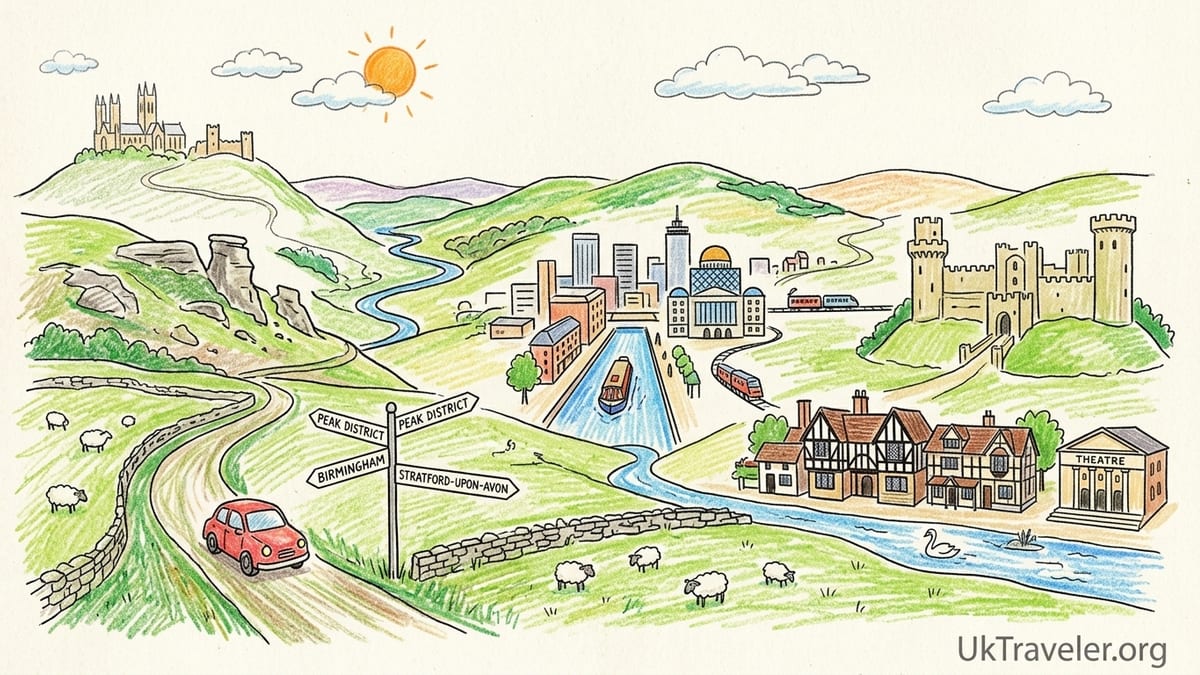
How to Structure a Midlands Trip
If you have three or four days, it makes sense to pick one city base with good rail links, then add one or two more rural days by hire car or local buses. Birmingham, Nottingham and Leicester are the best connected for trains, each with direct services from London in roughly 1 to 1.5 hours and from many other major UK cities. From any of these, you can tag on a day trip to a smaller historic town such as Warwick, Stratford-upon-Avon or Lichfield without changing hotel every night.
For a week or longer, consider combining one city with a stay in the countryside. A common pattern is two nights in Birmingham for food, canals and museums, then two or three nights in or near the Peak District for walking, with a final night in a characterful town such as Shrewsbury or Lincoln. Another popular option is to base in Stratford-upon-Avon or Warwick for Shakespeare and castles, then drive up to Ironbridge and Shropshire hills before looping back via the M40 or M6.
In terms of cost, you will typically pay less for accommodation in places like Nottingham or Leicester than in Oxford or York, even in peak months. Mid-range city hotels often run around £90–£140 per night if booked ahead, while B&Bs in smaller towns such as Bakewell or Church Stretton may start nearer £80–£120 for a double in high season. Railcards and advance fares can dramatically reduce train costs, so it is worth checking prices a few weeks before you travel rather than buying at the station on the day.
Public transport is good enough for a city-focused trip with a couple of organised excursions, but walking bases in the Peak District and the more rural corners of Shropshire are far easier by car. If you prefer not to drive, look at staying in towns actually on rail lines, such as Matlock Bath for the southern Peak or Shrewsbury for Shropshire, and then using local buses or taxis to trailheads and attractions.
Birmingham: Best for Urban Energy and Food
Birmingham is the most obvious Midlands hub and works especially well for first-time visitors who want an urban base with plenty of rainy-day options. The city’s network of canals around Brindleyplace and Gas Street Basin is far prettier than its reputation suggests, lined with converted warehouses, bars and restaurants. On a sunny afternoon you can take a short boat trip from near the International Convention Centre, then walk up to Centenary Square for the Library of Birmingham’s viewing terraces and the famous gold-topped Rotunda visible down on New Street.
Families gravitate toward attractions like the National SEA LIFE Centre and the Legoland Discovery Centre in the same central complex, plus Cadbury World a short train ride away in Bournville. At Cadbury World, timed tickets typically start in the low to mid £20s per adult when booked ahead online, with combined tickets available that also cover partners such as the National SEA LIFE Centre or Warwick Castle for those planning a multi-stop break. This can be good value if you are building a chocolate-and-castle themed trip for children or teenagers.
Birmingham’s food scene is one of the strongest in the UK outside London, and it is a major reason to stay at least two nights rather than treat the city as a simple transport hub. In the Balti Triangle south of the centre, long-established curry houses serve the city’s signature dish in stainless-steel baltis, while in the Jewellery Quarter and around Colmore Row you will find everything from modern British small plates to relaxed wine bars in handsome Victorian buildings. Budget roughly £15–£25 per person for a main course at a mid-range independent restaurant, with far cheaper options available in the city’s large Chinese Quarter and markets.
For visitors interested in contemporary culture, Birmingham offers the Birmingham Museum & Art Gallery (currently reopening in phases after refurbishment), Symphony Hall for classical concerts and the Utilita Arena for touring bands. Because so many attractions and restaurants cluster near New Street station, it is entirely feasible to arrive by train on a Saturday morning, spend a weekend on foot and leave without ever needing a car.
Stratford-upon-Avon and Warwick: Shakespeare, Castles and Romantic Weekends
If your picture of the Midlands is half-timbered houses and riverfront pubs, it probably comes from Stratford-upon-Avon. This compact town works beautifully as a one or two night base for couples, theatre fans and anyone interested in Shakespeare. The Shakespeare Birthplace Trust manages several properties associated with the playwright and his family, including his childhood home on Henley Street and Anne Hathaway’s Cottage in nearby Shottery. Combined tickets are available covering multiple houses, and there is now a joint ticket that also includes Shakespeare’s Schoolroom and Guildhall and even a quirky mechanical art attraction, which simplifies planning if you want to see several venues over 24–48 hours.
For many visitors the highlight is an evening performance by the Royal Shakespeare Company in one of its riverside theatres. Typical ticket prices can range from under £20 for upper gallery seats to £60 or more for the best stalls on popular nights. Combine this with a pre-theatre dinner in a cosy bistro near Sheep Street and a twilight stroll along the River Avon and you have one of the most atmospheric romantic weekends in the region, especially in spring and early autumn when the town is busy but not yet overwhelmed.
Just 15 minutes away by train or around 20 minutes by car lies Warwick, dominated by Warwick Castle. Operated as a major family attraction, the castle mixes substantial medieval and Tudor fabric with costumed performers, bird-of-prey shows and seasonal events like light trails and jousting displays. Walk the ramparts for views over the River Avon, then spend an hour wandering the streets around Jury Street and Mill Street, where ivy-clad houses and small independent shops provide a gentler counterpoint to the crowds inside the castle grounds.
For history buffs, Warwick and Stratford together justify at least one overnight stay rather than a rushed day trip from Birmingham or London. A realistic plan is to arrive late morning, explore the Shakespeare properties in the afternoon, take in a play, then head to Warwick Castle the following day before moving on. If you are travelling with children, many families pair Warwick with Cadbury World via a combined ticket, building a two-day loop that mixes chocolate, castles and riverside picnics.
The Peak District and Bakewell: Walking, Views and Cosy Inns
The Peak District National Park begins less than two hours by car from Birmingham and is the obvious choice if you want hiking, big skies and stone-built villages. This is not a region of single blockbuster sights but of layered experiences: following an old packhorse route across moorland, descending to a valley pub with open fires, then catching a bus back to your base. Paths are generally well waymarked, though the terrain can be boggy in winter and exposed in poor weather, so good boots and waterproofs are essential.
Bakewell makes an excellent base for first-time visitors. Officially the only town within the national park, it sits on the River Wye, with stone bridges, a busy Monday market and a small riverside park that fills with families feeding ducks and sharing paper-wrapped Bakewell pudding slices from local bakeries. A published family walk starts at the Bakewell Visitor Centre and loops out along country lanes and the riverside, with clear directions past landmarks like Holme Bridge, a 17th century crossing that recalls the days when goods were carried by long lines of packhorses rather than lorries.
From Bakewell you are within a short drive or bus ride of stately homes such as Chatsworth and Haddon Hall, as well as rail-trail cycle routes on former railway lines like the Monsal Trail. Bike hire prices vary but expect to pay in the region of £20–£30 per day for an adult hybrid cycle from operators near Bakewell or Hassop. Even if you are not a serious walker, a short stroll to one of the Monsal Head viewpoints or a gentle wander along the river from Ashford-in-the-Water will provide the classic Peak District mix of drystone walls, grazing sheep and wide horizons.
The Peak District rewards at least two or three nights if you enjoy the outdoors. Those tight on time can still squeeze in a day trip from cities like Nottingham or Sheffield, but the slower rhythm of evenings in village inns, early morning mist in the valleys and late-day light on gritstone edges is what turns a visit into something memorable. For that reason, it is worth accepting one hotel change in your itinerary to overnight here instead of only visiting on a coach tour.
Nottingham and Leicester: Lively Cities with Strong Stories
Nottingham is the obvious Midlands choice for travellers intrigued by English folklore and social history. The city builds much of its visitor identity around Robin Hood, and you will see his image everywhere, from the famous bronze statue near the castle to themed tours and events. The official tourism board highlights a range of Robin Hood attractions, from walks through the city’s historic core to excursions out to Sherwood Forest to see the centuries-old Major Oak, a vast tree associated with the outlaw legend. A locally run Robin Hood Town Tour, led by a costumed guide, has gained a strong reputation for mixing history and humour, and often sells out on summer weekends.
Beyond the green-clad archer, Nottingham makes a good base for a budget-conscious city break with a bit of edge. The redeveloped Nottingham Castle complex, set on a sandstone outcrop above the city, offers galleries, interactive displays and views, and is easily combined with a stroll around the Old Market Square and the surrounding streets of the Lace Market, once the commercial heart of the world’s lace trade. Many visitors also head underground to explore parts of the city’s extensive cave network, sections of which are accessible on guided tours beneath shopping centres and historic pubs.
Leicester sits about half an hour away by train and offers a different but equally strong narrative focus: the rediscovery of King Richard III. The King Richard III Visitor Centre stands beside the spot where the monarch’s remains were found in what was once a council car park, and its exhibitions explain both his controversial life and the extraordinary archaeological detective story that led to his reburial in Leicester Cathedral in 2015. Combined with the cathedral itself and the compact, largely pedestrianised city centre, this makes Leicester an engaging day trip from Nottingham, Birmingham or even London.
Both Nottingham and Leicester are practical bases for travellers who prefer contemporary culture, sport and nightlife to quaint market squares. Nottingham’s independent bars and live music venues cluster in Hockley and around the canals, while Leicester has a strong South Asian food scene on and around Belgrave Road. Football fans might time a visit to coincide with a home match for Nottingham Forest or Leicester City, accepting that hotel rates will be higher and restaurants busier on those weekends.
Lincoln, Ironbridge and Shrewsbury: Cathedral Cities and Industrial Heritage
Lincoln offers one of the most satisfying historic cores in the Midlands and is particularly rewarding for photographers and history-minded couples. The uphill Cathedral Quarter is a compact warren of cobbled streets, independent shops and traditional pubs clustered between Lincoln Castle and the great Gothic cathedral that dominates the skyline for miles. Walking up Steep Hill from the lower town, you pass bookshops, tea rooms and craft stores, before emerging into an open square framed by medieval and Georgian buildings.
Both Lincoln Cathedral and Lincoln Castle charge admission, with a range of tickets that might include a rooftop tour of the cathedral or access to the castle walls. Expect to spend most of a day here if you include a guided walking tour of the old town; a seasonal open-top tour bus or city walking tours can help orient you, especially if you are visiting on a short break and want to understand the Roman, medieval and Victorian layers without working through guidebooks on your own.
Farther west, Ironbridge Gorge in Shropshire is the cradle of the Industrial Revolution and one of the region’s most distinctive destinations. The famous cast-iron bridge spans the River Severn in a deep, wooded valley, flanked by brick and stone houses that tumble down the hillsides. The wider area is dotted with a series of museums, from Blists Hill Victorian Town, where costumed interpreters bring a recreated industrial community to life, to the Coalbrookdale Museum of Iron. The Ironbridge Gorge Museum Trust sells day and annual passes that provide varying levels of access to multiple sites, and while headline adult prices can look high, many visitors find good value by using the pass over two days.
Ten miles or so up the river lies Shrewsbury, one of England’s most underappreciated county towns. Almost surrounded by a loop of the Severn, it is packed with black-and-white timber-framed buildings, narrow passages known locally as shuts and passages, and a red sandstone castle now housing the Shropshire Regimental Museum. Shrewsbury works exceptionally well as a base for exploring both Ironbridge and the Shropshire Hills, especially for visitors who like a blend of heritage streetscapes, independent shops and access to green landscapes within a short drive.
Market Towns and Countryside Bases Beyond the Big Names
Once you have chosen your core cities or headline towns, it is worth considering one stay in a smaller market town or in open countryside. In the southern Peak District, Matlock and Matlock Bath line a gorge-like stretch of the River Derwent and sit on a rail line to Derby, which means you can arrive by train and still have good walking and cycling within reach. In Shropshire, Church Stretton is nicknamed Little Switzerland for the way the Long Mynd and surrounding hills rise steeply on either side of the town; it has a railway station, several pubs and gear shops, making it a convenient base for walkers without a car.
Closer to Birmingham, historic Lichfield offers an impressive triple-spired cathedral, a walkable old centre and a cluster of cafes and restaurants, all around 40 minutes by direct train from Birmingham New Street. It is an easy day trip, but staying overnight lets you enjoy a quieter evening atmosphere and early morning light on the cathedral close when the day-tripper crowds have gone home. Similarly, smaller Leicestershire and Nottinghamshire villages on main bus routes, such as Melton Mowbray or Southwell, provide a softer, more rural feel while staying within reach of city cultural attractions.
For romantic trips, these smaller places often punch above their weight. A converted coaching inn with low beams and a good restaurant in somewhere like Ashbourne or Ludlow can feel far more special than a chain hotel in a ring road location, even if room rates are similar. The trade-off is that evening entertainment will likely revolve around one or two pubs and perhaps a small theatre, rather than a roster of late-opening galleries and cocktail bars.
In all of these towns, it is worth checking market days and local festivals, which can transform the atmosphere. A midweek visit to Bakewell or Shrewsbury in February will feel quiet and introspective, with easy restaurant bookings and uncrowded museums. Visit on a summer weekend during a food festival or Christmas market, and the same streets will be packed, hotel prices higher and parking spaces scarce. Plan accordingly if you dislike crowds or are travelling with small children.
What Works Best for Different Travelers
For classic city breaks, Birmingham and Nottingham are the strongest bases. Birmingham suits travellers obsessed with eating out, live music and big-ticket family attractions such as Cadbury World and the SEA LIFE Centre, while Nottingham feels slightly smaller and more bohemian, with its cave tours, independent bars and Robin Hood storytelling. Leicester is a good second-tier choice, especially for visitors fascinated by the Richard III story and those keen on South Asian food and culture.
History lovers will find most depth in Stratford-upon-Avon, Warwick, Lincoln and Shrewsbury. A two-night loop might involve driving from Birmingham to Stratford for Shakespeare’s houses and a performance, moving on to Warwick Castle and then continuing to Shrewsbury for a day of half-timbered streets and a detour to Ironbridge. Alternatively, pair Nottingham or Leicester with a day in Lincoln for a contrast between industrial, sporting cities and a hilltop cathedral city that feels closer in spirit to York or Durham.
Families are often happiest with a base that balances child-friendly attractions and easy dining. Birmingham, Stratford and Warwick clearly tick that box, but so do Shrewsbury and some Peak District towns when the weather cooperates. Specific child-pleasing experiences include the interactive Victorian town at Blists Hill in Ironbridge, picnic and paddle days by the River Wye in Bakewell, boat trips on the River Avon in Stratford, and city farm-style attractions on the fringes of Birmingham and Nottingham. Many parents find that two nights in a city followed by two nights somewhere with open space works better than four consecutive days in museums.
For hiking and outdoors, the Peak District is the obvious choice, with Church Stretton and the Shropshire Hills a quieter alternative. Couples seeking a romantic feel should look particularly at Stratford-upon-Avon, Bakewell, Lincoln’s Cathedral Quarter and Shrewsbury, plus out-of-the-way inns in villages like Baslow, Ashford-in-the-Water or Much Wenlock near Ironbridge. These are places where cobbled streets, riverside walks and candlelit dining rooms come as standard, and where an overnighter delivers far more atmosphere than a hurried afternoon detour between motorways.
The Takeaway
The Midlands is not a region of a single headline sight but a mosaic of medium-sized cities, historic towns and easily accessible countryside. The most satisfying trips combine a few of these elements rather than trying to race between every name on the map. Birmingham or Nottingham make excellent gateways for international visitors, while Stratford-upon-Avon, Warwick, Lincoln and Shrewsbury deliver the kind of concentrated history and urban fabric that many people associate with England at its most photogenic.
If you have only a long weekend, choose one city and one nearby historic town. With a week, add the Peak District or Shropshire Hills for fresh air and village pubs. Whether you come for Robin Hood legends, Shakespearean drama, industrial heritage or simply a slower rhythm of market towns and riverside walks, the Midlands rewards those who stop, stay overnight and look beyond the stereotypes.
FAQ
Q1. Is Birmingham or Nottingham better for a first Midlands city break?
Birmingham is better if you want big-ticket attractions, shopping and a huge food scene, while Nottingham feels more compact, walkable and tied to the Robin Hood story.
Q2. Do I need a car to visit the Peak District from the Midlands?
No, but it helps. You can reach some towns like Matlock Bath or Edale by train and use local buses, yet a car gives you far more flexibility for hikes and smaller villages.
Q3. How many nights should I spend in Stratford-upon-Avon?
One night is enough to see key Shakespeare sites and take a river stroll, but two nights let you add a Royal Shakespeare Company performance and slower meals without rushing.
Q4. Is Warwick Castle worth visiting for adults without children?
Yes, especially if you like castles, but be aware it operates as a modern attraction with shows and theming. Adults keen on quieter history may prefer combining a short visit with time in Warwick’s old streets.
Q5. Which is better for walking, the Peak District or Shropshire Hills?
The Peak District has more infrastructure, marked trails and famous viewpoints, while the Shropshire Hills feel quieter and less discovered, ideal if you prefer gentler crowds.
Q6. Is Lincoln a day trip or an overnight stay?
It works as both, but staying overnight lets you enjoy the Cathedral Quarter in the evening and early morning, when tour groups are gone and the historic core feels more atmospheric.
Q7. Can I visit Ironbridge as a day trip from Birmingham?
Yes, it is possible by car in about an hour each way, but if you want to explore several of the museums in depth, many travellers prefer at least one overnight stay in Ironbridge or nearby Shrewsbury.
Q8. Are Midlands towns good for budget-conscious travellers?
Generally yes. Hotel and restaurant prices in cities like Nottingham, Leicester and Birmingham are often lower than in southern hot spots, especially if you avoid major event weekends.
Q9. When is the best time of year to visit the Midlands?
Late spring and early autumn usually bring mild weather and fewer crowds. Summer offers longer days and more festivals but higher prices, while winter is good for cosy city and pub-focused trips.
Q10. Which Midlands destination is best for a romantic weekend?
Stratford-upon-Avon, Bakewell, Lincoln’s Cathedral Quarter and Shrewsbury stand out, thanks to riverside walks, historic streets and plenty of small inns and independent restaurants.